![Why you need an editorial calendar for your blog [Free template]](https://fronetics.com/wp-content/uploads/2015/02/editorial-calendar-template-1080x675.jpg)
by Elizabeth Hines | Feb 16, 2015 | Blog, Content Marketing, Marketing, Strategy
An editorial calendar is an invaluable tool; it will drive success.
When it comes to blogging, you may know what outcomes your company is looking to achieve, but do you have a specific plan to get there? We know post and pray isn’t an effective strategy.
Enter the editorial calendar. The use of an editorial calendar gives structure to your blogging efforts. Think of it as both a commitment to your potential customers and built-in accountability for your overall strategy.
The editorial calendar is a dynamic, internal document that will help your team determine what activities you’ll focus on (and when they’ll be completed) in order to connect and engage potential customers with your blog content. Presented in a calendar-like format, an editorial calendar makes it easy to visualize your marketing strategy, ensuring consistently scheduled blog posts and a diversity of topics. Beyond scheduling blog posts, the use of an editorial calendar keeps other essential considerations front of mind. Including related information, such as keyword assignments, target persona(s), and associated promotions or calls to action, will make your editorial calendar an indispensable guide to your blogging success.
We’ve created an editorial calendar template to guide your blogging efforts. Designed to keep you on track as you develop content that will attract and engage your prospects and customers, our template (it’s free) will help you map out your content in a strategic manner, maximize productivity, and keep you organized.


![The Girl Scout Cookie Supply Chain [Infographic]](https://fronetics.com/wp-content/uploads/2024/10/Girl-Scout-Cookie-Supply-Chain-810x675.jpg)
by Elizabeth Hines | Jan 15, 2015 | Blog, Marketing, Supply Chain

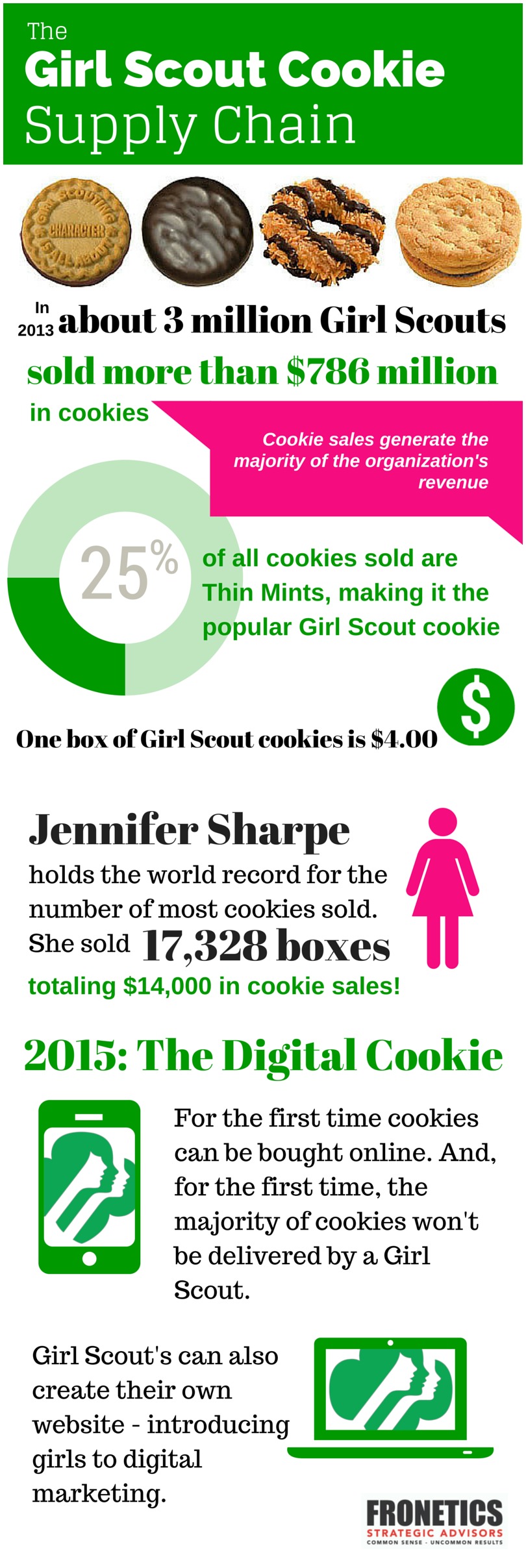
In 2015 The Girl Scouts launched the “Digital Cookie.” How will this impact the Girl Scout Cookie Supply Chain?
When the Girl Scouts of America began selling their now ubiquitous cookies way back in 1917, their operations were simple: cookies were baked in the ovens of troop members and sold in a high school cafeteria. On a mission to raise enough funds to cover the activities of their Muskogee, Oklahoma-based troop, these first cookie salesgirls unknowingly set the stage for a century-long operation that now includes over 2.8 million Girl Scouts and tops $700 million annually.
Throughout the program’s history, the Girl Scouts have made significant changes to the way they do business. To understand the evolution of their supply chain you have to look not only at the physical growth of the program, but the societal factors that have shaped their manufacturing, distribution, marketing and sales functions throughout the years.
From the cookie program’s modest beginnings in the late 1910s through the 1920s, operations were kept small and simple. Cars weren’t yet pervasive in American cities and towns, and door-to-door sales and delivery of goods were the norm. As such, each local troop of Girl Scouts baked, packaged, and priced their own cookies and then combined marketing and sales functions by going door to door. The 1930s saw the Girl Scouts professionalize their manufacturing operations by partnering with and licensing their first commercial bakery – a move concurrent with the rise of automated and commercial bakeries across the United States.
During World War II, flour, sugar, and butter shortages caused a brief stoppage of Girl Scout cookie production. In the post-war boom though, the Girl Scouts were back in the cookie business, setting up shop outside the shopping malls that had sprung up in the suburbs.
As membership rapidly grew, cookie flavors were narrowed to four types in order to standardize their product for greater manufacturing efficiency. Meanwhile, advancements within the packaging industry proved to be a boon for the marketing and sales of Girl Scout cookies as it brought extension to the shelf-life of their products. The most dramatic shift in operations came in 1978. By that time, the number of commercial bakeries involved in the manufacture of GirlScout cookies had swelled to an unmanageable amount. That year officials made the decision to limit operations to only four bakeries, showing a commitment from the organization to uniform quality, packaging, and distribution (a practice even further evidenced today by their licensing of only two bakeries).
From the 1950s through 2014 the sales and marketing strategy of Girl Scout cookies has remained almost unchanged. Each year, between January and April, thousands of girls and their parents have sold cookies by going door-to-door or by hawking their wares outside local supermarkets.
In 2015, in a move that has significant implications for their supply chain, the Girl Scouts have unveiled a new strategy that is directly influenced by yet another societal shift. “Digital Cookie” enables Girl Scouts to market and sell cookies online.
With Digital Cookie, girls are able to create personalized cookie websites and invite customers to visit their website via an email invitation. Digital Cookie also allows girls to take in-person cookie orders (at a local cookie booth for example) via mobile app.
Additional features of Digital Cookie include: campaign advertising, inventory tracking, and shipping management.
Kelly Parisi, Girl Scouts of the USA chief communications executive, points out that these changes are essential in terms of building leadership skills: “It is all about the girls and building future business leaders. They are learning about e-marketing, managing money and additionally creating their first websites.”
The Digital Cookie will have a significant impact on the organization’s supply chain. Not the least of which is that this year, for the first time, the majority of customers will have cookies delivered directly to them – the option of having a Girl Scout deliver the cookies is only available in select markets.
Hungry? Connect with your local Girl Scout or Girl Scout Troop, or try the free mobile Cookie Finder app for your iPhone or Android phone.

by Elizabeth Hines | Dec 30, 2014 | Blog, Logistics, Manufacturing & Distribution, Marketing, Social Media, Strategy, Supply Chain
 I wrote a guest blog for freight logistics company Cerasis in October which discussed how companies within the manufacturing, supply chain, logistics, and industrial industries can increase their B2B visibility on LinkedIn.
The catalyst for writing the blog were results from a recent survey focused on the supply chain and logistics industry. 58% of respondents rated LinkedIn as “very impactful,” and 37% rated LinkedIn as “somewhat impactful.” At the same time, respondents reported challenges associated with strategy (33%) and a lack of understanding about the application of social media (24%).
Leveraging LinkedIn
There are over 3 million LinkedIn company pages. Being present on LinkedIn is critical, but is not enough. To maximize your LinkedIn presence you need to take steps to increase your B2B visibility. Here’s how:
-
Create a compelling company page
Your company page is an extension of your company. Make sure that the page is compelling, informative, and presents your company as a leader within the industry.
-
Be active
In addition to keeping your company page up-to-date, you need to be active on LinkedIn on a daily basis. LinkedIn groups are great. Actively participating in LinkedIn groups will allow your company to: 1) gain business and market intelligence; 2) introduce you to new, interesting, and relevant topics; 3) help you increase brand awareness; and 4) position your company as an industry leader.
-
Distribute content
If you want your content to be seen you need to get it out there; you need to distribute your content. Distribute your content and curated content via your company page and (when relevant) within the LinkedIn groups to which you belong.
-
Employee engagement
Your employees are your brand ambassadors. Empower your employees to be active within LinkedIn groups as representatives of your company. Encourage employees to share your content and industry content with their connections. Additionally, encourage employees to share open positions with their LinkedIn connections, and to identify great talent within their network.
-
Prospect for leads
LinkedIn is an effective prospecting tool. Use LinkedIn to prospect for leads and to build your sales pipeline.
-
Optimize your profile
Every employee is a reflection of the company. Encourage employees to optimize their personal LinkedIn profiles.
-
Don’t be annoying
You will fail if you take a “me, me, me attitude.” Constantly self-promoting is bad for business.
If your company is not using LinkedIn you are missing out on opportunities and revenue.

by Elizabeth Hines | Dec 10, 2014 | Blog, Leadership, Strategy, Talent
 Kate Lee, the senior director of research and strategy at Fronetics Strategic Advisors, has been named by Procurious as one of the 24 Most Influential People in Procurement.
The online business network for a new generation of procurement and supply chain professionals compiled the list to show who “you should be connecting with.”
Kate said she was “honored” by the recognition.
“The network and its members are not only industry leaders, but also leaders in innovation,” Kate said. “Procurious has more than 2,000 members from more than 70 countries and I’m thrilled to be part of such a niche social network.”
For the past 20 years Kate has worked with a range of people from senior executives at Fortune 500 companies to academics to refugees. At Fronetics Strategic Advisors, a management consulting firm focused on strategy and inbound marketing for the logistics and supply chain industries, Kate said she has been able to build a strong team which provides clients with unmatched service and value.
“I am proud of the team and our efforts in helping companies develop and implement inbound marketing and strategies that create results,” Kate said.
Kate is a newcomer on the Procurious list that also includes profiles such as ‘Local Producer’ AKA Brian Heinen, a driving force behind LinkedIn biggest groups for supply chain and sourcing professionals; Paul Snell, managing editor of Supply Management and Supply Business magazines; Hal Good, another LinkedIn power player in procurement with 13.5K followers on Twitter; and Tim Hughes, a top 35 UK blogger with 81.9K Twitter followers.
Procurious also cited the Fronetics Twitter account as a reason to welcome Kate into the mix.
The recognition of Kate read, in part: “The Fronetics’ Twitter account is both super-active and full of fascinating insights related to the profession.”
Kate again credited her team for the success:
“It comes down to the wonderful team at Fronetics,” she said. “We are committed to providing the industry with industry news as well as information on how to create and implement strategies that will create value.”
She continued:
“Additionally, we love engaging with individuals and companies within the industry via LinkedIn, Twitter, and our blog.”

by Elizabeth Hines | Nov 27, 2014 | Blog, Leadership, Marketing, Strategy
The Dunkin’ Donuts in Boston’s Back Bay Station is a well-oiled machine. The whole process – ordering a cup of coffee, paying, and receiving said coffee – takes seconds. The experience is something reminiscent to Seinfield’s Soup Nazi.
For customers who frequent this Dunkin’ Donuts expect this. They have timed their commute down to the minute and they know that if they can move through a line of 30 or so people in seconds – and make the train. For customers who don’t frequent this Dunkin’ Donuts the experience can be jarring.
On the other hand, there is a small coffee shop I visit in Maine. It takes minutes (think two digit numbers) to get a cup of coffee, and then more minutes to pay. Customers who frequent this coffee shop savor this time that it takes to get their coffee. The minutes waiting allow for conversations or quiet meditation.
Watching someone new enter the coffee shop is always interesting. There are those that start to wait in line and then leave when, after minutes, they are no closer to getting coffee. There are others who wait it out, checking their watch or smart phone every few seconds as if this will speed up the process. These people generally leave in cloud of frustration.
These two businesses know their customers. They have taken the time to understand what the needs are of the customer and they have tailored their business to address these needs.
To grow your business you need to take the time to determine who your target customer is, what their needs are, and how you can address these needs and bring value to the customer.