by Elizabeth Hines | Jul 20, 2015 | Blog, Logistics, Marketing, Social Media, Strategy, Supply Chain
Sourcemap: doing well by doing good.
Leonardo Bonanni’s company, Sourcemap, is doing well by doing good, and he’s helping companies to do the same. In working on his doctoral thesis at MIT, Leonardo Bonanni created a service that is good for the world on many levels – it saves companies money and it works towards sustainability through transparency. Bonanni is bringing the people what they want. Consider these numbers from recent surveys:
- more than 88% of consumers think companies should try to achieve their business goals while improving society and the environment
- 83% of employees would seriously consider leaving their job if their employer used child labor in sweatshop factories
- 65% would seriously consider leaving their job if their company harmed the environment
Bonanni’s innovative company, Sourcemap, helps clients visually map the supply chain route, from raw materials to end-users, providing unique and important visibility. Companies like Stoneyfield, Mars Chocolate, Fairphone, and Office Depot can see risks and disruptions in the supply chain in real time, act responsibly, promote sustainability, and please consumers who are increasingly curious and conscientious about materials sourcing.
The likes of the Wall Street Journal, Forbes, and The Guardian have taken interest in Dr. Bonanni and Sourcemap. Here he shares some insights with Fronetics on the growth of the company and how he won’t rest until mapping the supply chain is status quo.
What’s the most exciting thing going on at Sourcemap right now?
2015 is the year of supply chain mapping. When we started helping companies trace their products to the source, it was 2007 and the question was ‘why would we want to do that?’ Today it’s ‘how fast can we start?’ Whether it’s risk, sustainability, or simply finding more efficient ways to source products, companies need a big picture of the end-to-end supply chain. What’s exciting is how fast and far we help our clients get there – sometimes in as little as one day.
Tell me about how the maps are built. Are the maps on the free source platform built the same way as the maps on the enterprise platform?
Sourcemap started as a service for consumers to find out where products come from (free.sourcemap.com is still the only website where anyone can make a supply chain map, no training required). Users log in and map a supply chain – from raw material to end customer – as easily as drawing dots and lines on a Google map. Soon after the free website launched manufacturers approached us to see if we could help them figure out where their products come from. We had a lot of experience from serving millions of visitors through our free website, so we knew how to make a robust and intuitive interface for supply chain mapping. We adapted the technology to enterprise needs by adding company specific KPI’s, network analytics, and real-time reporting. The difference is that our enterprise users don’t draw the supply chains one link at a time. Their maps are automatically generated in near-real time from transportation, purchasing, and product lifecycle management databases.
Is it hard to convince businesses that there is an economic or competitive advantage to a utilizing a platform like Sourcemap?
It’s true that Sourcemap was originally built for sustainability, and it can be hard for companies to dedicate resources to long-term issues when short-term priorities come up every day. But our first success wasn’t helping companies be more sustainable in the long term. It was helping them tackle short-term crises, by developing a supply chain repository for emergency response and business continuity planning. Our clients were spending days and weeks to determine how a natural or human-made disaster was impacting any of thousands of suppliers worldwide. We brought that time down to minutes. Then supply chain managers started to see the benefit of knowing not just who they buy from, but who their suppliers buy from – and making decisions to consolidate or diversify supply, move inventories around, and decide when to in-source / out-source processes. These decisions represent huge savings in overall supply chain cost.
This is fantastic tool for companies who are proud of their supply chains, but what about those companies who aren’t, or who aren’t even fully aware of the steps and impact of their chain?
Over the years we’ve worked with companies big and small, with widely differing visibility into their supply chains. What we’ve seen is that the biggest benefit – the low-hanging fruits – are there for first-time supply chain mappers. These are companies that have expanded through acquisitions, are entering new markets or introducing new products – basically any organization that needs to account for a whole new way of doing business. Then, supply chain mapping is the easiest way to keep tabs on everyone in the supply chain and make sure that decisions are taken with an eye on the big picture.
In the years you’ve been doing this work have you seen a shift in consumer demand around the sourcing of materials and making of products? Is there increasing social pressure for companies to “do good”?
We’ve seen two drivers for supply chain sustainability and transparency: companies who want to attract the best talent, and brands looking to differentiate their product by providing information on its price, its composition, or its source.
Given that you teach at Columbia, I’m wondering if you see a difference in the passion, awareness, and attitude around sustainability with younger generations? Have you seen growth in the enrollment numbers in your classes?
I like to teach one or two evening classes a year (this Fall at NYU) to see how supply chain thinking is evolving as it becomes more mainstream. My class hasn’t changed much since it started in 2007, but the students have. Sustainability used to be a futuristic concern, and no one outside logistics departments ever talked about supply chains. Today there is a real desire among students to be social entrepreneurs, and part of that means thinking about products and services holistically – making sure that the social and environmental impacts are drivers of innovation, not just a nice-to-have. Enrollment has grown, and so has the number of departments where supply chains play a role: from engineering, architecture and design to business, public policy and international affairs.
Has social media played a role in the growth of the business and/or the operations of the business?
Sourcemap wouldn’t be here without social media. The fact that our supply chain maps can be embedded in other websites attracted over a million visitors in the first year. We saw brands embedding maps of their supply chains on their own websites, and we got a tremendous amount of traffic from being embedded and linked from the Huffington Post, Wired and Fast Company.
What are your ultimate goals for Sourcemap?
Supply chain mapping – knowing where products originate – gets easier the more companies do it. It requires information sharing, which means tighter collaboration between buyers and sellers. We’ve seen it become a requirement of purchasing departments: if you want to sell your products, disclose the raw material origins. That makes it easier to trust – and verify – the quality, the compliance, the sustainability of the product. Personally, I won’t rest until supply chain mapping becomes part of doing business as usual.
Dr. Leonardo Bonanni is Founder and CEO of Sourcemap, the supply chain mapping company. The New York-based startup offers enterprise software for companies to trace products, evaluate social, environmental and financial risks, and monitor improvements over time. One day soon you’ll be able to scan a product on a store shelf and be connected to the people who made it through the Sourcemap social network.
Leo is a supply chain transparency advocate named among the 100 Most Influential People in Business Ethics (2011) and America’s Most Promising Social Entrepreneurs (2012). He teaches sustainability at Columbia and at MIT, where he received his doctorate from the MIT Media Lab. He has a background as an architect, an inventor and a performer.
Fronetics Strategic Advisors is a leading management consulting firm. Our firm works with companies to identify and execute strategies for growth and value creation.
Whether it is a wholesale food distributor seeking guidance on how to define and execute corporate strategy; a telematics firm needing high quality content on a consistent basis; a real estate firm looking for a marketing partner; or a supply chain firm in need of interim management, our clients rely on Fronetics to help them navigate through critical junctures, meet their toughest challenges, and take advantage of opportunities. We deliver high-impact results.
We advise and work with companies on their most critical issues and opportunities: strategy, marketing, organization, talent acquisition, performance management, and M&A support.
We have deep expertise and a proven track record in a broad range of industries including: supply chain, real estate, software, and logistics.


by Jennifer Hart Yim | Jun 22, 2015 | Blog, Manufacturing & Distribution, Strategy, Supply Chain
This article is part of a series of articles written by MBA students and graduates from the University of New Hampshire Peter T. Paul College of Business and Economics.
Melanie Payeur graduated from the University of New Hampshire in 2007 with a degree in Mechanical Engineering. She has since worked in various roles supporting manufacturing and packaging operations in the food and beverage industry.
Do you know where your byproducts go?
Manufacturing often produces some sort of physical byproduct. Examples range from plastic strapping on a pallet of corrugate boxes to carbon dioxide collected off a tank of fermenting beer. Byproducts are the unspoken of and often neglected “cousin” of manufacturing.
Byproducts of manufacturing can be compared to the stage crew at a Broadway show or on a Hollywood movie set. They serve an important purpose. Without the lights, cameras, and curtains, there is no show. Similarly, without plastic strapping, a pallet of corrugate would fall over during transport because it wasn’t properly secured.
The stars of the show are the finished goods on store shelves. Just like people don’t stick around to see the name of the on-set hair-stylist when the credits roll at a movie, consumers often don’t think about the byproducts associated with the packaged food they eat or other goods they purchase. It’s possible that they don’t even know these things exist.
However, consumers are becoming more conscious of supply chain issues. Many have an awareness what Fair Trade is in association with sourcing of products such as coffee and cocoa beans. They discuss agricultural sourcing and the ethical (or not) treatment of animals raised to be part of the food chain. Even the effects of emissions and chemical waste on the environment are among topics of which many consumers have some awareness.
Plastic old, Plastic new
What about the plastic strapping on that pallet of corrugate though? Where does it go? Who even knows it exists other than the operator that cuts it off the pallet in the factory? Could it become a plastic bottle someday? Or a swing set? Maybe it will become plastic strapping again?
While countless other types of byproducts exist, plastic is a particularly interesting example. Fluctuations in the price of petroleum are directly correlated to the price of brand new, non- recycled plastic pellets. It is completely possible, and often realistic, that it is less expensive to create brand new plastic strapping than it is to recycle old strapping.
Trailer Bags and Trash Bowls
Creative and novel uses of byproducts are happening today. One example is a Swiss company called Freitag who produces trendy messenger bags, wallets, and purses from old side panel tarps (popular on tractor trailers in Europe). At the end of their useful life on the road, these tarps are purchased by Freitag and sewn into functional accessories.
Another example specifically related to plastic are Garbage Bowls made famous by Food Network host, Rachael Ray. These bowls are made from recycled pieces of broken plates. There’s a byproduct in there somewhere!
While these are great examples of repurposing byproducts into something new, the truth is that Freitag was originally looking for a material that would create a durable and functional product. Lucky for them, reusing something that might have otherwise been thrown away is a great marketing story. They charge an average of $200 for a standard messenger bag. Is it realistic that the reverse situation can create profits? Can we find another use for production process byproducts which would create a trendy or otherwise highly desirable product?
Can we do better than throwing our byproducts away?
If it’s not a company’s core competency, it probably shouldn’t get into the business of designing handbags. However, as supply chain professionals, we should understand all of the byproducts of our manufacturing process; especially those related to materials that we source as inputs, like plastic strapping.
It is as important to look at the waste stream from our process as it is to examine how we source raw materials. Are we recycling our byproducts? Is there someone who is looking for our ‘trash’ as an input to their process? Do we have the opportunity to have a profitable side business as a coincidental supplier to someone else? At the very least, can we do better than throwing our byproducts away?
An example of success can be seen in the food manufacturing industry. Some companies donate or sell their byproducts to the Bakery Feeds Program. This organization creates animal feed out of food byproducts such as misshapen cupcakes and other edible process waste. It might be cost neutral to dispose of waste in this way, but that is better than otherwise paying for disposal.
I challenge you to examine the waste streams associated with your process. Identify where at least one of your byproducts could go. From here to there and there to here, your byproducts could end up anywhere.

by Jennifer Hart Yim | May 14, 2015 | Blog, Strategy, Supply Chain
This article is part of a series of articles written by MBA students and graduates from the University of New Hampshire Peter T. Paul College of Business and Economics.
Sarah Hebert is currently a full-time MBA student at the University of New Hampshire, having previously completed her Bachelor’s of English Language and Literature at the same institution in 2014. Following the completion of her Master’s degree, she hopes to find a job in Marketing and Advertising.
When “Food with Integrity” meets the bottom-line.
As Chipotle’s nation-wide gastronomic success has propelled their brand into the fast-casual limelight, so followed the news of their carnitas crisis, as the chain announced in January 2015 that they were and would be experiencing a significant strain in their Responsibly Raised® Pork supply for the foreseeable future.
Chipotle®, a Mexican fast-casual restaurant chain that has built its brand on self-established food quality standards, such as organic, local vegetables and ethically raised animals, made waves with their voluntary decision to cut their pork supply due to a supplier violation of their animal welfare standards. As stated by the chain, pigs living within these pork farms must be:
- Raised with outdoor access or deeply bedded pens
- Free of breeding, gestation, and farrowing crates
- Never treated with antibiotics
Upon discovering that this particular supplier did not allow their animals to have outdoor access and did not supply the alternative pens that were required under those conditions, Chipotle immediately ceased their business with the farm in question. As a result, 1/3 of their chain-wide supply was eliminated, directly affecting the 7-8% of total sales that are accounted for by their pork-consuming customers.
Rather than keeping mum about this potentially destructive development, Chipotle defied expectations and proactively embraced this supply-chain debacle as a strategic PR opportunity, fully acknowledging their decision and citing their core values as their motive. On the front end of their business, Chipotle addressed this issue across all channels—attention grabbing signage on storefronts, disclaimers at the launch of their online ordering services, an FAQ page on their website solely dedicated to their carnitas shortage, and countless press releases provided to news sources across the country.
On the back end, the chain exercised several strategies to try to compensate for the consequences of their actions. In a short-term attempt to alleviate the additional, compensatory pressures faced by their remaining pork suppliers and to satisfy pork-consuming customers where possible, Chipotle chose to geographically rotate their carnitas supplies around the country every 6 weeks. Realizing that their characteristically high standards for food sourcing would continue to be tested as the chain continues to grow at an astronomical pace (currently operating approximately 1800 locations nation-wide), Chipotle wasted no time to begin addressing their long-term supply concerns, exploring solutions such as acquiring additional suppliers, integrating new cuts of pork into their carnitas option, and feasibly increasing the amount of meat secured from their current providers in order to best insulate themselves from future supply constraints.
Since their notorious announcement back in January, it is estimated the Chipotle’s decision to stand by their ethically-poised brand and diminish their supplies volume will cost them nearly a year of operating at full capacity, projecting that the chain’s shortage will not completely recover until the end of Q4. Translation? No carnitas until December 2015. At the conclusion of the first quarter of 2015, Chipotle fell 1.3% short of their projected 11.7% sales growth put forth by Wall Street, achieving a growth rate of only 10.4% total.
Despite Chipotle’s applaud-worthy success at capitalizing on this marketing opportunity by means of reinforcing their “Food with Integrity” adage and raising awareness for animal welfare, the question shifts from a concern regarding their recovery timeline to one of sustainability and future growth. As the chain continues to mature and prosper, are their sourcing practices and business model sustainable? At what point do you scale back your growth for the sake of maintaining your brand integrity, or to better meet your demand with an already constrained supply? While the admirable decision made by the chain played nicely into the hands of their marketing and public relations teams, one has to wonder about how these decisions may jeopardize the future of their consumer dependability–ultimately, at what cost is your pride more important than your profits?
To say that Chipotle turned the tides on their self-inflicted disaster would be an understatement—more than ever, the chain is being commended for their devotion to their ethical standards and continues to gain national attention for their damage control tactics. As the problem has yet to be completely rectified and the light is still being brightly shone on Chipotle’s radical supply-chain stance, the eyes of the consumers remain locked on the positive statement being made in the here and now. After the storm passes and carnitas are back in the hands of Chipotle customers, the reliability and sustainability of their sourcing practices will undoubtedly come into question. With growth of business comes increased demand, and as the company has yet to establish a long-term supply solution for its Responsibly Raised meats, it’s certainly not irrational to wonder if the fast-casual kingpin will be as lucky to weather the storm the next time around.

by Elizabeth Hines | Sep 3, 2014 | Blog, Content Marketing, Marketing, Supply Chain
Before personal computers became ubiquitous, my family’s desktop computer served as our sole connection to the digital world. It wasn’t uncommon for someone to rush through dinner so they could be the first to claim their spot in front of it for the evening. On any given night you could find my mom scouring the web for new dinner recipes, my dad waiting his turn to research ways to improve his golf swing, and my sister bemoaning her wait to explore something decidedly less practical. Regardless of subject matter, though, each one of them sought the same thing – information.
Many years later, that same unbridled access to information has shaped a new environment. Companies are taking note and are reexamining the way they target and interact with consumers. As marketers, we are well aware that this new landscape, driven by changes in buyer behavior, looks far different than it did before. What’s less apparent though, is how we should develop our marketing strategy to reflect these changes.
By leveraging advances in technology and using what we know about current buyer behaviors, we can begin to think about implementing an information-driven marketing strategy. That is, empowering buyers through thoughtful content curation and publication.
So, how can your company start putting some of these ideas into practice? Well, here are the basics.
You need a content strategy.
In a marketing environment where direct messages are being largely ignored by consumers, it’s essential that companies provide real, meaningful value through the materials they publish. Just like my family, consumers are seeking to be educated. Gleanster Research found that 50% of leads are qualified, but not yet ready to buy. However, the odds are that someday they will be, and the content they’re reading today will inform their decision to look to you – or not.
Publish and align your content thoughtfully.
Identify when and where your prospects are most likely to want or access your expert content. What kind of content will attract visitors, convert leads, close customers, and delight promoters? Where will they likely look for this information? Aim to deliver relevant content to the right people in the right places, at the right time. Consider that a recent study by Forrester found that a full 85% of business decision-makers said at least one social media channel is very important in the consideration of business technology purchase decisions. It’s not just simply good business for your company to align content correctly – it’s essential.
Consider the Buyer’s Journey.
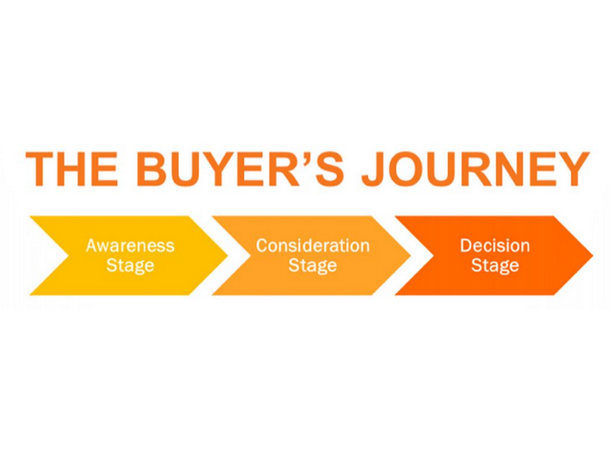
Gone are the glory days of the Sales Funnel. Enter the buyer’s journey. This (relatively) new concept suggests that buyers follow a linear path as they move through the sales process: first the awareness stage, then the consideration stage, and finally the decision stage. Each of these stages in the buyer’s journey necessitates corresponding content. Want to raise awareness of your brand and attract visitors? Try offering a free eBook that addresses a key pain point of your ideal buyer. Looking to close that almost-there sale? Propose a free trial. By considering the journey of your buyer, you are more likely to provide relevant content at the precise moment your buyer needs it.
Considering the characteristics of this new environment, it’s very unlikely that our prospects come to us completely uninformed. With more knowledgeable buyers, businesses must stay one step ahead. Implementing an information-driven marketing strategy gives us an attainable and inclusive way of achieving that.

by Elizabeth Hines | Jul 24, 2014 | Blog, Leadership, Marketing, Social Media, Strategy, Supply Chain, Talent
The supply chain industry has a talent crisis. The question is: how can we solve this crisis? To answer this question I turned to Rodney Apple, founder of the SCM Talent Group. Apple has worked as a supply chain recruiter for the majority of his 19+ year career within the staffing industry and he has filled more than 1,000 positions within the industry ranging from executive-level in Fortune 500 headquarters settings to leadership and staff-level roles across large networks of manufacturing and distribution facilities within North America. Apple’s role affords him the ability to witness the talent crisis from the perspective of the industry, the company, and the job seeker.
Kate Lee: The supply chain talent crisis is a hot topic. Is the job market as crazy as it is being made out to be?
Rodney Apple: The job market has been hot for years and there is always a crunch to find and source top supply chain talent. Baby Boomers are retiring in droves and there just aren’t enough people with the necessary skills and experience coming in to fill that gap. With that being said, I don’t think the job market is as crazy as the media makes it out to be. However, we still need the media to continue researching and reporting on this critical topic as this builds more awareness and helps to generate new ideas and solutions for solving the talent problem.
Lee: When it comes to supply chain talent, what is the biggest challenge?
Apple: We don’t have enough students at the K-12 levels that are saying “when I grow up, I want to be a Supply Chain Manager.” Many students coming up through our educational ranks don’t even know what supply chain is or they perceive supply chain as a blue collar industry where you either drive freight trucks or load and unload them at a warehouse dock.
There needs to be big thinking and big solutions to change this image at the macro level. The industry needs to make a concerted effort to communicate to K-12 students what supply chain is and what the career paths look like. Ultimately, it needs to find a way to brand supply chain as a top career choice. Investing into K-12 outreach programs and mass media campaigns, similar to how our military branches advertise for recruiting purposes, could be a great way to educate the future workforce about the supply chain and get them excited about pursuing degrees and careers within supply chain.
Lee: What other challenges do you see?
Many companies haven’t taken the initiative to develop best-in-class talent acquisition resources and programs. Companies that perform the best are the ones that treat the recruiting department like a strategic, value-added program versus a low-level, tactical HR cost center.
In addition, many companies are being too strict and inflexible with their hiring requirements. Instead of defining the job when they write out their job descriptions, they focus on defining the candidate by listing out a ridiculously long and unrealistic list of skills and qualifications that the “ideal candidate” must have to be “qualified”. This antiquated technique usually ends up deterring top candidates from applying and disqualifies candidates that have what it takes to do the job.
Lee: What can companies do to attract top talent?
Apple:
- Develop a best-in-class talent acquisition strategy and program
o People – hire the best talent sourcers and recruiters that you can find and make sure you have a properly staffed department so they’ll operate in a “proactive” versus “reactive” capacity.
o Process –streamline the end-to-end talent acquisition process with the goal of alleviating administrative, burdensome tasks and unnecessary touch points.
o System – implement a robust Applicant Tracking System, one that integrates with the company career site and ideally the HRIS or ERP system.
o Employee Referral Program – referrals are typically the top source for hires so companies should invest into developing a best-in-class employee referral program. Get the CEO and all senior executives to champion the program so all employees are involved and incented to participate.
o College Recruiting Program – partner with supply chain universities and proactively recruit students from these universities, early and often.
o External Supply Chain Recruiting Partners – identify supply chain recruiting agencies that specialize in the areas where hiring help is needed the most.
- Upgrade Career Branding Materials – Develop attractive branding/marketing materials to include a separate company career website that highlights company culture, history, key stats, job opportunities, career paths, etc. Incorporate interviews from employees and testimonials that illustrate why your company is a great place to work. In addition, learn how to write job descriptions that attract top supply chain talent.
- Create a Supply Chain Leadership Development Program –This is a great and cost-effective way to attract top entry-level talent and aggressively train and ramp them up to speed by rotating them into different functional areas within the supply chain. GE is well known for having best-in-class leadership development programs.
- Be open-minded when it comes to considering top talent from other fields/industries. Many candidates in other professionals have very transferable skill sets for careers within supply chain.
- Develop a program for employing Veterans, candidates with disabilities and long-term unemployed.
- Invest more into job training and mentoring programs e.g. supply chain certifications and tuition reimbursement.
Lee: What is the role of social media in recruitment?
Apple: Companies and their recruiters need to be on social media to establish their employment brand, to attract talent, and to share job openings and upcoming recruitment events. Furthermore, social media can be leveraged by all employees as a talent acquisition tool. For example, companies could require all employees to distribute jobs out to their social media connections/networks.
Lee: What advice do you have for job seekers?
Apple: A job search should be conducted strategically, not haphazardly. It’s all about laying out a robust job search strategy with a corresponding action plan. In addition, networking is where job seekers should spend the bulk of their time versus applying online and waiting for the phone to ring.
Lee: Do you have any advice for job seekers trying to break into the supply chain industry?
Apple: Changing industries is tough to do but not impossible. Start by looking at what skills are transferrable and highlight these skills on your resume, LinkedIn profile, and in interviews. In some cases going back to school may be necessary. This may mean a degree program, or it could mean obtaining a supply chain certificate.
Networking is paramount. Join local chapters of supply chain associations, attend their meetings and network your butt off.
Finally, remember that it may be necessary to take a step back in both job level and compensation. Often times taking one small step back in your career could result in three giant leaps forward.