by Elizabeth Hines | Jun 23, 2014 | Blog, Logistics, Marketing, Social Media, Strategy, Supply Chain
Many companies within the logistics and supply chain industries are stuck on the social media starting line. The reason – “they can’t get past the word ‘social’ and the perception it creates.” The reality is that social media is a tool that can be utilized to create value and grow your business.
This is the fourth in a series of articles that provides examples of companies within the logistics and supply chain industries who have moved beyond the social media starting line and have realized the business value of participating in social media.
Cerasis is a top freight logistics company and truckload freight broker. During the company’s first 15 years it focused on traditional sales and marketing strategies and relied heavily on referrals. This strategy worked. Cerasis acquired new customers, retained current customers, and realized positive growth. However, Cerasis was not viewed as an industry leader, and brand awareness was low.
In 2012 Cerasis decided to participate in social media and launch a content marketing strategy.
Cerasis began actively blogging, and began using Twitter, LinkedIn, Facebook, Pinterest, and Google+. The company quickly became seen as a leader within the industry, and brand awareness increased dramatically.
Within 15 months the company received 71 leads from search engines, 65 leads from social media, and 52 leads from webinars. Even more impressive, within 15 months the company gained 35 customers (one customer within the freight logistics industry can mean a lot of revenue).
The results show that Cerasis is no longer on the social media starting line – rather, Cerasis is now a leader, not only in the freight logistics industry, but also in using social media as a business tool.
by Jennifer Hart Yim | May 6, 2014 | Blog, Content Marketing, Marketing, Social Media, Strategy
This is the second in a series of blog posts written by Adam Robinson, Director of Marketing at Cerasis. Founded in 1997, Cerasis is a top freight logistics company and truckload freight broker.
#1: What are your Marketing Objectives?
The following were the marketing objectives we decided for the Cerasis marketing strategy:
- Create a consistent marketing program of brand awareness campaigns and multi-channel marketing platforms in order to gain leads and sales from a more sophisticated and larger shipper.
- Achieve market perception as a thought leader in the logistics industry through consistent content marketing.
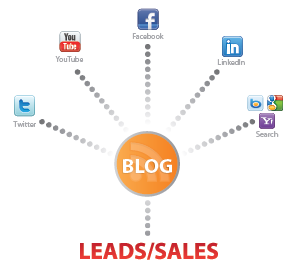
As part of our strategic plan, the Cerasis website and blog is the hub of the entire process. Every marketing element’s purpose is to (a) build brand awareness, (b) build community, and (c) drive traffic from those elements to the blog and website. This is important for several reasons:
- We are in total control of our website content, messaging, and engagement.
- Our blog and website is the best place for inbound lead generation.
- Blog content lasts longer than posts within the realm of social media and other traditional channels such as advertising in a magazine.
- A blog is the best place for sharing your story and showing expertise.
#2: Understanding Content Marketing and the Approach
Consumers of any product or service work through a process that starts with becoming aware of a need and ends with making a decision to purchase or not to purchase (Universal Marketing Funnel). Because of our marketing efforts, at any given moment in time Cerasis will have potential customers considering our company within various stages of the decision process. Our content marketing strategy will focus on building content that communicates with these prospective customers no matter where they are in their decision journey with Cerasis.
- Awareness – This is the stage in which a potential customer becomes aware that your company exists. Of the content you create, 30 percent to 40 percent will be for the purposes of awareness — making potential customers aware of your company and exposing you to your target market. Awareness content focuses on trends, education of best practices, and is completely devoid of over salesy messaging.
- Evaluation – This is the stage in which potential customers are in the market for what you are selling and they are trying to formulate their buying criteria. Like the awareness stage, 30 percent to 40 percent of our content will be focused on helping the customer evaluate your offering. Try and create content which evaluates your type of business vs. another. Another good example is iPhone vs. Android.
- Decision – Decision-based content that communicates why a customer should buy from Cerasis will represent about 20 percent of our content strategy. This kind of content is not overtly salesy, but is in line with your strengths and unique selling proposition
- Fanatic – This is content that is mostly user generated from your customer base and brand loyalists. These are in the form of testimonial, case studies, and guest blogs. This kind of content is about you, but from someone else’s perspective.
#3: Target Audience Establishment and Research
Of course if you want to even have results in social media and content marketing, you have to understand who you are trying to reach. It’s important to think holistically when considering who you are trying to reach at a potential prospects’ company. Typically, your target audience falls into two categories: Primary (decision makers) and Secondary (influencers of the decision maker), but there could also be Tertiary (these are the vetters; admins, executive assistants, and those gathering info to present to the group, usually in a B2B environment).
When thinking about your target audience, think of the following:
- Broad Categories: Think of the different verticals you can support. For example, a logistics company may want to reach those in the industries of Manufacturing, Supply Chain, Logistics, Transportation, Distribution and Freight. Let the categories be your guide for when you are joining digital communities or writing content you will then distribute in these communities.
- Job Titles: Next, ask the sales staff who they typically must talk to in order to get a signed contract. Typically, the person who signs the check, or the contract, is in leadership and makes the ultimate decision. This may be a CFO of a manufacturing company, or a Manager of some sort. Then, ask the customer service reps who fulfill your service or product offering who they deal with at your customers’ companies. For example, it may be Account Manager. Then, finally, continue to ask if there are other job titles that make sense. You can use these job titles to find communities easily on LinkedIn.
- Search Engine Key Phrases: To complete your list of your target audience, next go to Google.com and search some of these job titles to find related job titles, which you can find at the bottom of the search page. You may also use Google’s free Keyword Tool, plugin the job titles, and see related key phrases to those job titles.
More Action Items with this information:
- Start researching what kind of content is relevant to these job titles and industries in preparation for your content planning session
- Identify popular news sources, people, and blogs from which you may draw inspiration, establish key relationship for future guest blogging or networking, and of course in curation of content of value to your target audience to spur community growth and engagement in platforms such as LinkedIn, Facebook, Google+, or Twitter.
#4: Understanding Digital Assets, Social Media Platforms, and Online Communities Activation
Digital Assets
Digital assets are online environments you create from scratch. Digital assets are often created using a technology framework, a hierarchy of navigation, your company logo and custom graphics, and professional copy writing. The major digital assets you should consider when getting ready to activate your content marketing strategy are Website, Company Blog, Landing Pages, Videos, Podcasts.
Social Media Platforms
In general, most social media platforms you set up require you to amass a following in order to be effective. There are some platforms where the entire reason you establish it in the first place is to build followers, and then add value in the way of posts or messages or use to distribute your original content in order to lead back your desired target audience to your digital assets in order to gain awareness and inbound leads. The following are the major social media platforms, what they are, and what they may be used for:
- LinkedIn Company Page: A LinkedIn company page allows you to post information about your company such as founding date, about section, post location information, hours, products and services, job postings, and allow employees to list the company page within their own individual profiles. The page is used for marketing by accruing followers and post messages, such as your own original content, which reach those followers. LinkedIn offers great analytics around how many people were reached with your posts, how many clicks you receive, and how many followers you have gained over time. Company pages are a great way to find out company intelligence such as key decision makers.
o USES: Typically, a LinkedIn page is most effective in a business-to-business environment, as the mindset of the users on LinkedIn are for either finding jobs, finding information on their industry of choice, or consuming content distributed or curated by companies. Aid in the vetting process of potential clients who look up your company via search engines or LinkedIn search, aids in establishing credibility with target audience, reach your followers through consistent, relevant, and remarkable content, promote products and services, stay in touch with employees
- LinkedIn Profile: LinkedIn gives you the keys to controlling your online identity. Have you Googled yourself lately? You never know what may come up. LinkedIn profiles rise to the top of search results, letting you control the first impression people get when searching for you online.
o USES: Again, a profile, when used for digital marketing, is friendlier in a B2B environment, over a business-to-consumer (B2C) geared marketing campaign. The LinkedIn profile allows you to build awareness of yourself and company through consistent posting, serve as a repository for your own personal brand, join LinkedIn groups through your profile, search engine optimize your profile for increased visibility, gain valuable market insight through LinkedIn Today, build connections with your desired target audience
- Twitter: Twitter is an information network that brings people closer to what’s important to them. Every day, millions of people turn to Twitter to connect to their interests, to share information, and find out what’s happening in the world right now. Anyone can read, write and share messages of up to 140 characters on Twitter. These messages, or Tweets, are available to anyone interested in reading them, whether logged in or not. Your followers receive every one of your messages in their timeline – a feed of all the accounts they have subscribed to or followed on Twitter. This unique combination of open, public, and unfiltered Tweets delivered in a simple, standardized 140-character unit, allows Twitter users to share and discover what’s happening on any device in real time.
o USES: Think of Twitter as a consumption platform. Consumption of industry news and original opinionated content. In this way, it is great for B2B marketing. If using for B2C, it works well to extend brand affinity by creating campaigns or using branded hashtags for those who want to follow your company. Unlike a LinkedIn company page and a bit different than requesting a LinkedIn connection, you can follow other thought leaders, or those in your target audience to elicit a follow back. Additionally, Twitter is highly searchable via key word to find and follow those in your target audience or those talking about your products and services. Furthermore, Twitter aids in Search Engine Optimization through sharing your content, show thought leadership and attract your target audience by using strategic hashtags and curating industry news, consume industry news gaining valuable insights, gain inbound leads via content marketing by tweeting your original content, gain followers to increase brand awareness and chances of inbound leads
- Facebook Page: A Facebook Page, much like a LinkedIn Company Page allows you to include your company information, match your graphics to your website, include store locations, hours, mission and value statements, and categorize your business. In order to amass a following people must “Like” your page. Once they do, you can then hope to reach them with your posts. Unlike LinkedIn however, Facebook posts from a page only reach 10-16% of those who “Like” your page, thanks to Facebook’s “Edge Rank” an algorithm designed to declutter your personal Facebook Feed when you login.
o USES: Facebook often times is leveraged in a more B2C environment, but can be wildly successful in B2B if you know the power of a business Facebook’s ability to “Like” another Facebook business page, and thus still receive the posts from the page, hopefully reaching your desired target audiences. Furthermore, you can use Facebook to create Events, which you can promote and gain RSVPs, you can run contests via Facebook ads to increase awareness of your brand, curate and post original content to show your thought leadership, leverage the Facebook Ad platform to target Facebook users who are within your target audience with great precision, and ultimately, through pictures and video, you are able to show the personality of your business via Facebook.
- Google+: Is a social network owned by Google. If you have a google account, you already have a Google+ profile. There are Google+ individual profiles and Google+ Pages. Google views it as a social layer to compliment it’s other products of search, advertising, Gmail, maps, and Google Places (local listings). With a profile or a page, you can amass “Followers” here as well, whenever another Google+ user adds you to their circles.
o USES: Google owns Google+, so you must understand if you are wanting to have success in search engine optimization, Google+ is a must. Like a Facebook Page, you can post to your followers and they can see your posts, and +1, comment, or share on that post. The more +1s you have on your own content the more Google sees your content as trustworthy, thus uplifting your overall SEO efforts. This platform also allows you to fill in your company information, like a LinkedIn Page or Facebook Page, but here you can also connect your Google Local listing (formally known as Google Places) to your Google+ page to aid in further SEO, but also so customers may easily leave reviews and other potential customers can see your information and reviews all in one place. Finally, with a Google+ profile you can add Authorship, so that when your content does show up in search engines, your listing in the search engine stands out and increases the likelihood someone will actually click on it, as you see to the right.
- Pinterest: Pinterest is a fairly new social media platform, having come to prominence in late 2011. Pinterest allows you to create both a personal user account, as well as a business account. Pinterest is very similar to Twitter in that you can create a page and curate content. Except, instead of being driven by links and text, Pinterest is driven by images and video. A page or user can amass followers, and like twitter can follow those in your target audience to hopefully gain a follow back. One may pin your own original content or thought leadership content in the hopes to reach your target audience where they either repin or pin your content, like, comment, and more importantly click on your content.
o USES: Increase Search Engine Optimization by posting your blog and website content, build a community of followers made of your target audience, and display content in a more visual format
- YouTube: This is another platform owned by Google, and also very important in search engine optimization. Again, like many social media platforms, you are allowed to either be a user or have a company YouTube channel. As a company you can establish your channel and upload videos of original content, as well as fill out information about your company. You are able to amass subscribers and subscribe to other channels of interest. Additionally, your videos can gain likes and comments, and you may add descriptions to each video.
o USES: YouTube has applications in both B2B and B2C, and doesn’t require a lot of upkeep or posting, like some of the other platforms. YouTube primarily, in a B2B setting is used to increase search engine visibility with targeted key phrases in each video, gain subscribers of your target audience, and allows you to embed video in your digital assets as a way to make your marketing message stand out.
Online Communities
Finally, we come to online communities. Unlike digital assets and social media platforms, online communities allow you to tap into your target audience and not be at the mercy of having to amass followers or attract visitors to your brand. I am not saying you should not try and attract members of the community to your company, but you can think of online communities where you can use content of relevancy as bait to reel them back into your own controlled environments and established pages in order to support your overall marketing and business goals as laid out in your digital marketing plan. The following are the main online communities which give you broad reach:
- LinkedIn Groups: LinkedIn Groups are communities you may join within LinkedIn with your LinkedIn profile. You may search out LinkedIn groups by key word and decide to join as a member. LinkedIn will tell you the size of the group, the description, the rules of the group, who are the managers, and even the stats. You are allowed to post discussions, comment on others discussions, and after some time, post original content as you build up your influence in the group.
- USES: Increase the awarenes and raise the profile of yourself and your company through relevant discussions and engaging with other group members, gain traffic to your blog and website by posting original, relevant, and not too salesy content, increase connections with other LinkedIn users in your desired target audience, leverage deep search capability to find discussions around your products and services solutions, potentially reach hundreds of thousands of people in your target audience by joining up to 50 groups made up of your target audience.
- Google+ Communities: Google+ Communities are fairly new, but act very much like LinkedIn Groups. You can join strategic groups found by key phrase and post messages in them. You can engage with other members and add targeted users you may want to talk further with to your circles.
- USES: Primarily used to aid in SEO by posting links to your original content, allows for broad reach of your content and brand through reaching large numbers of people in each group
- Quora: Quora is a question and answer site where you can search by specific key word as well. You have to be a member, and it’s as straight forward as someone asking a question, and people offering their expert answers. Other users will then vote on the answer with the best ones being featured.
- USES: The first thing you DON’T want to do is SPAM Quora. This is the place where you simply want to provide value by answering questions related to your expertise. If it makes sense, you can post a link to your content, but this is highly frowned upon unless it truly adds value (this is why proper content marketing where you lead with value is SO IMPORTANT! More to come in future blog posts!). Once you add value and build out your influence, you can be known as “That person” who is the expert. And who doesn’t want to do business with an expert!
- Reddit: Reddit is a fantastic community, but the challenge is how large it is. Like LinkedIn Groups, there are several niche places, called subreddits, where you can simply search for your industry and post your content to. Again, like LinkedIn groups, if you don’t want to be spammy in nature, you have to be relevant and engaging. Don’t over post here, but try a piece of content once per day.
by Jennifer Hart Yim | May 6, 2014 | Blog, Content Marketing, Marketing, Social Media, Strategy
This is the first in a series of blog posts written by Adam Robinson, Director of Marketing at Cerasis. Founded in 1997, Cerasis is a top freight logistics company and truckload freight broker.
The purpose of this series of blog posts is to give others in our industry and especially those in the manufacturing industry, a guide to create an effective digital, social media, and content marketing strategy which will produce results for your company. If you have followed the Cerasis blog since its launch in March 2013, you have noticed that we work really hard at executing our strategy. The reason we work so hard is because we are passionate about educating the marketplace on information that matters to them. In that way, we want to be the de facto expert in the manufacturing and logistics industries. If we can help those who are our customers and potential customers (manufacturers and distributors) with best practices around logistics and freight, as well as manufacturing industry news, we are continuing our mission of driving long term value (even if we give the information away for free). The result (we hope and have seen) is that people view us as the expert and will want to engage us in a long term relationship as their logistics services provider. We hope this is helpful and you learn something from it!
Background of Cerasis use of Content Marketing and Social Media
- Company started formal marketing for the first time in October 2012, its 16th year.
- Little brand awareness, not thought of as a thought leader, but company still grew well by referral.
- It was important for us to establish our messaging, our target audience, and how we were going to best market the company.
- We didn’t have any budget for advertising, and with the rise of content marketing, we knew it was important to use social media and content as a way to start marketing and fine tuning the messaging of the company.
- We finished our market research phase (tips below on how to conduct one), and knew the content and who we wanted to reach.
- We then looked at all the social media channels and decided which platforms to use and what online communities to join.
- We built a strategy and started executing our content by simply posting one piece of content every business day.
Digital Marketing Strategy Approach for Cerasis
There is a process to strategic planning in order to lead towards sustainable marketing programs which yield a tangible return-on-investment (ROI). The process starts with understanding where social, digital, content, and traditional marketing fits in the world of inbound lead generation and increased brand awareness.
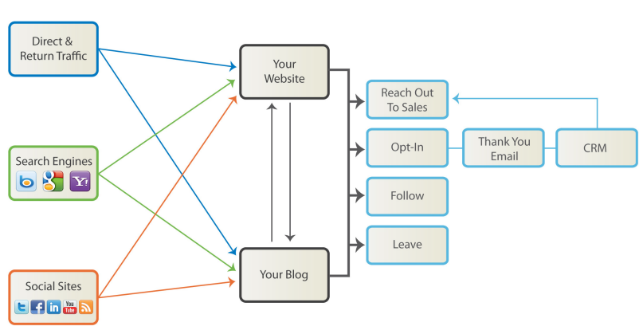
The goal of any strategic plan should be to find and acquire new customers and to grow existing customer relationships. The map on the next page shows how customer engagements happen online and in general. This map to the left helps us determine Cerasis’s route, analyze where we currently are, and hone in on where we should focus our attention to keep the strategy on track.
So, what are all the results from our social and digital marketing you ask?
Cerasis Quick Stats (Sept 12 to March 14)
- All Visits to Cerasis.com: 4,476 to 34,461 (669.91% Increase)
- Blog Visits: 0 to 28,271 (notice how without our content and social media, we would not have grown our website visits to where they are today)
- Social Media Visits: 4 to 8,546 (214,550% Increase)
- Search Visits: 711 to 16,275 (2,189.03% Increase)
- Social Community: 175 users total to 9,635 users total
- Twitter: 0 to 2,760 Followers
- FB: 0 to 492 Likes
- LinkedIn Group Members: 0 to 3,550
- LinkedIn Profile Connections: 120 to 1,456
- LinkedIn Company Page Followers: 51 to 529
- Google Plus Followers: 0 to 662 and over 310,000 views of the Company Page
- Pinterest Followers: 0 to 188
- Engagement Numbers:
- Twitter Mentions/RTs: 14,825/5,721
- LinkedIn Group Comments: 12,766
- Facebook Comments, Likes, Shares: 1,484
- LinkedIn Page Impressions/Interactions/Clicks: 247,359/566/1,560
- Pinterest Impressions/Repins: 73,698/327
- Blog Comments: 841
- Google Plus +1s: 2,976
- Conversion data (note, leads vary based on industry; 1 sale for us can mean a lot of revenue)
- Leads From Search Engines: 71
- Leads From Social Media: 65
- Leads From Webinars: 52
- Total Customers Gained: 35
Conclusion
Social media, content, and digital marketing are much like the Pareto Principle: Focus on the platforms and entities which yield the highest results, don’t just do something or be somewhere to do it! It all comes down to strategy! Now, if you have the resources to be on every social media platform, you should, but only if you do it well!
by Elizabeth Hines | Feb 3, 2014 | Blog, Marketing, Social Media
Getting 10,000 hits a week on your website may be huge accomplishment for your business (and it is), but if at the end of the week none of those hits turn into a lead how do you measure your business’ success?
Knowing which metrics you need to be paying attention to is a crucial task for your marketing team. Whether you’re using Google Analytics or another custom web application, the data that you can learn about your customers – based on their actions online – is priceless. This data will help you create the kind of content that will convert your website visitors into customers, all in good time, of course.
Here are five metrics you should be looking for and measuring in 2014:
1. Customer Engagement
How do your customers interact with the content you digitally share? Do your customers frequently engage with your company’s LinkedIn page, respond to or retweet your tweets, or comment on your blog? If the answer is yes, you have a high level of customer engagement. It’s important to stay engaged with your customers (and potential ones) through these different types of media. The more your customers are engaging with you, the better.
Ignoring negative feedback on your Facebook page, Twitter or blog can be greatly detrimental to your engagement, however. Use these platforms as a customer service tool in order to leverage them to take full advantage of the power of your channels.
2. Conversions
Driving a high volume of traffic to your site is a great way to improve your SEO ranking, build brand awareness, and most importantly, sell your product. Create a definitive way to measure your website analytics and traffic in order to track conversions from your website. If you’re not seeing as many conversions, you may need to take a step back and reevaluate your website. Keep in mind that 55 percent of customers commit to a company because of the ability to find the information or help they need. Are there calls to action on your homepage? Is there easy to find content for consumers to download? And most importantly – how prominent are these calls to action for the untrained eye of your customer to locate?
3. Profit vs Revenue
Many companies generate a significant amount of revenue over the course of a fiscal year but still find themselves coming up short and often times operating at a loss. Expenses over the course of a year may outweigh the actual net profit the company earns. Throwing money at improperly used marketing tools and signing contracts can ultimately be a waste of money. Measure the ROI of these tools to make better buying decisions and save some money.
4. Customer Satisfaction
While this may be a difficult metric to gauge, there are several ways to measure customer satisfaction, both organically and through paid tools. Customer satisfaction is also one of the most important metrics businesses need to consider in order to promote a successful business. Create surveys for customers to provide qualitative and quantitative feedback. Follow product reviews and utilize your social media channels to keep an on what your customers are saying. The value of this type of data is priceless and will help your business plan for future product launches and train customer service representatives.
5. Returning Customers
The success of your business lies on the shoulders of your customers. If your customers are happy, they will keep coming back for more. But how do you ensure that your customers remain in your sales funnel until they are ready to make a purchasing decision again? Keep in touch with them! Send special offers, newsletters and create and distribute content that will keep your customers informed about your products and your industry in order to maintain a level of engagement with them, even when they are not interested in buying something. Businesses with a high number of returning customers will ultimately experience success and growth.
by Elizabeth Hines | Nov 5, 2019 | Blog, Content Marketing, Logistics, Marketing, Social Media, Supply Chain
LinkedIn has released a new guide to using video on its platform. Here’s what supply chain companies need to know to get the most out of video on LinkedIn.
Highlights:
- Effective B2B marketing videos start with an analysis of your prospects’ unique purchasing journey and needs.
- Videos for the awareness stage of the buyer’s journey should be concise and geared to forging an emotional connection.
- Bottom-of-the-funnel video types include product demonstrations, welcome videos, webinars, and FAQ sessions.
Visual content, particularly video, is the future of social media marketing. And video on LinkedIn is no exception. A recent report from Kleiner Perkins indicates that 62% of B2B marketers rate video as an effective content-marketing tactic. Not only that, but, according to internal data from LinkedIn, users are 20 times more likely to share a video on the platform than any other type of content.
Thanks to a recent guide published by the platform, leveraging video on LinkedIn for the supply chain has never been more attainable. The Tech Marketer’s Guide to B2B Video is an invaluable resource. Whether you’re relatively new to B2B video marketing, or a seasoned video creator, the guide contains useful nuggets of information, as well as examples of effective video on LinkedIn, for marketers at any stage.
We’ve pulled out key points for you.
6 steps to approaching video on LinkedIn
It’s worth pointing out that the six steps that LinkedIn identifies to building an effective video strategy are applicable elsewhere as well. Your strategy for video on LinkedIn should likely also apply to your strategy for video content across your digital assets.
1) Analyze your buyer’s journey
Consider the unique buyer’s journey for your company. What content do prospects want to see at each stage, and what actions do you want them to take?
2) Set your marketing strategy
What medium is optimal for delivering content at each stage? Which stages are particularly conducive to video content?
3) Establish metrics and KPIs
Choosing the right key performance indicators (KPIs) and metrics will allow you to determine how your content is performing.
4) Create video content
At the stages where video content is the best way to deliver, what type of video is most effective?
5) Target your content
Use your understanding of your target audiences, in combination with the targeting capabilities of LinkedIn, to ensure that your video is reaching the right people at the right times.
6) Optimize your campaign
Keep track of your data. Note what’s working. Adjust what isn’t performing.
Using video on LinkedIn throughout the buyer’s journey
Awareness
The first stage of the buyer’s journey, the awareness stage, is particularly opportune for video on LinkedIn. At this point, your goal is to tell a story, evoke a response, and introduce your brand and products.
Videos at this stage should be concise and geared to connecting with your audience, demonstrating an understanding of their challenges, and how your company is positioned to address those challenges.
LinkedIn’s guide points out a major advantage of video: its measurability. As opposed to text-based marketing, where your knowledge of audience behavior is limited to downloads and time on page, video on LinkedIn comes with richer data. You can tell, for example, when someone has watched your video and when they stopped. This means you can adjust your video length suit the preferences of your audience.
At the awareness stage, important video metrics include how many times your video was viewed, how much of the video was watched, and how many viewers responded to your call to action.
Consideration
Using video on LinkedIn for the second stage of the buyer’s journey, the consideration stage, is about introducing your products and their features, as well as giving a sense of what it’s like to work with your business. Ideal video formats at this stage include explainers, case studies, webinars, how-to videos, and virtual tours. Your foremost goal is to be authentic and to represent your business and the solutions it offers.
Key metrics at this stage are about engagement. Keep track of the number of interactions your videos get (comments, likes, clicks, shares, etc.), compared to the number of views. Also keep an eye on your estimated cost per view (eCPV) to track the efficacy of your video budget.
Decision
Because the decision phase of the buyer’s journey is all about personalization, video has traditionally been used less here. But that’s starting to change. Authentic, trust-building videos can be a powerful asset for the decision stage, reassuring your prospects that they’re making the right decision, using testimonials from existing customers. Welcome videos, FAQ sessions, and webinars are also effective in the decision phase, as well as full-length product demonstrations.
If you’re using lead-generation forms with your video on LinkedIn, keep track of which generate the most leads, as well as the quality of those leads. Otherwise, track click-through rates to gain insights into your estimated cost per click (eCPC).
Metrics for video on LinkedIn
LinkedIn offers a robust set of metrics for videos on its platforms:
- Views: At least one second of playback while the video is at least 50% on screen on desktop, or 300 milliseconds on mobile
- Views at 25%: The number of times your video was watched at 25% of its length, including watches that skipped to this point
- Views at 50%: The number of times your video was watched at 50% of its length, including watches that skipped to this point
- Views at 75%: The number of times your video was watched at 75% of its length, including watches that skipped to this point
- Completions: The number of times your video was watched at 97-100% of its length, including watches that skipped to this point
- Completion Rate: Completions divided by views as a percentage
- View Rate: Number of views divided by impressions, multiplied by 100
- eCPV: Estimated cost per view
- Full Screen Plays: Total number of clicks to view video in full screen
Do you use video on LinkedIn for your business? Let us know your experience in the comments.
Related posts: