by Elizabeth Hines | May 1, 2014 | Blog, Content Marketing, Logistics, Manufacturing & Distribution, Marketing, Social Media, Strategy, Supply Chain

By launching a new digital, social media, and content marketing strategy, Cerasis saw a big, positive impact on its bottom line.
Companies within the manufacturing, supply chain, logistics, transportation, distribution and freight industries have been slow to create and execute digital, social media, and content marketing strategies. The primary reason: a lack of understanding of the business case or value.
These strategies utilize platforms that many within these industries perceive to be for socializing, sharing photos, and connecting with friends (e.g., Twitter and Facebook), and they turn the sales process on its head. Content marketing strategies are fundamentally different from traditional strategies employed by businesses to attract new customers, foster relationships with current customers, and grow their bottom line. Because of this, companies do not recognize how these strategies can positively impact their bottom line and therefore decide to steer clear — they feel engaging is too risky.
The reality is that not participating is risky. Like it or not, things have changed. The internet and social networks are where customers are. Content is how you can establish your company as a thought leader within the industry, and how you can attract and retain customers. If you want to grow your business you need to participate.
Looking at the manufacturing, supply chain, logistics, transportation, distribution and freight industries, there are a few companies that have emerged as leaders — companies that exemplify the business value of creating and executing digital, social media, and content marketing strategies. Cerasis, a freight logistics company, is one of them.
How Cerasis acquired 98 customers through content marketing
Cerasis was founded in 1997. For 15 years the company utilized traditional sales and marketing strategies: placing ads in industry print publications, and relying heavily on referrals. This strategy worked. The company acquired new customers, retained current customers, and realized positive growth.
There is a saying: “If it ain’t broke don’t fix it.” Cerasis ignored these words of wisdom.
In the fall of 2012, Cerasis launched a digital, social media, and content marketing strategy. The results have been impressive. For example, visits to the company website have increased by close to 670 percent, and search visits have increased by close to 2,190 percent. The company boasts an impressive number of Twitter followers, Facebook fans, and LinkedIn followers.
The business value of the strategy? Cerasis has acquired 98 customers. For the freight logistics industry, one customer can generate significant revenue; 98 new customers has a positive impact on the company’s bottom line.
Cerasis will be guest blogging for Fronetics for the next three weeks. The three-part series will begin with an overview of the company’s strategy and will discuss the results the company has realized through the execution of the strategy. The next two articles focus on how to create and execute a strategy.
When looking for best practices, Cerasis is a clear example. For companies within the manufacturing, supply chain, logistics, transportation, distribution and freight industries these articles are a great opportunity to learn why (and how) your company should create and execute a digital, social media, and content marketing strategy.
Download the case study to learn more about how Cerasis’ content marketing strategy helped the company acquire new business and increase sales.

Related posts:

by Elizabeth Hines | Apr 29, 2014 | Blog, Content Marketing, Logistics, Marketing, Social Media, Supply Chain

Content will help you grow your business; by creating and distributing valuable and relevant content in a strategic and consistent manner you can drive profitable customer action. But, it’s not all about you. It’s not all about the content you and/or your business creates. Here’s why content curation is an essential component of a successful content strategy.
The internet is a fire hose stream of content. Being able to navigate the deluge of content and identify the content that is valuable to your customers and to your business is essential. The process of identifying and sharing this content is content curation.
By consistently being able to identify, make sense of, and share content that is important and relevant to your customers and to your industry you will establish your business as a thought-leader and a trusted resource.
A 2014 survey found that 76 percent of respondents reported that content curation positively impacted their business goals in 2013. Ninety percent of respondents predicted that content curation will have a positive impact on their business goals in the upcoming year.
This article was originally published on DC Velocity.
by Elizabeth Hines | Apr 23, 2014 | Blog, Content Marketing, Logistics, Marketing, Supply Chain
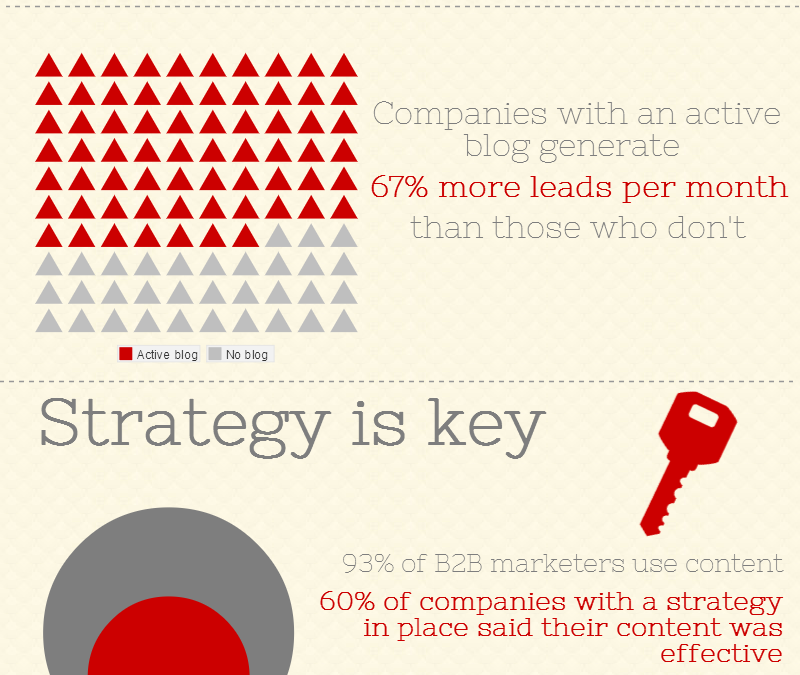
Content infographic: how to grow your business with content
by Elizabeth Hines | Apr 21, 2014 | Blog, Content Marketing, Logistics, Marketing, Strategy, Supply Chain
When it comes to content your company doesn’t need to go it alone. Not only is it possible to outsource content, for many companies it may be the best solution. Here is how to determine if outsourcing content is right for your company, and what your company needs to consider when looking for an outsource partner.
Is outsourcing right for you?
Outsourcing is not the panacea. It may be the right solution for your company – or maybe not. Here is what to consider when determining if outsourcing content is the right solution for your company:
- What are your company’s core competencies?
- How can your company deliver the best value to your customers?
- A successful content strategy needs to be deliberate and needs to have someone in charge. Do you have in-house talent who can put together a content strategy for your company and manage the execution of the strategy?
- Does your company have in-house talent that can consistently create good content?
- Does your company have in-house talent that has the time to consistently create good talent?
- Does your company have in-house talent that can distribute your company’s content?
- Does your company have in-house talent that can track and analyze your company’s content strategy?
Be honest. Cobbling together staff or passing content like a hot potato from one person to another is not going to be effective. If content is not an area where your company excels, or if content could be carried out more efficiently and effectively if the service was outsourced – start looking for an outsource partner.
If you do decide that outsourcing is right for your company, know that you are not alone. Forty-four percent of B2B marketers report that they outsource content creation. Diving down further, 72 percent of large B2B companies (1,000 employees or more) outsource content creation and 34 percent of small B2B companies (10 to 99 employees) outsource content creation. Looking specifically at the manufacturing industry – 55 percent of manufacturing marketers report that they outsource content creation.
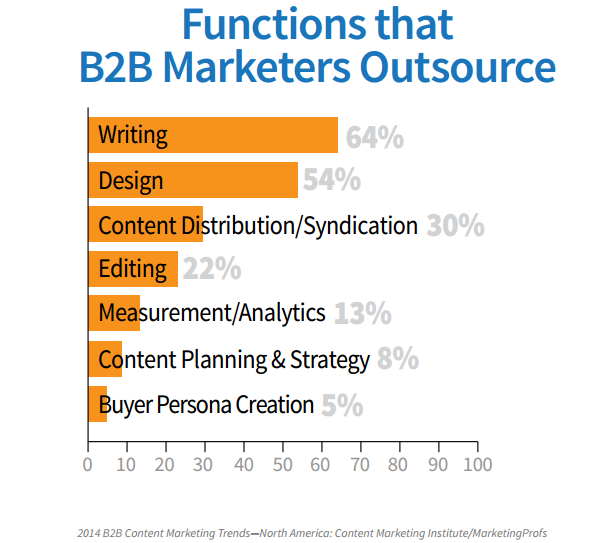
As shown in Figure 1 the content functions that B2B marketers outsource vary from writing to design to distribution to creating a buyer persona. When it comes to outsourcing content functions it doesn’t need to be the kitchen sink.
Figure 1

What to look for in an outsource partner
When it comes to finding an outsource partner you want to find a partner that will bring value to your company and to your customers. Whether you outsource all content functions or just one, here is what to look for in an outsource partner:
- Experience and knowledge of your industry;
- Willing to work with your company to help you achieve your goals;
- Open to exploring and furthering your company’s creative ideas;
- Able to follow instructions and execute with minimal oversight;
- Able to create the type of content your company needs;
- Interested in entering into a long-term relationship.
More generally, Frank Cavallaro wrote that when choosing your perfect outsource mate it is important to start by looking at the mission or value statement of your potential partner. Are these aligned to your company’s? If they are, move on and explore the partnership further. If not, walk away. “Mission and value statements speak to the core culture of the company, so if you can’t find common ground here, it is unlikely you will be able to build a positive working relationship.”
This post was originally published on DC Velocity.

by Elizabeth Hines | Apr 8, 2014 | Blog, Content Marketing, Logistics, Marketing, Social Media, Strategy, Supply Chain
Content is king. By creating and distributing valuable and relevant content in a strategic and consistent manner you will be able to create demand for your products and services and will be able to drive profitable customer action. That being said, while content is king, content doesn’t go far (actually it goes nowhere) without distribution. Wise words by BuzzFeed’s Jonathan Perelman: “Content is king, but distribution is queen and she wears the pants.”
For content to be successful for your business you need to do more than create content – you need to distribute content. Moreover, the content needs to be delivered consistently over time, at the right time, and in the right place.
For your company this means taking the time to identify the distribution channels that are the right fit for your company, your content, and your goals. It also means taking the time to learn how to distribute content via these channels effectively.
For example:
- LinkedIn and Twitter are good candidates for letting people know about the white paper your company just released, whereas Pinterest is probably not a good white paper distribution channel.
- Levering your 140 characters for Twitter is key, but taking those same 140 characters to LinkedIn or Facebook will likely result in you falling flat.
- Distributing your content multiple times a day via Twitter is essential given the short lifespan of a Tweet; however, distributing content multiple times a day via email will not be well received.
Content will help you move the needle. Content will drive profitable customer action. However, your content, no matter how valuable it is, will not be seen and therefore will not be effective if you do not have a solid content distribution strategy. If you want results, remember who wears the pants.
This post was first published on DC Velocity.

by Elizabeth Hines | Apr 1, 2014 | Blog, Content Marketing, Logistics, Marketing, Supply Chain

In the 1970s people were exposed to an average of 2,000 ads per day. Today we are exposed to more than 5,000 ads per day. The barrage of ads has resulted in buyers tuning them out. With buyers no longer paying attention to ads, businesses need to adjust how they find and engage new prospects, and how they establish and maintain long-term relationships with customers.
The solution: content. Why content is king and your business should take an oath of alliance to the kingdom.
Content is inclusive of blogs, white papers, e-books, newsletters, infographics, podcasts, webinars, and video. Creating and distributing valuable and relevant content in a strategic and consistent manner is what will drive profitable customer action.
Valuable and relevant content is not a sales pitch. It is not content that pushes your products and services. Rather, it is content that communicates valuable information to customers and prospects so that they have the knowledge to make better informed decisions. Moreover, it is content that establishes your business as a reliable source of knowledge – as the thought-leader within the industry.
How does this translate into consumer acquisition and retention? When the customer is ready to make a purchase they will reward your company with their business and with loyalty.
Skeptical? B2B companies with an active blog generate 67 percent more leads per month than those who don’t. A study by the Custom Content Council found that 72 percent of marketers think branded content is more effective than advertising in a magazine, 62 percent say it is more effective than advertising, and 69 percent say it is ‘superior’ to direct mail and PR.
Content that will move the needle for your business is valuable content. It is content that is informative, educational, interesting, and speaks to your customer’s emotions and speaks to their pain points. Furthermore, it is content that is delivered consistently over time and at the right time.
Before you start to create content for your business consider this sage advice offered by Arjun Basu: “Without strategy, content is just stuff, and the world has enough stuff.”
Research supports Basu. Companies that have a documented content strategy are more likely to consider themselves effective than companies that don’t have a strategy in place (60 percent v. 11 percent). Similarly, companies who put a person in charge of content marketing were more likely to be successful than those who did not (86 percent v. 46 percent).
How do companies put together and execute a content strategy? Eight percent of B2B marketers outsource content planning and strategy. Sixty-four percent of B2B marketers report that they outsource writing and thirty percent outsource distribution and syndication. Diving down further, 72 percent of large B2B companies (1,000 employees or more) outsource content creation and 34 percent of small B2B companies (10 to 99 employees) outsource content creation.
Content is king. By taking an oath of alliance to the kingdom, your company will attract and retain customers. Your company will realize an increase in leads, short sales cycles, and more loyal customers.
If you’d like to learn more about creating a content strategy for your business and/or about content creation , get in touch.
A version of this article also appeared on DC Velocity