by Elizabeth Hines | Oct 6, 2016 | Blog, Content Marketing, Logistics, Marketing, Social Media, Supply Chain
What is influencer marketing and how can supply chain companies use it to win over customers?
All eyes were on Peyton Manning following the Denver Broncos’ win over the Carolina Panthers in Super Bowl 50. Would he use this weighty moment to announce his much-anticipated retirement? The nation was a captive audience when a reporter asked him about plans for his future.
“I’m going to drink a lot of Budweiser tonight, Tracy. I promise you that,” replied Manning. He again mentioned the beer brand by name moments later on the winner’s podium.
Budweiser was quick to assure the Twittersphere that the company had not paid Manning for his endorsement but were “delighted” that he had. I’m sure that was an understatement, given Manning’s two (free) casual mentions were valued at about $13.9 million. The now-retired quarterback just likes a good Bud Light — and that’s very good for the Budweiser brand.
This moment illustrates the power of influencer marketing. When celebrities or other popular figures become brand advocates, customers quickly follow. The potential bottom-line impact has both B2C and B2B companies thinking through how they can leverage influencer marketing in their promotional efforts. In fact, it was identified as one of the next big trends in content marketing for 2017.
What is influencer marketing?
Forbes describes influencer marketing as “a non-promotional approach to marketing in which brands focus their efforts on opinion leaders, as opposed to direct target market touchpoints.” Basically, highly visible people become brand advocates by employing your products or services in their everyday lives. There are two types: earned and paid.
Earned influencers
Earned influencers, like Manning to Budweiser, use a company’s product regularly because they like it. The most obvious examples come from the sports and entertainment sector: Marshawn Lynch and Skittles; country duo Florida Georgia Line and Fireball Whiskey; Oprah and everything on her annual Favorite Things list.
Paid influencers
Paid influencers receive compensation for using certain brands. Popular bloggers and social media users, specifically those targeting the growing millennial and mom demographics, are the most prevalent example. In fact, a number of sites — like BrandBacker and Tapinfluence — now exist to help connect brands with social influencers.
How supply chain marketers can leverage influencer marketing
Peer recommendations are increasingly important to the B2B buyers’ purchase process. In fact, nearly half listed their peers and colleagues as a top source of information when evaluating vendors, according to Demand Gen’s most recent B2B buyers survey. This sets the stage for organizations to leverage influencer marketing as a strategic tool to gain new business.
While celebrity endorsements probably aren’t feasible for the supply chain, that doesn’t mean influencer marketing is out of the question. In fact, your company likely has a number of natural brand advocates at your fingertips. Here are a few examples.
1) Your social media followers
Social media has played a prominent role in the rise of influencer marketing because it “enables peer recommendations to play a much greater role in purchasing decisions,” according to Forbes contributor Kyle Wong. So your company’s social platforms are a natural place to begin any influencer marketing campaign. As a start, check your Twitter Analytics dashboard to see who your top follower is this month.
2) Your customers
Happy customers are your best influencers. When customers discuss their experiences with brands on social media, as is the norm these days, their entire networks see this interaction. And review sites are becoming an increasingly popular research tool for B2B buyers. Offering superior service to your customers can prompt them to praise your company on these platforms — not to mention, recommend your business to their peers and colleagues offline.
3) Industry experts and analysts
Who do your buyers turn to for information and opinions about what is happening in the current marketplace? More than this, who are up-and-coming thought leaders in the space?
4) Journalists and bloggers
Having an industry publication drop your company’s name is any marketer’s dream. Engaging in thoughtful discussion with the writers and editors behind that media — either online or at industry events — can be the beginning of a professional relationship that leads to brand advocacy.
Related posts:

by Elizabeth Hines | Oct 5, 2016 | Blog, Content Marketing, Logistics, Marketing, Social Media, Strategy, Supply Chain
It’s time to stop ignoring Snapchat — now Snap Inc. — and start thinking about how to use it in B2B marketing.
You may know Snapchat because your kids use it obsessively. You may still think of it as the “sexting app.” Whatever your thoughts, it’s time to stop thinking it will never be relevant to you and your business.
Founder of the Content Marketing Institute Joe Pulizzi named Snapchat one of the next big trends in content marketing for 2017. He sites the platform’s impressive growth as one reason to pay attention.
Snapchat becomes Snap Inc.
In fact, it’s becoming one of the most popular social media networks available: Snapchat reached 10 billion daily video views, passing Facebook in April 2016, and overtook Twitter in daily usage in June 2016, with an estimated 150 million daily active users.
Celebrities, B2C organizations, and even the White House have jumped on board. Everyone is eager to reach the 41% of American 18 to 34 year olds that Snapchat’s ad division claims are using the platform on a given day.
Snapchat’s success has prompted the company to expand and diversify. In September, it launched a new line of business, video-enabled sunglasses (called Spectacles), and rebranded with a new corporate name, Snap Inc. CEO Evan Spiegel hinted at even more to come in a blog post: “Now that we are developing other products, like Spectacles, we need a name that goes beyond just one product.”
What’s next for the self-proclaimed “camera company” is a mystery, but one thing is for sure: B2B companies should be paying attention.
Behind every B is a C
Gary Vaynerchuk, CEO of Vayner Media, makes a convincing argument in his article Why Snapchat Will Be Great for B2B Companies. He recognizes a pattern among social networks that signals the rise of Snapchat in the B2B space:
“These platforms start off young, start off consumer based, start in a niche, and then go mainstream. It baffles me that people don’t understand that when an app hits 100 million active users, it’s gone mainstream. And what does that mean? It means that the platform can start to mature and start getting deeper into the business world. That’s because once you have the attention of the 35- to 65-year-old world, you now have the potential to cross over into the B2B world.”
Vaynerchuk is also quick to note that “behind every B is a C,” meaning there is a human behind every business making a decision. If a company is able to reach that human with relevant content on the user’s preferred platform, that’s a win.
Perhaps it’s early to start pouring major resources into Snapchat. But Vaynerchuk predicts that it has enormous potential for B2B organizations as early as 2018:
“Snapchat will be an excellent place for B2B players who act like media companies — media companies that create stories to bring value to their end users. Those players will find their niche and their audience, allowing them to disproportionately pick up business. Meanwhile, their competitors will still be debating the ROI of Snapchat. And they’ll be left behind if they can’t adapt and evolve with the evolution of these platforms.”
How could your company use brief video storytelling to bring value to your customers? It’s time to start the wheels turning.
Related posts:

by Elizabeth Hines | Oct 4, 2016 | Blog, Content Marketing, Logistics, Marketing, Social Media, Supply Chain
This list of social media articles includes useful information for both people who rarely use social networking sites and for more advanced users.
We’ve been using this space to write about social media a lot lately. That’s partly because so many exciting new developments and enhancements keep popping up. It’s also because we can’t underscore enough how important it is for companies in the supply chain industry to participate in social media.
I thought it would be helpful to revisit some of our recent information, guides, and tips and tricks regarding social media use for B2B marketers. The following list encompasses both general, how-to-type instruction and more detailed advice for more advanced users.
I’ve segmented articles by platform and included a catch-all category at the bottom as well. Don’t see what you’re looking for? Shoot me an email to let me know what social media-related content you’d like to hear about on our blog.
LinkedIn
LinkedIn is the most popular social network for B2B companies. Here’s what you need to know to get started.
Learn about the free and paid methods LinkedIn offers to help you find and recruit new employees.
LinkedIn’s 433+ million member base presents an enormous opportunity for your company to earn new business. Start attracting those members to follow you.
Twitter
One of the top social media sites for B2B marketers, Twitter can help businesses spread brand awareness and communicate with customers.
You may find yourself frequently strapped for quality tweeting material. Here are some ideas to not only fill your feed but to keep your followers interested and engaged.
Leverage insights from Twitter’s analytics dashboard to improve audience engagement, reach, and content development.
We did an experiment to determine the ideal frequency for posting on Twitter. The resulting numbers were abysmal. But that means the experiment worked.
Add stickers to your photos on Twitter to join in on real-time conversations about trending topics and to grow your audience.
Twitter is changing its rules on the 140-character limit for your tweets. Learn what’s going to be different.
Facebook
Facebook Live offers businesses a new, creative platform for engaging customers. This article describes what marketers need to know about it and how to use it.
YouTube
YouTube is a useful engagement tool for B2B marketers who want to reach the social network’s more-than-3-billion users. Learn how to get started in this article.
Get started creating YouTube videos for your business with these easy-to-use tools and ideas for content.
Learn how to improve the reach of your YouTube videos with these strategies for distribution.
Reddit
Reddit is a gold mine for relevant, engaging content to share with your social media followers. Here’s how it works and how you can get started.
Other resources
Fronetics has developed this training specifically for business owners, marketers, and employees looking to learn more about social media and how they can contribute to their company’s success through these networks.
Fronetics has developed a comprehensive report exploring social media use in general and, specifically, within the logistics and supply chain industries.
Businesses are using social media as a strategic tool. This article explains the top three benefits companies in the logistics and supply chain industries can enjoy from participating on social platforms.
Your business should be on social media showing buyers that you know what they want and that your business can provide it.
A cross-departmental social media team can help your company get more out of social networking sites.
Participating in social media is not about earning followers; it’s about building relationships with your current and future customers.
If your social media strategy doesn’t align with your business objectives and target audience, your marketing budget is probably better spent elsewhere.

by Elizabeth Hines | Sep 29, 2016 | Blog, Content Marketing, Logistics, Manufacturing & Distribution, Marketing, Strategy, Supply Chain, Warehousing & Materials Handling
Content marketing can help your organization amplify its efforts to drive traffic, improve conversion rates, and increase sales.
A recent survey of over 4,500 marketers at organizations around the globe found that converting leads to customers (74%) and growing traffic to their websites (57%) were their companies’ top marketing priorities. Perhaps not surprisingly, these marketers also overwhelmingly reported that generating traffic and leads was their top challenge. Often our business priorities are the most difficult to achieve.
Enter, content marketing.
Content marketing is a form of inbound marketing in which businesses publish content to attract prospects who are interested in products in services like theirs. This marketing approach can be highly effective in growing brand awareness, generating leads, and increasing sales. In fact, according to the same survey, organizations using inbound marketing were four times more likely to rate their marketing strategy highly than outbound organizations.
Let’s look at one example from the warehousing sector.
Business was decent for Company X. It had experienced positive growth for over a decade, despite lacking a clear marketing strategy. But leadership started to wonder: Are we missing opportunities for growth?
Company X sought a multi-level digital marketing strategy that would help them increase web traffic, generate more leads, and convert prospects to customers. The team hired Fronetics to create and implement such a strategy.
After 24 months, the results were telling: Web traffic increased by nearly one-fifth (19%). Company X tracked 244 high-quality leads directly sourced from its new content marketing efforts. And new business grew by a remarkable 30%.
Content marketing was highly successful for Company X in achieving its business goals of driving traffic and new business. In fact, the organization realized many other positive benefits as well. You can read about more of them, as well as the strategy Fronetics used to get there, by downloading the case study below.

Want to increase traffic to your business’ website and generate more leads and customers? Have you tried content marketing? Here are a few resources to get you started.
Related resources:
Need more help? Contact Fronetics to request a free strategy session.

by Elizabeth Hines | Sep 28, 2016 | Blog, Content Marketing, Logistics, Marketing, Strategy, Supply Chain
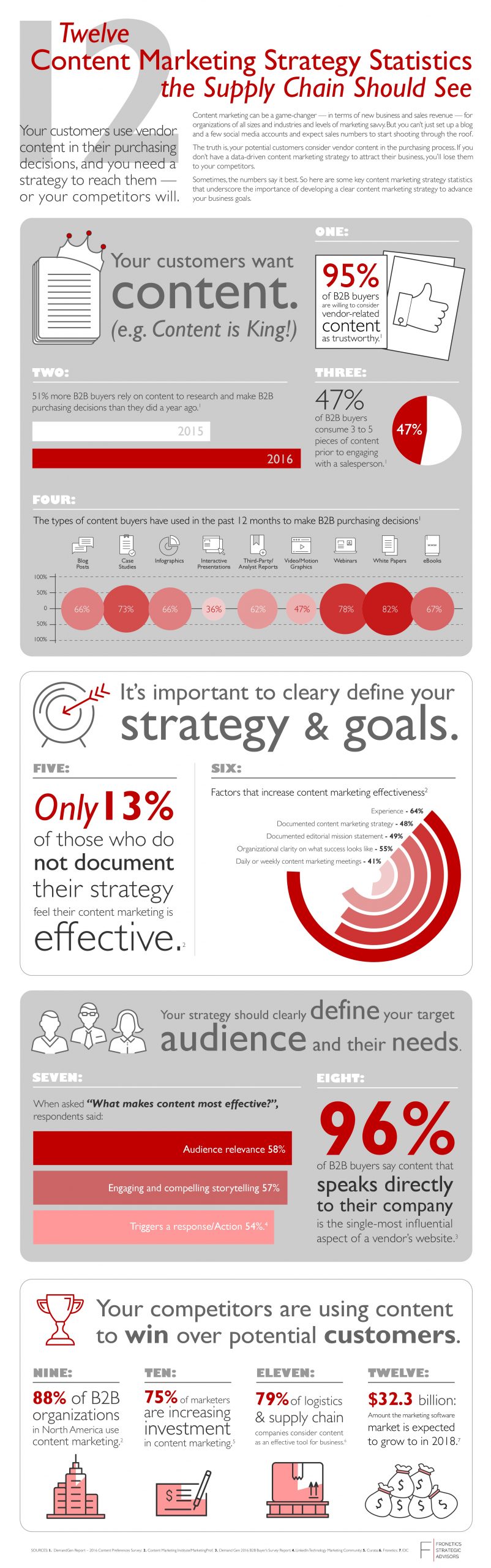
Companies in the logistics and supply chain industries should take a look at this content marketing infographic.
Content marketing is a form of inbound marketing in which vendors publish digital content to attract customers who are searching for products and services like theirs. If done right, it is highly effective in growing brand awareness, generating and converting leads, and driving sales and repeat business.
If your organization is exclusively using traditional outbound marketing techniques, like advertisements in print publications, you’re missing out on growth opportunities. We rounded up some of the most telling facts about the role of content marketing in today’s B2B purchasing environment for you to consider.
Here are 12 facts about content marketing that your business should keep in mind.

by Jennifer Hart Yim | Sep 27, 2016 | Blog, Strategy, Supply Chain, Talent
The supply chain talent deficit is real — but what about the experienced people who can’t find a job?
This guest post comes to us from Argentus Supply Chain Recruiting, a boutique recruitment firm specializing in Supply Chain Management and Procurement.
It’s no secret that we write a lot about the Supply Chain talent deficit — the growing industry consensus about a looming shortage of talent needed to fill Supply Chain, Procurement, and Logistics jobs as those roles grow in prominence and the baby boomers retire. It’s an important issue to the field that we recruit in, and we’re interested to see how companies, educational institutions and other industry players respond as it plays out. But today we wanted to comment on an interesting side note of the whole issue:
Every time we write about the Supply Chain talent deficit, on the Argentus blog or elsewhere, we see comments from experienced professionals in the field who aren’t able to find work. We’re always sure to say that the Supply Chain talent deficit is a big-picture trend, and doesn’t mean that everyone in the field is going to be able to get a job easily. But it’s interesting that we hear from quite a few people who are having difficulty finding work, despite the fact that companies are having more difficulty hiring in the field than perhaps ever before.
A comment by 3PL executive Valerie Kucherenko on one of our recent LinkedIn Publisher posts pointed out this disconnect, and got us thinking. First of all, here’s the relevant part of the comment:
“Frankly speaking there are so many articles, including the ones by Argentus Supply Chain Recruiting, indicating a shortage of qualified candidates in the Supply Chain field that I am torn between this feeling of high demand for Supply Chain professionals and the fact that many experienced ones can not find a job. Where is the confusion coming from?”
Let’s try to answer this question.
If there is a Supply Chain talent deficit, why are so many people in the field having trouble finding work?
First of all, the talent deficit in Supply Chain isn’t just buzz. Experts throughout the industry are talking about it, but it’s also something we’re hearing about daily from our clients looking to hire in the field, and from executives we speak to. We’re on the front lines of the talent war in this industry, and we can observe it directly. So it’s not that the difficulty of hiring in Supply Chain is made up.
Of course, the trouble that certain experienced people are having looking for work isn’t made up either. So we started thinking about big-picture reasons for this disconnect, based on our experience as people who have been recruiting in Supply Chain for over a decade. Here they are:
A certain amount of churn in employment is inevitable, and even a productive fact of the economy. There’s a reason why under economists’ definitions of “full employment,” there’s still about 5% of the workforce that’s unemployed. Structural factors such as geographic shifts and technological change mean that there will always be a certain number of unemployed people, independent of other factors like economic downturns, etc. This means that no matter the demand for Supply Chain talent, there will always be a certain number of people in between jobs — people who haven’t yet found work because it takes some time to get the right opportunity in front of the right people.
But that doesn’t tell the whole story. The other thing that helps explain this disconnect is the fact that the deficit of talent isn’t, strictly speaking, a numbers game. What matters isn’t necessarily the raw number of experienced candidates vs. positions (e.g. 10,000 candidates and 50,000 positions) so much as the kind of experience companies are looking for. This is one of the things that comes up over and over again in our conversations with executives.
Supply Chain’s role in companies is expanding. Instead of just being about putting product in the right place at the right time, Supply Chain now uses data, innovation, and supplier relationships to provide companies with a strategic edge. It interfaces with sales to plan and predict demand, etc. And while the function’s scope is increasing, companies are becoming more specific in their experience requirements. For example, more companies are looking for specific category experience (like Real Estate or IT) in Procurement. It’s possible that certain experienced professionals don’t have the right experience in the most high-demand niches (such as Demand Planning, S&OP), making it harder for them to find work than if “Supply Chain” was a more monolithic category. The nature of the experience required is changing — for example companies requiring specific software experience — and much of the deficit of talent exists on this cutting edge of skills requirements, rather than for more general, classic Supply Chain roles.
The solution to this issue? We think it’s two-fold: companies need to be more open-minded in their hiring, recognizing that strong business acumen can be as important to Supply Chain success as niche experience. And on the other side, candidates need to constantly work to adapt and diversify their skillsets, expanding their knowledge to follow the niches that are in highest demand among companies.
Hopefully that sheds some light on why it can be tough for certain Supply Chain professionals to find work even though there’s a deficit of Supply Chain talent more broadly. As F. Scott Fitzgerald once said, “the test of a first-rate intelligence is the ability to hold two opposed ideas in the mind at the same time, and still retain the ability to function.”
Which is true (in our experience), but we get that it doesn’t make it any easier for those Supply Chain workers who are having trouble finding that next role! Feel free to reach out to us for help.
Related posts: