by Elizabeth Hines | Feb 12, 2018 | Blog, Current Events, Logistics, Manufacturing & Distribution, Supply Chain
As Cupid spreads his wings, gifts of experience and romantic, at-home options will take over the market for Valentine’s Day 2018.
Consumers will spend a near-record $19.2 billion on Valentine’s Day 2018, up from $18.2 billion in 2017. According to NRF’s annual survey, over half of the country will participate (55%) in the romantic holiday, spending just over $140 on average.
Gifts of experience
A new Valentine’s trend is giving gifts of experience, such as a spa treatment, concert tickets, or a cooking class. Almost half of celebrants said they would prefer a gift of experience, and 23% said they plan on giving a gift of experience. Blue Apron’s Love at First Bite targets couples looking for gifts of experience with a foolproof, stay-at-home option for Valentine’s Day 2018. And they’re not the only ones! Hello Fresh, Plated and even Whole Foods are publishing blog articles and offering meal options for creating the perfect Valentine’s dinner from the comfort of your own kitchen.
Out on the town
The NRF’s survey also found that younger people (ages 18-34) are more likely to take their Valentine out for the evening than older generations. So it’s no surprise that 6 out of 10 younger celebrants (ages 18-34) would also prefer a gift of experience over candy and flowers.
Mobile trend
95% of Americans own a cell phone. The growing connection between smartphones and digital information is starting to take over Valentine’s Day, as well. Over half of participants plan to use their smartphones to assist with Valentine’s Day purchase decisions. Nearly 40% said they plan to use their cell phone to research products and compare prices.
Tradition prevails
Not to worry, though: Celebrants will still purchase plenty of flowers, jewelry and candy to mark the holiday. Celebrants are most likely to give candy as a gift, followed by greeting cards, flowers, and an evening out.
Here’s a look at how U.S. consumers will be celebrating Valentine’s Day 2018.
Valentine’s Day 2018 Supply Chain Infographic

Related posts:

by Elizabeth Hines | Feb 8, 2018 | Blog, Content Marketing, Logistics, Marketing, Social Media, Strategy, Supply Chain
These social media statistics are important to keep in mind when planning out your content marketing strategy.
A strong social media presence is key to successful marketing in 2018. Social media is simply unavoidable these days.
So, you jumped on board and you’re posting and tweeting. You’re creating content. You’re learning about search engine optimization and how to improve your rankings. But you’re still not reaching the audiences you were hoping to attract. What’s going wrong?
When you are posting on social media could be as important as what you’re posting.
Timing is everything, and that statement especially holds true when it comes to posting content to social media. If you are sending out your message and nobody is there to see it, you are that proverbial tree falling in the forest; you did not make a sound. Your post had little to no impact.
So, even if you are putting in the time and effort to craft informative blog posts, tweets with just the right message, or Facebook posts that inspire more than just page likes, you still are not getting the most exposure you can out of social media.
We have done our homework when it comes to the best times to post on social media. And the truth is there is no “one size fits all” answer to when you should post. There are general guidelines that differ for each site. But in general, it’s important to keep your target audience in mind when deciding where and when to post.
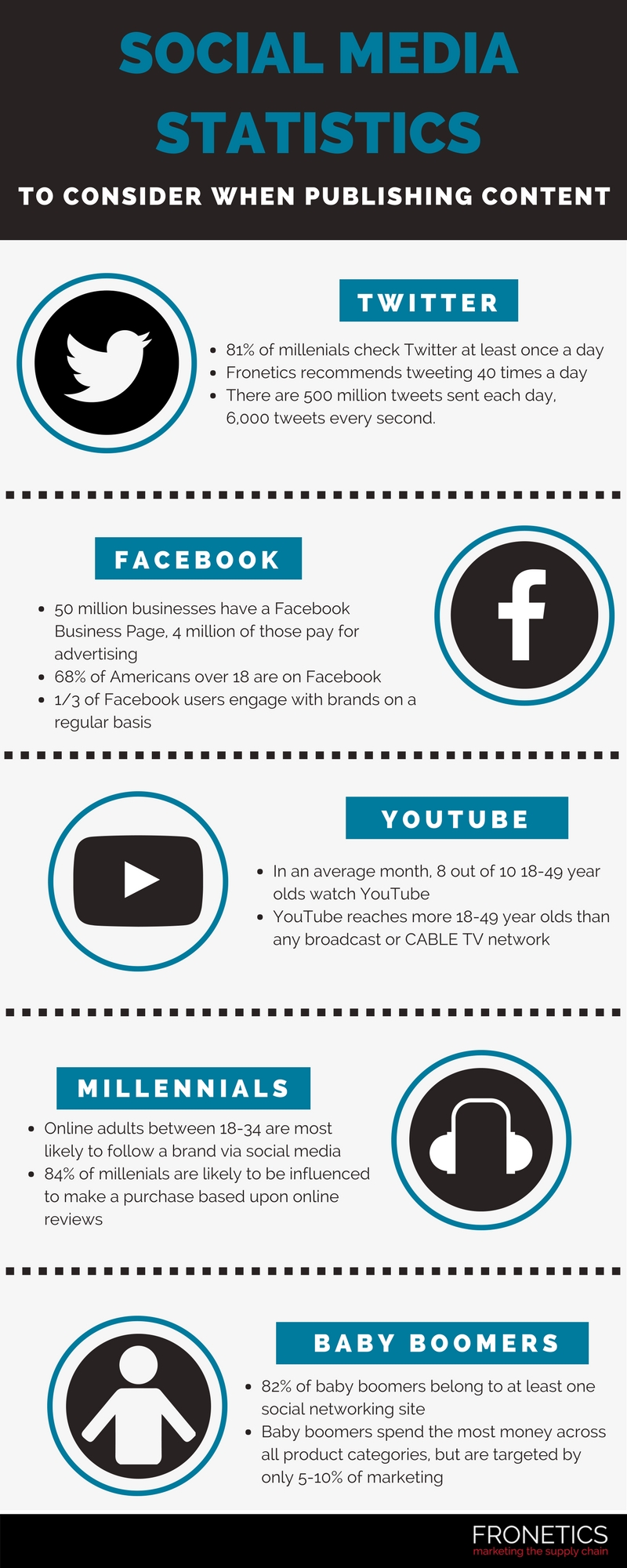
Here are some social media statistics that you need to consider when deciding when to post your content.
Social media statistics your business needs to consider when publishing content
(Made with Canva)
Related posts:
SaveSave
SaveSave

by Elizabeth Hines | Feb 6, 2018 | Blog, Content Marketing, Logistics, Marketing, Strategy, Supply Chain
Here are three tips for creating a content strategy that will help advance your business goals.
If we’re adamant about one thing at Fronetics, it’s creating a documented content strategy. But, as a recent Harvard Business Review article suggests, many strategies fail because they are not actually strategies.
This begs the question: what constitutes a real strategy? According to Freek Vermeulen, associate professor of strategy and entrepreneurship at the London Business School, “A real strategy involves a clear set of choices that define what the firm is going to do and what it’s not going to do.” The keyword here is “clear.”
Here are three strategy-creation tips to help you create a clear content strategy that aligns with and furthers your business goals.
3 content strategy tips
1) Show your work.
Just like in high school math class, arriving at the right answer isn’t enough — you need to communicate the logic for how you got there. As you create or refine your strategy, take a step back and examine the reasoning behind each choice.
Says Sly Bailey of the UK publisher Trinity Mirror, “If there is one thing I have learned about communicating choices, it is that we always focus on what the choices are. I now realize you have to spend at least as much time on explaining the logic behind the choices.”
Understanding the reasoning behind each of your choices allows you and your team to fully believe in your strategy, and ensures you carry it out optimally.
2) Trickle down doesn’t work.
Many implementation efforts fail because executives see strategy creation as a top-down process. On this topic, Stanford Professor Robert Burgelman writes, “Successful firms are characterized by maintaining bottom-up internal experimentation and selection processes while simultaneously maintaining top-driven strategic intent.”
In other words, while you need top-down strategic direction, this will only be effective if you simultaneously empower your employees to create bottom-up initiatives that meet the strategic intent.
3) Flexibility is key.
Another source of failure for implementation efforts is the institutional unwillingness to change habits. “People are often not even aware that they are doing things in a particular way and that there might be different ways to run the same process,” says Vermeulen.
It’s important to identify and effectively work against the bad habits that hamper your strategy’s effectiveness. As Vermeulen describes in his book, Breaking Bad Habits, “There are various practices you can build into your organization to make it work.” This often involves identifying key processes, and asking, “Why are we doing it this way?” If the logic isn’t clear (see above), this process is likely a good candidate for change.
Related posts:


by Elizabeth Hines | Feb 1, 2018 | Blog, Content Marketing, Logistics, Marketing, Supply Chain
Our readers voted LTX Solutions, Women In Trucking, and Apex Capital Blog as the top 3 logistics and supply chain blogs of 2018.
You voted, and the results are in! LTX Solution is your number one favorite blog of the year, with “Ellen’s Blog” of Women In Trucking and Apex Capital Blog coming in second and third.
We love hearing what blogs you enjoy reading and find valuable. There are lots of great industry options, so we know it’s not easy to narrow down your favorites. We had lots of great responses, but only Women In Trucking held its spot on our list of the top logistics and supply chain blogs from last year.
What did remain consistent from previous years is the quality of the content and the consistency of posting by the three winners. These key components have remained invaluable across all successful logistics and supply chain blogs.
Here are the top 3 logistics and supply chain blogs of 2018.
1. LTX Solutions
LTX provides professional supply chain logistics management and customer service solutions to improve transportation efficiency, reduce costs, and give companies a competitive advantage. The blog focuses on topics that impact the global supply chain, including freight management, cutting-edge data and analytics trends, and risk prevention. The blog, which consistently posts a few times a week, tackles the most pressing issues facing the supply chain industry, as well as professional tips and insight into the latest industry technology.
2. Ellen’s Blog – Women In Trucking
The Women In Trucking Association is a non-profit organization focused on encouraging the employment of women in the trucking industry, promoting their accomplishments, and minimizing obstacles. President and CEO Ellen Voie’s blog offers thought-provoking insight on topics from best practices to becoming a thought leader in a male-dominated industry. Her years of experiences and passion for advancing women’s position within the trucking industry make her blog invaluable to readers. For the second year in a row, this blog has been one of our readers’ favorites due to the relatable topics and insightful content, such as family problems stemming from job-related realities and assimilating to trucking culture.
3. Apex Capital Blog
Apex Capital specializes in factoring freight invoices for small to medium-sized trucking companies with over 20 years’ experience. Apex clients include owners and operators starting their own trucking company with one truck to large-scale companies with hundreds of trucks and employees. The blog focuses on the latest trends and happenings in the trucking industry. In the past five years the blog has published over 500 articles on topics ranging from trucking regulations, tips on running a successful trucking business, and interviews with industry leaders. The posts highlight news and information that companies can use to run and grow their trucking business.
Runner up: Muddassirism
Dr. Muddassir Ahmed’s blog focuses on all things supply chain management, including advancements in development and strategies, professional development, and improving customer experience.
Related posts:


by Jennifer Hart Yim | Jan 30, 2018 | Blog, Current Events, Logistics, Supply Chain
Looking at Tesla’s suppy chain issues, here are the biggest takeaways so you don’t have to repeat their mistakes.
This guest post comes to us from Argentus Supply Chain Recruiting, a boutique recruitment firm specializing in Supply Chain Management and Procurement.
Back in 2016, we posted about Tesla’s ambitious plan to ramp up production of its consumer-grade Model 3 electric car to 500,000 vehicles a year by 2020. At the time, pretty much every analyst agreed that was an ambitious target for a manufacturer without solid experience mass-producing vehicles at that scale. In the two years since, Tesla’s CEO Elon Musk has issued a number of other bold predictions. He’s championed a whole host of emerging technologies. He’s made the world feel like the future could resemble a sci-fi novel – were he to deliver on the herculean tasks of sending humans to mars, shifting the world to solar power production, and figuring out how to directly connect computers to human brains.
But in the meantime, there’s also been the pesky matter of the more mundane – but seemingly no less difficult – task of delivering on the very high demand in the marketplace for Tesla Model 3s. In 2016, the company faced scrutiny for allegedly hiring 140 workers from Eastern Europe for $5 an hour. Then, in 2017, various press outlets reported on a number of issueswith the Model 3’s Supply Chain, specifically issues related to the vehicle’s battery design, as well as issues with manufacturing automation. The result?
Only 220 Model 3s were delivered as of October 2017. We’re sure the company has delivered more cars since then, but that’s a brutal statistic almost two years after over 400,000 consumers paid $1000 each to preorder the car. Investors are growing restive, with the company’s share price down 6.8%, and the company reporting a $671.1 million loss for the 3rd quarter of 2017. Musk has compared the Model 3’s current production state to the “8th circle of hell,” and acknowledged that Tesla won’t hit the goal of 5,000 units produced a month until “sometime in March 2017.”
A great article last month from CIPS’ industry magazine Supply Management dove into some of Tesla’s Supply Chain woes, discussing how the company, still considered a visionary in the industry, has got to this place, as well as some optimistic scenarios for how it can get out of it. Written by Paul Simpson, it’s an interesting account of how Supply Chain issues can stymie a company, even if that company and product have huge positive brand association. Similarly to what we did with analysis of Target’s Canadian misadventure, we wanted to see what lessons we can draw from Tesla’s Supply Chain issues that might be useful in industries other than automotive manufacturing.
Here are our biggest takeaways for what can be learned from Tesla’s Supply Chain woes:
- If you’re not confident that your production and Supply Chain are up to snuff, don’t overpromise to the consumer. Elon Musk has made a cottage industry out of bold pronouncements about the future, and he’s delivered on some of them before. It’s why he’s gained a reputation as a visionary. Musk had to know that promising to quickly scale up production to 500,000 cars a year was an unrealistic goal. He’s also someone who believes in setting big goals as a way of achieving the impossible. But even with that in mind, it’s possible he also underestimated the inevitable difficulties in mass-producing a product with 10,000 individual parts, and that’s led to way too many 2 a.m. nights tinkering with robotics on factory floors.For his part, Musk acknowledged that he’s now trying not to make pronouncements about production timelines.
- Take ownership for Supply Chain failures rather than blaming suppliers. Even if suppliers are failing to deliver, consumers (and, relevant to Tesla, shareholders) will almost always blame the company itself rather than those suppliers – and rightly so. They’re the ones who selected those suppliers, after all. In Tesla’s case, Musk took personal ownership over the decision to select the system integration subcontractor that’s behind the latest delays – instead of blaming his Supply Chain staff. Depending on your perspective, you can either look at this as a visionary CEO being transparent about Supply Chain difficulties, or a manufacturer throwing a supplier under the bus.
- Great companies need a Supply Chain guru. Simpson quotes an argument by American journalist Travis Hoium, who said that “Elon Musk Needs his Own Tim Cook to Take Over Operations.” Drawing a parallel to Steve Jobs, Hoium argues that Musk needs an operations genius who can match his vision for the future and product development excellence with Supply Chain execution. Sometimes business leaders – especially those with the vision of someone like Elon Musk – overrate their own ability to understand the intricacies of managing complex Supply Chains, to their detriment. Tesla’s issues underscore the importance of having the right talent in place to avoid the murky waters of Supply Chain failure – and figure out how to right the ship if things go awry.
Despite these numerous issues, it looks like – for now – Tesla is facing more heat from shareholders than consumers. Anticipation for the Model 3 is still high, showing that a strong product and brand can trump some Supply Chain issues. But these issues are starting to have a real impact on Tesla’s share price and bottom line, and the pressure is on. Let’s see how this story develops as 2018 proceeds.
Related posts:

by Elizabeth Hines | Jan 29, 2018 | Blog, Content Marketing, Logistics, Marketing, Supply Chain
Use these 8 quick tips in your blog posts to improve SEO and help your target audience find your content.
Search engine optimization: It’s a phrase every blog writer looking to grow readership has wrestled with at one time or another. Part science, part art, SEO writing can evade even the most seasoned blogger. You want people searching the internet to find your blog, but you also want readers to enjoy your posts and not feel like they’re written for machines.
Search engines continue to evolve and improve their algorithms to make sure readers are finding exactly what they’re looking for. Never artificially stuff your posts with keywords, links or images. Search engines, like Google, penalize webpages that use sneaky techniques, like keyword stuffing, by demoting or even removing their pages from their indexes.
Ultimately, if you want to improve your SEO, your content needs to be value to your target audience. That should be your priority when planning and producing content like blog posts. But you can also keep these quick tricks in mind to optimize your posts, and thus increase the likelihood internet searchers will find them in the first place.
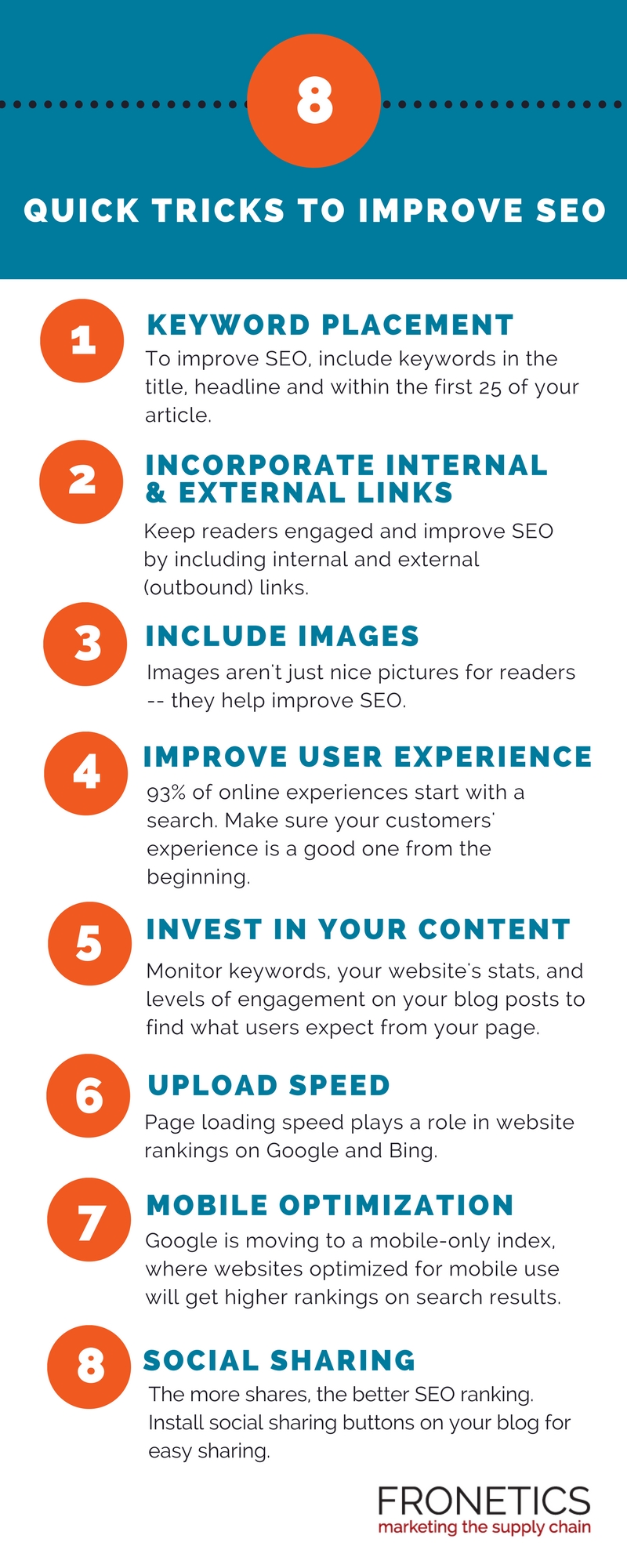
Infographic: 8 quick tips for blog posts to improve SEO
(Made with Canva)
Using these 8 quick tips will improve SEO and get your blog posts in front of your target audience. Remember, your best bet on moving up on search engine results pages is to create content that readers want to read. Sounds simple, I know, but it can be challenging. Let us know how these tips helped improve your SEO.
Related posts:

SaveSave