by Jennifer Hart Yim | Jun 5, 2014 | Blog, Manufacturing & Distribution, Strategy, Supply Chain
This article is part of a series of articles written by MBA students and graduates from the University of New Hampshire Peter T. Paul College of Business and Economics.
By now we have all heard the story of GM’s faulty ignition switches that are being linked to thirteen deaths and thirty one front-end collisions. The ignition switches in car models: Chevy Cobalt; Chevy HHR; Pontiac G5; Pontiac Solstice; Saturn Ion; and Saturn Sky, lacked the torque specs required by GM engineers. Heavy key chains, bumpy roads, or an accidental knee hit were all reasons reported that could cause the ignition switch to rotate to the off or idle position. Once this happened, the driver would lose control and the air bags would fail to deploy if a front end collision occurred. A total of 2.6 million vehicles were recalled, of that 2.2 million were in the United States. For this type of recall, GM was not requiring vehicles to go back to the manufacturer or be disposed. Rather, a more robust key ignition was distributed to all authorized GM dealerships and customers were told to bring their cars to the local dealership and a new ignition switch would be put in for them.
Despite the massive recall and all the negative publicity that goes along with such an event, GM still posted positive numbers in their quarterly earnings. GM posted an operating income of $0.5 billion for 1Q14, which is included the $1.3 billion recall-related charge. Furthermore, GM controlled approximately 17% of the U.S. market share. After the ignition switch incidents started to gain traction, GM swore to reorganize their global engineering department, and they did. So, if GM’s sales profitability is surviving, their negative press contained, and their market share intact, what exactly went wrong?
Two-thirds of General Motors automotive costs in 2014 are from supplier sourced parts. However, this was not always the situation. Back in 1999, GM underwent an extensive effort to disassemble their vertical integration in hopes of reducing overall costs. At this time, Delphi Automotive was owned by GM, but separated during the same year. For decades, GM was Delphi’s only customer, and even when Delphi executives knew GM was going to make them a public company, they were only able to move 22% of their business to other customers. When GM officially made Delphi a public company, 82.3% of their shares went to GM shareholders. That means that only 17.7% of Delphi was sold to public investors. In order to survive as a company, Delphi had to start making cost reduction decisions. To do this, companies often lay off employees and make cheaper parts, Delphi was no different. Now during this same time period, GM executives were focused on focused on costs reductions and were driven by numbers, hence the selling off of Delphi. It should be noted that if a company sells off their single largest parts supplier, fully aware that the move may cause the supplier to go belly up, there will be some strained relationships. Delphi was now thrown into a position where they must compete with other parts suppliers for GM’s business. An important part of the deal GM made when selling off Delphi was to keep all current supplier contracts. In addition, GM gave Delphi the opportunity to match any competitor’s bid until 2002. The earliest model of a recalled GM car was 2003.
Strained supplier relationships are not ideal for business, but should not affect the quality of a product, such as an ignition switch. Let’s fast forward to 2008. Delphi had declared bankruptcy three years prior and GM was beginning to pull them out of their financial burden. A contract was found between GM and Delphi that was drafted in 2008. The document is a little difficult to follow, but there are a few interesting lines in Section 5.09 Product Liability Claims. It appears that, GM said they would share the blame with Delphi for any claims against them. However, GM would not be held responsible if one of Delphi’s parts, or a part made for Delphi by a third party, fails. The contract continues on to say that GM would pay any legal fees if a claim was made against Delphi, but Delphi must defend GM through a potential lawsuit. This contract was drafted and signed in 2008, during which Delphi was bankrupt, so it appears they had little negotiating power.
This raises concerns specifically about the ignition switch specs. It came out that GM officials knew the ignition switch they purchased from Delphi was not up to their standards. After some more research, an email transaction between Delphi officials in regards to the plunger, the vital part that holds the key slot in place with a spring, and the ignition switch. At the end of the document, the original engineer drawings are attached. From the technical drawings it can be seen that Delphi did in fact outsource the design specs, and possibly the manufacturing, for the plunger design. Another document, that was preceding the email transaction, appears to inform GM that the plunger part was changed and the responsibility of the supplier is “closed”. This could have been a legal move meant to save Delphi if any claims were made related to these parts.
After all of this evidence, where does the blame lie? It would appear that GM used their powers to force Delphi into a contract that held them responsible for any claims against their products. While Delphi did warn GM that the torque requirement for their ignition switch did not meet GM’s requirement, it is unclear whether or not a verbal warning will play into the legal battle. This case is currently ongoing, and it will be interesting to see how it plays out.
Connor Harrison holds a B.S.M.E and MBA from the University of New Hampshire.
by Elizabeth Hines | Jun 3, 2014 | Blog, Marketing, Social Media, Strategy, Supply Chain, Transportation & Trucking
Many companies within the logistics and supply chain industries are stuck on the social media starting line. The reason – “they can’t get past the word ‘social’ and the perception it creates.” The reality is that social media is a tool that can be utilized to create value and grow your business.
Over the next four weeks I will be providing examples of companies within the logistics and supply chain industries who have moved beyond the social media starting line and have realized the business value of participating in social media.
Using social media to move freight
Transportation logistics is vital to the supply chain and logistics industries. For companies within these industries; however, transportation logistics can prove to be challenging to navigate and can prove challenging to the bottom line.
MercuryGate International Inc. and Con-way Inc. are two companies that have used social media to turn transportation logistics on its head – they use social media to move freight.
TweetLoad
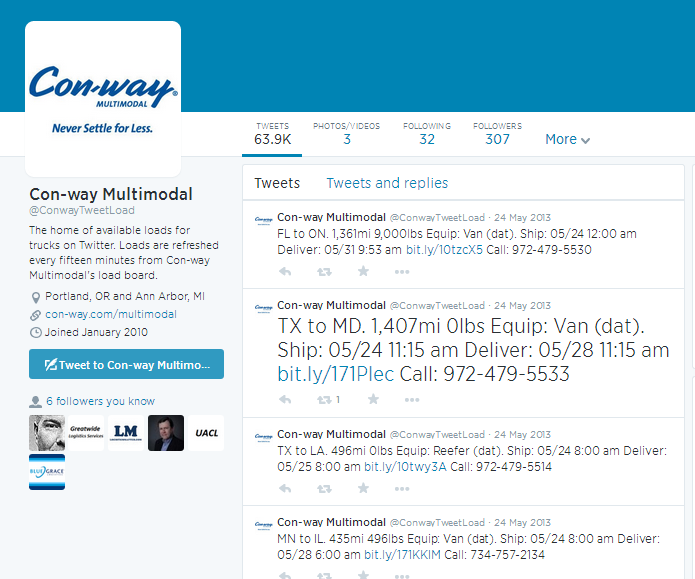
Con-way Multimodel, a division of Con-way Inc., launched TweetLoad™ in 2010. TweetLoad enables carriers to access available loads from Con-Way Multimodel via Twitter. Carriers who follow @ConwayTweetLoad on Twitter are able to see the latest available shipments as well as links to additional information on the company’s link board. Load information is updated on Twitter every 15 minutes, meaning that carriers who follow @ConwayTweetLoad have real-time information on available loads.
Figure 1: Conway TweetLoad
Bill Graves, president, American Trucking Associations (ATA): “With this novel use of Twitter, Con-way Multimodal is leading the industry in maximizing the best features of new technology to improve their processes. This is a great example of how innovative transportation companies can make it easier for carriers to do business with them, which will be a benefit to our industry overall.”
View a YouTube demonstration of TweetLoad at www.youtube.com/watch?v=0zL7h7kTU1M.
Freight Friend
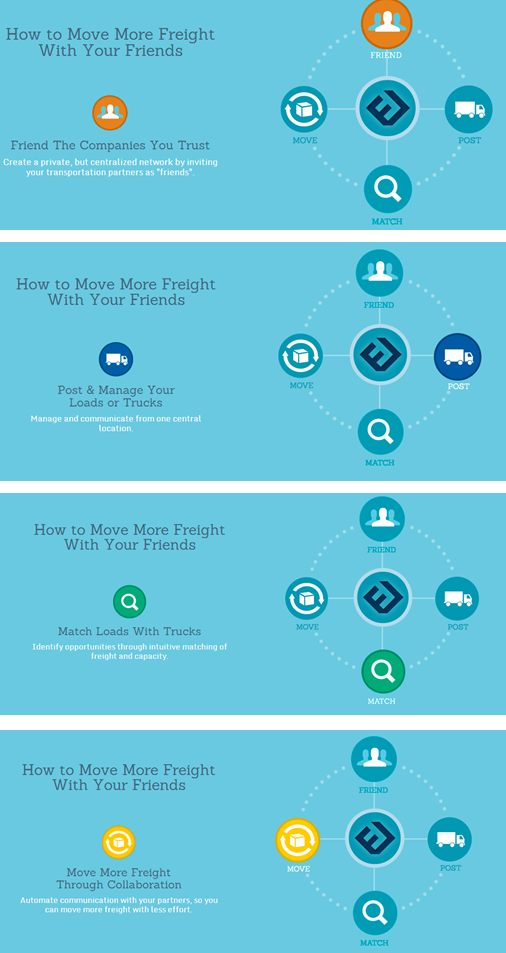
In 2011 MercuryGate International Inc. launched Freight Friend. Freight Friend is a free relationship-based full-featured load and truck internet posting service for shippers, brokers and carriers. Freight Friend creates a private network between transportation partners, and utilizes technology to automatically identify appropriate matches. The combination of the technology utilized and the relationship-based nature of Freight Friend allows companies to have real-time visibility to book trucks and find freight with companies they trust.
The Freight Friend concept is shown in Figure 2.
Figure 2: Freight Friend
“FreightFriend is perfect for carriers, shippers, brokers, 3PLs and freight management firms who only want to share information with companies they trust. They can keep their current information in one place, knowing that friends – and only friends – will have constant access. While public load boards fill a real need, they come at a cost – a lot of unknown companies bidding to carry the freight. Private boards are often useful too, but they’re inconvenient to carriers with multiple clients asking them to check their bid portals. FreightFriend solves the dilemma with a single service where carriers can easily communicate with all of their clients and brokers can find available capacity from carriers they trust.”
Freight Friend is fully integrated into MercuryGate’s TMS and Carrier Management System (Carma). Freight Friend is also available to integrate with other TMS providers.

by Elizabeth Hines | May 25, 2014 | Blog, Logistics, Marketing, Social Media, Strategy, Supply Chain
Some companies within the logistics and supply chain industries have chosen to participate in social media while others have not. Why have some companies chosen not to participate while others have decided to participate? What social networks do companies within the logistics and supply chain perceive to provide the most value to their business? What challenges do companies face with respect to social media?
Fronetics Strategic Advisors aims to gain insight into these questions and more. We are conducting a survey on social media within the logistics and supply chain industries. The objective of the survey is to learn about the participation and use of social media within the logistics and supply chain industries.
The survey is aimed at companies within the logistics and supply chain industries, and takes only about 5 to 10 minutes to complete.
This survey is confidential. Responses will be reported in aggregate and no individual- or company-identifiable information will be shared with anyone.
If your company is part of the logistics or supply chain industries please take the time to take the survey.

by Elizabeth Hines | May 19, 2014 | Blog, Content Marketing, Marketing, Social Media, Strategy
The internet is a fire hose stream of content. Being able to navigate the deluge of content and identify the content that is valuable to your customers and to your business is essential; it can also be incredibly time consuming. Content curation tools can save time and increase productivity.
Here are 11 content curation tools that will help you establish your business as a thought-leader and trusted resource.
Bundle Post
With Bundle Post you connect and control Alerts and RSS feeds based on keywords. Bundle Post saves the content from your feed channels as a social media post, allowing you to view, edit or delete the content within the channel, all in one place, then merge selected curated content with scheduled posting times you create for each of your social media accounts and networks. Bundle Post offers a free 30 day trial. After that subscriptions start at $19.99 per month.
ContentGems
ContentGems monitors more than 200,000 news sites, blogs, and social media accounts. With ContentGem you can filter content a number of different ways including: custom keywords, sources, and media types. With ContentGems it is easy to share content via social media (one-click publishing and the ability to schedule posts). Freemium and premium options available.
feedly
feedly enables you to organize, read and share the content of your favorite feeds, blogs and news sites. If you liked Google Reader, feedly fills that gap. Free and premium versions available.
iFlow
iFlow allows users to discover, create, and curate ‘flows’ on any topic. Flows are topic-based streams that let users stay connected and updated with selected topics. These ‘flows’ may be followed, which results in users being continually updated with content relevant to selected topics. Flows can be set up to include detailed filters to provide for high quality of content curation. iFlow also allows users to create their own private flows. Users may invite others to contribute on their flows or can even keep their flows private. iFlow is free.
Individurls
Individurls is quite similar to feedly. One of the strengths of this content curation is how easy it is to use on your mobile phone. Individurls is free.
Netvibes
Although Netvibes is one of the original content curation tools, it remains a solid (and not outdated) solution. Netvibes offers a number of ready-made feeds and widgets. Both freemium and premium versions are available.
Newsle
Newsle is a great tool to keep you on top of what is happening with people within the industry and within your social network. It is also a great tool if there are specific writers or journalists whose content you want to keep track of. With Newsle you identify the people and Newsle sends you an email when those individuals are mentioned in the news.
paper.li
paper.li enables you to create your own online newspaper based on content you select. You add various sources and specify filters on these sources and a paper is produced. You can then add or remove “articles” from the paper. While paper.li can be used for free, the paid version allows you to brand your newspaper.
Post Planner
Post Planner is a solution for those who are avid Facebook users; PostPlanner is a Facebook app. With PostPlanner you enter in keywords and search for trending content within your niche. You can then sort this content to view the content with the most likes or shares so you can see the most popular content. While PostPlanner does offer a free version, to get the most from this tool you will need to upgrade to one of the premium packages.
Scoop.it
Scoop.it offers users a great experience and a constant stream of content. Scoop.it automatically finds and features comment from places like Twitter and Google blogs based on your target keywords and interests. It is also customizable, allowing for additional sources to be added to your stream(s). In Scoop.it you create boards of content around specific topics and then add content to these boards. Scoop.it allows for one-click publishing to your blog and social networks. Scoop.it offers a free trial, after that plans start at $12.99 per month.
Trapit
Trapit positions itself as a “smart” curation tool, increasing in intelligence and relevance the more you use it. It features more than 100,000 vetted content sources and includes “hidden gems” that have the potential to make your presence stand out. How does it do this? Trapit uses the same Artificial Intelligence and Machine Learning Technology from which Siri is derived.
by Elizabeth Hines | May 15, 2014 | Blog, Consumer Electronics, Content Marketing, Marketing, Social Media, Strategy, Supply Chain
Curating content is an essential component of your content strategy and to demand generation. Content curation can help you grow your business by establishing your business as a thought-leader within the industry and as a trusted resource.
Here are four factors to doing content curation successfully:
Know your audience
Identify your audience. In many cases your target audience is your company’s buyer persona.
Take the time to know your audience. For example, take the time to understand what type of information and/or resources they are likely to be looking for, learn what platform(s) they are most likely to use (e.g. Twitter, LinkedIn, Facebook), learn their interests, and learn their passions.
Be relevant
Curate content that is relevant to your audience. The content you curate should provide your audience with value and knowledge.
Quality, quality, quality
Content can be stuff. Content can be clutter. If you want the content your business curates to stand out, you make sure the content you curate is quality – every time. Quality is a differentiator.
Be consistent
Share content on a regular and consistent basis. This will not only increase your visibility, but it will also establish you as a trusted resource – as the go-to resource for information and for knowledge.
This article also appeared on DC Velocity.
by Elizabeth Hines | May 12, 2014 | Blog, Content Marketing, Marketing, Social Media, Strategy
Adam Robinson of freight logistics company Cerasis wrote a series of posts which outlined the company’s social media and content marketing strategy and the successes the company has achieved through the execution of their strategy. The series also included how-to guides: how to create a social media and content marketing strategy and how to execute a social media and content marketing strategy. Robinson’s series is a must read for companies interested in learning the potential business value of a social media and content marketing strategy and for companies wondering the steps they need to take to create and execute a successful strategy.
Two sentences in Robinson’s series stand out:
“It all comes down to strategy!”
“Now, if you have the resources to be on every social media platform, you should, but only if you do it well!”
Sage advice.
Without a strategy it is unlikely that your company will be successful. Social media and content marketing can be effective tools for attracting new customers and retaining current customers; however, it is unlikely that your company will reap these benefits if you do not have a strategy in place. A 2014 study shows just how important strategy is. The study found that 60 percent of companies with a documented strategy in place consider their efforts to be effective as compared to 11 percent of companies with no documented strategy in place.
A successful strategy takes into consideration your company’s strengths, resources, limitations, and goals. Another component of success – doing things well. For some companies it is possible (and makes sense) to be on every social media platform. For many companies a well-executed strategy means focusing on one or two platforms. Don’t spread yourself thin, make your company show up strong!
It is also important to remember that if you need help, there is help available. It is possible to obtain training in social media and content marketing and it is possible to outsource these functions.
This article also appeared on DC Velocity.