by Elizabeth Hines | Aug 6, 2014 | Blog, Logistics, Marketing, Social Media, Strategy, Supply Chain, Transportation & Trucking

Keychain Logistics has made two bold promises. The company has promised truckers that they will never drive empty again and has promised shippers that Keychain will improve their bottom line.
Can the company deliver on these promises?
Who is Keychain Logistics?
Keychain is a leading transportation provider enabling businesses to directly engage carriers, track shipments, and monitor its logistics needs online.
According to Bryan Beshore, the company’s founder, Keychain grew out of the idea that a technology driven marketplace could operate with significantly lower overhead than a manual, human powered brokerage:
“My initial contact with the industry was in 2000. I have researched, analyzed, and thought about the industry ever since. Keychain is a product in understanding the fundamental efficiency problems the third party logistics industry has faced for a long time.”
Beshore goes on to point out that while building a technology company is tough, building Keychain was easier than anticipated:
“With Keychain it was a natural process and easier than I had imagined. I believe the reason for this is twofold: the challenges this industry faces are huge, and the solutions we are building to meet those problems are really fun to solve. Because our work directly affects the wallets of our users (increased pay for drivers, better rates for shippers), we are effectively helping people create better lifestyles for themselves and their families, and that’s really rewarding.”
The company was slated to be built in 2007; however, the timing was not right given the low proliferation of internet-connected mobile devices (500 million). Beshore waited. In 2012 he decided to move forward with the launch of the company (the number of internet connected devices reached 8.7 billion in 2012).
How does it work?
One can draw a parallel between Keychain and Uber – the company removes the broker and connects truckers directly with shippers therefore enabling truckers to focus on driving and shippers to focus on selling products.
Keychain is a marketplace for truckers to book commercial shipments directly with shippers. The company’s technology matches owner operator drivers (and small fleets) with shippers who rely on Keychain Logistics to find the ideal carrier for their freight.
The core of the company’s platform is their network of ten-of-thousands of carriers throughout the US who are connected 24/7/365 via Keychain’s iOS, Android, and Windows phone apps. Keychain can instantly communicate load opportunities to independent owner-operators, 97 percent of whom operate in fleets of 20 trucks or less, and small carrier fleets.
Too good to be true?
One of the biggest challenges the company has faced is that it is perceived as being “too good to be true.” Beshore:
“The transportation industry is traditional and technologically far behind. Because of this, the inherent challenge to sharing our offering is overcoming the “too good to be true” bias. While many of our potential customers have wanted a product like ours for a while, they either don’t know how to articulate it in a Google search or are skeptical that tech companies like Keychain are committed to solving their problems.”
Solving immediate need
Keychain has been working to overcome the perception of being too good to be true. It has been talking to current users, and has honed in on developing a solid marketing message. The message – we can solve your immediate need.
Not expressing the full-vision up front has been a challenge when Keychain reaches out to companies with whom they have little or no relationship; however, they have found that solving an immediate need is what gets companies excited.
What immediate need(s) can the company address? According to Beshore: “For shippers, this is getting them access to trucks, sometimes within just minutes of our first contact. For drivers, this means getting them a paying load when they’re stuck at a rest stop, are far from home, or simply need a line-haul out.”
Leveraging social media to grow the company
The company has found that one of the best ways to use social media is for listening. Rather than spend time and money putting together and distributing sales literature, the company searches for relevant industry hashtags (i.e.: #trucking) to see what people are talking about, and more importantly what they care about. By using social media this way, Keychain is an audience to users instead of the other way around. This has enabled the company to shape their offering with a solid understanding of what people want from a transportation provider.
“From phone calls to interviews, crowdfunded campaign partnerships, and beyond, social media has certainly helped us grow our business,” says Beshore.
Can they deliver?
Can Keychain deliver on their bold promises? Their customers believe so. Here is what three customers say about the company:
“With Keychain I no longer have to waste hours on logistics. Their platform makes it easy to quickly enter shipment details and receive the most competitive rates available.” Marc DeVidts, Double Robotics
“Keychain gives us instant access to thousands of reliable carriers nationwide. It’s the most efficient and cost effective tool we’ve found.” Nathan Brown, Reclaimed American Hardwood
“Within minutes I can enter my shipment details and Keychain handles the rest. Annoying phone calls and exorbitant broker fees are over.” Ad Sachan, Treeline Woodworks.

by Elizabeth Hines | Aug 5, 2014 | Blog, Content Marketing, Marketing, Strategy

The amount of content on the internet is tremendous – and is growing by the second. With 93 percent of B2B companies using content marketing, and with more than $16.6 billion dollars being invested annually by B2B companies in digital content publishing – how can your content and your business stand out?
The CMO Council, Content ROI Center, and Netline conducted a survey of 352 senior-level B2B buyers, influencers, and decision makers with the objective of determining content’s role in influencing B2B buyers in the purchase process. The results of the survey can be used as a guide for creating content that will help you grow your business by driving profitable customer action.
Why do buyers consume content?
Sixty-two percent of B2B buyers turn to content in order to learn about new market developments and industry practices. Sixty percent turn to content to discover new solutions to address a specific problem. 52 percent look to content to address a project or a program being undertaken by their company.
Why do buyers value content?
Fifty-four percent of B2B buyers report they believe content keeps them current on new techniques. Forty percent say that it helps identify partners and solution providers. Thirty-eight percent of B2B buyers believe content provides strategic insights and shapes their purchase specifications. Thirty-seven percent of B2B buyers report that content educates them about industry issues, problems, and challenges.
Content that will grow your business
Content that will draw customers to your website and to your business is content that educates, informs, and addresses specific needs.
So that your business does not get lost in the clutter, you need to create and curate content that educates consumers about the industry, technology, and new market trends. Moreover, your content should address the needs and pain points of your target customer. Therefore, your content should answer questions, provide solutions, and provide strategic insight.
If you consistently create and curate content that B2B buyers find valuable, you will realize results.
by Elizabeth Hines | Jul 31, 2014 | Blog, Data/Analytics, Strategy, Supply Chain
Want to have a better-run business? Define clear metrics and use them as a launch pad to move your organization forward.
Metrics enable you to operate more effectively and efficiently because they provide you with valuable information on how you can drive improvement and how you can apply resources (people, time, money) to the activities and programs that will get you to where you need to go.
Critical metrics for effective business are ones that focus on the strategic goals of your organization. Here are five metrics every business can benefit from using:
Financial metrics
Make sure you have, at the very least, a quarterly plan in place. A yearly plan is ideal, but a quarterly plan is a good starting point. Track against your plan. Looking at financials in aggregate is not a helpful exercise. Rather, look at your financials on a granular level.
Business metrics
Determine what makes your customers happy and what enables your organization. Track these. Soon, you will know what you should do more of and what should be cut back.
Customer metrics
Determine the who, what, when, and why of your customers. Knowing what matters to them will help you understand how to serve them better.
Vendor metrics
Determine the who, what, when, and why of your vendors. Relationship management and partnering can only be built on a strong foundation.
Quality metrics
When it comes to quality it is important to look at anything and everything. That is, the quality of your products, the quality of your relationships with your clients, the quality of work your employees produce… Start tracking all of this.
Track the data
Develop tracking methods for each of these five metrics. Archive the data. Learn by studying the results on a regular basis. You’ll start understanding how to drive the direction of your organization. You’ll develop a focus for your organization and your performance. You’ll be able to make better decisions and drive performance.
Although most (if not all) of the material will be used internally, you should make sure that it is “external facing ready.” What you are creating is a database that you can query when you need it. In the end, you’ll have, at your fingertips, a decision database to run a better business.

by Elizabeth Hines | Jul 30, 2014 | Blog, Marketing, Social Media, Strategy, Supply Chain, Talent
Source: www.social-hire.com
Great talent is out there. The question is – where? With more than 73 percent of online adults and 89 percent of job seekers using social networking sites the answer is clear – online.
Many companies employ a strategy of “post and pray.” That is, they post the job on their website and then they sit back and wait for the applications to pour in. If you want to attract top talent, you need to move away from post and pray and instead use an active talent acquisition strategy.
Here are the components of an active strategy– one that will enable your company to attract and land top talent.
Post
In addition to posting the job description on your company’s website, post it on industry job boards and on LinkedIn.
Share
LinkedIn, Twitter, and Facebook are great places to share that your company has an opening and is looking for great talent. When using social media to share the job posting remember that, for example, the lifespan of a Tweet is about 18 minutes. Given this, it is necessary to share the job opening more than once so that it doesn’t get lost in the chatter.
Explore
Go out and look for talent. Look to the LinkedIn groups to which you belong. Are there individuals who, given their contributions to the group, seem like they would be a good fit for the position? If so, reach out to them and let them know they caught your attention. Share the position with them, and go from there.
Similarly, look to Twitter and to blogs. When looking at blogs to identify a potential candidate, look not only at the author, but also at people mentioned within a blog post.
Network
Use your network and your employee’s networks to share the position and to identify potential candidates.
The next time you have a job opening, try an active strategy. You’ll be amazed – an active approach to talent acquisition will yield a stronger pool of candidates.

by Elizabeth Hines | Jul 24, 2014 | Blog, Leadership, Marketing, Social Media, Strategy, Supply Chain, Talent
The supply chain industry has a talent crisis. The question is: how can we solve this crisis? To answer this question I turned to Rodney Apple, founder of the SCM Talent Group. Apple has worked as a supply chain recruiter for the majority of his 19+ year career within the staffing industry and he has filled more than 1,000 positions within the industry ranging from executive-level in Fortune 500 headquarters settings to leadership and staff-level roles across large networks of manufacturing and distribution facilities within North America. Apple’s role affords him the ability to witness the talent crisis from the perspective of the industry, the company, and the job seeker.
Kate Lee: The supply chain talent crisis is a hot topic. Is the job market as crazy as it is being made out to be?
Rodney Apple: The job market has been hot for years and there is always a crunch to find and source top supply chain talent. Baby Boomers are retiring in droves and there just aren’t enough people with the necessary skills and experience coming in to fill that gap. With that being said, I don’t think the job market is as crazy as the media makes it out to be. However, we still need the media to continue researching and reporting on this critical topic as this builds more awareness and helps to generate new ideas and solutions for solving the talent problem.
Lee: When it comes to supply chain talent, what is the biggest challenge?
Apple: We don’t have enough students at the K-12 levels that are saying “when I grow up, I want to be a Supply Chain Manager.” Many students coming up through our educational ranks don’t even know what supply chain is or they perceive supply chain as a blue collar industry where you either drive freight trucks or load and unload them at a warehouse dock.
There needs to be big thinking and big solutions to change this image at the macro level. The industry needs to make a concerted effort to communicate to K-12 students what supply chain is and what the career paths look like. Ultimately, it needs to find a way to brand supply chain as a top career choice. Investing into K-12 outreach programs and mass media campaigns, similar to how our military branches advertise for recruiting purposes, could be a great way to educate the future workforce about the supply chain and get them excited about pursuing degrees and careers within supply chain.
Lee: What other challenges do you see?
Many companies haven’t taken the initiative to develop best-in-class talent acquisition resources and programs. Companies that perform the best are the ones that treat the recruiting department like a strategic, value-added program versus a low-level, tactical HR cost center.
In addition, many companies are being too strict and inflexible with their hiring requirements. Instead of defining the job when they write out their job descriptions, they focus on defining the candidate by listing out a ridiculously long and unrealistic list of skills and qualifications that the “ideal candidate” must have to be “qualified”. This antiquated technique usually ends up deterring top candidates from applying and disqualifies candidates that have what it takes to do the job.
Lee: What can companies do to attract top talent?
Apple:
- Develop a best-in-class talent acquisition strategy and program
o People – hire the best talent sourcers and recruiters that you can find and make sure you have a properly staffed department so they’ll operate in a “proactive” versus “reactive” capacity.
o Process –streamline the end-to-end talent acquisition process with the goal of alleviating administrative, burdensome tasks and unnecessary touch points.
o System – implement a robust Applicant Tracking System, one that integrates with the company career site and ideally the HRIS or ERP system.
o Employee Referral Program – referrals are typically the top source for hires so companies should invest into developing a best-in-class employee referral program. Get the CEO and all senior executives to champion the program so all employees are involved and incented to participate.
o College Recruiting Program – partner with supply chain universities and proactively recruit students from these universities, early and often.
o External Supply Chain Recruiting Partners – identify supply chain recruiting agencies that specialize in the areas where hiring help is needed the most.
- Upgrade Career Branding Materials – Develop attractive branding/marketing materials to include a separate company career website that highlights company culture, history, key stats, job opportunities, career paths, etc. Incorporate interviews from employees and testimonials that illustrate why your company is a great place to work. In addition, learn how to write job descriptions that attract top supply chain talent.
- Create a Supply Chain Leadership Development Program –This is a great and cost-effective way to attract top entry-level talent and aggressively train and ramp them up to speed by rotating them into different functional areas within the supply chain. GE is well known for having best-in-class leadership development programs.
- Be open-minded when it comes to considering top talent from other fields/industries. Many candidates in other professionals have very transferable skill sets for careers within supply chain.
- Develop a program for employing Veterans, candidates with disabilities and long-term unemployed.
- Invest more into job training and mentoring programs e.g. supply chain certifications and tuition reimbursement.
Lee: What is the role of social media in recruitment?
Apple: Companies and their recruiters need to be on social media to establish their employment brand, to attract talent, and to share job openings and upcoming recruitment events. Furthermore, social media can be leveraged by all employees as a talent acquisition tool. For example, companies could require all employees to distribute jobs out to their social media connections/networks.
Lee: What advice do you have for job seekers?
Apple: A job search should be conducted strategically, not haphazardly. It’s all about laying out a robust job search strategy with a corresponding action plan. In addition, networking is where job seekers should spend the bulk of their time versus applying online and waiting for the phone to ring.
Lee: Do you have any advice for job seekers trying to break into the supply chain industry?
Apple: Changing industries is tough to do but not impossible. Start by looking at what skills are transferrable and highlight these skills on your resume, LinkedIn profile, and in interviews. In some cases going back to school may be necessary. This may mean a degree program, or it could mean obtaining a supply chain certificate.
Networking is paramount. Join local chapters of supply chain associations, attend their meetings and network your butt off.
Finally, remember that it may be necessary to take a step back in both job level and compensation. Often times taking one small step back in your career could result in three giant leaps forward.
by Elizabeth Hines | Jul 16, 2014 | Blog, Manufacturing & Distribution, Marketing, Social Media, Strategy, Supply Chain, Talent, Warehousing & Materials Handling
According to the 2013 CareerBuilder Candidate Behavior Study, job seekers looking for a position with the manufacturing, transportation, and warehousing industries are using the internet and social media not only to look for jobs, but also to research companies within these industries.
Candidates use the internet and social media throughout their job search
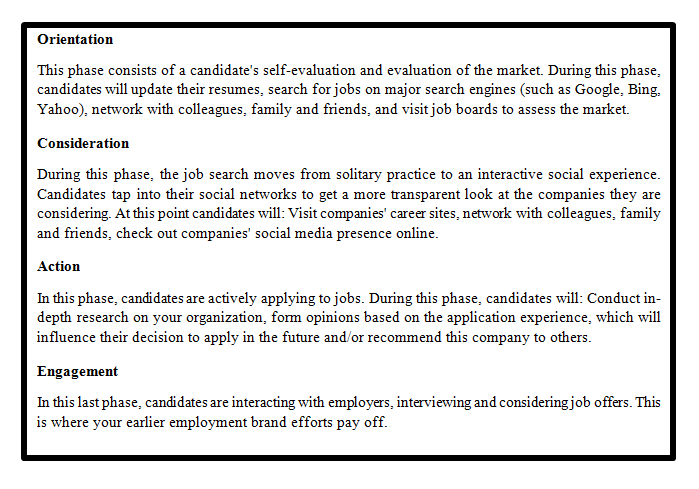
The CareerBuilder study looked at the behavior of candidates throughout the four phases of their job search (orientation, consideration, action, and engagement) and found that the internet and social media were used throughout each of the phases. (See Figure 1 for a definition of each of the four phases.)
Figure 1: The four phases of the the job search
Source: 2013 CareerBuilder Candidate Behavior Study
Job seekers in the orientation and consideration phases have not yet applied for a job at your company. Instead they are assessing the market, learning about an industry, and learning about companies within the industry. These stages are very much knowledge seeking phases for the candidate. Companies who are positioned right can attract great talent during these phases. However, companies who do not have a strong online presence and who do not participate in social media will not catch the eye of job seekers. Think of it as speed dating – you only have a short period of time to make an impression. According to the Neilson Norman Group you have 10 to 20 seconds to make that great impression. If you don’t make a great impression during those few seconds the user will navigate away from your website. Therefore you need to make sure that your website is visually engaging, easy to navigate, and contains quality and informative content.
When a candidate reaches the action stage they not only apply to jobs, they also conduct more in-depth research about a company, and form opinions based on the application experience. Candidates are not afraid to share their experience with the application process. Fifty percent of candidates share bad experiences with others and 64 percent share positive experiences.
In the engagement stage candidates interact with employers, interview for positions, and consider offers. Ninety-one percent of candidates believe employment brand plays a role in their decision whether or not to apply – therefore it is at this stage where your company’s online presence and participation in social media pays off.
How do candidates looking for a position within the manufacturing, transportation, and warehousing industries approach their job search? Let’s look.
Manufacturing industry
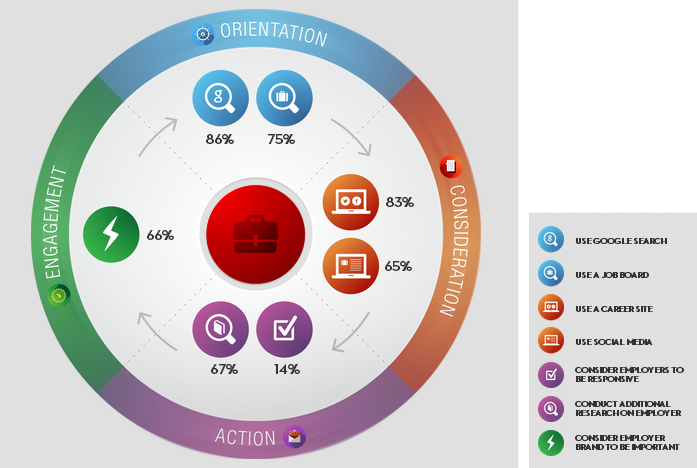
As shown in Figure 2, within the orientation stage, 85 percent of candidates looking for a job within the manufacturing industry turned to Google and 75 used a job board. In the consideration stage 83 percent used a company’s career site and 65 percent used social media to learn more about the company.
In the action stage 67 percent of candidates reported that they conducted additional research on an employer. In this stage only 14 percent of candidates reported employers in the manufacturing industry to be responsive.
Finally, looking at the final stage of the candidate’s journey, 67 percent reported that they felt the employer brand to be important.
Figure 2: The four phases of the job search; manufacturing industry
Source: 2013 CareerBuilder Candidate Behavior Study
Transportation and warehousing industries
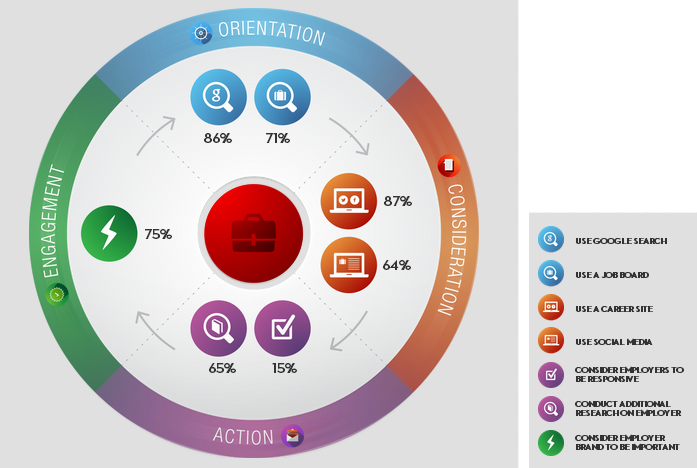
Figure 3 shows that within the orientation stage 86 percent of candidates looking for a job within the transportation and warehousing industries turned to Google and 71 percent used a job board. In the consideration stage 87 percent used a company’s career site and 64 percent used social media to learn more about the company.
In the action stage 65 percent of candidates reported that they conducted additional research on an employer. In this stage only 15 percent of candidates reported employers to be responsive.
In the engagement phase, 75 percent of candidates reported that they felt the employer brand to be important.
Figure 3: The four phases of the job search; manufacturing industry
Source: 2013 CareerBuilder Candidate Behavior Study
In the end
Candidates looking for jobs within the manufacturing, transportation, and warehousing industries are using the internet and social media. They are researching these industries and researching companies within these industries. They are forming opinions, acting on these opinions, and sharing their opinions with others.
If the manufacturing, transportation, and warehousing industries want to attract great talent and retain their interest throughout a candidate’s job search they need to invest in their online presence and become active in social media.