by Elizabeth Hines | Apr 7, 2015 | Blog, Leadership, Strategy
There are times when change is good. There are also times when change is bad for business.
The phrase “If it ain’t broke, don’t fix it” is often attributed to Thomas Bertram Lance, businessman and Director of the Office of Management and Budget under President Jimmy Carter. He was quoted in the May 1977 issue of the magazine Nation’s Business, though the sentiment feels as old as human existence. If something is working, and has always worked, then why change it? There are many adages along the same lines: leave well enough alone, never change a running system, don’t change a winning team.
True, humans are always evolving, but we also like consistency and stability. In his book Handbook of Contemporary Economics, Morris Altman wrote, “Without some stability over at least the short term, it is hard to conceive of humans engaging in sustained goal-oriented activity.” Change, adaptability, and flexibility, especially in business culture and lore, have turned from buzzwords to commandments. There are some things, though, that don’t require change. Assess whether change is necessary, rather than assuming it is because it’s socially and commercially popular. Ask:
- Are there assessment tools in place to monitor the business’s success?
- Are customers reporting satisfaction?
- Do your goods match customer needs?
- Do you understand the current market and your place amongst competitors?
- Are profits growing?
- Are overall finances sound?
- Are things running efficiently?
- Are current practices meeting regulations?
- Do you have the right people to meet your objectives?
- Are employees engaged, trained, and developing?
If the answer to these questions is yes, then why change? According to Harvard Business Review change could alienate your base, confuse people, damage your brand, and lose you money. Cadbury and its parent company, Kraft, are experiencing intense backlash due to a change in the Cadbury Creme Egg recipe. People are protesting, writing letters, posting negative comments online, and accusing the company of “ruining Easter.” We’ve seen this before. According to TIME’s article on the top 10 bad beverage ideas, “April 23, 1985, stands as one of the most significant dates in business history — the date the 99-year-old Coca-Cola company announced it was scrapping its original soda formula for a newer, sweeter version.” This change brought with it over 40,000 letters of protest, not to mention the bad press. Within three months the original soda formula, Coca-Cola “classic”, was back and met with an incredibly positive reception.
Some companies opt for a subtler approach to change by expanding its traditional offering. Instead of changing the successful product line for women, Dove expanded into the male market, creating Dove Men+Care, while still adhering to their public image and mission of creating personal care products that support natural health and realistic beauty.
The Harvard Business Review lists Brooks Brothers as a company that successfully found new opportunities without changing its values, “Instead of simply sticking to selling classic clothing, and waiting for outside catalysts (such as the popularity of the fashion in the television show Mad Men) to increase its popularity, the chain innovated around the edges by offering more fashionable accessories — shoes, belts, bags and the like — while leaving its core basically unchanged.” Capitalizing on this opportunity did not drive customers away because Brooks Brothers’ base products remained.
Remember that change has a cost. Are your consumers willing to pay the cost, especially if they didn’t require the change in the first place? Will your partners in the supply chain be willing to do business with you if the change you implement doesn’t suit them or benefit them? Think about some of the elements, for example, of a brand change:
- Content
- Communication
- Collateral
- Contacts
Things such as graphic design, business cards, letterhead, social media, advertising, re-launch, etc. all require real time and money. You must assess if your change will reap real, solid benefits. You don’t want to expend the effort, time, and money to change if you don’t have to, especially if it requires reversing the change or worse, killing your business.
by Elizabeth Hines | Mar 31, 2015 | Blog, Content Marketing, Logistics, Marketing, Strategy, Supply Chain
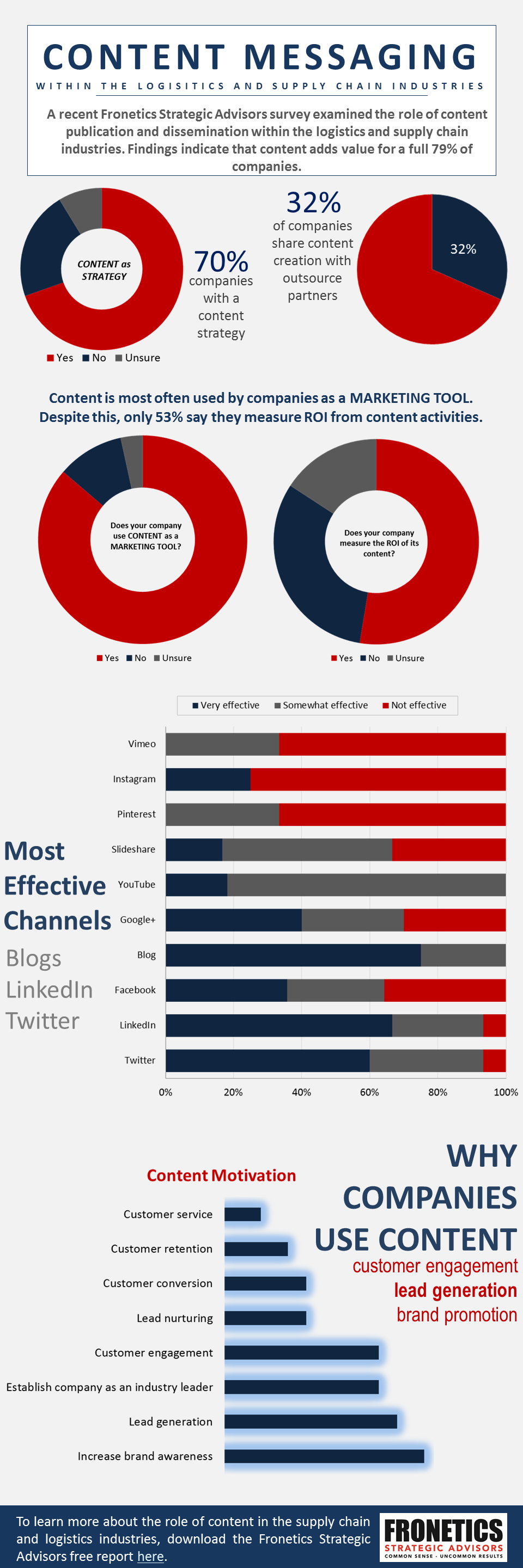
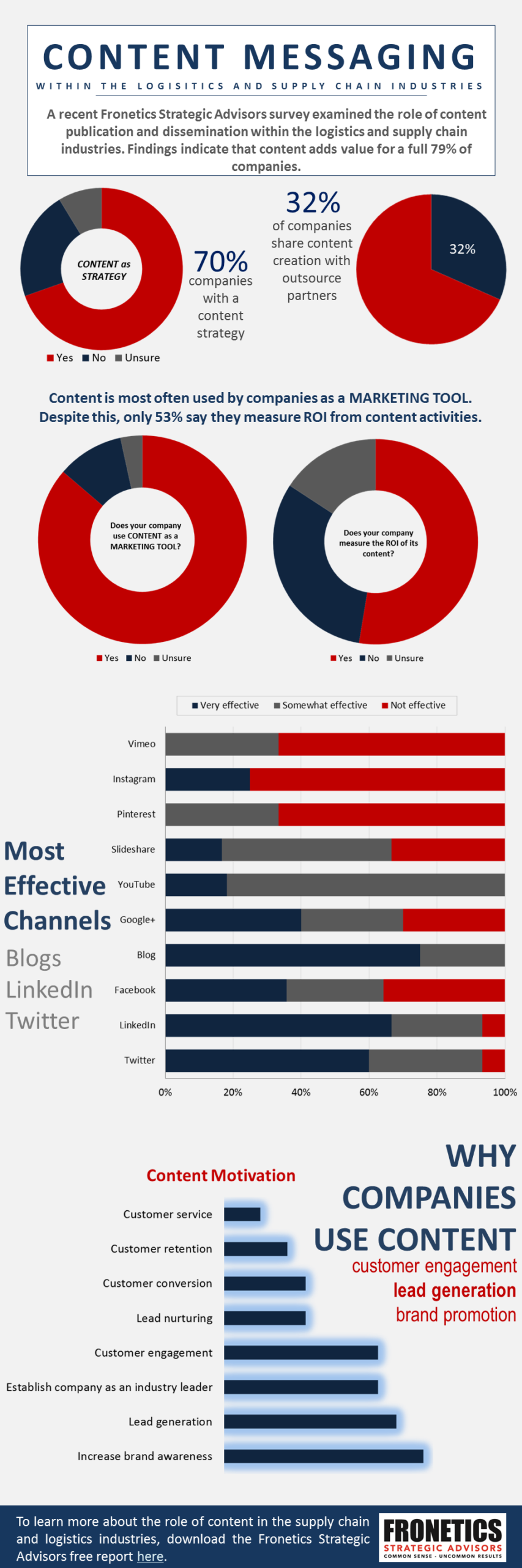
Chief among the determinants of success and failure of companies around the world is the ability to effectively communicate ideas and information. Both internal and external communication play critical roles in advancing business objectives. To be sure, connecting with audiences to convey messaging is a central component of building a solid business strategy. Recent cultural shifts and advances in digital technology have pushed aside traditional methods of communication and given way to the rise of a new type of communication strategy– one that puts content at the very center.
Fronetics Strategic Advisors conducted a survey to better understand the role and use of content within the logistics and supply chain industries.
The survey found that companies within the logistics and supply chain industries are using content as a marketing tool and are realizing benefits.
Survey respondents were asked to identify the goals of their company’s content strategy. The top three goals identified were:
- Increasing brand awareness
- Lead generation
- Establishing the company as an industry leader.
To learn more, check out our infographic, or download the report.

by Elizabeth Hines | Mar 24, 2015 | Blog, Strategy, Supply Chain

The Blumberg Advisory Group’s 2014 ITAD Trends Report shows that data security is the number one reason why companies implement an IT asset disposition (ITAD) strategy. That companies are concerned about data security is no surprise. Ongoing media reports have not only focused on data breaches, but have also highlighted examples of sensitive data being found on retired assets. The costs associated with data breaches and with the improper disposal of IT assets are great. They include financial implications such as penalties as well as the loss of customer loyalty and reputation. To mitigate risk, asset recovery management is critical to companies operating in today’s global supply chain.
Data security is viewed as an important piece of asset recovery management
Ninety-nine percent of companies surveyed by the Blumberg Advisory Group reported that “concern about data security” is either “very important” or “extremely important” with respect to motivating the creation of their current end-of-life IT disposition strategy. Other important factors include: commitment to “Green” businesses and IT practices, mitigating legal and financial risks, and redeploying assets to reduce costs (Table 1).
Concerns about data security have resulted in companies becoming more aware of the need for ITAD and the need to budget for it. In 2014 87 percent of companies reported having an ITAD budget; 38 percent more than in 2012.
Companies turn to 3rd-party service providers
The majority (63 percent) of companies reported that they use a 3rd-party service provider to manage end-of-life assets. The factors seen as most important in selecting a 3rd-party service provider include: adoption of industry-recognized compliance standards (97 percent); a well-documented and enforced chain of custody (95 percent); and high-quality, thorough client reporting (95 percent).
What to look for in a 3rd-party service provider
ITAD is expensive and it can be risky. It is therefore important to find a 3rd-party service provider who can provide as much safety and security as possible. It is also important to find a provider that takes the time to understand your business and your needs – and develops and manages an asset recovery program that is right for you rather than one that is “out of the box.”
We have put together a list of five must-ask questions. These are questions you should ask providers with whom your company is considering engaging. Before engaging, make sure that you are given answers to these questions and that you feel confident with responses.
-
What is your specialization?
3rd-party service providers are becoming increasingly specialized, particularly when comes to corporate IT take-outs. This specialization is largely being driven by data security and data breach concerns. If your company has highly specialized assets it is essential to determine what specializations, if any, the provider has.
-
Is there uniformity in the process?
Does the provider operate on a single global platform, or will it be necessary to use different platforms for different regions of operation. Uniformity in the process generally increases the ease of operation and ease of use.
-
Who would manage our relationship?
Would the provider assign one global account manager, or will it be necessary to interface with several account managers? Again, this boils down to ease of operation and ease of use.
-
How flexible are your operations?
Disruptions such as recent closure of west coast ports, natural disasters such as Hurricane Sandy, and changing standards and regulations (on a local, regional, and global scale) all impact the supply chain. Given this, it is important that flexibility be a component of asset recovery management.
-
What if something goes wrong?
This question is the most important question to ask. If something goes wrong and if ITAD does not occur as it should, what happens? Does the provider carry indemnification? If so, how much does the provider carry? Will the provider work with you to mitigate risk?
Data security, data breaches, and the improper disposal of assets are issues which global supply chain companies face on a day to day basis. The economic and social implications of the mismanagement of asset recovery are great. It is therefore important that companies operating in today’s global supply chain take the necessary steps to mitigate risk when it comes to asset recovery management.

by Elizabeth Hines | Mar 18, 2015 | Blog, Strategy, Talent
Here’s why paying out actually pays off.
Contract buyouts within the sports and business worlds aren’t exactly a novel approach to making personnel changes. But what about paying employees — employees who don’t have contracts and haven’t yet earned further compensation — to quit? It’s a move that’s finding ground in the business world.
Take Zappos for example. The company pays employees $4,000 to quit. Yes, the company shells out $4,000 to employees who say just two words: “I quit.”
Here’s why it is a great idea.
All Zappos employees must participate in a four-week training program when they are hired. When they complete the four weeks, they are given a choice: They can continue to work for Zappos, or they can quit. Those who quit will be paid a bonus of $4,000.
Essentially, Zappos is putting their money where their mouth is when it comes to cultivating its company culture. Zappos leadership believes an employee who is not happy after participating in the training program or is not excited about the company and its culture won’t be a good match. By offering such employees an out, Zappos can quickly and effectively weed out employees who are not a good fit within the company’s culture.
This may seem crazy, but the reality is that when unhappy employees leave the company within their first four weeks of employment, the financial implications are much, much lower than the cost of unhappy employees who are likely to be uninspired at work and quit in less than a year.
Why does Zappos do this?
It wants to attract and retain great talent. In his book Delivering Happiness: A Path to Profits, Passion, and Purpose, Zappos CEO Tony Hsieh says: “Your personal core values define who you are, and a company’s core values ultimately define the company’s character and brand. For individuals, character is destiny. For organizations, culture is destiny.” In short, Zappos is big on company culture. This focus has made it successful — very successful.
So how many Zappos employees take the money and run? You might be surprised to learn that only between 2 to 3 percent of people quit and take the $4,000.
Another example of front-end hiring processes from eBay
During his time as the COO of eBay, Maynard Webb also employed front-end hiring processes to determine if a candidate would be a good fit within the company’s culture. To assemble a solid team, he recommends asking the right questions during the hiring process. He gives as an example of a question he would routinely ask job candidates to determine fit at eBay. “If something breaks at 2 a.m. but miraculously resolves itself before anyone understands it, is it okay to unplug and go to sleep? The answer should be no.”
With the U.S. Department of Labor currently estimating the average cost of a bad hiring decision to be as much as 30% of an individual’s first-year potential earnings, a single bad hire with an annual income of $50,000 can equal a potential $15,000 loss for a company. It might actually pay to create a company payment system that is designed to weed out new hires who reveal themselves to be less-than-stellar prospects for long-term employment.
What do you think about the idea of paying your employees to quit? What processes do you have in place to detect personnel issues up front?
Related posts:


by Elizabeth Hines | Mar 16, 2015 | Blog, Marketing, Social Media, Strategy
How your business can use social media to generate leads.
Leads are essential to the growth of your business, and your marketing strategy is built around finding and connecting with leads. So when 92% of all marketers indicate that their social media efforts have generated more exposure for their businesses, you should take note and make social media part of your prospecting strategy.
Building a network of online connections is an effective way to find new leads. And with social media, you can find new leads by doing something called social prospecting. Social prospecting is the art of searching the social web, identifying potential prospects for your business, and engaging them in a manner that draws them to your company’s website and through your funnel. At the core, social prospecting is about listening. It’s about listening to social media conversations in order to generate leads for your business. It goes beyond monitoring keywords to engaging people that may or may not know what your business can do for them.
As you build your social prospecting strategy and develop new approaches to connect with leads, keep these 25 handy tips close by to guide your efforts.
Twitter
- Post content that draws prospects back to your website.
- Aim to share useful content on Twitter two to three times per week.
- Make customers feel appreciated by prioritizing their questions.
- Keep prospects engaged by retweeting some of their organic content.
- Favorite tweets with content that leads share.
- Respond to and offer help to industry peers’ questions.
- Delight customers by replying or favoriting tweets when they mention your company.
- Engage with potential prospects by offering help using relevant content.
LinkedIn
- Post at least twice a week to your company’s LinkedIn page.
- Join five LinkedIn Groups that could connect you with potential prospects.
- Join conversations in the group where you can add value with your content.
- “Like” content that others are sharing in the group.
- Share your own content to the group.
- Use LinkedIn Answers to respond to questions posted by others in your industry.
- Make a habit of routinely reviewing the content posted within your groups.
- Comment and add value to posts from others in the group.
- Ask for an offline meeting with your most engaged prospects.
Facebook
- Link to your blog from Facebook.
- Add calls to action to posts.
- Promote a special product or service offer solely for Facebook fans.
- Create and post visual content, like infographics and videos.
- Share a quote or industry statistic with your fans.
- To draw more comments from fans, pose a question.
- Create a Facebook event to promote trade show appearances or webinars.
- Update your company’s profile and cover photos routinely.
Ready to build a more full-bodied social prospecting strategy? We’ve laid out the quickest ways for you to find more leads and prospects on Twitter, Facebook, LinkedIn, Pinterest, and Google+ in our social prospecting workbook. In a dedicated worksheet to each of those social media platforms, you’ll find every worksheet includes: a short preparatory work to make the actual prospecting easy; visual instructions on how and where to find prospects; pro tips that will help you get the best results; prescriptions (Marketing Rx) for success; and take-home exercises for follow-up prospecting. To get started growing your prospecting opportunities and building alternative lead generation and nurturing strategies, download our free workbook.
Curious about what we’re up to on social media? Find out.

by Elizabeth Hines | Mar 2, 2015 | Blog, Leadership, Strategy
Frank Underwood and his house of cards offers up valuable business lessons.
Netflix’s Emmy-winning drama House of Card’s is one of the most binge-watched shows. Two percent of U.S. Netflix subscribers watched the entire 649 minutes of the second season in just over 72 hours. Around 6 to 10 percent of US subscribers watched at least one episode of the season the weekend it was released.
At the heart of House of Cards is Frank Underwood (F.U.), a man you hate to love. Notwithstanding Frank’s blatant disregard for morals and ethics, Frank and his house of cards offers up business lessons.
1. Relationships matter
Frank focuses much of his time on forging and nurturing relationships. He understands that relationships matter.
Relationships between individuals and relationships between organizations are what drive success. Develop and nurture relationships.
2. A strong team is essential
Frank’s team is critical to his success. This is not happenstance. Frank has assembled a team comprised of individuals with the right skillset to achieve his goals. He understands that success cannot be achieved without these individuals.
Assembling the right team is critical whether it be at the project or organizational level. A strong team is essential for success.
3. Be proactive
Frank once said: “If you don’t like how the table is set, turn over the table.” Frank does not wait for things to happen, he makes things happen.
If you don’t like how it is going (or not going), do something about it.
4. Stay true to your word
In business as in life it is important to stay true to your word. In Frank’s words: “The nature of promises, Linda, is that they remain immune to changing circumstances.”
5. Knowledge is powerful
“I don’t want to assume, I want to know”
Knowledge is critical to Frank’s success. Frank doesn’t make assumptions, rather he takes the time to learn the facts and to learn how the information he has gathered can best be used.
Do the same. Take the time to learn about what matters to those around you, to your customers, and your industry. Use this knowledge constructively.
6. Emotions matter
Not all decisions are made based on logic. Although often ignored, emotion plays a significant role in business. Understanding and speaking to the emotions of a customer or potential business partner, for example, can be the key to success. Or as Frank puts it: “I should have thought of this before. Appeal to the heart, not the brain.”
7. Change often
Remy Danton, Frank’s former Chief of Staff, gives Frank a watch inscribed with a quote from Winston Churchill: “To improve is to change. To perfect is to change often.”
Change is critical. Without change it is not possible to meet the dynamic needs of customers and of your business. Without change growth opportunities will diminish.
8. Don’t let your weaknesses be your downfall
Don’t let your weaknesses be your downfall. Work at strengthening your weaknesses so that you are not an easy target. As Frank points out: “Even Achilles was only as strong as his heel.”
9. Don’t lose sight of the details
The details often get lost in the big picture. However, it is often the details that are critical to success. As Frank puts it: “Pay attention to the fine print. It’s far more important than the selling price.”