by Elizabeth Hines | Dec 30, 2014 | Blog, Logistics, Manufacturing & Distribution, Marketing, Social Media, Strategy, Supply Chain
 I wrote a guest blog for freight logistics company Cerasis in October which discussed how companies within the manufacturing, supply chain, logistics, and industrial industries can increase their B2B visibility on LinkedIn.
The catalyst for writing the blog were results from a recent survey focused on the supply chain and logistics industry. 58% of respondents rated LinkedIn as “very impactful,” and 37% rated LinkedIn as “somewhat impactful.” At the same time, respondents reported challenges associated with strategy (33%) and a lack of understanding about the application of social media (24%).
Leveraging LinkedIn
There are over 3 million LinkedIn company pages. Being present on LinkedIn is critical, but is not enough. To maximize your LinkedIn presence you need to take steps to increase your B2B visibility. Here’s how:
-
Create a compelling company page
Your company page is an extension of your company. Make sure that the page is compelling, informative, and presents your company as a leader within the industry.
-
Be active
In addition to keeping your company page up-to-date, you need to be active on LinkedIn on a daily basis. LinkedIn groups are great. Actively participating in LinkedIn groups will allow your company to: 1) gain business and market intelligence; 2) introduce you to new, interesting, and relevant topics; 3) help you increase brand awareness; and 4) position your company as an industry leader.
-
Distribute content
If you want your content to be seen you need to get it out there; you need to distribute your content. Distribute your content and curated content via your company page and (when relevant) within the LinkedIn groups to which you belong.
-
Employee engagement
Your employees are your brand ambassadors. Empower your employees to be active within LinkedIn groups as representatives of your company. Encourage employees to share your content and industry content with their connections. Additionally, encourage employees to share open positions with their LinkedIn connections, and to identify great talent within their network.
-
Prospect for leads
LinkedIn is an effective prospecting tool. Use LinkedIn to prospect for leads and to build your sales pipeline.
-
Optimize your profile
Every employee is a reflection of the company. Encourage employees to optimize their personal LinkedIn profiles.
-
Don’t be annoying
You will fail if you take a “me, me, me attitude.” Constantly self-promoting is bad for business.
If your company is not using LinkedIn you are missing out on opportunities and revenue.

by Elizabeth Hines | Dec 24, 2014 | Blog, Marketing, Social Media, Talent
LinkedIn is the largest social network for professionals. There are more than 332 million users – and this number is growing rapidly. An average of 2 users joins LinkedIn every second.
There is the perception that LinkedIn is only for job seekers, and that a red flag will be raised if those who are employed update their profile. Neither is accurate.
Here are 6 reasons you need to be on LinkedIn even though you have a job:
Your personal brand matters
People are looking at your LinkedIn profile to learn more about you. And it isn’t just recruiters or potential employers looking on LinkedIn. Clients, colleagues, and even your current employer look to your LinkedIn for information on who you are, what you have done, and what you do.
Because your personal brand matters, take the time to optimize your LinkedIn profile.
Network, network, network
Networking is often thought of as a (dreaded) job search action item. However, thinking about networking in this manner will leave you at a disadvantage. Networking is an action item necessary for your professional and personal growth.
LinkedIn is an incredible network building tool. Leverage it and “Network your face off.”
Industry groups
Being involved in relevant LinkedIn groups will help you grow your network. It will also help you stay up-to-date on what is happening within your industry, and give you the opportunity to get involved in the conversation.
News
Company and individuals are posting content, and having conversations on LinkedIn every day. These conversations and the content posted are chock full of relevant news.
Be a brand ambassador
Is your company hiring? Share the posting with your connections. Also, take the time to look through your connections; is there anyone who might be a good fit for the position? If so, reach out to them. Bonus: your company may compensate you for referring a candidate if they are hired.
Opportunities
You may not be looking for a new position, but what if the perfect position fell into your lap? If you are active on LinkedIn and have optimized your profile, you may find that people begin reaching out to you and present you with opportunities.
Have a job? Be active on LinkedIn. Not being active is more likely to raise a red flag.
by Elizabeth Hines | Dec 18, 2014 | Blog, Marketing, Social Media, Strategy
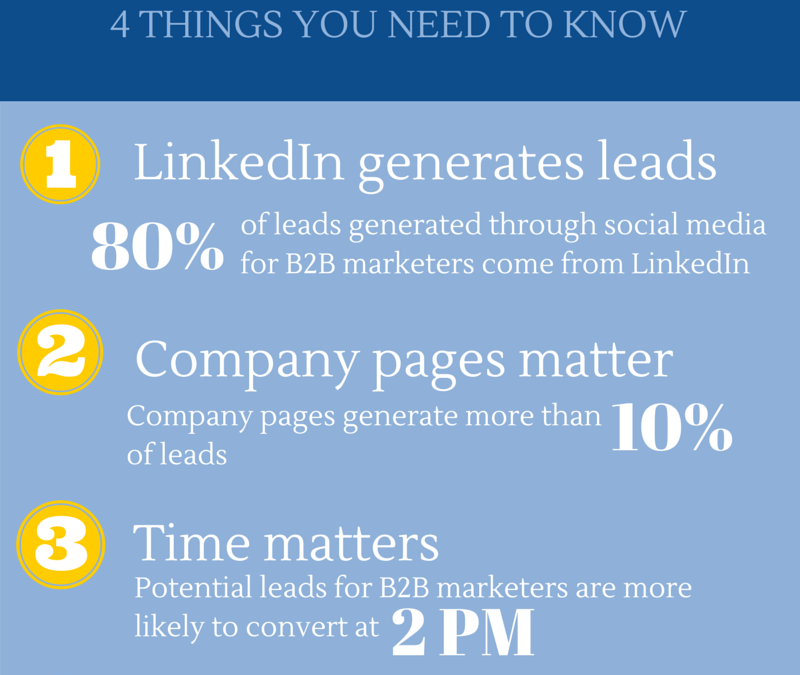
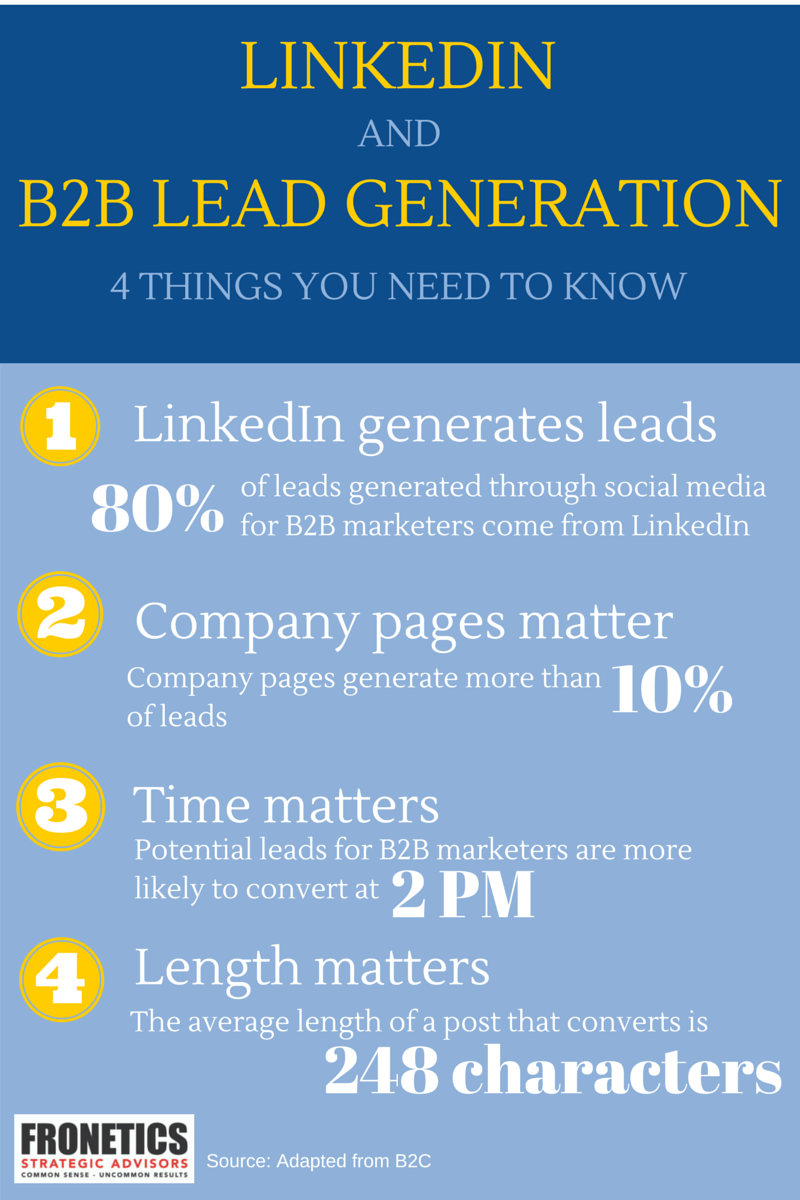
Oktopost, a social media marketing platform, analyzed over 100,000 posts on four different social networks (LinkedIn, Twitter, Facebook, and Google+) and found that LinkedIn is the most effective social network for B2B.
Oktopost found that more than 80% of B2B leads were generated through LinkedIn. Lead generation through other social networks paled in comparison:
- Twitter: 12.73%
- Facebook: 6.73%
- Google+: 0.21%
We’ve put together an infographic that outlines four things you need to know about LinkedIn and lead generation.
by Elizabeth Hines | Nov 25, 2014 | Blog, Internet of Things, Marketing, Social Media, Strategy, Supply Chain
The 2014 UPS B2B Buyers Insight Study found that companies need to have a strong online presence to grow their business.
Buyers are looking for information online
Buyers are conducting research on industrial suppliers online. Sixty-eight percent of buyers research supply purchases via supplier website, and 52 percent use search engines.
In their report, UPS and TNS discuss the importance of a strong online presence:
“Given buyers’ high satisfaction levels with supplier performance on key selection criteria, and considering that web-based research is most preferred, it’s reasonable to infer that many buyers consider online research essential to their supplier selection process. The use of search engines means that suppliers may be at greater risk of losing share to companies whose products are perhaps easier to find, in stock or competitively priced. On the other hand, suppliers whose products are easy to find online and meet buyers’ criteria may also stand to gain customers.”
Being able to buy online is more important to buyers than a sales rep
Being able to access information about products online and being able to make purchases online is more important to buyers than sales representatives and printed catalogs.
Respondents were asked to rate attributes with respect to deciding from which industrial supplies vendor to purchase. Seventy-eight percent of respondents rated product information on the supplier website as “extremely important” or “very important.” Seventy-four percent of respondents rated the ability to make purchases on the supplier’s website as “extremely important” or “very important.” In contrast, fifty-eight percent of respondents rated having a sales representative as “extremely important” or “very important.” Fifty-four percent of respondents rated having a hardcopy product catalog as “extremely important” or “very important.”
Buyers like to purchase through websites
Sixty-three percent of industrial supplies buyers reported that they purchase through websites (directly from suppliers or via a third-party provider).
Sixty-seven percent of buyers responded that the ability to order through a supplier’s website is considered “extremely important” or “very important”
If you think your current customers don’t care if you don’t offer the ability to purchase products online – think again. The survey found that 34 percent of buyers say that they have gone outside of their existing supply base to make an online purchase.
Meet your customers online
Having a strong online presence is an essential component to your business strategy. If you want to grow your business you need to be online. UPS and TNS sum this up nicely:
“Be in the right place when buyers are looking: Having a superior supplier website with stellar functionality means little if buyers can’t find the site or don’t know it’s available. Making sure products and supplier information can be found easily by search engines (SEO), and being visible when buyers search for products (SEM), are essential strategies for retaining and increasing customer base.”

by Elizabeth Hines | Nov 20, 2014 | Blog, Marketing, Social Media, Strategy
 Last month when Flipboard launched the third version of its mobile news app, Mashable called it “the most personal and magazine-like experience the platform has offered yet”. Compared to previous versions, Flipboard 3.0 seems more adept in curating relevant and individualized content for users – a function that can be traced to Flipboard’s newly acquired, topics-based technology.
Earlier this year when Flipboard acquired Zite from CNN, it announced plans to integrate Zite’s technology into Flipboard’s product, improving its capability to personalize news feeds for users. The company reports that once the full integration is in place, they’ll sun-set the nine year old Zite app. First debuting as an iPad-only application, Zite quickly expanded its reach into the smartphone applications market while concurrently navigating acquisitions by CNN then eventually landing at the giant media aggregation app Flipboard. So what is it, exactly, that CNN and Flipboard found so appealing about Zite? Quite simply, it’s personalization.
What the founders of Zite realized early on, and then successfully developed, was that users wanted an individualized news feed that served up topics-specific content. Not only did Zite deliver on that functionality, but it took news feed generation a step further by introducing an element of fluidity. Over time, the application learned what type of content and topics the user found valuable and used that information to curate highly-relevant material. Setting Zite further apart from competitors was its expertise in culling articles from sources other than what users would typically find on social media or search engine results. Flipboard has positioned themselves well to leverage the Zite technology given their similar user bases and platforms. Indeed, Flipboard 3.0 is both more personal and less personal – striking a balance of topic specific, uniquely-sourced content and trending, staff-curated content.
4 Flipboard Uses for Content Marketers
-
Use it to Promote
If your content strategy includes blog writing and the distribution of your content, you should be using Flipboard. It naturally lends itself to the social promotion of your brand and content. Extending your brand beyond your website is as simple as creating a Flipboard magazine of your products and/or services.
-
Use it to Learn:
Flipboard’s 100 million active readers have already amassed a sizable collection of insightful content about specific topics. No matter what industry you work in, it’s almost guaranteed that you’ll find unique content either generated or curated by industry peers.
-
Use it for Productivity:
You’ve already created great content. Flipboard makes it easy to share content across your existing social networks. Want to send a prospect a product or service listing? Tweet them a link to your Flipboard magazine showcasing your products and services.
-
Use it to Unwind:
Miss the last episode of your favorite show? Catch up by reading show-related content. Want to plan a trip to the beach in February? Browse Flipboard’s travel magazines to find the best hotel deals and insider information about resorts.
You can download Flipboard for free. It is available for iOS, Android, Windows, Blackberry, Kindle Fire & NOOK.

by Elizabeth Hines | Nov 19, 2014 | Blog, Leadership, Marketing, Social Media, Strategy, Talent

Networking is often thought of as a (dreaded) job search action item. However, thinking about networking in this manner will leave you at a disadvantage. Networking is an action item necessary for your professional and personal growth.
Those who view networking as more than just a job search must, gain a competitive edge over those who turn to networking only when they are making a job/career change. Glen Llopis puts it this way:
“The more you procrastinate, the more you will find yourself disconnected from the opportunities that may potentially advance your career or allow you to meet the right people.”
How and why does networking matter? Here are five reasons why networking is essential and why connections matter:
- Research has shown that the larger the network, the larger the salary
- Networks beget jobs
- Networks bring opportunities that benefit and feed your career, professional development, and personal interests.
- Networks make people smarter
- Networks make people happy
Moreover, Kathryn Minshew, founder and CEO of The Muse and The Daily Muse, points out that:
“Networks are powerful, and when done right leave you surrounded by a core of individuals who are all rooting for your success and happy to help you.”
One of the greatest networking tools for professionals is LinkedIn. So before you begin, make sure you optimize your LinkedIn profile for success.