by Elizabeth Hines | Sep 26, 2019 | Blog, Current Events, Marketing, Social Media
Having the right social media image sizes for each platform is a key part of creating visually appealing posts.
Highlights:
- Each social media platform has its own set of image guidelines.
- Choosing the right social media image sizes ensures that your content is as visually appealing as possible.
- We like Canva Pro for quick resizing of images and graphics.
Social media is all about the visual. Whether it’s Instagram, Facebook, Twitter, or LinkedIn, having the right image can make or break the effectiveness of a post. Social media image size might seem like a relatively unimportant facet of choosing an effective image for a post. But you might be surprised to discover how important it can be.
An incorrect social media image size can make your post less visually appealing than it could be, and it can even erode how the number of impressions a post receives. Because each platform has its guidelines for sizes — and because each image type (profile picture, cover photo, etc.) has different size restrictions — determining correct social media image size is no easy task.
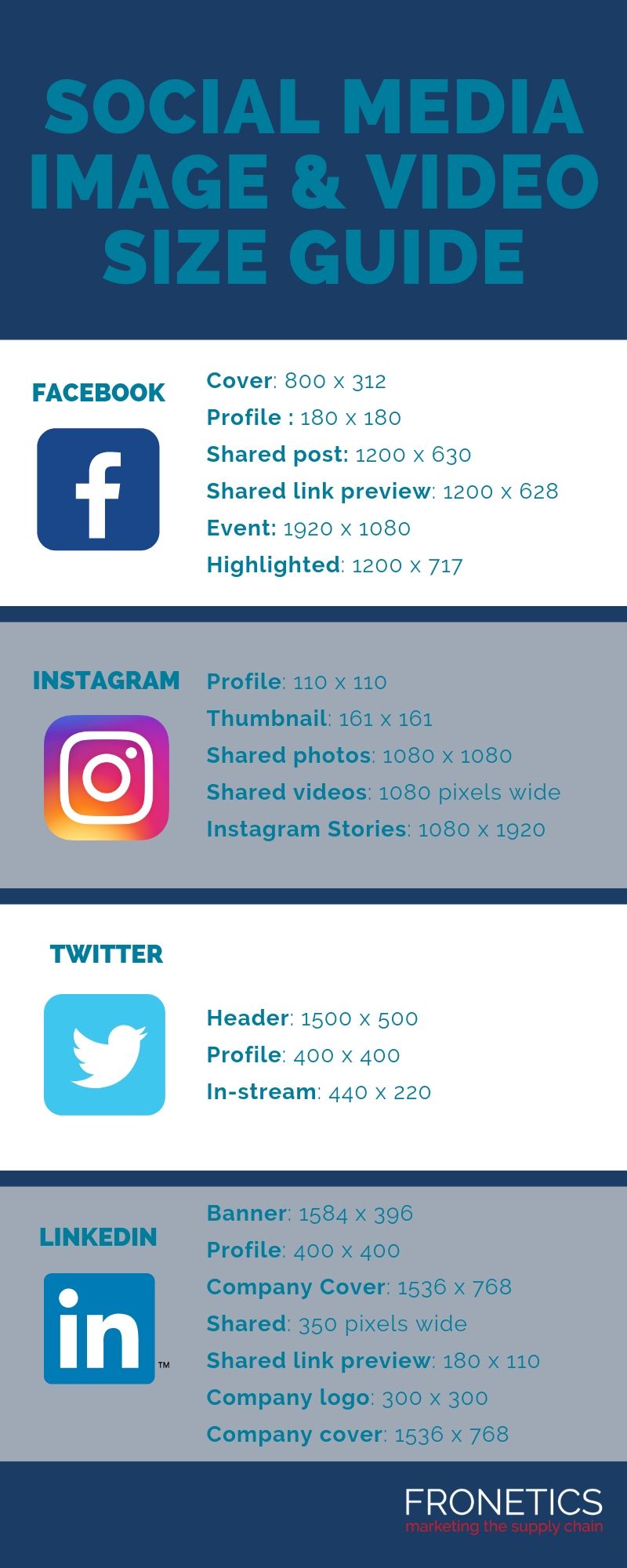
The infographic below gives you a complete guide to the various image size requirements on Facebook, Instagram, Twitter, and LinkedIn. Once you know the correct social media image sizes, you can set your photo editing software to the correct dimensions.
Social media image sizes: by the network
(Made with Canva)
Facebook
Facebook is perhaps the crown jewel of social media platforms, boasting 1.5 billion daily active users. While the platform is text-friendly, images are key to creating engaging content on the platform. An important thing to remember when it comes to images on Facebook is that they will display differently on your page’s timeline as compared to a user’s newsfeed. This means that your choice of image dimensions should be based on where you want your viewers to see your image.
Image dimensions:
- Cover image: 800 x 312
- Profile image: 180 x 180 (though it will display as 170 x 170 on desktop, and 32 x 32 as a thumbnail)
- Shared post image: 1200 x 630
- Shared link preview image: 1200 x 628
- Event image: 1920 x 1080
- Highlighted image: 1200 x 717
Instagram
Instagram is all about the visual – which means that it’s crucial that your brand’s presence on the platform is driven by high-quality images. As a rule, the platform scales down photos to 612 x 612, but it’s still recommended that shared images be set to 1080 x 1080 to optimize quality.
Image dimensions:
- Profile image: 110 x 110
- Image thumbnail: 161 x 161
- Shared photos: 1080 x 1080
- Shared videos: 1080 pixels wide
- Instagram Stories: 1080 x 1920 (minimum 600 x 1067); maximum 4 GB
Twitter
Twitter has 313 billion monthly active users and has recently updated its image guidelines.
Image dimensions:
- Header image: 1500 x 500; maximum 5 MB
- Profile image: 400 x 400; maximum 2 MB
- In-stream image: 440 x 220
LinkedIn
While the network may not be thought of as a highly visual platform, images on LinkedIn make a big difference in terms of post engagement. With 467 million registered users, it’s the world’s largest professional network. Having polished, well-sized images on the platform can go a long way toward maximizing its potential for professional networking and industry visibility.
Image dimensions:
- Banner image: 1584 x 396; maximum 4 MB
- Profile image: 400 x 400 (minimum 200 x 200); maximum 10 MB
- Company Cover image: 1536 x 768
- Shared image: 350 pixels wide
- Shared link preview: 180 x 110
- Company logo image: 300 x 300; maximum 4 MB
- Company cover image: 1536 x 768 (minimum 1192 x 220); maximum 4 MB
- Company page banner image: 646 x 220; maximum 2 MB
- Square logo (appears in company searches): 60 x 60; maximum 2 MB
An insider trick for quick and easy resizing
As you can see, there is quite a bit of variability in social media image sizes. You could spend hours resizing graphics or images for the same post across multiple platforms… Or, you could do what we do, and try a design platform like Canva. Not only does it already have all the proper dimensions available as templates, Canva Pro lets you change the size of graphics you created in a single click. It definitely makes life a lot easier.
Related posts:

by Elizabeth Hines | Sep 19, 2019 | Blog, Data/Analytics, Marketing, Marketing Automation, Supply Chain
In a highly competitive B2B landscape, AI can be the strategic advantage your brand needs. Here’s everything you need to know about AI for marketing.
Highlights:
- AI enables predictive analysis – the ability to look at a large set of data and predict what steps to take to reach a desired outcome.
- Social listening powered by AI gives marketers key insights into brand perception and audience reaction.
- When considering purchasing an AI technology for marketing, consider if it includes its own Big Data source.
When we think about artificial intelligence (AI), it’s often with a twinge of unease. Whether it’s pop culture telling us that robots will take over at their earliest opportunity, or fears of human labor being replaced with machines, AI is a complex, controversial, and even mysterious topic. But when it comes to the applications of AI for marketing, there’s actually a lot to celebrate.
It’s important for marketers not only to have a thorough understanding of the uses of AI for marketing, but to be aware of industry trends, and how to determine investment to maximize ROI.
What is AI for marketing?
While it’s not necessary for marketers to be artificial intelligence and robotics experts, it’s beneficial to have a functional understanding of the technology that enables AI for marketing. In a general sense, the term “AI” refers to the area of computer science that enables the creation of software and machines that possess what we think of as intelligence. That is, they are able to work, react, and learn without being specifically programmed for each task.
AI is enabled by data science, “the practice of organizing and analyzing massive amounts of data.” When it comes to marketing, AI can be thought of as an extension and development of marketing automation. Essentially, AI for marketing is software that collects, analyzes, and reacts to large amounts of data, with increasing levels of sophistication.
According to content intelligence expert Bart Frischknecht, of Vennli, AI for marketing can be categorized in one of two ways.
- Recommending: This type of marketing software “predicts which action will have the most positive outcome in order to recommend a next step in a series of events.” Frischknecht describes these recommendations as “stepping stones on the way to fully automating a given task.”
- Automating: Software that automates is a furtherance of software that recommends. For a task to be automated, it needs to be “routine and repeatable, the goal needs to be specific, and the steps to achieve that goal must follow an exact set of rules.”
Think of data as the fuel that powers AI for marketing. As we gather more and more data, and devise increasingly sophisticated analytical methods, the possibilities for intelligent automation in marketing will continue to expand.
5 examples of AI for marketing
1) Data filtering and analysis
At Fronetics, we’ve advocated for a data-driven approach to marketing since our founding. For marketers, data is the most powerful strategic weapon in your arsenal, and AI is sharpening it even further. AI software can consolidate large amounts of data, and analyze it to determine patterns and trends.
2) Social listening
Social listening, also known as social monitoring, is the process of observing and examining social media, to identify and access what is being said about your brand. Social listening gives marketers valuable market intelligence, prospect insight, tone awareness, and competitive advantage.
Current AI software lets marketers not only engage in sophisticated social monitoring, but it also enables “sentiment analysis,” automatically generating a report of the overall attitude of your audience and perception of your brand.
3) Predictive analysis
Beyond simply filtering and analyzing data, AI for marketing goes a crucial step further: predictive analysis, the practice of applying the information extracted from data sets to predict a future outcome or trend.
This revolutionary capability of AI can be used to analyze buyer purchase behavior, for example, and determine when and how to distribute certain types of content. Social media scheduling tools, for instance, use predictive analysis to suggest the optimal times to share content.
4) Audience targeting and segmentation
As B2B buyers increasingly come to expect personalization at all stages of the buyer’s journey, it can be a challenge for marketers to deliver. However, AI makes personalization possible at a large scale, drawing on data to segment and categorize audiences.
The limits of the specificity of this segmentation are determined only by the amount of data available. In other words, the more data, the more the AI software can instantly segment a contact list and deliver personalized correspondence.
5) Chatbots
One of the most ubiquitous examples of AI for marketing, chatbots are computer programs that simulate human conversation using auditory or textual methods. Chatbots communicate with buyers within a messaging app, like Facebook messenger.
3 questions to ask when considering an investment in AI for marketing
While the possibilities of AI for marketing are virtually endless, the reality for most companies is that marketing budgets are not. When considering an investment in any technology, including AI, maximizing ROI should be top of mind. Frischknecht suggests that marketers ask the following three questions when considering an investment in AI for marketing:
- Which marketing task will this technology automate, and will doing so alleviate a significant burden for marketing staff?
- Does purchase of the tech include its own Big Data source, or do I need to provide all the data? If the latter, do I have adequate data, and can I connect my data source to the tech?
- What evidence exists of the tech making good recommendations or automating one of my tasks.
AI is revolutionizing marketing. Investing intelligently in these technologies can provide critical market insights, data processing capabilities, and predictive analysis.
Related posts:

by Elizabeth Hines | Sep 18, 2019 | Blog, Marketing, Social Media, Video Marketing
Here are 15 social video marketing statistics that every supply chain marketer should be aware of in 2019.
Highlights:
- 87% of business use video as a marketing tool.
- 83% of marketers report that video gives them a good ROI.
- Social video marketing trends to be on the lookout for: live video and 1:1 personalized video.
If you believe everything you read, you might think that social video marketing has taken a bit of a hit in the past year or so. Largely thanks to Facebook’s well-publicized inflation of video view metrics, companies are naturally wary of investing in video creation and promotion on the platform.
But Facebook’s transgressions shouldn’t undermine marketers’ confidence in the future of social video marketing. Both expert analysis and hard numbers support the notion that video isn’t going anywhere. As digital media expert Michael Humphrey puts it, “All the major upward trends still wrap around video.”
According to Lux Narayan, CEO of independent social analytics company Unmetric, audiences “are longing for more interactive experiences as well as long-form storytelling that only video can best achieve.”
Here are 15 social video marketing statistics we think supply chain marketers should be aware of.
15 social video marketing statistics for 2019
- 47% of internet users have watched brand advertising videos on social media within the past 3 months. (Toluna)
- Of the social media users who have watched branded videos in the past 3 months, 43% watched on Facebook, 38% on YouTube, 18% on Instagram, and 13% on Twitter. (Toluna)
- 87% of businesses now use video as a marketing tool, up from 63% in 2017. (Wyzowl)
- 55% of people consume videos thoroughly – the highest percentage of any content type. (HubSpot)
- 30% of users prefer video ads to text or still image ads, while 52% report having no preference. (Only 18% prefer text or still image ads). (Toluna)
- 83%of marketers say video gives them a good ROI, up from 78% in 2018. (Wyzowl)
- 52% of consumers say that watching product videos makes them more confident in online purchase decisions. (Invodo)
- 68%of people say they’d most prefer to learn about a new product or service by watching a short video, over text-based articles (15%), infographics (4%), presentations and pitches (4%), and ebooks and manuals (3%). (Wyzowl)
- 48% of social media users have sought more information about a product or service based on social video marketing. (Toluna)
- 33% of survey respondents answered yes to having bought a product or service from a brand solely based on social video marketing. (Toluna)
- 88% of video marketers are satisfied with the ROI of their video marketing efforts on social media. (Animoto)
- 82% of social media users prefer live video from a brand to social posts. (Impact)
- 81% of marketers say video has helped them generate leads, and 84% say video has helped them increase traffic to their website. (Wyzowl)
- 61% of marketers have made more marketing videos in house in 2018 than they did in 2017. (Animoto)
- 67% of users said they would like to see more social video marketing in the future over other types of ads. The remaining 33% are indifferent, not opposed. (Toluna)
The future of social video marketing
Suffice it to say, the numbers bear out the fact that video marketing, and particularly social video marketing, is a trend that’s here to stay. Live video is increasingly popular, and savvy brands are incorporating it into their strategies.
In addition to live video, given the growing ease of shooting video on smartphones, another big trend is likely to be 1:1 video. Marketers can nurture leads via personalized video messages, rather than phone calls or emails, using video to offer additional content, product support, or simply to foster a relationship.
The bottom line is that video offers up the kind of engaging storytelling that users today want. And social media is the ideal distribution platform for video, making social video marketing a winning strategy.
Related links:

by Elizabeth Hines | Sep 12, 2019 | Blog, Content Marketing, Marketing, Social Media, Video Marketing
Live video streaming offers businesses a cost-effective strategy for engaging with and appealing to today’s buyers.
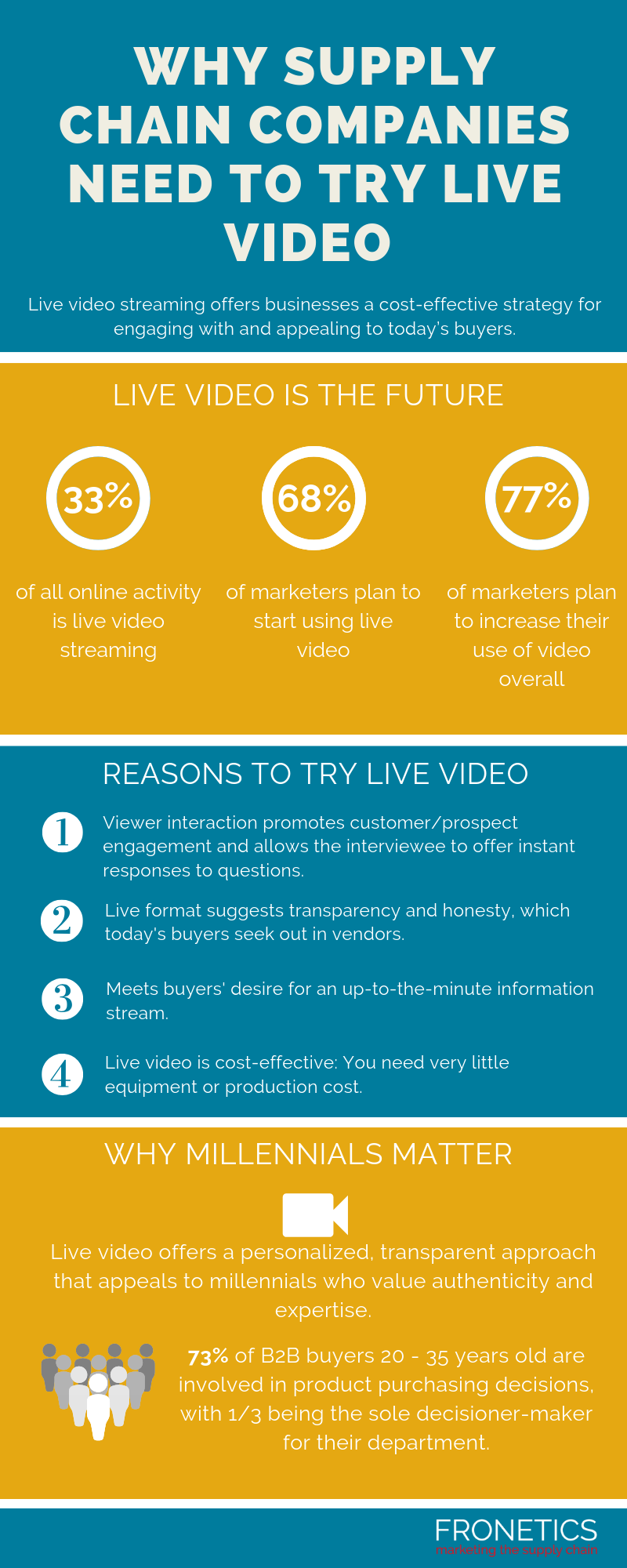
With YouTube emerging as the world’s second largest search engine and video becoming themost popular form of online content,it is no surprise that businesses are looking for ways to engage their target audience through video. And they’re even diving into a growing trend in video marketing: publishing content in real time. It makes sense, given live video streaming now represents 33% of all online activity.
Live video was used more for niche markets in its early days. But 68% of marketers plan to start using live video in the next year, and 77% of marketers plan to increase their use of video overall.
(Made with Canva)
How can live video work for the supply chain?
Live video is an increasingly popular content medium for the millennial generation, which is important for supply chain marketers to note as the B2B purchasing landscape skews younger. Consider that around 73% of 20 to 35 year olds are involved in product purchasing decisions at their companies, with one-third reporting being the sole decision-maker for their department. And a 2015 Google/Millward Brown survey of buyers found that about half of purchasing researchers were between the ages of 18 and 24 — and that percentage has only grown in the last few years.
Another important trait to note about millennials? They’re immediately turned off by overt sales pitches. Instead, they expect vendors to offer them value outside the sales funnel by way of education, entertainment, inspiration, or knowledge. So instead of creating video content to promote products, supply chain companies should use the opportunity to provide viewers with these elements of value they expect.
Live video streaming is the ideal medium for doing so, as it offers the transparency, emotion, and personal elements millennial buyers desire. Vendors can connect with buyers on an emotional level while simultaneously communicating their companies’ expertise, which directly impacts the buyers’ opinions of their solutions.
4 reasons to try live video streaming
Live video streaming offers real benefits for supply chain companies in addition to the increasing opportunity to connect with prospective buyers. When clients ask about whether they should try live video, I give them these four reasons:
1. Earn customer/prospect engagement and feedback
Most live video platforms have features that allow for viewer interaction, meaning customers and prospects can ask you questions and get instant responses. (Talk about excellent customer service!) That generates a positive experience that strengthens their relationship with your company. Also, you get the benefit of hearing feedback from a portion of your audience, which you can use to drive change and growth.
2. Promote transparency
Live video can be unpredictable, raw, and honest — which, admittedly, can be scary for the person filming. But today’s buyers crave this kind of transparency. When you go live, things may not always go as planned, but that will work in your favor more often than not.
3. Appeal to those who love to be in-the-minute
Social media users love to feel on top of their information streams. Live video offers that sense of insider, up-to-the-minute scoop that appeals to them.
4. Publish video in a cost-effective way
High-production videos can be costly and can take weeks to produce. One of the best parts about live video is that you need only a smart phone, a Wi-Fi connection, and someone willing to appear on camera (which is sometimes harder than it sounds). Publishing happens in real time, and then most platforms allow you to archive the footage for viewers to access later.
The takeaway
We’ve seen clients have great success with live video streaming. It’s one of those trends that’s not going away anytime soon. In fact, social platforms are increasingly adding “live” and “Stories-like” features to satisfy users’ seemingly insatiable appetite for this format.
That means if you haven’t tried live video, you should think about it. Pretty soon you’ll be one of the only ones among your competitors who is not — if you’re not already.
This post originally appeared on EBN Online.
Related posts:

by Elizabeth Hines | Sep 11, 2019 | Blog, Content Marketing, Marketing, Strategy
Ushering qualified leads through the sales funnel requires the right kind of content at the right time. Here’s what kind of content you need for ToFu, MoFu, and BoFu.
Highlights:
- ToFu, MoFu, and BoFu are abreviations for top of funnel, middle of funnel, and bottom of funnel, respectively.
- ToFu content should be geared toward audience engagement and getting contact information – not converting.
- MoFu stage content should establish that your business can address a prospect’s specific needs.
Consider this statistic: 50% of qualified B2B leads aren’t ready to make a purchase when they initially convert. That means that in order to usher prospects effectively through the sales funnel, marketers need to deliver the right content for each stage of the buyer’s journey. That’s where idea of ToFu, MoFu, and BoFu content comes in.
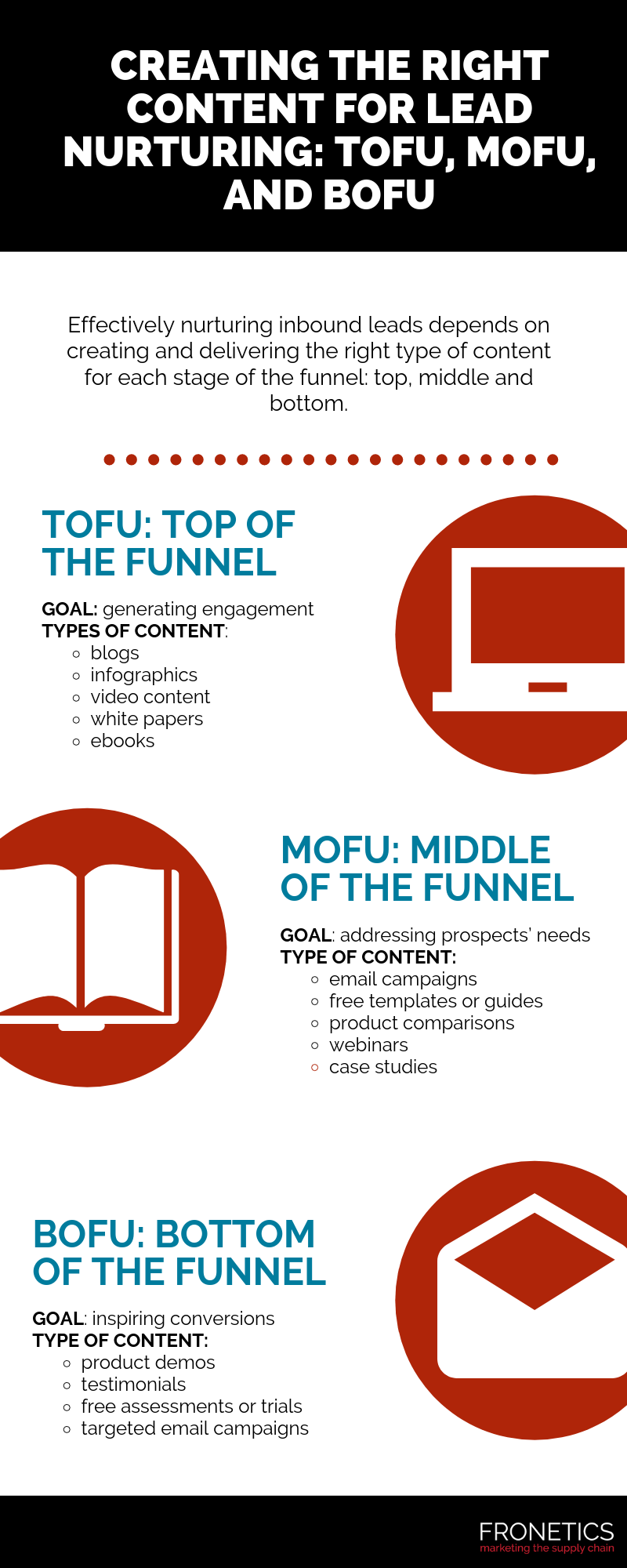
In case you’re wondering, none of these three words refer to soy-based vegetarian snacks. Instead, ToFu, MoFu, and BoFu are marketing portmanteaux, meaning top of funnel, middle of funnel, and bottom of funnel, respectively. Effectively nurturing inbound leads depends on creating and delivering the right type of content for each stage of the funnel.
ToFu, MoFu, and BoFu: a primer
Before we talk about what kind of content to deliver to prospects at each stage of the buyer’s journey, let’s take a closer look at what the terms ToFu, MoFu, and BoFu refer to and what your goals should be at each stage.
ToFu: top of the funnel
At the top of the sales funnel (ToFu), your goal is to draw in a wide audience of prospective leads, increasing brand awareness and customer engagement. This is the awareness stage of the buyer’s journey, and it represents your first impression. Leads at the top of the funnel are getting a sense of what your business does and your brand identity.
For ToFu leads, your goal isn’t conversion but simply to obtain contact information and generate interest. Says Gaetano DiNardi, Director of Demand Generation for Nextiva, ToFu “is where strangers become familiar with your brand for the first time… At this stage of the game, you don’t care about conversions; you care about piquing intrigue.”
MoFu: middle of the funnel
The middle of the funnel (MoFu), is the consideration stage of the buyer’s journey. This can be a tricky and uncertain stage as your leads continue to engage with your brand and learn about your products and services but remain unready to commit to purchase. “MoFu is usually the most complicated funnel stage because of how hard it is to define,” says DiNardi.
Ideally, by the MoFu stage, you should have a clearer idea of who your leads are and what they’re looking for. Your focus should be on continuing to educate your leads and situating your products and services as the solution to the challenges and needs of your prospects.
BoFu: bottom of the funnel
The bottom of the funnel (BoFu) is the decision stage of the buyer’s journey. You’ve established a relationship with your prospect during the MoFu stage, and your lead is now turning to you for specific information about your products and services. It’s at the BoFu stage that leads are ready to make a purchasing decision.
This is the stage when it’s all about conversion. Your goal is to inspire your lead to convert, helping them to realize that your business has the solutions they need. It’s important to note here that your goal is not to “sell,” but rather to make sure your leads know that you’re there to help.
(Made with Canva)
Optimizing ToFu, MoFu, and BoFu content for lead nurturing
Once you have a clear idea of the stages of the sales funnel and your goals for each, it’s time to consider the right types of content to ensure that prospects receive exactly the right message for each step of the buyer’s journey.
ToFu content: generating engagement
At the top of the sales funnel, where your goal is to engage your audience and collect contact information from qualified prospects, your content needs to educate leads and establish thought leadership. ToFu content shouldn’t pressure your audience to make a purchase, but instead should be geared toward providing information that speaks to needs, challenges, and questions common to your target audience.
According to Coralie Wood, Director of Demand Generation at LoginRadius, “Top-of-funnel content needs to be much more digestible and informative to ensure you are positioned as a thought leader.”
Some types of content that work particularly well for the ToFu stage:
- Blog posts
- Infographics
- Video content
- Whitepapers
- eBooks
MoFu content: addressing prospects’ needs
At this challenging middle stage, your content should begin to establish your business as the solution to a prospect’s specific needs and challenges. This is the consideration stage, and your lead is in the process of evaluating all available information to prepare to make a purchasing decision. Developing the relationship requires that your content be highly informative about how your business is ready to meet your prospect’s needs.
Because of the “wide net of interested leads who haven’t been fully qualified,” says DiNardi, “if you are too shameless about plugging your products or services, you’ll come across as pushy and likely to turn off buyers.” Instead, he suggests being “helpful and knowledgeable, while guiding your prospects into the right decision.”
Effective content types for the MoFu stage include:
- Email campaigns
- Free templates or guides
- Product-to-product comparisons
- Webinars
- Case studies
BoFu content: inspiring conversions
Now that your ToFu and MoFu content have attracted and nurtured a qualified lead, it’s time for your BoFu content to convince your lead to convert. It’s the closing stage of the buyer’s journey, which means marketers should be directing prospective buyers toward content that sells. This type of content is about cementing a decision and helping your leads recognize that your business has the right solutions.
“It’s important to note here that BoFu content can also lead directly into validation. This starts to cross the line from traditional content marketing to things like product marketing and customer testimonials,” says Mike Baker, marketing director at Lola.com. “As you work closer to the bottom-of-the-marketing funnel, your content should shift from purely educational to a more consultative, product-focused and a ‘show-don’t -ell’ style of marketing.”
BoFu content types geared to inspiring conversions include:
- Product demos
- Case studies and testimonials
- Free assessments or trials
- Targeted email campaigns
Related posts:
by Elizabeth Hines | Sep 10, 2019 | Blog, Content Marketing, Current Events, Marketing, Social Media
As social media users increasingly prefer to share content and recommendations via private messaging apps, brands need to be aware of how to take advantage of this trend.
Highlights:
- Nearly two-thirds of social media users now prefer to share content and recommendations through private messaging apps.
- Facebook Messenger is by far the most popular of these platforms.
- Chatbots can help brands engage in conversations on messaging apps and capture leads.
A recent study has confirmed a trend we’ve long predicted: A significant majority (63%) of social media users now express a preference for private messaging apps for sending messages or recommendations to people in their circle, as opposed to posting publicly on social media.
Marketers need to be aware of the implications of this shift toward private messaging apps, or “dark social channels.” Recognizing that three out of five users now prefer to connect via a private channel rather than open social media platforms, brands can tailor content accordingly and create a strategy that capitalizes on this shift.
Private messaging apps by the numbers
GlobalWebIndex and WeAreSocial teamed up to conduct research on content-sharing preferences, looking at more than 3,100 internet users. They asked research subjects how they tend to share information like articles, photos, videos, and recommendations and received the following responses:
- Private messaging apps: 63%
- Social media accounts: 54%
- Word of mouth: 51%
- SMS: 48%
- Email: 37%
Next, researchers broke down the results further, to reveal which messaging platforms users prefer:
- Facebook Messenger: 82%
- WhatsApp: 56%
- Instagram: 34%
- Snapchat: 32%
These are striking numbers. Not only is the preference for messaging apps clear, but brands should take note of the dominance of Facebook Messenger as the preferred platform. It’s likely that this preference is accounted for by the prevalence of social media for content consumption and distribution. Therefore, private messaging apps within social media platforms, with Facebook Messenger chief among them, are an easy and convenient way for users to share information.
What brands need to know about private messaging apps
The trend toward content sharing via messaging apps is mixed news for brands. On the one hand, marketers are likely be dismayed that a significant percentage of website visitors will likely be coming from these untraceable sources. On the other hand, says Olivia Valentine of We Are Social, “it means that there are likely more brand advocates than you might think.”
Valentine is right. When users share content and recommendations on messaging apps, they are engaging in authentic, private conversations, making the recommendations all the more meaningful.
Not only are social messaging apps becoming the preferred content-sharing platform among users, but brands can use these apps directly to engage with their audience. Facebook Messenger now has over 1.3 billion active monthly users globally and offers businesses the opportunity to connect directly and authentically with their audience.
Chatbots
Perhaps you’ve been reading about the rise of private messaging apps for content sharing and despairing over the idea that to keep your business relevant, your marketing staff will now need to be spending every working hour responding to thousands of messages with prospects.
Don’t despair. This is where the latest trend in artificial intelligence for marketers can help. Chatbots are computer programs that simulate, with ever-increasing accuracy, human conversation. This software communicates with your prospects inside a messaging app, carrying on a conversation until a prospect is ready to move down the sales funnel.
When it comes to creating chatbots, we recommend platforms including HubSpot’s Chatflows, Chatfuel, ChatScript, and Facebook’s Bots for Messenger tool.
The takeaway: the shift toward messaging apps is a net positive for marketers
To take full advantage of the growing user preference for private messaging apps, marketers need to ensure that their content is easily shared, engaging, and generative of authentic conversations among their audience. Furthermore, using chatbots can help businesses capture leads and engage in direct conversations on these platforms.
As Valentine points out, while the increased use of private messaging apps does mean that a certain amount of web traffic will be coming from untraceable sources, brands should be celebrating the fact that this trend means that recommendations are far more meaningful and your audience is becoming increasingly empowered to advocate for your brand.
Related links: