by Elizabeth Hines | Jun 24, 2014 | Blog, Logistics, Marketing, Social Media, Strategy
Many companies within the logistics and supply chain industries are stuck on the social media starting line. The reason – “they can’t get past the word ‘social’ and the perception it creates.” The reality is that social media is a tool that can be utilized to create value and grow your business.
This is the fifth in a series of articles that provides examples of companies within the logistics and supply chain industries who have moved beyond the social media starting line and have realized the business value of participating in social media.
Logistics industry start-ups leverage social media
Social media allows for instant connections and communication. Two start-ups, Trucker Path and Keychain Logistics, have created solutions for the logistics industry which leverage these characteristics of social media.
Trucker Path
Launched in February 2013, Trucker Path is a mobile platform for the trucking industry which connects shippers and carriers, and provides crowdsourced logistical assistance.
Specifically, the Trucker Path app (available via iOS, Andriod, and Web) enables carriers to find truckloads, shippers to move their cargo, and for truckers to get crowdsourced logistical information such as the locations of truck stops, rest areas, and information on weigh stations.
Keychain Logistics
Keychain Logistics uses technology to automate the marketplace and match shippers with carriers.
The Keychain Logistics app (available via iOS, Andriod, and Web) provides instant communication between shippers and carriers – eliminating the need for human powered brokerage.
Both Trucker Path and Keychain Logistics have recognized that there is more to social media than socializing – they have recognized that social media is a business tool.
by Elizabeth Hines | Jun 23, 2014 | Blog, Logistics, Marketing, Social Media, Strategy, Supply Chain
Many companies within the logistics and supply chain industries are stuck on the social media starting line. The reason – “they can’t get past the word ‘social’ and the perception it creates.” The reality is that social media is a tool that can be utilized to create value and grow your business.
This is the fourth in a series of articles that provides examples of companies within the logistics and supply chain industries who have moved beyond the social media starting line and have realized the business value of participating in social media.
Cerasis is a top freight logistics company and truckload freight broker. During the company’s first 15 years it focused on traditional sales and marketing strategies and relied heavily on referrals. This strategy worked. Cerasis acquired new customers, retained current customers, and realized positive growth. However, Cerasis was not viewed as an industry leader, and brand awareness was low.
In 2012 Cerasis decided to participate in social media and launch a content marketing strategy.
Cerasis began actively blogging, and began using Twitter, LinkedIn, Facebook, Pinterest, and Google+. The company quickly became seen as a leader within the industry, and brand awareness increased dramatically.
Within 15 months the company received 71 leads from search engines, 65 leads from social media, and 52 leads from webinars. Even more impressive, within 15 months the company gained 35 customers (one customer within the freight logistics industry can mean a lot of revenue).
The results show that Cerasis is no longer on the social media starting line – rather, Cerasis is now a leader, not only in the freight logistics industry, but also in using social media as a business tool.
by Elizabeth Hines | Jun 17, 2014 | Blog, Marketing, Social Media, Strategy, Supply Chain
Many companies within the logistics and supply chain industries are stuck on the social media starting line. The reason – “they can’t get past the word ‘social’ and the perception it creates.” The reality is that social media is a tool that can be utilized to create value and grow your business.
This is the third in a series of articles that provides examples of companies within the logistics and supply chain industries who have moved beyond the social media starting line and have realized the business value of participating in social media.
Sourcemap: End-to-end supply chain visibility
In the wake of events such as hurricane Sandy, the Fukushima nuclear distaster, the Bangladesh factory collapse, and the horse meat scandal, businesses and consumers are increasingly demanding supply chain transparency.
Sourcemap is a social network which provides end-to-end visibility within a supply chain. Sourcemap offers supply chain mapping, crowdsourced RFIs, risks and alerts, and KPI dashboards. Launched by researchers at MITs Media Lab, Sourcemap was recently named one of Spend Matters Top 50 companies to watch.
Figure 1: What Sourcemap Offers

Sourcemap connects producers, manufacturers, and consumers for end-to-end visibility. Manufacturers can use Sourcemap to trace products down to raw materials, to manage risk, to and plan more resilient, efficient supply chains.
Consumers can use Sourcemap to learn where things come from and what they’re made of, including their social and environmental impact.
Stonyfield used Sourcemap to create an interactive sourcing map for its yogurt – to show consumers where the ingredients that go into their yogurt comes from.
Consumers simply click on an ingredient shown on the map (Figure 2) and then are shown information about the specific ingredient (Figure 3).
Figure 2

Figure 3

In the process of creating the map, Stonyfield engaged suppliers and fostered increased communication and stronger relationships. These relationships, this communication, and the ability for companies (and consumers) to know their supply chain from end-to-end is what Sourcemap wants to provide.
Sourcemap takes social media and makes it a vital supply chain tool.

by Elizabeth Hines | Jun 9, 2014 | Blog, Marketing, Social Media, Strategy, Supply Chain, Transportation & Trucking
Many companies within the logistics and supply chain industries are stuck on the social media starting line. The reason – “they can’t get past the word ‘social’ and the perception it creates.” The reality is that social media is a tool that can be utilized to create value and grow your business.
This is the second in a series of articles that provides examples of companies within the logistics and supply chain industries who have moved beyond the social media starting line and have realized the business value of participating in social media.
Long-haul truck drivers are more likely to be overweight or obese than the general public (86% v. 65%). Additionally, truck drivers are more likely to smoke, have high blood pressure, and suffer from sleep apnea than the general public. The poor health of long-haul truckers is largely due to their lifestyle. Long-haul trucking is a sedentary lifestyle. It is also a lifestyle which makes it challenging to access gyms and healthy foods.
The cost of poor health is enormous – for truckers and for their employers. The estimated annual health care costs of obesity-related illness are $190.2 billion, or nearly 21 percent of annual medical spending in the United States. Looking specifically at the trucking industry – a study published in the Journal of Occupational and Environmental Medicine found that obese truckers had an annual average total health care cost of $1,944, compared with $1,755 for overweight truckers and $1,131 for normal-weight drivers. A sleep apnea screening and treatment program conducted by Schneider National identified 350 drivers who required treatment. Treating these drivers not only improved their health, but it also improved the company’s bottom line – over a one year period, Schneider National saved $530 per month per driver in insurance costs and saw a 71 percent reduction in accidents involving those drivers during the same period.
An article in Today’s Trucking shares the story of Jason Janneta a 42 year old trucker who had been driving for 20 years and was a poster boy for the statistics – overweight and unhealthy. Fed up, he decided to make a lifestyle change. Within six months of embracing a healthier lifestyle he had lost 80 pounds. During this period he had also taken to Twitter to share his experience and to motivate other truckers to adopt a healthier lifestyle, lose weight, and improve their health.
Tweeting as @urbanhauler with #fittrucker, Jannetta captured the attention of other truckers (he quickly grew his followers to more than 1,500) and the attention of Jared Martin, the President of Speedy Transport.
Martin recognized the value of Jannetta’s efforts and of #fittrucker – healthier individuals, a healthier bottom line, and opportunity to attract new drivers.
According to Martin:
“I really enjoyed a lot of his posts and what he was trying to do for the industry, so we brought him in for a meeting.”
The two discussed the role of health and fitness on the future of the transportation industry. The next day, Martin offered Jannetta a job at Speedy Transport – Driver Trainer and Wellness Advisor. Martin accepted the position and now tweets for @speedywellness where he brings “#trucking and #fitness/#wellness together.”
Speedy Transport is one company which has recognized social media as a business tool and has moved far beyond the social media starting line. The Twitter profile of @speedywellness rightly points out “we #ChangeTheGame of #Trucking.”
by Elizabeth Hines | Jun 3, 2014 | Blog, Marketing, Social Media, Strategy, Supply Chain, Transportation & Trucking
Many companies within the logistics and supply chain industries are stuck on the social media starting line. The reason – “they can’t get past the word ‘social’ and the perception it creates.” The reality is that social media is a tool that can be utilized to create value and grow your business.
Over the next four weeks I will be providing examples of companies within the logistics and supply chain industries who have moved beyond the social media starting line and have realized the business value of participating in social media.
Using social media to move freight
Transportation logistics is vital to the supply chain and logistics industries. For companies within these industries; however, transportation logistics can prove to be challenging to navigate and can prove challenging to the bottom line.
MercuryGate International Inc. and Con-way Inc. are two companies that have used social media to turn transportation logistics on its head – they use social media to move freight.
TweetLoad
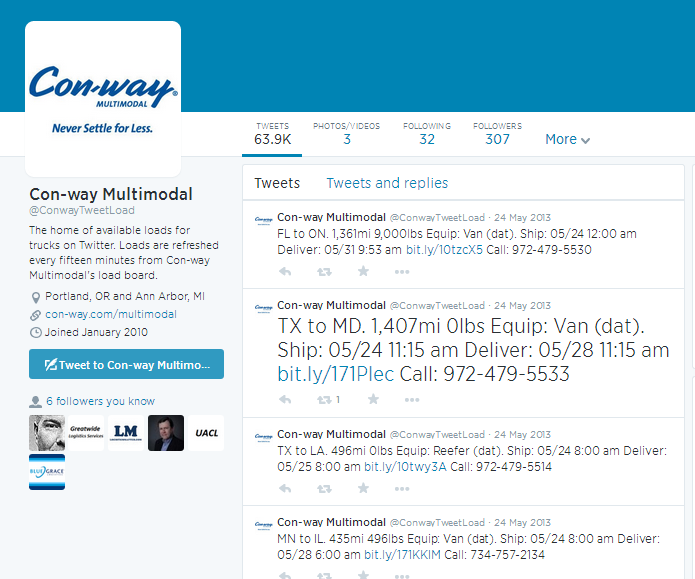
Con-way Multimodel, a division of Con-way Inc., launched TweetLoad™ in 2010. TweetLoad enables carriers to access available loads from Con-Way Multimodel via Twitter. Carriers who follow @ConwayTweetLoad on Twitter are able to see the latest available shipments as well as links to additional information on the company’s link board. Load information is updated on Twitter every 15 minutes, meaning that carriers who follow @ConwayTweetLoad have real-time information on available loads.
Figure 1: Conway TweetLoad
Bill Graves, president, American Trucking Associations (ATA): “With this novel use of Twitter, Con-way Multimodal is leading the industry in maximizing the best features of new technology to improve their processes. This is a great example of how innovative transportation companies can make it easier for carriers to do business with them, which will be a benefit to our industry overall.”
View a YouTube demonstration of TweetLoad at www.youtube.com/watch?v=0zL7h7kTU1M.
Freight Friend
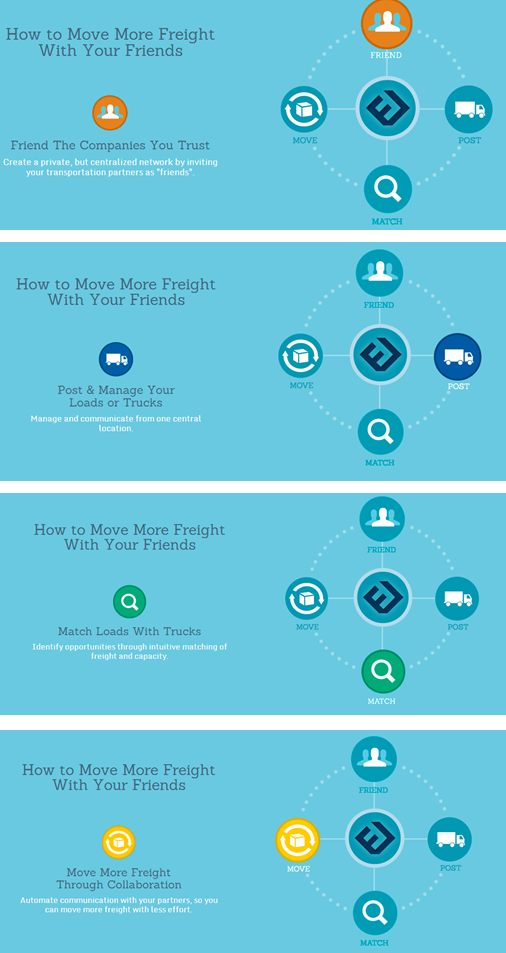
In 2011 MercuryGate International Inc. launched Freight Friend. Freight Friend is a free relationship-based full-featured load and truck internet posting service for shippers, brokers and carriers. Freight Friend creates a private network between transportation partners, and utilizes technology to automatically identify appropriate matches. The combination of the technology utilized and the relationship-based nature of Freight Friend allows companies to have real-time visibility to book trucks and find freight with companies they trust.
The Freight Friend concept is shown in Figure 2.
Figure 2: Freight Friend
“FreightFriend is perfect for carriers, shippers, brokers, 3PLs and freight management firms who only want to share information with companies they trust. They can keep their current information in one place, knowing that friends – and only friends – will have constant access. While public load boards fill a real need, they come at a cost – a lot of unknown companies bidding to carry the freight. Private boards are often useful too, but they’re inconvenient to carriers with multiple clients asking them to check their bid portals. FreightFriend solves the dilemma with a single service where carriers can easily communicate with all of their clients and brokers can find available capacity from carriers they trust.”
Freight Friend is fully integrated into MercuryGate’s TMS and Carrier Management System (Carma). Freight Friend is also available to integrate with other TMS providers.

by Elizabeth Hines | May 25, 2014 | Blog, Logistics, Marketing, Social Media, Strategy, Supply Chain
Some companies within the logistics and supply chain industries have chosen to participate in social media while others have not. Why have some companies chosen not to participate while others have decided to participate? What social networks do companies within the logistics and supply chain perceive to provide the most value to their business? What challenges do companies face with respect to social media?
Fronetics Strategic Advisors aims to gain insight into these questions and more. We are conducting a survey on social media within the logistics and supply chain industries. The objective of the survey is to learn about the participation and use of social media within the logistics and supply chain industries.
The survey is aimed at companies within the logistics and supply chain industries, and takes only about 5 to 10 minutes to complete.
This survey is confidential. Responses will be reported in aggregate and no individual- or company-identifiable information will be shared with anyone.
If your company is part of the logistics or supply chain industries please take the time to take the survey.