by Elizabeth Hines | Apr 14, 2015 | Blog, Leadership, Marketing, Talent
As much as 80 percent of employee turnover is due to bad hiring decisions, which doesn’t fare well for a company since a poor hiring choice can cost from 1.5x to 3.5x of that person’s annual salary. Consider an employee who earns $50,000 a year. If that person is a bad hire it could cost a company up to $175,000. The higher the position, the higher the salary, the higher the cost is to lose or fire that person.
More than ever companies are hiring project-based professionals who provide a specific skill-set. These placements might be short-term or long-term, depending on the company’s needs. According to the Wall Street Journal, in March 2014, more than 2.8 million workers, or 2.5% of the workforce, held temporary jobs, up from 1.7 million in 2009. One reason for the spike in numbers is due to companies having to reassess their processes and spending after the recession. Some of these employees, many of whom hold multiple part-time jobs as temps or contractors, are the new semi-permanent, temporary, or “perma-temp” work force. They are in charge of their own brand, skill-set, and advancement.
Why do companies continue to lean in this direction, even while the economy is recovering?
Let’s have a look at the benefits for employers:
- Hiring a temp or contractor allows a company to meet work demand and deadlines without having to make rushed decisions about long-term, expensive, permanent staffing.
- By hiring a contractor or temp employee companies cut expensive benefit, administrative, and payroll costs, not to mention unemployment insurance.
- Bringing in temps or contractors can boost morale amongst other employees who may feel overtaxed. A temp or consultant can take some of the work overflow from other employees.
- Temporary and contracted employees are often eager to work hard to prove themselves and gain experience. Some may be coming off of a period of unemployment and anxious to get back to work. Temporary and contract workers may work creatively and tirelessly to meet their own financial obligations. They might not have the same loyalty as full-time, permanent employees, but since they have to fend for themselves, they are not complacent. According to University of Illinois professor Joe Broschak, “On average, these temporary workers displayed better performance relative to goals compared to their full-time counterparts.” When those temps were hired on as full-time employees “they continued to become better workers after becoming permanent.”
- Temp and contract workers can offer an area of specialization that a company might be lacking in current staffing. It might be less expensive to hire a new contracted employee with years of experience in a specific skill-set than to train a current employee.
Semi-permanent work is not ideal for everyone. Some employees, especially those seeking security, certainty, and the full gamut of benefits will not be satisfied with this work. One concern is how temporary or semi-permanent employees are paid and treated. If paid fairly and treated well, this paradigm will work smoothly for some people.
What are the benefits for employees?
- Many contracting and temporary positions allow for flexibility. The jobs might be part-time and allow for adjusted hours that could accommodate an employee’s home life, another part-time job, or other interests. Because these workers have a different status than permanent, full-time employees, the same “in-office face-time” expectations may not apply to a consultant or temporary worker.
- If a temporary worker or consultant is hired for a specific skill set, they are able to focus on work they’re good at and interested in. If they’ve been out of work they can use this as an opportunity to sharpen their skillset or, perhaps, learn a new one.
- Working on a short-term project might be freeing and invigorating. Having more of a sense of control over one’s own branding, hours, and projects is exciting for many people.
- This can be a wonderful opportunity for people to network, build their personal “press kit”, and garner new, current references.
- Temporary positions often turn into long-term, semi-permanent project based consulting positions. Some people find the combination of interesting work and flexibility perfect for their lives.
It is important to remember that every dollar paid to employees –temporary, semi-temporary, “perma-temp”, full-time, or part-time—is not a dollar taken away from the bottom line, but an investment in the company. Finding the right fit that benefits employers and employees is critical.
by Elizabeth Hines | Mar 31, 2015 | Blog, Content Marketing, Logistics, Marketing, Strategy, Supply Chain
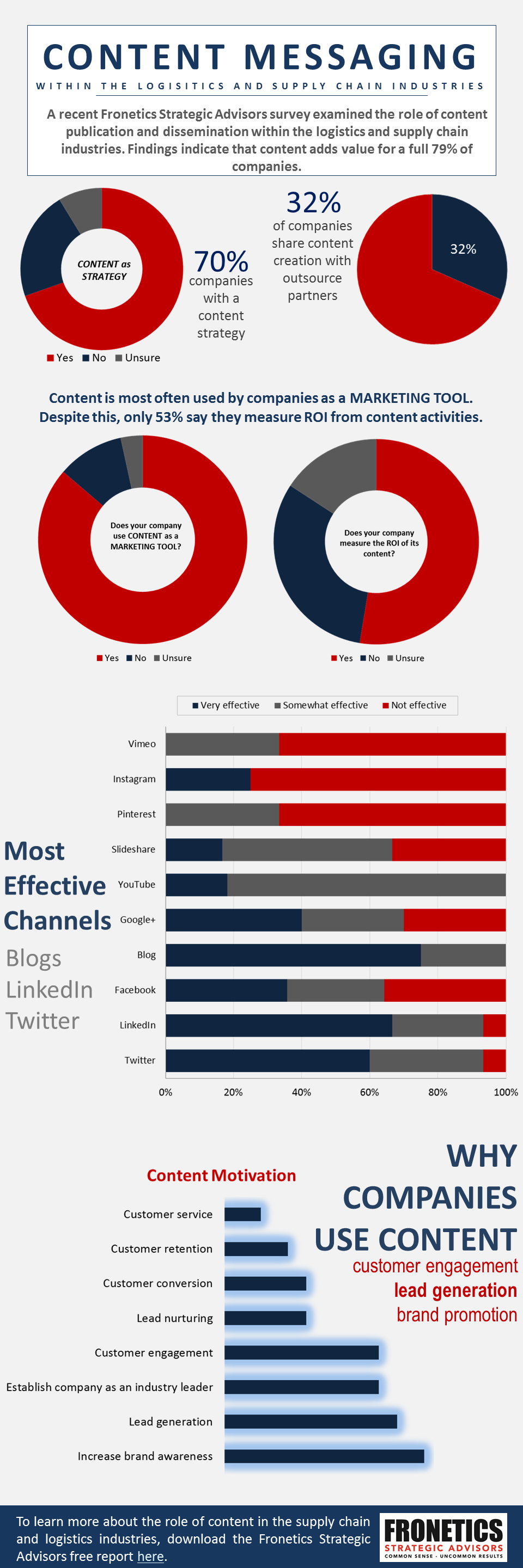
Chief among the determinants of success and failure of companies around the world is the ability to effectively communicate ideas and information. Both internal and external communication play critical roles in advancing business objectives. To be sure, connecting with audiences to convey messaging is a central component of building a solid business strategy. Recent cultural shifts and advances in digital technology have pushed aside traditional methods of communication and given way to the rise of a new type of communication strategy– one that puts content at the very center.
Fronetics Strategic Advisors conducted a survey to better understand the role and use of content within the logistics and supply chain industries.
The survey found that companies within the logistics and supply chain industries are using content as a marketing tool and are realizing benefits.
Survey respondents were asked to identify the goals of their company’s content strategy. The top three goals identified were:
- Increasing brand awareness
- Lead generation
- Establishing the company as an industry leader.
To learn more, check out our infographic, or download the report.

by Elizabeth Hines | Mar 30, 2015 | Blog, Content Marketing, Logistics, Marketing, Supply Chain
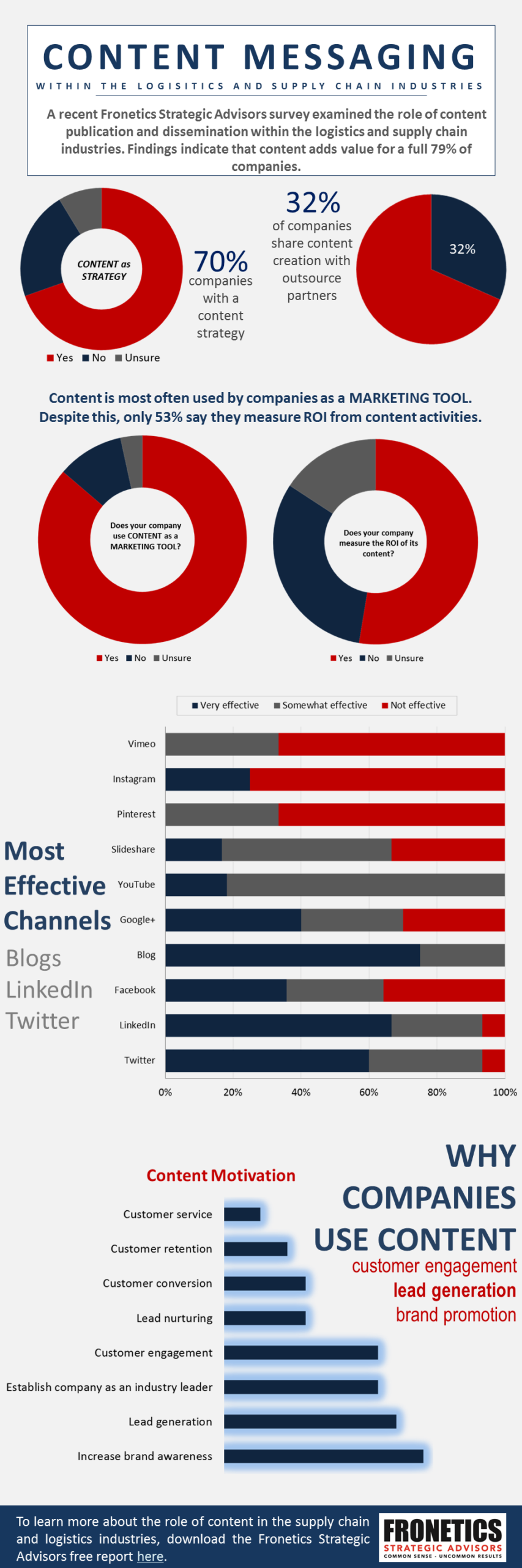
A survey conducted by Fronetics Strategic Advisors on the use of content within the logistics and supply chain industries found that content is being used by companies as an effective marketing tool.
86% of survey respondents reported that their company uses content as a marketing tool. 79% reported that content is an effective marketing tool for their company.
Central to effectiveness is strategy. 70% of survey respondents reported that their company has a strategy in place.
For the majority of companies (58%) the strategy and execution are handled in-house. However, not all companies handle everything internally. 32% of respondents reported that their company outsources some of their content creation, while 5% reported that their company outsources all content creation.
Blog content, case studies, and white papers are the most common types of content created. 78% of respondents reported that their company creates blog content. Other types of content created include:
- Case studies: 61%
- White papers: 61%
- Infographics: 48%
- Reports: 30%
- Slideshows: 26%
To learn more about content and content use within the logistics and supply chain industries, please download the report.


by Elizabeth Hines | Mar 26, 2015 | Blog, Marketing, Social Media, Supply Chain
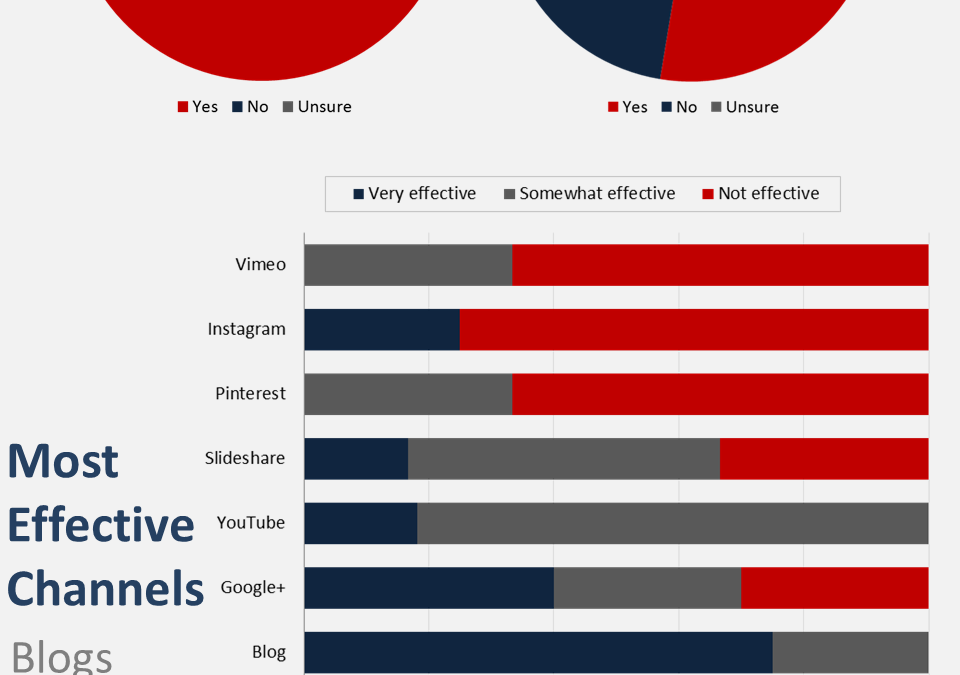
A survey on content use within the logistics and supply chain industries found that company blogs, Twitter, and LinkedIn are seen as the most effective content distribution channels.
75% of survey respondents reported that their company blog is a “very effective” channel for content distribution. 67% reported LinkedIn to be “very effective.”
Respondents reported that Vimeo, Instagram, and Pinterest were the least effective channels for content distribution.
To learn more, download the report.

by Elizabeth Hines | Mar 25, 2015 | Blog, Content Marketing, Logistics, Marketing, Supply Chain
B2B companies are creating more content than ever before. This is true too for companies within the logistics and supply chain industries.
Fronetics Strategic Advisors conducted a survey focused on the use of content within the logistics and supply chain industries. The survey found that companies within the logistics and supply chain industries are using content as a marketing tool and are realizing results. 79% of survey respondents reported that content is an effective marketing tool.
Survey respondents reported that their company uses content to:
- Strengthen overall brand awareness (96%)
- Generate leads (83%)
- Establish the company as an industry leader (74%).
To learn more about the role of content with the logistics and supply chain industries, download the report.

by Elizabeth Hines | Mar 16, 2015 | Blog, Marketing, Social Media, Strategy
How your business can use social media to generate leads.
Leads are essential to the growth of your business, and your marketing strategy is built around finding and connecting with leads. So when 92% of all marketers indicate that their social media efforts have generated more exposure for their businesses, you should take note and make social media part of your prospecting strategy.
Building a network of online connections is an effective way to find new leads. And with social media, you can find new leads by doing something called social prospecting. Social prospecting is the art of searching the social web, identifying potential prospects for your business, and engaging them in a manner that draws them to your company’s website and through your funnel. At the core, social prospecting is about listening. It’s about listening to social media conversations in order to generate leads for your business. It goes beyond monitoring keywords to engaging people that may or may not know what your business can do for them.
As you build your social prospecting strategy and develop new approaches to connect with leads, keep these 25 handy tips close by to guide your efforts.
Twitter
- Post content that draws prospects back to your website.
- Aim to share useful content on Twitter two to three times per week.
- Make customers feel appreciated by prioritizing their questions.
- Keep prospects engaged by retweeting some of their organic content.
- Favorite tweets with content that leads share.
- Respond to and offer help to industry peers’ questions.
- Delight customers by replying or favoriting tweets when they mention your company.
- Engage with potential prospects by offering help using relevant content.
LinkedIn
- Post at least twice a week to your company’s LinkedIn page.
- Join five LinkedIn Groups that could connect you with potential prospects.
- Join conversations in the group where you can add value with your content.
- “Like” content that others are sharing in the group.
- Share your own content to the group.
- Use LinkedIn Answers to respond to questions posted by others in your industry.
- Make a habit of routinely reviewing the content posted within your groups.
- Comment and add value to posts from others in the group.
- Ask for an offline meeting with your most engaged prospects.
Facebook
- Link to your blog from Facebook.
- Add calls to action to posts.
- Promote a special product or service offer solely for Facebook fans.
- Create and post visual content, like infographics and videos.
- Share a quote or industry statistic with your fans.
- To draw more comments from fans, pose a question.
- Create a Facebook event to promote trade show appearances or webinars.
- Update your company’s profile and cover photos routinely.
Ready to build a more full-bodied social prospecting strategy? We’ve laid out the quickest ways for you to find more leads and prospects on Twitter, Facebook, LinkedIn, Pinterest, and Google+ in our social prospecting workbook. In a dedicated worksheet to each of those social media platforms, you’ll find every worksheet includes: a short preparatory work to make the actual prospecting easy; visual instructions on how and where to find prospects; pro tips that will help you get the best results; prescriptions (Marketing Rx) for success; and take-home exercises for follow-up prospecting. To get started growing your prospecting opportunities and building alternative lead generation and nurturing strategies, download our free workbook.
Curious about what we’re up to on social media? Find out.