by Elizabeth Hines | Jan 5, 2015 | Blog, Content Marketing, Internet of Things, Logistics, Marketing, Social Media, Strategy, Supply Chain, Talent

Here are the top supply chain and logistics blog posts of 2014
2014 is over and a new year has begun. We look back at the content we created and shared in 2014.
Looking at content focused on the supply chain and logistics industries, there are three topics which garnered the most interest:
- The use of social media and content marketing;
- Supply chain talent;
- Technology.
Here are the top ten supply chain and logistics blog posts of 2014 based on pageviews. #1 receiving the most pageviews.
The Internet of Things trend is quickly approaching and will impact the way we live and work through increased productivity and efficiency. Supply Chain Management will continue utilizing these advanced technologies to improve factory workflow, increase material tracking, and optimize distribution to maximize revenues. Read the full blog post.
Within the past five years companies within the logistics and supply chain industries have begun to see social media as a strategic tool and have begun to actively use and leverage social media. A survey conducted by Fronetics Strategic Advisors looks, broadly, at the use of social media within the logistics and supply chain industries. The report discusses use, motivations, preferences, benefits, and challenges. Read the full blog post.
Santa’s supply chain was the first to run “in the cloud.” Read the full blog post and check out the infographic.
Looking at the manufacturing, supply chain, logistics, transportation, distribution and freight industries there are a few companies that have emerged as leaders – companies that exemplify the business value of creating and executing digital, social media, and content marketing strategies. Cerasis, a freight logistics company, is one of these companies. Read the full blog post.
The supply chain industry has a talent crisis. The question is: how can we solve this crisis? To answer this question I turned to Rodney Apple, founder of the SCM Talent Group. Apple has worked as a supply chain recruiter for the majority of his 19+ year career within the staffing industry and he has filled more than 1,000 positions within the industry ranging from executive-level in Fortune 500 headquarters settings to leadership and staff-level roles across large networks of manufacturing and distribution facilities within North America. Apple’s role affords him the ability to witness the talent crisis from the perspective of the industry, the company, and the job seeker. Read the full blog post.
The purpose of this series of blog posts is to give others in our industry and especially those in the manufacturing industry, a guide to create an effective digital, social media, and content marketing strategy which will produce results for your company. If you have followed the Cerasis blog since its launch in March 2013, you have noticed that we work really hard at executing our strategy. The reason we work so hard is because we are passionate about educating the marketplace on information that matters to them. In that way, we want to be the de facto expert in the manufacturing and logistics industries. If we can help those who are our customers and potential customers (manufacturers and distributors) with best practices around logistics and freight, as well as manufacturing industry news, we are continuing our mission of driving long term value (even if we give the information away for free). The result (we hope and have seen) is that people view us as the expert and will want to engage us in a long term relationship as their logistics services provider. We hope this is helpful and you learn something from it! Read the full blog post.
3PL provider Coyote Logistics is one of the fastest growing companies in North America. The company’s incredible growth (five-year growth: 3,585 percent) and tenacious spirit has not gone unnoticed. Forbes included Coyote in its list of Most Promising American Companies; Supply & Demand Chain Executive listed Jeff Silver, Coyote CEO, as one of their “Pros to Know;” and the company was listed as one of the best places to work by the Chicago Tribune. There are undoubtedly many factors that have contributed to the success of the company. Coyote’s approach to social media is likely one of the company’s keys to success. Read the full blog post.
Here’s the thing – the supply chain industry is perceived by those outside the industry as having no “wow” factor whatsoever. If the supply chain industry is going to attract new and qualified talent, it needs a face lift. It is time for the supply chain industry to re-brand itself. Read the full blog post.
Without a comprehensive social media strategy, your message may be getting lost in the chatter. There are a number of tools that will help you monitor your online influence and, effectively, make the necessary adjustments to ensure your efforts are paying off. Here are 10 free tools to help you measure your social media ROI. The basic features of each of these tools are free. Read the full blog post.
Regularly tracking your relationship with your suppliers and their performance toward your expectations is critical to ensure the success of your business. One mechanism for tracking this is the supplier scorecard. A scorecard is in essence a report card for your supplier. Supplier scorecards when used effectively can help maintain a healthy supply chain and will benefit both parties. If not used effectively supplier scorecards can damage the supplier relationship and hurt both businesses. Read the full blog post.
by Elizabeth Hines | Dec 17, 2014 | Big Data, Blog, Data/Analytics, Internet of Things

The Internet of Things (IoT) is ubiquitous. Because of this it can seem abstruse. Puneet Mehta does a great job of putting the concept in layman’s terms: “[A] plethora of “dumb” objects becom[ing] connected, sending signals to each other and alerts to our phones, and creating mounds of “little data” on all of us that will make marketers salivate.”
The mounds of data created by the advent of the IoT does not just make marketers salivate. Gartner predicts that the IoT will add $1.9 trillion in value to the economy by 2020. Looking ahead, Cisco estimates that the IoT will create over $14 trillion in value over the next 10 years.
In 2003 there were 500 million connected devices. Cisco estimates that this number will increase to 50 billion by 2020. Morgan Stanley believes this number will be higher – it estimates there will be 75 billion IoT devices by 2020.
“Dumb” objects are becoming connected; the physical and digital worlds are converging. Mounds of data are being collected.
IoT and Big Data
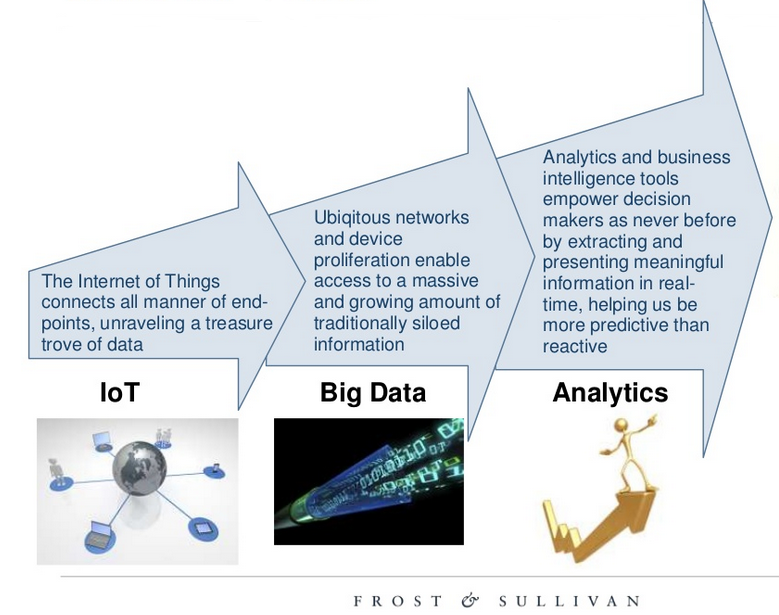
Mukul Krishna, from Frost & Sullivan, presented a simple incremental view of the relationship between the IoT and big data. In short, IoT devices can be thought of as data sources. These data sources generate an incredible amount of data – much of which was previously not accessible. The information and insights from big data allow for better decision-making.
The amount of big data created each day in 2012 was 2.5 exabytes (2.5×10¹⁸). In 2014 the amount of data were created each day was 2.3 zettabytes (2.3×10²¹),
An IDC forecast shows that the Big Data technology and services market will grow at a 27% compound annual growth rate (CAGR) to $32.4 billion through 2017 – or at about six times the growth rate of the overall information and communication technology market.
The need for a plan
McKinsey & Company offer sage advice: put a plan in place.
The payoff from joining the big-data and advanced-analytics management revolution is no longer in doubt. The tally of successful case studies continues to build, reinforcing broader research suggesting that when companies inject data and analytics deep into their operations, they can deliver productivity and profit gains that are 5 to 6 percent higher than those of the competition. The promised land of new data-driven businesses, greater transparency into how operations actually work, better predictions, and faster testing is alluring indeed.
But that doesn’t make it any easier to get from here to there.
So how does one get from here to there?
The answer, simply put, is to develop a plan. Literally. It may sound obvious, but in our experience, the missing step for most companies is spending the time required to create a simple plan for how data, analytics, frontline tools, and people come together to create business value. The power of a plan is that it provides a common language allowing senior executives, technology professionals, data scientists, and managers to discuss where the greatest returns will come from and, more important, to select the two or three places to get started.
What impact has the IoT and big data had on your company? Does your company have a plan in place?
by Elizabeth Hines | Nov 25, 2014 | Blog, Internet of Things, Marketing, Social Media, Strategy, Supply Chain
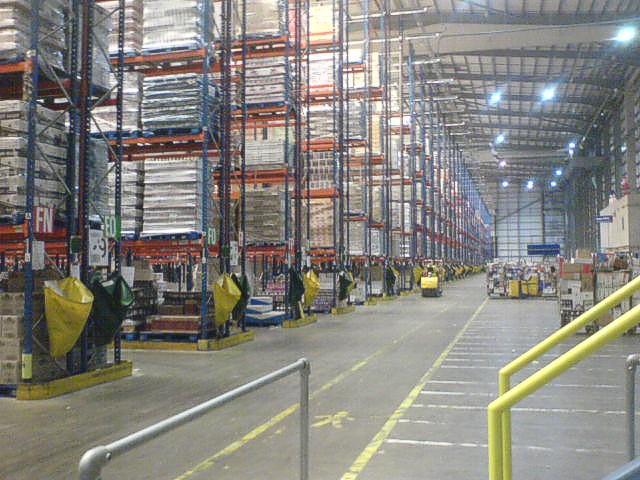
The 2014 UPS B2B Buyers Insight Study found that companies need to have a strong online presence to grow their business.
Buyers are looking for information online
Buyers are conducting research on industrial suppliers online. Sixty-eight percent of buyers research supply purchases via supplier website, and 52 percent use search engines.
In their report, UPS and TNS discuss the importance of a strong online presence:
“Given buyers’ high satisfaction levels with supplier performance on key selection criteria, and considering that web-based research is most preferred, it’s reasonable to infer that many buyers consider online research essential to their supplier selection process. The use of search engines means that suppliers may be at greater risk of losing share to companies whose products are perhaps easier to find, in stock or competitively priced. On the other hand, suppliers whose products are easy to find online and meet buyers’ criteria may also stand to gain customers.”
Being able to buy online is more important to buyers than a sales rep
Being able to access information about products online and being able to make purchases online is more important to buyers than sales representatives and printed catalogs.
Respondents were asked to rate attributes with respect to deciding from which industrial supplies vendor to purchase. Seventy-eight percent of respondents rated product information on the supplier website as “extremely important” or “very important.” Seventy-four percent of respondents rated the ability to make purchases on the supplier’s website as “extremely important” or “very important.” In contrast, fifty-eight percent of respondents rated having a sales representative as “extremely important” or “very important.” Fifty-four percent of respondents rated having a hardcopy product catalog as “extremely important” or “very important.”
Buyers like to purchase through websites
Sixty-three percent of industrial supplies buyers reported that they purchase through websites (directly from suppliers or via a third-party provider).
Sixty-seven percent of buyers responded that the ability to order through a supplier’s website is considered “extremely important” or “very important”
If you think your current customers don’t care if you don’t offer the ability to purchase products online – think again. The survey found that 34 percent of buyers say that they have gone outside of their existing supply base to make an online purchase.
Meet your customers online
Having a strong online presence is an essential component to your business strategy. If you want to grow your business you need to be online. UPS and TNS sum this up nicely:
“Be in the right place when buyers are looking: Having a superior supplier website with stellar functionality means little if buyers can’t find the site or don’t know it’s available. Making sure products and supplier information can be found easily by search engines (SEO), and being visible when buyers search for products (SEM), are essential strategies for retaining and increasing customer base.”
by Elizabeth Hines | Nov 6, 2014 | Blog, Internet of Things, Marketing, Social Media, Supply Chain
I was recently introduced to a new social network: Procurious. Procurious is a niche social network and online community created for procurement and supply chain professionals. It is a wealth of information, resources, and opportunity.
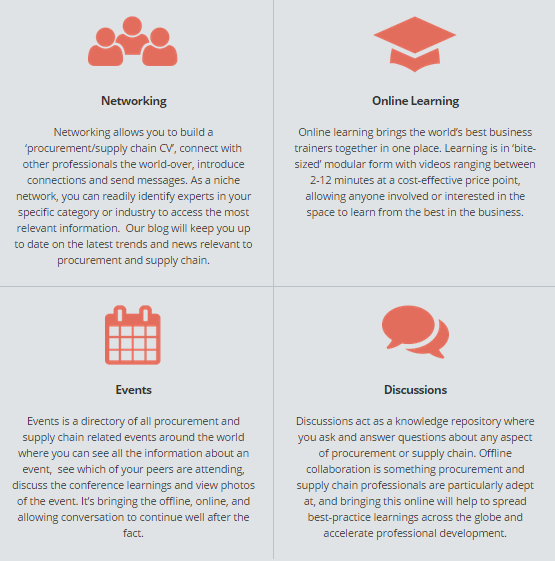
Developed by procurement and supply chain professionals, Procurious offers a wealth of resources and opportunity for those within the industries. It not only includes a social networking platform which can be leveraged for networking, communication, and sharing of knowledge, it also provides a comprehensive listing of events happening throughout the globe, on-line learning, a blog, and a news feed. In short, it can be seen as a go-to resource for procurement and supply chain professionals.
Procurious is markedly global – Members come from 70+ countries. Given the global nature of the procurement and supply chain industries, the global nature of Procurious is inherently valuable. Moreover, as the supply chain industry faces a talent gap and suffers from misperceptions, Procurious puts a much needed “fresh face” on procurement.
“We know that the procurement and supply chain profession has struggled to overcome outdated stereotypes and it’s time we join forces to become more collectively valued. By empowering our future procurement and supply chain leaders, we aim to change the face of the profession from the inside out.”
Why join the network? Here are four reasons:
After a four month beta period, Procurious launched in early 2014. Since the launch, the network has realized positive growth:
- 2000+ members
- Members from 70+ Countries
- Members come from the private and public sector, including from some of the world’s largest businesses, such as: Apple, Telstra, Lloyd’s Banking Group, Alcoa, Rio Tinto, NHS, Schweppes and IBM
- 20+ online learning modules – all currently free to access
As I have discussed before, not only is it impossible for you and your business to be present on every social network, it is also not a good use of time and resources. Instead, you need to identify which social networks (or even which social network) is right for you and for business.
Procurious is worth checking out. It is free to join and, at this time, all online learning and resources are free. Register at www.procurious.com
by Jennifer Hart Yim | Jun 26, 2014 | Blog, Internet of Things, Logistics, Manufacturing & Distribution, Marketing, Social Media, Strategy, Supply Chain
This article is part of a series of articles written by MBA students and graduates from the University of New Hampshire Peter T. Paul College of Business and Economics.
Supply Chain Management will use the Internet of Things to improve factory workflow, increase material tracking, and optimize distribution to maximize revenues.
“Clap on “(clap, clap), “Clap off” (clap, clap), “the Clapper”!!
When introduced in 1986, “The Clapper” light switch was considered a significant breakthrough in home automation. Today, with advances in communication, sensors, and internet-connected devices, you can change the temperature of your home, your lights, appliances, and security system all from your smartphone — from anywhere in the world. This is just one simple example in the growing “Internet of Things” technology. The potential is enormous, not just in home automation but in industrial applications like manufacturing and distribution.
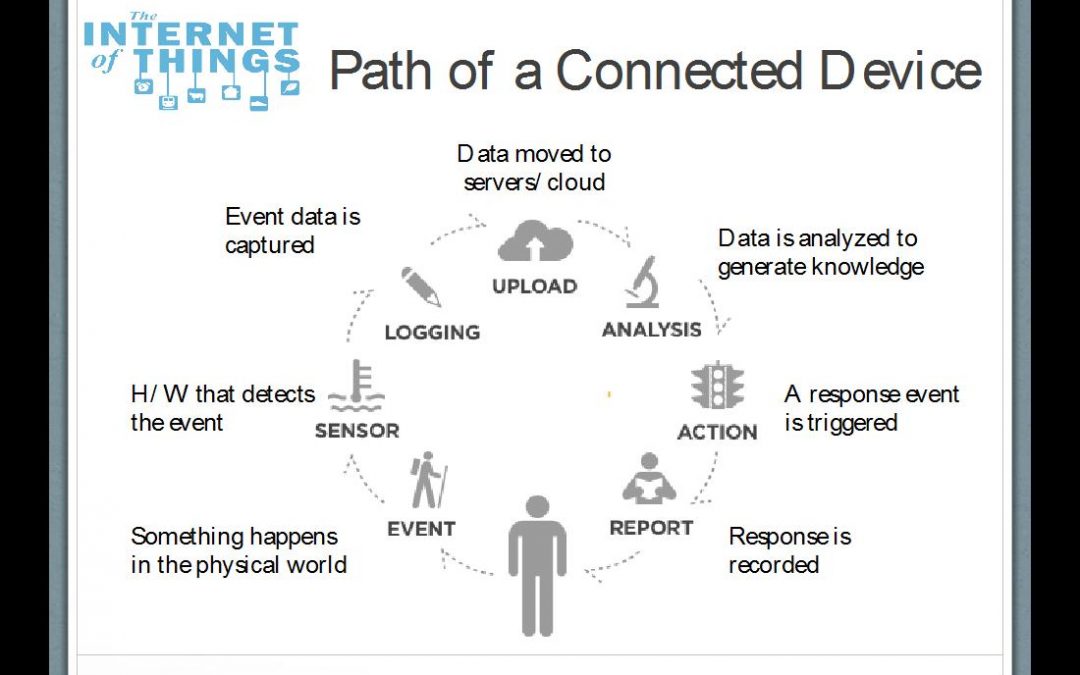
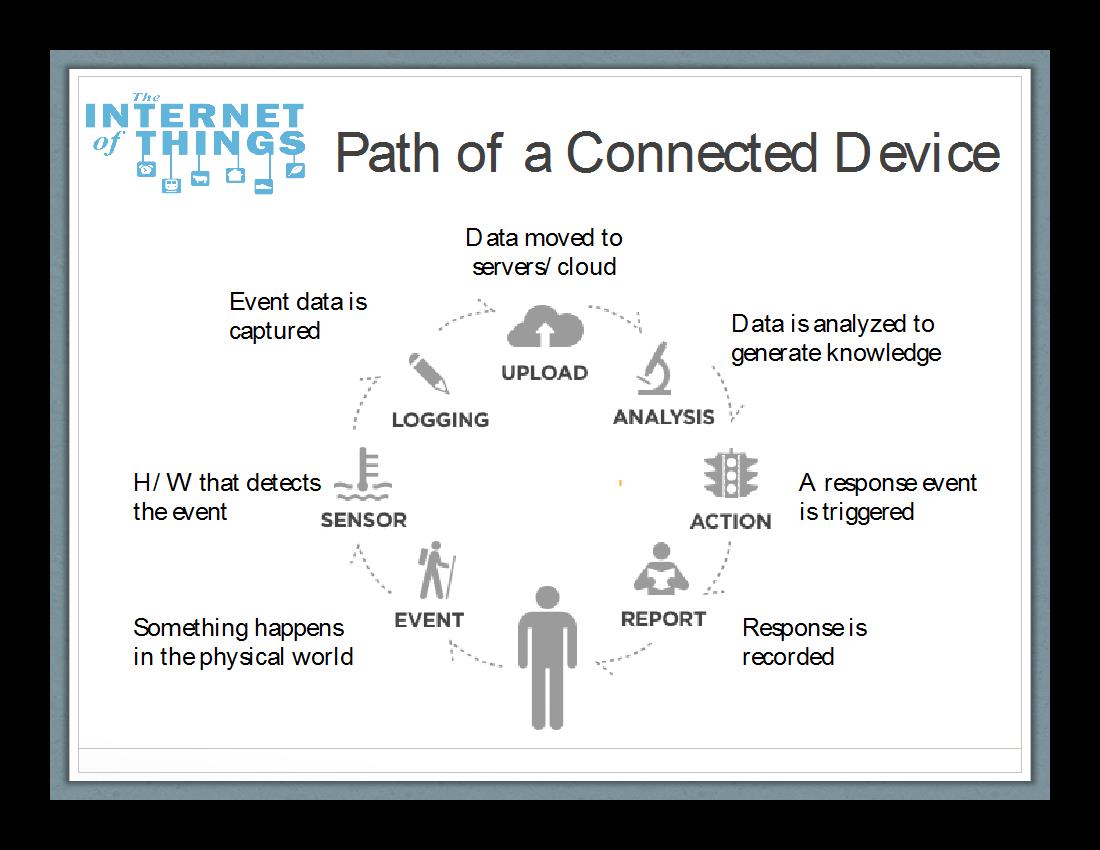
The Internet of Things (IoT) is broadly defined as the merging of the physical and digital worlds. It’s a scenario in which people and/or objects can be uniquely identified with the ability to share information over a network without any actual conscious intervention. The data is automatically transferred, analyzed, and used to trigger an event. Figure 1 below demonstrates how one of these devices functions and interacts with the Internet and other devices.
Figure 1.
The IoT and Supply Chain Management
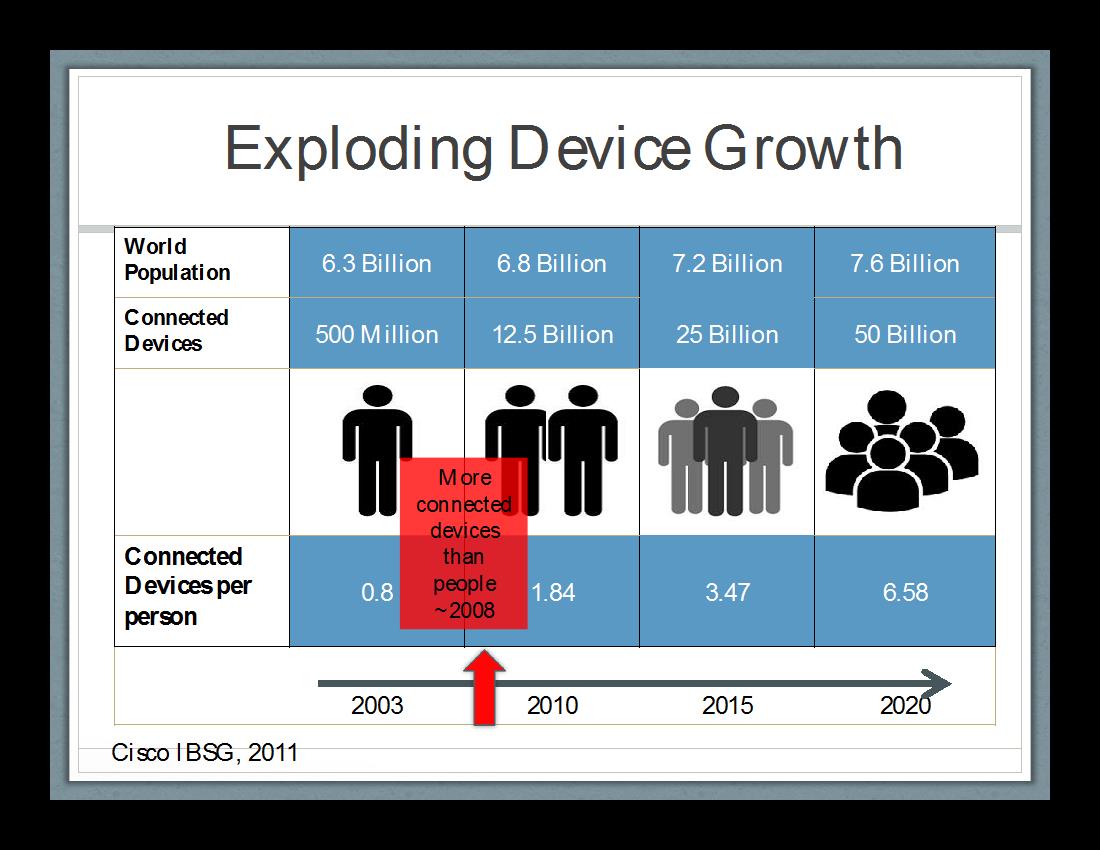
While many of us may be familiar with recent advancements in home automation, like the Nest thermostat, the real impacts of IoT will be in Supply Chain Management. Recent reports by Cisco, IDC and Gartner all claim that a significant increase in the number of devices making up the Internet of Things will have a profound impact on how future supply chains will operate. The 2011 Cisco report predicts there will be 50 billion connected devices globally by 2020, or about 6.5 devices for each person, up from only approximately 2.5 today (see figure 2). More active devices means more available data — to the point where they will be ubiquitous and transparent in our every day lives.
Figure 2.
Impacts to supply chain will be broad and far-reaching, utilizing Big Data to gather and analyze information across the entire process.
Some IoT devices have been in place for some time, such as commercial telematics now used in trucking fleets to improve logistics efficiency. Other commercial type applications — like fabrics that use sensors within clothing and industrial fabrics to monitor human health or manufacturing processes — are just being developed now.
Mark Morely of GSX, a leading provider of monitoring and management solutions, recently discussed three key impacts he believed IoT would have on the Supply Chain industry: Pervasive Visibility, Proactive Replenishment, and Predictive Maintenance. This is a great way to explain the immediate benefits, so I will summarize Mark’s description and expand with some real-world examples.
Three key impacts the IoT will have on the supply chain industry
1) Pervasive Visibility
Mark describes this as the ability to track and monitor a shipment in real time using a combination of sensors (RFID), connected devices, and communication channels (3G/4G, GPS, internet). It provides the ability to have real-time transit status, including location, temperature, and diagnostics — far more information than legacy infomatics provided.
One great example I found is from a company called Purefresh, who are at the cutting edge of Supply Chain IoT technology. They offer not only real-time shipment condition tracking, but also the ability to model and develop transit routes to optimize freshness in perishable cargo — taking into account environmental elements, such as ozone, atmospheres, and temperature. They indicate that an estimated “30% to 50% (or 1.2-2 billion tons) of all food produced on the planet is lost before reaching a human stomach.” IoT advancements will not only better optimize transit flow but also better serve humanity.
2) Proactive Replenishment
It’s the capability to automatically recognize the need to order and restock a product on a “machine-to-machine” basis, reducing the need for human interaction. The most common example is that vending machines will know when it’s out of or low on a Snickers bars and immediately trigger an alert to reorder them, instead of waiting for a service person to check on the vending machine and reorder products manually. The result is less human intervention, quicker replenishment, better sales forecasting and ultimately increased revenues. Oh, and many more happy office workers who really need a mid-afternoon sugar rush!
Opportunities for this technology go far beyond the candy vending machine though. Industries with time critical inventories like hospitals and pharmacies can better maintain supplies by supplementing human inventory control with real time use tracking. A much less critical but more broadly used application comes from Coke’s Freestyle fountain soda machine. It’s about the same size as the existing vending machines but it can dispense 126 kinds of flavors, offering an almost infinite amount of combinations. It uses Radio Frequency ID (RFID) cartridges that store the concentrated syrups in the machine. The RFID chips detect how much of each syrup it has and what combinations are being used. When it detects that it needs supplies, it transmits the information to both Coca-Cola and the storeowner including what has been sold, a record of when sales occurred, troubleshooting information, and service data. As a result, soda sales and customer satisfaction increases, all with less effort by the storeowner.
3) Predictive Maintenance
This application is closer to the true machine-to-machine communications the IoT was intended for. From large-scale manufacturing to diagnostics on the family minivan, predictive maintenance utilizes sensors and connected devices to monitor and react to issues. This self-diagnosis capability can detect a potential issue before there’s a failure, order a replacement part, and even schedule maintenance to avoid costly downtime.
Not only does predictive maintenance help keep factories running longer and the family minivan from unexpectedly breaking down, it can improve efficiency throughout the whole supply chain. If equipment manufacturers constantly receive service data from factory equipment, they can better trend problems and focus on those issues for future products. Parts depots can better forecast inventories and determine consistent safety stock levels. IoT, in this example, is a true B2B (business to business) — automating the communication between businesses on every link of the chain.
In relation to home automation, predictive maintenance will become integrated into our everyday lives. Appliances will become smarter, more efficient, and easier to monitor. Internet-connected sensors will be embedded into everything from refrigerators to washers/dryers and HVAC systems. So much so that companies like GE are investing heavily into these technologies, in both commercial and industrial applications. These connected appliances will perform self-diagnosis, determine the most cost-efficient time to operate, and even automatically order maintenance parts like furnace filters when needed. Imagine getting an alert on your smartphone that your forced hot air furnace needs a new air filter, and it has already been ordered through your Amazon account. It just saved you effort in remembering to check the filter and ordering it — leading to a cleaner, longer-lasting, and more efficient furnace.
So, why isn’t IoT here yet?
It’s close but there are still hurdles to overcome. In recent years, advances in sensor technologies, 4G communications, and cloud computing has made achieving Internet of Things capabilities even more possible. But for companies in the Supply Chain to leverage these opportunities, they will need to expand investment into cloud-based platforms that can support scalable devices and data-analysis services.
Critical to IoT’s success will be the necessary “middleware” software communication protocols to link all these devices. Companies like ProSyst and open-source SW projects like OPENIoT are pioneering these capabilities. But even with this progress, agreements on industry standards will be key to long-term platform success.
Having a common IoT protocol will be necessary to link the physical and digital worlds on a consistent and economical basis. Understanding the need for standards and common architectures, Intel has led the way by recently creating the not-for-profit Industrial Internet Consortium (IIC) with other vested companies like AT&T, Cisco, GE, and IBM. The connected Supply “Chain” will become exponentially longer once these common standards are in place.
The Internet of Things trend is quickly approaching and will impact the way we live and work through increased productivity and efficiency. Supply Chain Management will continue utilizing these advanced technologies to improve factory workflow, increase material tracking, and optimize distribution to maximize revenues.
In 1986, I recall how innovative I thought the Clapper was — I couldn’t have imagined how connected we would become only 28 years later. And the next 28 will be sure to amaze.
Steve Mondazzi is a Principal Master Planner in the Defense Contracting industry. After 20 years’ experience in project management and schedule development, he decided to further his education by recently earning a Masters in Technology Management at the University of New Hampshire. He’s a certified PMI Project Management Professional, an entrepreneur, and an avid lover of all things technology. He currently resides in Massachusetts with his wife, two teenagers, and an excessive collection of headphones. Steve can be contacted via his Twitter account @schedulepro or through LinkedIn.
Related posts: