by Elizabeth Hines | Apr 1, 2015 | Big Data, Blog, Data/Analytics, Logistics, Supply Chain
A distribution center struggling with a high number of forklift truck impacts found a way to leverage big data to address a nagging, costly warehouse issue. The company had installed a telematics solution on its forklift trucks, but could not determine the cause of the impacts. The time and location of impacts were known, as well as the identity of the drivers involved, but the company still needed to pull in more data sources for an effective assessment.
Forget for a moment the potential of adopting big data analytics throughout the entire supply chain and consider instead how big data can untangle and integrate seemingly unrelated masses of data to solve small problems in a warehouse or distribution center. That’s exactly what this company did.
By analyzing the link between environmental factors inside the distribution center and the forklift impact records, the culprit was swiftly identified: fast-moving thunderstorms that caused the humidity level to rise so quickly that the dehumidifiers could not keep up, increasing the risk of drivers losing control on the slippery concrete floor. That knowledge helped the company prevent sliding accidents by using a function of the telematics solution to reduce the maximum speed of the trucks when the humidity hit a certain level.
Indeed, distribution centers and warehouses present ideal environments — microcosms — for big data applications. Modern facilities are loaded with sensors and detectors to track every pallet and every piece of material handling equipment in real-time. Managers see the benefits in increased productivity, improved inventory flow, optimized equipment usage, and more. However, for that Eureka moment, organizations should also apply big data analytics across these multiple sources of data to uncover patterns that will drive even more, and perhaps surprising, operational improvements.
Rather than looking at data in isolation, a holistic approach holds significantly more power. Managers typically keep careful track of the performance of lift trucks, batteries, and chargers. But it is not until those entities are reviewed as a single system and matched with data coming off the lift trucks that a new level of revelations can be had.
Look for big data analytics to further raise the IQ of our “smart” warehouses and DCs. Inbound Logistics sums it up this way: “Accessing the right information to make smart decisions in the warehouse is one main reason why the demand for big data has grown so much — and so rapidly — in the distribution sector.”
Do you think distribution center and warehouse managers do enough to leverage big data?

by Elizabeth Hines | Mar 19, 2015 | Big Data, Blog, Data/Analytics
“[Companies] don’t know how to manage it, analyze it in ways that enhance their understanding, and then make changes in response to new insights… they don’t magically develop those competencies just because they’ve invested in high-end analytics tools.” –You May Not Need Big Data After All” Harvard Business Review, December 2013
Since the concept of big data became the buzzword du jour, big data has become big business. But a recent study by Harvard Business School suggests that many big-data investments fail to deliver because most companies can’t handle the information they already have. That’s why when it comes to big data, bigger is not always better, particularly for small to midsized companies. Lured by the promise of big payoffs, many companies have sunk millions of dollars into sophisticated data analytics software only to realize they did not have the capabilities to interpret the new insights nor the expertise to turn them into a competitive advantage. For some companies, focusing on small data often makes more sense.
It’s not hard to see why the temptation to jump headfirst into a big-data project can be strong. Giants like Amazon, Google, and Walmart showcase how an entire enterprise can be built around the interpretation of unfathomable masses of data. These companies have perfected the science of gleaning — and capitalizing on — detailed insights about customer behavior. (For example, Walmart was able to pinpoint something as specific as what kind of Pop-Tarts customers stock up on before a storm — strawberry.) With similar analytics tools now available to companies in all kinds of industries, the opportunity to turn hype into hope may be irresistible.

Companies within the logistics and supply chain industries don’t seem to be impervious to the draw of big data. In fact, a survey conducted by Supply Chain Insights found that one fourth of respondents had a big data initiative in place and 65% planned on launching one in the near future. A full seventy-six percent of survey respondents viewed big data as an opportunity. The promise of benefit from the theoretical application of big data no doubt sharpens its appeal. A supply chain company could on the demand side, for example, determine to use big data to map all the quotes and online searches that never became orders and change its marketing strategy based on a newfound understanding of how the purchase of one product leads to the purchase of another. On the supply side, big data could be used to measure the impact of a catastrophic event on suppliers abroad, and consequently, allow the company to plan in advance to mitigate the effects on American consumers. These big data benefit examples could lead to significant advantage for companies with the expertise, structure, and knowledge to collect, analyze, and draw strategy cues from large sets of raw data. Unfortunately, small and mid-sized companies usually aren’t well positioned to do so.
Start Small
Starting with small data, even if you want to eventually head into big data, is a solid strategy that will produce lasting results. To start, clearly articulate what kinds of data you want to collect and begin running a few simple analytics. Choose from which sources you’ll draw data, because randomly scanning everything between heaven and earth will do you no good. Align your goals with your business objectives and turn your analytics professionals loose on the data. If your company doesn’t have in-house analytics expertise, work to attract the appropriate talent; regardless of whether or not you have a new hire, integration and structuring of analytic personnel positions will be a more significant factor in your success than even your use of the most advanced statistical software program. Finally, spend some time determining how the findings should be presented. You’ll want them to be formatted in an understandable manner and to have a clear application for how they will improve your business.
For those of you working in small to midsized companies, what’s your take on big data? What kind of approach would make a successful small-data initiative?
by Elizabeth Hines | Dec 17, 2014 | Big Data, Blog, Data/Analytics, Internet of Things

The Internet of Things (IoT) is ubiquitous. Because of this it can seem abstruse. Puneet Mehta does a great job of putting the concept in layman’s terms: “[A] plethora of “dumb” objects becom[ing] connected, sending signals to each other and alerts to our phones, and creating mounds of “little data” on all of us that will make marketers salivate.”
The mounds of data created by the advent of the IoT does not just make marketers salivate. Gartner predicts that the IoT will add $1.9 trillion in value to the economy by 2020. Looking ahead, Cisco estimates that the IoT will create over $14 trillion in value over the next 10 years.
In 2003 there were 500 million connected devices. Cisco estimates that this number will increase to 50 billion by 2020. Morgan Stanley believes this number will be higher – it estimates there will be 75 billion IoT devices by 2020.
“Dumb” objects are becoming connected; the physical and digital worlds are converging. Mounds of data are being collected.
IoT and Big Data
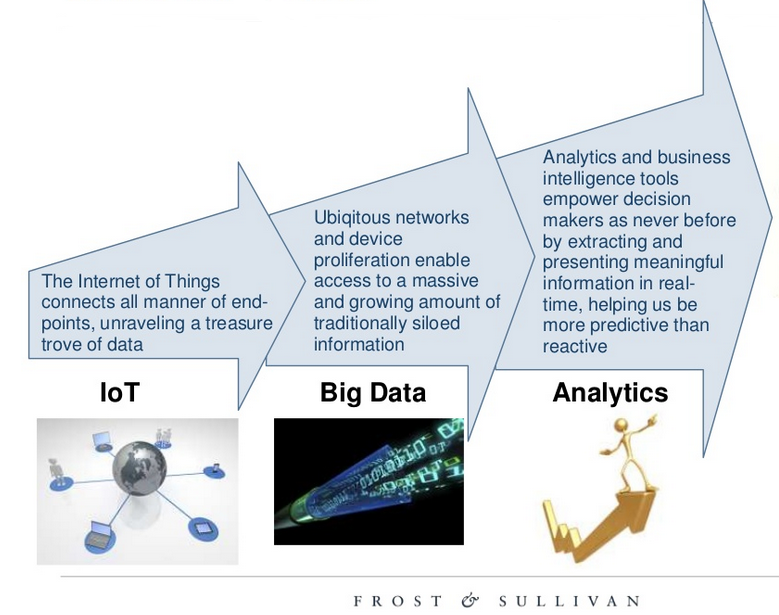
Mukul Krishna, from Frost & Sullivan, presented a simple incremental view of the relationship between the IoT and big data. In short, IoT devices can be thought of as data sources. These data sources generate an incredible amount of data – much of which was previously not accessible. The information and insights from big data allow for better decision-making.
The amount of big data created each day in 2012 was 2.5 exabytes (2.5×10¹⁸). In 2014 the amount of data were created each day was 2.3 zettabytes (2.3×10²¹),
An IDC forecast shows that the Big Data technology and services market will grow at a 27% compound annual growth rate (CAGR) to $32.4 billion through 2017 – or at about six times the growth rate of the overall information and communication technology market.
The need for a plan
McKinsey & Company offer sage advice: put a plan in place.
The payoff from joining the big-data and advanced-analytics management revolution is no longer in doubt. The tally of successful case studies continues to build, reinforcing broader research suggesting that when companies inject data and analytics deep into their operations, they can deliver productivity and profit gains that are 5 to 6 percent higher than those of the competition. The promised land of new data-driven businesses, greater transparency into how operations actually work, better predictions, and faster testing is alluring indeed.
But that doesn’t make it any easier to get from here to there.
So how does one get from here to there?
The answer, simply put, is to develop a plan. Literally. It may sound obvious, but in our experience, the missing step for most companies is spending the time required to create a simple plan for how data, analytics, frontline tools, and people come together to create business value. The power of a plan is that it provides a common language allowing senior executives, technology professionals, data scientists, and managers to discuss where the greatest returns will come from and, more important, to select the two or three places to get started.
What impact has the IoT and big data had on your company? Does your company have a plan in place?

by Elizabeth Hines | Oct 2, 2014 | Big Data, Blog, Data/Analytics, Strategy, Supply Chain
Big data is big. It is revolutionary. It is transformative. But what the heck is it?
MIT’s Technology Review does a great job of outlining the hype and the confusion around big data:
“There is unanimous agreement that big data is revolutionizing commerce in the 21st century. When it comes to business, big data offers unprecedented insight, improved decision-making, and untapped sources of profit.
And yet ask a chief technology officer to define big data and he or she will stare at the floor. Chances are, you will get as many definitions as the number of people you ask. And that’s a problem for anyone attempting to buy or sell or use big data services—what exactly is on offer?”
Research conducted by Accenture highlights this dichotomy. Eight-nine percent of survey respondents reported that they believe big data will revolutionize business operations in the same way that the Internet did. Seventy-nine percent of respondents reported that “companies that do not embrace big data will lose their competitive position and may face extinction.” However, the research found that companies hold “differing views of data sources and uses,” and that “valuable data sources are omitted or overlooked.”
Big data and the supply chain
Accenture’s Global Operations Megatrends research looked at big data analytics in the supply chain. Ninety-seven percent of supply chain executive reported that big data analytics can benefit their supply chain. Their expectations for big data analytics include: creating an organizational ability to react more quickly to changes (48 percent); helping their company gain insights about the future (45 percent); and achieving a cross-functional view of the supply chain with the objective of optimizing overall supply chain performance (43 percent).
Although the majority of executives believe big data analytics will benefit their supply chain only 17 percent of survey respondents reported that their company has already implemented analytics in one or more supply chain processes/functions. Accenture makes this supposition:
“While there is considerable hype about, and a high level of general awareness of the value of, ‘big data,’ many companies still do not fully understand how to apply analytics to this data to drive higher supply chain (and overall enterprise) performance.”
Given Accenture’s research, as well as that conducted by Jonathan Stuart Ward and Adam Barker at the University of St Andrews in Scotland, I’d take this one step further. In spite of the hype (or perhaps because of it) there remains confusion regarding what big data actually is. Without a clear definition and understanding of big data, it is (and will continue to be) a challenge to implement big data analytics. Before we realize transformation we need to get to understanding.