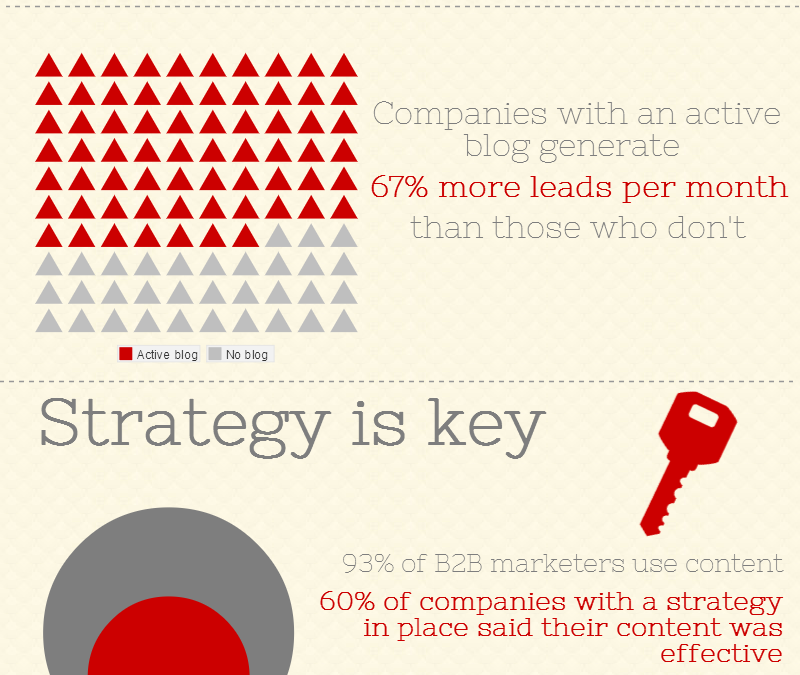
Infographic: How to grow your business with content
Content infographic: how to grow your business with content

Content infographic: how to grow your business with content
When it comes to content your company doesn’t need to go it alone. Not only is it possible to outsource content, for many companies it may be the best solution. Here is how to determine if outsourcing content is right for your company, and what your company needs to consider when looking for an outsource partner.
Outsourcing is not the panacea. It may be the right solution for your company – or maybe not. Here is what to consider when determining if outsourcing content is the right solution for your company:
Be honest. Cobbling together staff or passing content like a hot potato from one person to another is not going to be effective. If content is not an area where your company excels, or if content could be carried out more efficiently and effectively if the service was outsourced – start looking for an outsource partner.
If you do decide that outsourcing is right for your company, know that you are not alone. Forty-four percent of B2B marketers report that they outsource content creation. Diving down further, 72 percent of large B2B companies (1,000 employees or more) outsource content creation and 34 percent of small B2B companies (10 to 99 employees) outsource content creation. Looking specifically at the manufacturing industry – 55 percent of manufacturing marketers report that they outsource content creation.
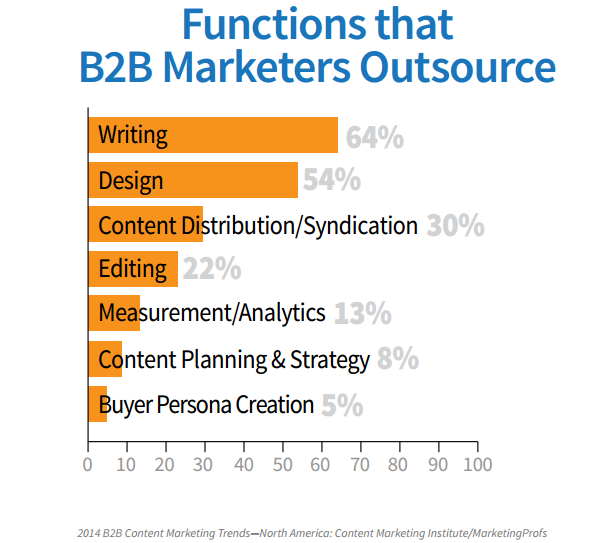
As shown in Figure 1 the content functions that B2B marketers outsource vary from writing to design to distribution to creating a buyer persona. When it comes to outsourcing content functions it doesn’t need to be the kitchen sink.
Figure 1
When it comes to finding an outsource partner you want to find a partner that will bring value to your company and to your customers. Whether you outsource all content functions or just one, here is what to look for in an outsource partner:
More generally, Frank Cavallaro wrote that when choosing your perfect outsource mate it is important to start by looking at the mission or value statement of your potential partner. Are these aligned to your company’s? If they are, move on and explore the partnership further. If not, walk away. “Mission and value statements speak to the core culture of the company, so if you can’t find common ground here, it is unlikely you will be able to build a positive working relationship.”
This post was originally published on DC Velocity.

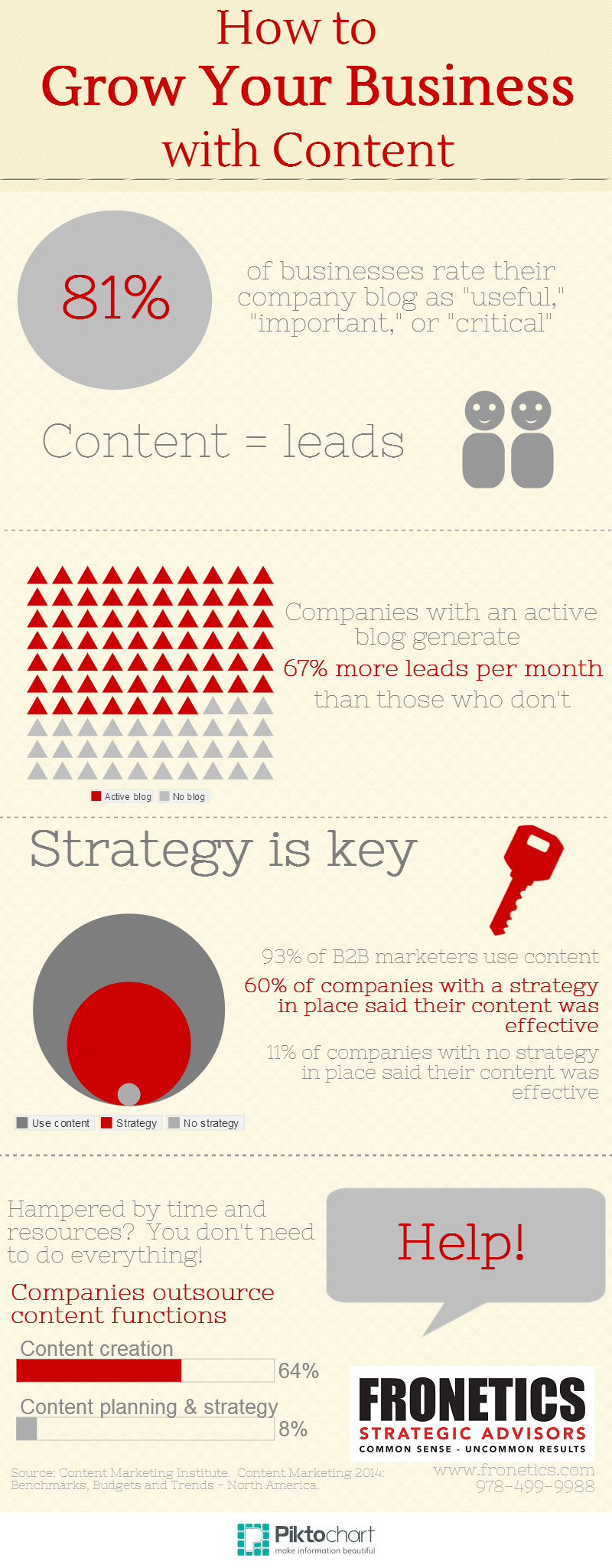
A 2014 study found that 93 percent of B2B marketers use content marketing and that there is a significant difference in the effectiveness of content marketing if a strategy is in place – 60 percent of companies who have a documented content strategy in place consider their efforts to be effective as compared to 11 percent of companies with no documented content strategy in place. Similarly, the study found that companies who put a person in charge of content marketing were more likely to be successful than those who did not (86 percent vs. 46 percent).
In short, the majority of companies do not have a strategy in place despite the fact that companies are budgeting for and creating content and, that those who have a documented content strategy in place are more effective than companies who do not have a strategy in place. If your company is going to be effective at using content to drive profitable customer action, your company needs to have a strategy in place. Arjun Basu wisely said: “Without strategy, content is just stuff, and the world has enough stuff.”
If you want your company’s content strategy to be effective, you need to put someone in charge. Make sure they are in charge not just in name, but also in execution. That is, make sure the person in charge is given the authority to execute the strategy.
Why does your company want to create content? Do you want to shorten your sales cycle? Increase leads? You don’t want your content to be just stuff. You don’t want content to be ineffective. Therefore it is important to define what it is you want your content to do for your company.
Who is your audience? Create a persona. Take your time. Be honest. If you identify and define your audience correctly you will be more likely to reach your target audience and engage them than if you get this step wrong.
Determine how you are going to track and measure success. Determine the metrics that you are going to track on a daily, weekly, monthly, and yearly basis.
When it comes to content, distribution is essential – your content will not reach your target audience and will not be read unless it is distributed. Take the time to identify the distribution channels that are right fit for your company, your content, and your goals.
A publishing or editorial calendar provides you with a framework to create and distribute content. It helps you create content that is consistent, that is quality, and is tailored to your company’s goals. It is also helpful in terms of managing workflows, meeting deadlines, and managing writer’s block.
Valuable and relevant content is not a sales pitch. It is not content that pushes your products and services. Rather, it is content that communicates valuable information to customers and prospects so that they have the knowledge to make better informed decisions. Moreover, it is content that establishes your business as a reliable source of knowledge – as the thought-leader within the industry. Be thoughtful when you create content.
Distribute your content via your target distribution channels. Distribute the content consistently over time and at the right time.
Once your content has been distributed, engage with your audience. Respond to comments, respond to questions, and provide clarification. Make your content more than words – make it a relationship.
Track and analyze your metrics on a daily, weekly, monthly, and annual basis. Take a look at what is working and what is not. By tracking and analyzing your metrics you can see, for example, what type of content is most effective and which distribution channels are helping you achieve your goals.
Your strategy should not be set in stone. Your strategy should be flexible. Look at your metrics, look at the feedback you are getting through your engagement with customers and prospects – make adjustments to your strategy as needed.
Remember that when it comes to content it is important to think marathon not sprint. An effective content strategy requires patience and determination. Many companies make the mistake of giving up on a content strategy too early; make a long-term commitment to your strategy.
This article was originally published on DC Velocity.

Content is king. By creating and distributing valuable and relevant content in a strategic and consistent manner you will be able to create demand for your products and services and will be able to drive profitable customer action. That being said, while content is king, content doesn’t go far (actually it goes nowhere) without distribution. Wise words by BuzzFeed’s Jonathan Perelman: “Content is king, but distribution is queen and she wears the pants.”
For content to be successful for your business you need to do more than create content – you need to distribute content. Moreover, the content needs to be delivered consistently over time, at the right time, and in the right place.
For your company this means taking the time to identify the distribution channels that are the right fit for your company, your content, and your goals. It also means taking the time to learn how to distribute content via these channels effectively.
For example:
Content will help you move the needle. Content will drive profitable customer action. However, your content, no matter how valuable it is, will not be seen and therefore will not be effective if you do not have a solid content distribution strategy. If you want results, remember who wears the pants.
This post was first published on DC Velocity.

In the 1970s people were exposed to an average of 2,000 ads per day. Today we are exposed to more than 5,000 ads per day. The barrage of ads has resulted in buyers tuning them out. With buyers no longer paying attention to ads, businesses need to adjust how they find and engage new prospects, and how they establish and maintain long-term relationships with customers.
The solution: content. Why content is king and your business should take an oath of alliance to the kingdom.
Content is inclusive of blogs, white papers, e-books, newsletters, infographics, podcasts, webinars, and video. Creating and distributing valuable and relevant content in a strategic and consistent manner is what will drive profitable customer action.
Valuable and relevant content is not a sales pitch. It is not content that pushes your products and services. Rather, it is content that communicates valuable information to customers and prospects so that they have the knowledge to make better informed decisions. Moreover, it is content that establishes your business as a reliable source of knowledge – as the thought-leader within the industry.
How does this translate into consumer acquisition and retention? When the customer is ready to make a purchase they will reward your company with their business and with loyalty.
Skeptical? B2B companies with an active blog generate 67 percent more leads per month than those who don’t. A study by the Custom Content Council found that 72 percent of marketers think branded content is more effective than advertising in a magazine, 62 percent say it is more effective than advertising, and 69 percent say it is ‘superior’ to direct mail and PR.
Content that will move the needle for your business is valuable content. It is content that is informative, educational, interesting, and speaks to your customer’s emotions and speaks to their pain points. Furthermore, it is content that is delivered consistently over time and at the right time.
Before you start to create content for your business consider this sage advice offered by Arjun Basu: “Without strategy, content is just stuff, and the world has enough stuff.”
Research supports Basu. Companies that have a documented content strategy are more likely to consider themselves effective than companies that don’t have a strategy in place (60 percent v. 11 percent). Similarly, companies who put a person in charge of content marketing were more likely to be successful than those who did not (86 percent v. 46 percent).
How do companies put together and execute a content strategy? Eight percent of B2B marketers outsource content planning and strategy. Sixty-four percent of B2B marketers report that they outsource writing and thirty percent outsource distribution and syndication. Diving down further, 72 percent of large B2B companies (1,000 employees or more) outsource content creation and 34 percent of small B2B companies (10 to 99 employees) outsource content creation.
Content is king. By taking an oath of alliance to the kingdom, your company will attract and retain customers. Your company will realize an increase in leads, short sales cycles, and more loyal customers.
If you’d like to learn more about creating a content strategy for your business and/or about content creation , get in touch.
A version of this article also appeared on DC Velocity

Despite the considerable amount of attention paid to demand generation, many companies (including some companies actively employing a demand generation strategy) do not have a clear understanding of what demand generation actually is.
When asked to define demand generation, a common response is: the generation of demand. Another common response: a marketing strategy. An honest response: I don’t know; what the heck is demand generation?
Demand generation is the creation of awareness and excitement about your company and your products and services. Demand generation is not a one-off; rather it is a continuous process of engaging and nurturing both current and future customers. Demand generation helps you attract new customers and engage (or re-engage) current customers. Demand generation grows your business.
Components of a demand generation strategy include: blogs, social media, podcasts, video, newsletters, email, white papers, and case studies. These components work together. They position your company as a thought leader, expert, and influencer in your industry. They build trust. Importantly, they drive engagement and communication. The foundation of demand generation is the creation and sustaining of relationships between your company and your customers – current and future.
According to DemandGen, 90 percent of business buyers say when they’re ready to buy, they’ll find you. How will they find you? When B2B buyers were asked to rank where they turn to find a new solution, 46 percent listed a “web search” as their first source for information. The leading choice for both the second and third ranked sources was vendor web sites.
With respect to social media, DemandGen found that blogs are considered to be the social media channel with the biggest impact on the researching process (46 percent). LinkedIn was also found to be a place where buyers turned to conduct research (41 percent).
The survey also found that content had a significant impact on the decision to buy. Nearly two-thirds of respondents said “a vendor’s content had a significant impact on their buying decision,” and 34 of respondents “strongly agreed that the winning vendors provided a better mix of content to guide them through each stage of the researching and decision-making process.”
What is the take away? The take away is that a company with a strong presence and a demand generation strategy is more likely to be successful than a company who does not have a strong presence or a demand generation strategy.
What is the different between a successful demand generation strategy and one that falls flat? A successful strategy incorporates communication, engagement, and quality content. Furthermore, a successful demand generation strategy is built upon an understanding of customer needs and interests –real, not perceived.
At Fronetics we work with our clients to design and implement a demand generation strategy that is right for them – for their company and for their customers. We know how to create awareness and excitement about our clients’ companies and their products and services. We also know how to help our clients engage with and nurture their customers.
Through our demand generation service, Engage, we help companies acquire new customers and grow their businesses by penetrating new markets and deepening their presence and impact in existing markets. If you are interested in learning more about Engage and about creating a successful demand generation strategy, we’d love to talk with you.