by Elizabeth Hines | Aug 19, 2014 | Blog, Content Marketing, Leadership, Marketing, Strategy, Talent

By consistently creating, curating, and distributing valued and trusted content you can position your company as an industry leader.
What is valued and trusted content?
“Peer-power”
A survey by the CMO Council found that all content is not viewed equally by B2B buyers. “Peer-powered content” is more valued and trusted than non-peer content.
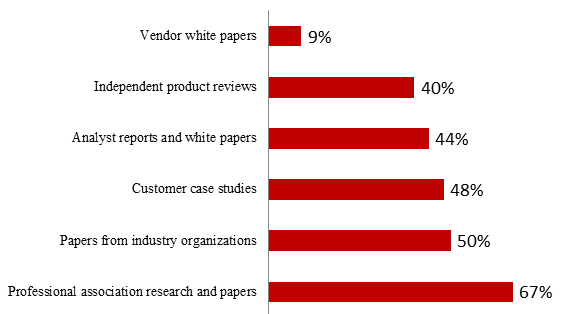
The survey found that professional association research and papers are the most valued and trusted content. Papers from industry organizations, case studies, and analyst reports and white papers were also reported to be valued. In contrast, vendor white papers were not found to be valued highly.
What type of content do you most value and trust?
Source: CMO Council
Depth not promotional
The characteristics that were found to be valued the most by B2B buyers were depth of the content (47 percent) and ease of access and readability (44 percent). Respondents reported that they do not like content that has too many requirements to download (50 percent) or is promotional or self-serving (43 percent).
Good content is shared
B2B buyers report that they share good content. Fifty-nine percent of survey respondents share content with 25 or more peers and associates, and 28 percent of survey respondents forward content on to 100 or more people.
Position yourself
To position your company as an industry leader you need to provide valued and trusted content. This means creating, curating, and distributing content that educates, informs, and addresses specific needs.
It also means avoiding the trap of self-promotion. Valued and trusted content is not content that is self-serving or promotional, rather valued and trusted content provides customers with answers, solutions, and education.
Blogging is essential, but additional content is necessary as well. Case studies and white papers are two go-to content solutions that can help you position your company as a trusted leader within your industry.
Remember that you don’t need to go it alone. More than 44 percent of B2B marketers report that they outsource content creation.

by Elizabeth Hines | Aug 12, 2014 | Blog, Content Marketing, Marketing, Social Media, Supply Chain

Connectivity, mobility and accessibility are game changers for business. Companies that recognize this and adapt accordingly will succeed, companies that don’t will not.
Unnovation
Olaf Swantee, CEO of EE, calls this refusal to innovate “unnovation” and defines it as the following:
If unnovation ever made it into the Oxford English Dictionary, I believe the description would be something along the lines of “unnovation (noun) … the refusal to identify, create, embrace or adopt new ideas, leading to the unnecessary and un-timely end to a business, which is ultimately overtaken by external progress.
What are companies who have fallen prey to unnovation? Yell (Google), Borders (Amazon), and Blockbuster Video (Netflix) are just three examples.
Companies within the supply chain, and the supply chain industry in general, are at risk of falling prey to unnovation despite being in a prime position to innovate.
Unnovation and the supply chain
KPMG’s 2013 Global Manufacturing Outlook reported that the US manufacturing sector “seems primed for an era of ‘hyper-innovation,’ in which companies develop not only new products, but also entirely new ways to build them.” Unfortunately, companies within the manufacturing sector are not primed for innovation. KPMG found that 44 percent of survey respondents reported that they still use “old” technologies such as email, fax, and “snail” mail to manage their supply chains.
Similarly, the supply chain industry has been slow to participate in social media and to invest in creating a strong online presence. The primary reason: a lack of understanding of the business case or value.
Participating in social media and investing in creating a strong online presence are fundamentally different from the traditional strategies which companies within the supply chain industry have employed to attract new customers, foster relationships with current customers, communicate with partners, and grow their bottom line. Because of the stark contrast between “old” and “new,” companies do not recognize how these strategies can positively impact their bottom line and therefore decide to steer clear – they feel engaging is too risky. The reality is that not participating is risky; not participating is unnovation.
These companies embrace change
Keychain Logistics
Companies that choose to unnovate will be eclipsed by companies who embrace the world of mobility, connectivity and accessibility. Keychain Logistics is one company that has decided to embrace change.
Bryan Beshore, Keychain’s founder, recognized the changes taking place and decided not just to embrace them, but to also capitalize on them. Keychain leveraged the ideas of mobility, connectivity and accessibility and created a new way for the freight transportation industry to conduct business. Keychain is a marketplace that connects drivers directly with shippers – and is available via mobile app.
Keychain has also become an active participant on social media. This participation has enabled the company to shape their offering with a solid understanding of what people want from a transportation provider. Furthermore, Beshore notes that social media has helped grow their business: “From phone calls to interviews, crowdfunded campaign partnerships, and beyond, social media has certainly helped us grow our business.”
Cerasis
Another company that has been successful – Cerasis. For 15 years the freight logistics company used traditional sales and marketing strategies. This strategy worked; however, the company recognized that if it were going to remain competitive and grow it needed to adapt. The company launched a digital, social media, and content marketing strategy. The strategy lead to an increase in website traffic of close to 670 percent, an increase in search visits by close to 2,190 percent and, most importantly, the company acquired 35 new customers – a significant number for the industry.
Swantee believes that if companies choose unnovation, “Ultimately, it could lead to disastrous consequences for their businesses, their staff and their future.” I agree. If a company wants to remain relevant and competitive, and if a company wants to grow – it needs to recognize that connectivity, mobility and accessibility are game changers for business.

by Elizabeth Hines | Aug 5, 2014 | Blog, Content Marketing, Marketing, Strategy

The amount of content on the internet is tremendous – and is growing by the second. With 93 percent of B2B companies using content marketing, and with more than $16.6 billion dollars being invested annually by B2B companies in digital content publishing – how can your content and your business stand out?
The CMO Council, Content ROI Center, and Netline conducted a survey of 352 senior-level B2B buyers, influencers, and decision makers with the objective of determining content’s role in influencing B2B buyers in the purchase process. The results of the survey can be used as a guide for creating content that will help you grow your business by driving profitable customer action.
Why do buyers consume content?
Sixty-two percent of B2B buyers turn to content in order to learn about new market developments and industry practices. Sixty percent turn to content to discover new solutions to address a specific problem. 52 percent look to content to address a project or a program being undertaken by their company.
Why do buyers value content?
Fifty-four percent of B2B buyers report they believe content keeps them current on new techniques. Forty percent say that it helps identify partners and solution providers. Thirty-eight percent of B2B buyers believe content provides strategic insights and shapes their purchase specifications. Thirty-seven percent of B2B buyers report that content educates them about industry issues, problems, and challenges.
Content that will grow your business
Content that will draw customers to your website and to your business is content that educates, informs, and addresses specific needs.
So that your business does not get lost in the clutter, you need to create and curate content that educates consumers about the industry, technology, and new market trends. Moreover, your content should address the needs and pain points of your target customer. Therefore, your content should answer questions, provide solutions, and provide strategic insight.
If you consistently create and curate content that B2B buyers find valuable, you will realize results.
by Elizabeth Hines | Jul 1, 2014 | Blog, Content Marketing, Manufacturing & Distribution, Marketing, Strategy, Supply Chain
Think like a manufacturer
Gartner’s Jake Sorofman wrote a great piece about building a content supply chain. His advice for understanding what it takes to use content as a tool to grow your business: think like a manufacturer.
Why? Sorofman connects the dots:
Manufacturing is actually an instructive example for what it takes to scale and sustain a content marketing program. Why? Because content marketing requires a replenishing pipeline of engaging content—a content supply chain—that helps feed the beast every day.
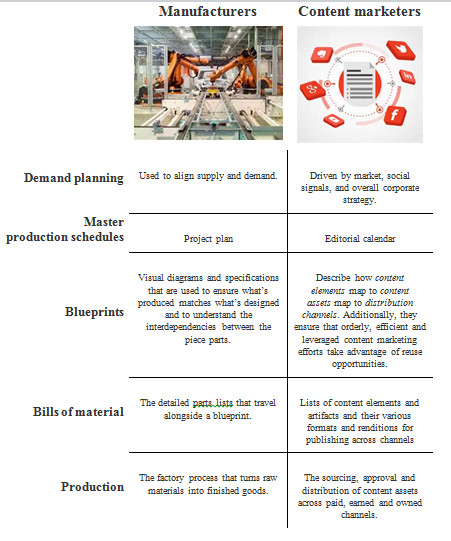
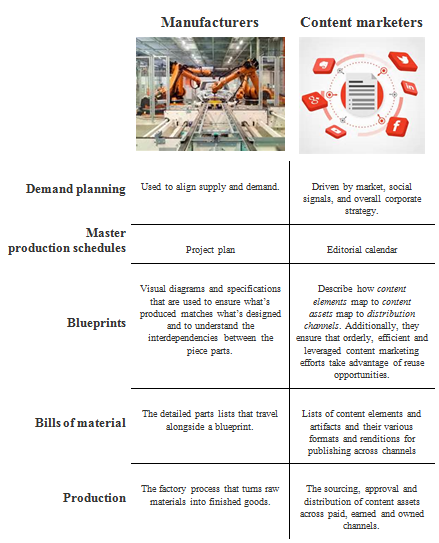
The following table (adapted Sorofman’s article) further illustrates the parallel between manufacturing and content marketing.
How can you successfully replenish your content supply chain and grow your business?
Strategy. As in manufacturing, strategy is essential when it comes to content. Without a strategy in place your content efforts will fall flat and will not help you grow your business. Want to learn more about creating a content strategy that will drive profitable customer action? Download our eBook: Grow your business with content: 12 steps to a content strategy.

by Elizabeth Hines | Jul 1, 2014 | Blog, Content Marketing, Marketing, Strategy
Content can grow your business.
How can content such as blog posts, white papers, eBooks, newsletters, infographics, podcasts, webinars, and video grow a business? Content can grow your business by increasing your search engine ranking, positioning your company as an industry leader, attracting new customers, and helping you retain current customers.
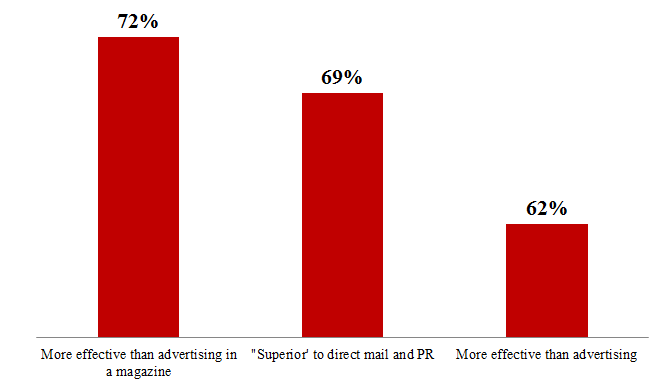
Not convinced? B2B companies with an active blog generate 67% more leads per month than those who don’t. What’s more, a study by the Custom Content Council found that 72% of marketers believe branded content is more effective than advertising in a magazine, 62% believe it is more effective than advertising, and 69% believe it is ‘superior’ to direct mail and PR.
Not all content is equal. Not all content will help you grow your business.
Content that will move the needle for your business is valuable content. It is content that is informative, educational, interesting, and speaks to your customer’s emotions and speaks to their pain points. Valuable content is not a sales pitch. Furthermore, valuable content is content that is delivered consistently over time and at the right time.
Strategy is vital
A 2014 study of B2B marketers found that companies who have a documented content strategy in place are more likely to consider their efforts to be effective than companies who do not have a documented strategy in place (60 percent vs. 11 percent).
The 12 steps to creating a content strategy that will help your company drive profitable customer action are:
- Put someone in charge
- Define your goals
- Define your audience
- Define your metrics
- Identify the right distribution channels
- Create a publishing calendar
- Create content
- Curate content
- Distribute content
- Engage with customers and prospects
- Track and analyze metrics
- Make adjustments as necessary
Want to learn more about these 12 steps and creating an effective content strategy? Download our eBook.


by Elizabeth Hines | May 19, 2014 | Blog, Content Marketing, Marketing, Social Media, Strategy
The internet is a fire hose stream of content. Being able to navigate the deluge of content and identify the content that is valuable to your customers and to your business is essential; it can also be incredibly time consuming. Content curation tools can save time and increase productivity.
Here are 11 content curation tools that will help you establish your business as a thought-leader and trusted resource.
Bundle Post
With Bundle Post you connect and control Alerts and RSS feeds based on keywords. Bundle Post saves the content from your feed channels as a social media post, allowing you to view, edit or delete the content within the channel, all in one place, then merge selected curated content with scheduled posting times you create for each of your social media accounts and networks. Bundle Post offers a free 30 day trial. After that subscriptions start at $19.99 per month.
ContentGems
ContentGems monitors more than 200,000 news sites, blogs, and social media accounts. With ContentGem you can filter content a number of different ways including: custom keywords, sources, and media types. With ContentGems it is easy to share content via social media (one-click publishing and the ability to schedule posts). Freemium and premium options available.
feedly
feedly enables you to organize, read and share the content of your favorite feeds, blogs and news sites. If you liked Google Reader, feedly fills that gap. Free and premium versions available.
iFlow
iFlow allows users to discover, create, and curate ‘flows’ on any topic. Flows are topic-based streams that let users stay connected and updated with selected topics. These ‘flows’ may be followed, which results in users being continually updated with content relevant to selected topics. Flows can be set up to include detailed filters to provide for high quality of content curation. iFlow also allows users to create their own private flows. Users may invite others to contribute on their flows or can even keep their flows private. iFlow is free.
Individurls
Individurls is quite similar to feedly. One of the strengths of this content curation is how easy it is to use on your mobile phone. Individurls is free.
Netvibes
Although Netvibes is one of the original content curation tools, it remains a solid (and not outdated) solution. Netvibes offers a number of ready-made feeds and widgets. Both freemium and premium versions are available.
Newsle
Newsle is a great tool to keep you on top of what is happening with people within the industry and within your social network. It is also a great tool if there are specific writers or journalists whose content you want to keep track of. With Newsle you identify the people and Newsle sends you an email when those individuals are mentioned in the news.
paper.li
paper.li enables you to create your own online newspaper based on content you select. You add various sources and specify filters on these sources and a paper is produced. You can then add or remove “articles” from the paper. While paper.li can be used for free, the paid version allows you to brand your newspaper.
Post Planner
Post Planner is a solution for those who are avid Facebook users; PostPlanner is a Facebook app. With PostPlanner you enter in keywords and search for trending content within your niche. You can then sort this content to view the content with the most likes or shares so you can see the most popular content. While PostPlanner does offer a free version, to get the most from this tool you will need to upgrade to one of the premium packages.
Scoop.it
Scoop.it offers users a great experience and a constant stream of content. Scoop.it automatically finds and features comment from places like Twitter and Google blogs based on your target keywords and interests. It is also customizable, allowing for additional sources to be added to your stream(s). In Scoop.it you create boards of content around specific topics and then add content to these boards. Scoop.it allows for one-click publishing to your blog and social networks. Scoop.it offers a free trial, after that plans start at $12.99 per month.
Trapit
Trapit positions itself as a “smart” curation tool, increasing in intelligence and relevance the more you use it. It features more than 100,000 vetted content sources and includes “hidden gems” that have the potential to make your presence stand out. How does it do this? Trapit uses the same Artificial Intelligence and Machine Learning Technology from which Siri is derived.