by Elizabeth Hines | Feb 14, 2018 | Blog, Logistics, Supply Chain, Talent
Google’s management study shows that supply chain students who learn soft skills will be more innovative and successful.
A recent Google study of its top employees is shaking up the way we think about how we should be educating students. We’ve all heard about the importance of focusing on a STEM (science, technology, engineering, and math) curriculum to give students the skills they need to compete in the workforce. But Google’s study, dubbed Project Oxygen, suggests that the conventional wisdom about “hard skills” might be counterproductive.
Google’s findings have broad implications for the way supply chain companies think about training and recruitment. While an understanding of the industry and relevant technologies is, of course, important, it turns out that “soft skills” are often a more accurate predictor of innovation and success.
STEM expertise is not a priority
Project Oxygen ranked the seven most important qualities of Google’s top employees. STEM expertise ranked seventh. The shock waves of this finding are still resounding through the tech sector, as Google and other companies are rethinking the way they recruit talent.
Rather than searching only for top STEM students, Google has changed its hiring practices to include humanities majors, artists, and MBAs.
For Google’s top employees, these six “soft skills” all ranked higher than STEM expertise:
- Being a good coach;
- Communicating and listening well;
- Possessing insights into others (including differing values and points of view);
- Having empathy toward and being supportive of colleagues;
- Being an effective critical thinker and problem solver; and
- Being able to make connections across complex ideas.
What to look for when recruiting supply chain students
For training and recruitment of supply chain students, what’s emerging is a picture of a team player who is creative, empathetic, communicative, and caring. As a recent guest post on Fronetics’ blog points out, “soft skills are taking on more relevance as automation begins to handle the nuts and bolts of how products come to market, and how companies work with suppliers.”
This means that the function of the human component is to do what only humans can: be flexible, strategic, creative, understanding, and empathetic.
According to Cathy Davidson, founding director of the Futures Initiative and a professor in the doctoral program in English at the Graduate Center, CUNY, “We desperately need the expertise of those who are educated to the human, cultural, and social as well as the computational.”
Davidson goes on to point out that “what helps you thrive in a changing world isn’t rocket science. Broad learning skills are the key to long-term, satisfying, productive careers.”
What do you look for when interviewing supply chain students?
Related posts:


by Elizabeth Hines | Feb 13, 2018 | Blog, Content Marketing, Logistics, Marketing, Supply Chain
Here are three tips for writing pillar content that will help structure your posts, attract leads and gain better page rankings.
In case you missed our series on writing for SEO, pillar content is a highly effective way to define your brand, drive traffic, and convert website visitors to leads. But in order to be effective, these pages should be strategically designed to do their proper job in telling search engines what your site is all about.
Before we go further, let’s take a step back and talk about exactly what pillar content is. As search engines adjust their algorithms to favor topic-based content, savvy marketers are turning to topic clusters to structure their content.
“This method uses a single pillar page as the main hub of content for a given topic. All of your content assets related to that topic link back to the pillar page,” explains HubSpot blogger Amanda Zantal-Wiener.
Need some ideas for writing and structuring effective pillar content? Here are three tips to get you started.
3 tips for writing pillar content
1) Start thinking about your site differently.
Not so long ago, SEO optimization was all about keywords. But search engines are changing. As their algorithms get more sophisticated, they look for websites that can provide depth and breadth on a particular topic. That means topic-based content wins you better page rank. It’s time to start thinking about your site as a collection of topics rather than a collection of keywords.
2) Consider your core audience.
“Think about the top interests and challenges of your core audience personas to give you ideas for pillar page content,” says HubSpot blogger Sophia Bernazzani.
Good content marketing is all about cultivating your reputation as a trusted resource for your audience, and pillar pages are no exception. Chose topics that answer the needs of your target audience. Topics should be broad enough to be able to generate multiple related blog posts, but narrow enough that you can cover all related content on a single pillar page.
3) Your content is about answering questions.
“Pillar pages should answer any question or query a searcher might have about a topic — which will make them want to click on your pillar page when they enter a Google search term that your page ranks for,” writes Bernazzani. The goal is to draw site visitors with savvy pillar content, and let them explore all content in your topic cluster.
Related posts:


by Elizabeth Hines | Feb 12, 2018 | Blog, Current Events, Logistics, Manufacturing & Distribution, Supply Chain
As Cupid spreads his wings, gifts of experience and romantic, at-home options will take over the market for Valentine’s Day 2018.
Consumers will spend a near-record $19.2 billion on Valentine’s Day 2018, up from $18.2 billion in 2017. According to NRF’s annual survey, over half of the country will participate (55%) in the romantic holiday, spending just over $140 on average.
Gifts of experience
A new Valentine’s trend is giving gifts of experience, such as a spa treatment, concert tickets, or a cooking class. Almost half of celebrants said they would prefer a gift of experience, and 23% said they plan on giving a gift of experience. Blue Apron’s Love at First Bite targets couples looking for gifts of experience with a foolproof, stay-at-home option for Valentine’s Day 2018. And they’re not the only ones! Hello Fresh, Plated and even Whole Foods are publishing blog articles and offering meal options for creating the perfect Valentine’s dinner from the comfort of your own kitchen.
Out on the town
The NRF’s survey also found that younger people (ages 18-34) are more likely to take their Valentine out for the evening than older generations. So it’s no surprise that 6 out of 10 younger celebrants (ages 18-34) would also prefer a gift of experience over candy and flowers.
Mobile trend
95% of Americans own a cell phone. The growing connection between smartphones and digital information is starting to take over Valentine’s Day, as well. Over half of participants plan to use their smartphones to assist with Valentine’s Day purchase decisions. Nearly 40% said they plan to use their cell phone to research products and compare prices.
Tradition prevails
Not to worry, though: Celebrants will still purchase plenty of flowers, jewelry and candy to mark the holiday. Celebrants are most likely to give candy as a gift, followed by greeting cards, flowers, and an evening out.
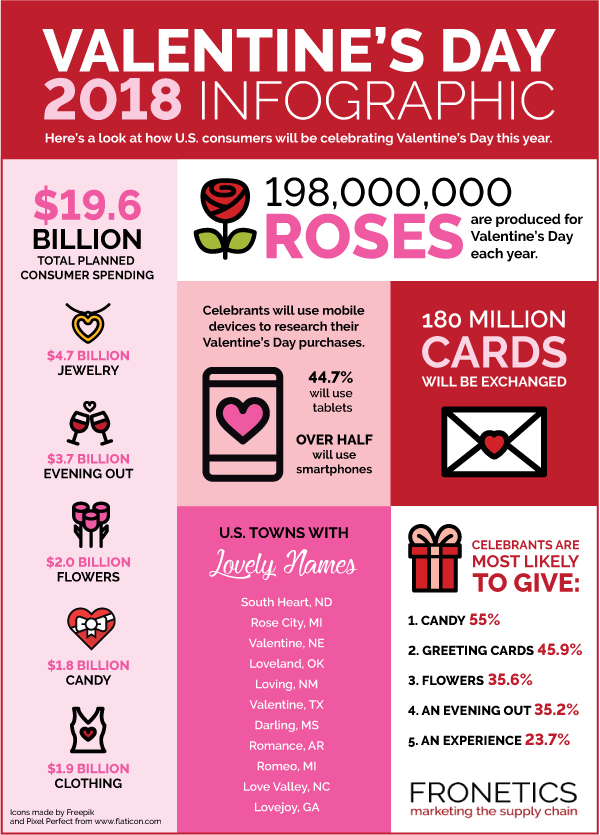
Here’s a look at how U.S. consumers will be celebrating Valentine’s Day 2018.
Valentine’s Day 2018 Supply Chain Infographic
Related posts:


by Elizabeth Hines | Feb 8, 2018 | Blog, Content Marketing, Logistics, Marketing, Social Media, Strategy, Supply Chain
These social media statistics are important to keep in mind when planning out your content marketing strategy.
A strong social media presence is key to successful marketing in 2018. Social media is simply unavoidable these days.
So, you jumped on board and you’re posting and tweeting. You’re creating content. You’re learning about search engine optimization and how to improve your rankings. But you’re still not reaching the audiences you were hoping to attract. What’s going wrong?
When you are posting on social media could be as important as what you’re posting.
Timing is everything, and that statement especially holds true when it comes to posting content to social media. If you are sending out your message and nobody is there to see it, you are that proverbial tree falling in the forest; you did not make a sound. Your post had little to no impact.
So, even if you are putting in the time and effort to craft informative blog posts, tweets with just the right message, or Facebook posts that inspire more than just page likes, you still are not getting the most exposure you can out of social media.
We have done our homework when it comes to the best times to post on social media. And the truth is there is no “one size fits all” answer to when you should post. There are general guidelines that differ for each site. But in general, it’s important to keep your target audience in mind when deciding where and when to post.
Here are some social media statistics that you need to consider when deciding when to post your content.
Social media statistics your business needs to consider when publishing content
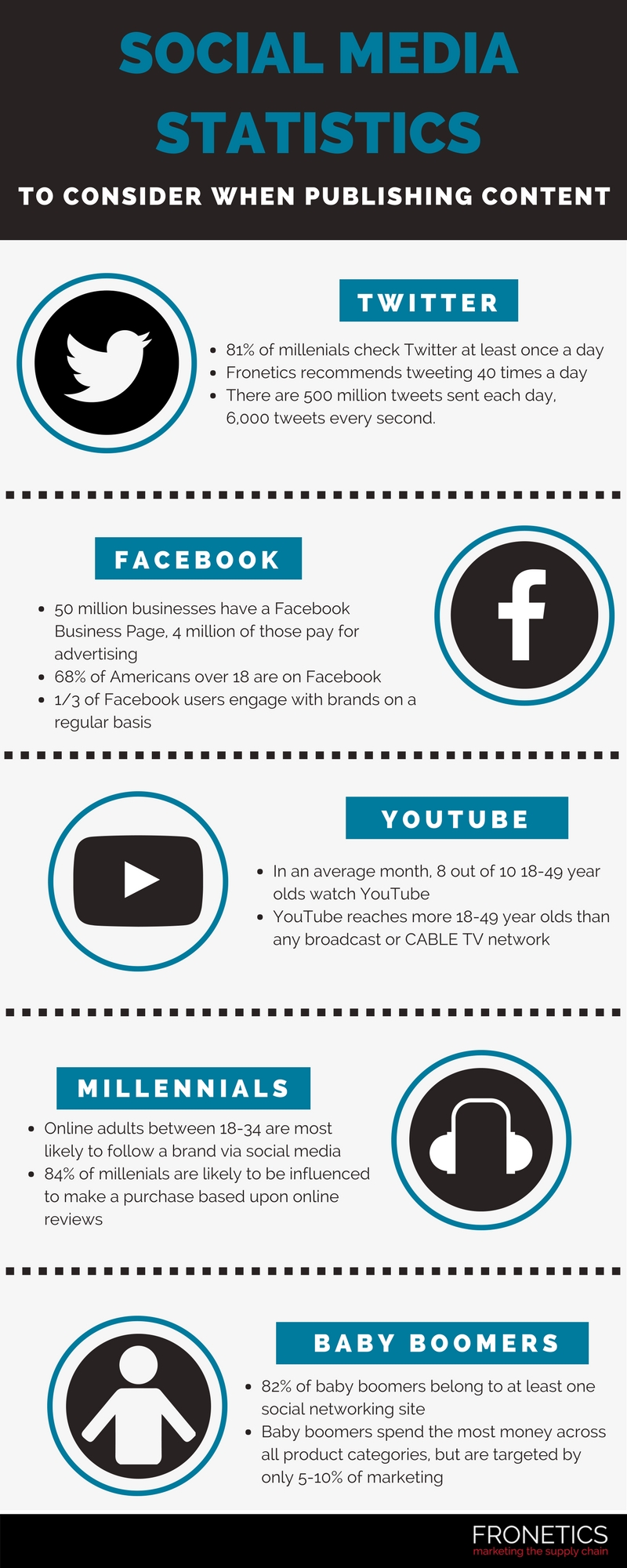
(Made with Canva)
Related posts:
SaveSave
SaveSave

by Elizabeth Hines | Feb 7, 2018 | Blog, Content Marketing, Marketing, Strategy
To be effective, your content marketing strategy should align with your sales goals. Here are three simple questions to ask yourself to make sure your documented strategy is on target.
I recently read an article on the Harvard Business Review that discussed pairing your sales goals with your marketing goals. This strikes at the heart of what we do at Fronetics: build a client’s content marketing strategy that will help advance their short- and long-term business goals. It sounds simple, but you have no idea how many organizations’ marketing goals are misaligned with what the larger organization is trying to accomplish
We need to make sure that — while we’re continuing to increase content production — we have a fundamental understanding of what we’re trying to create.
According to the Content Marketing Institute, 88% of marketers use content marketing. But a mere 30% of B2B marketers say their organization is effective at it. What that says to me is that a lot of companies are dumping their resources into content marketing, but, without a strategy that advances their business goals, they’re throwing away their time and money.
A content marketing strategy outlines the methods by which you will target, reach, and engage your audience. Research and execution of these tasks can be quite complex. Writing out a plan and assigning appropriate resources can offer clarity and guidance to your organization throughout the course of your program.
Here are three questions to ask yourself to make sure that your content marketing strategy is complementing your sales goals.
3 questions to align your sales goals and content marketing strategy
1. Why: Why am I doing this?
This question should be fairly easy to answer. The reason you’re documenting a content marketing strategy is for your business. You’re looking to align your marketing efforts with your business objectives. For a lot of companies, this ultimately means increased revenue from sales growth.
When done correctly, content marketing can support sales goals, making it easier to generate leads and helping the sales team close business. But you need to continually ask yourself, why?
The constant demand for more and more content can have a great impact on quality. More isn’t always better. Make sure you’re checking in with your strategy to make sure the content you’re producing is in alignment with your business goals.
2. Who: Who am I trying to attract?
In order to get the ball rolling in content marketing, you have to understand who you are trying to reach. Your company’s sales goals will help guide this target audience. It’s important to think holistically when considering who you are trying to reach at a potential prospect’s company. Typically, your target audience falls into two categories: Primary (decision-makers) and Secondary (influencers of the decision-maker).
Going one step further, you need to identify your target audience’s needs and pain points so that you can direct your content marketing strategy at creating awareness around those needs.
Once you have a thorough understanding of who your target audience is, you can begin to identify the different social media platforms they use. Using analytics tools within social networks can help you identify trends in social media use.
3. What: What content is going to work the best?
You’ve discovered your why and who, but now you need to finalize what kinds of content you’re going to create. Create the kinds of content your target audience seeks, and distribute it through the platforms on which they seek it. How-to videos on YouTube? Thought leadership on LinkedIn? Optimize the material you distribute for each channel. Use the social channels that best suit your brand message, type of content, and target audience.
Valuable and relevant content is not a sales pitch, but can help the sales process. Create content that communicates valuable information to customers and prospects so that they have the knowledge to make more informed decisions. Moreover, concentrate on content that establishes your business as a reliable source of knowledge — as a thought leader within the industry. Be thoughtful when you create content.
Even though 39% of marketers expect their content marketing budgets to increase this year, that doesn’t mean you should continue throwing money at your content marketing efforts until you have a clear plan that will advance your business. To be effective, marketers should document a content marketing strategy that aligns with their business and sales goals. It doesn’t have to be complicated. But it should reflect the “why, who, and what” of your sales strategy.
Related posts:


by Elizabeth Hines | Feb 6, 2018 | Blog, Content Marketing, Logistics, Marketing, Strategy, Supply Chain
Here are three tips for creating a content strategy that will help advance your business goals.
If we’re adamant about one thing at Fronetics, it’s creating a documented content strategy. But, as a recent Harvard Business Review article suggests, many strategies fail because they are not actually strategies.
This begs the question: what constitutes a real strategy? According to Freek Vermeulen, associate professor of strategy and entrepreneurship at the London Business School, “A real strategy involves a clear set of choices that define what the firm is going to do and what it’s not going to do.” The keyword here is “clear.”
Here are three strategy-creation tips to help you create a clear content strategy that aligns with and furthers your business goals.
3 content strategy tips
1) Show your work.
Just like in high school math class, arriving at the right answer isn’t enough — you need to communicate the logic for how you got there. As you create or refine your strategy, take a step back and examine the reasoning behind each choice.
Says Sly Bailey of the UK publisher Trinity Mirror, “If there is one thing I have learned about communicating choices, it is that we always focus on what the choices are. I now realize you have to spend at least as much time on explaining the logic behind the choices.”
Understanding the reasoning behind each of your choices allows you and your team to fully believe in your strategy, and ensures you carry it out optimally.
2) Trickle down doesn’t work.
Many implementation efforts fail because executives see strategy creation as a top-down process. On this topic, Stanford Professor Robert Burgelman writes, “Successful firms are characterized by maintaining bottom-up internal experimentation and selection processes while simultaneously maintaining top-driven strategic intent.”
In other words, while you need top-down strategic direction, this will only be effective if you simultaneously empower your employees to create bottom-up initiatives that meet the strategic intent.
3) Flexibility is key.
Another source of failure for implementation efforts is the institutional unwillingness to change habits. “People are often not even aware that they are doing things in a particular way and that there might be different ways to run the same process,” says Vermeulen.
It’s important to identify and effectively work against the bad habits that hamper your strategy’s effectiveness. As Vermeulen describes in his book, Breaking Bad Habits, “There are various practices you can build into your organization to make it work.” This often involves identifying key processes, and asking, “Why are we doing it this way?” If the logic isn’t clear (see above), this process is likely a good candidate for change.
Related posts: