by Elizabeth Hines | Sep 10, 2018 | Blog, Content Marketing, Leadership, Logistics, Marketing, Supply Chain
In today’s rapidly evolving economy, embracing change is crucial for success. These 5 behaviors define supply chain leaders who are change-agile.
They say the only constant in life is change. When it comes to leadership in the supply chain, the old adage certainly rings true.
If the last few decades have been consistent in any regard, it has been in the need to embrace change to keep things running. Agile leadership has been crucial for supply chain and logistics businesses. Are you the kind of leader that truly embraces change?
Why do I need to embrace change?
NextBridge Consulting managing partner Edith Onderick-Harvey identifies 5 behaviors that are common among agile leaders. Onderick-Harvey points to an inability to embrace change as a key cause of failure in business — making the idea of “change-agile” leadership a crucial part of a business and a leader’s DNA.
Change isn’t easy in any area of life, and corporate leadership is no exception. However, being a successful leader depends on embracing change by “seizing opportunities, including throwing out old models and developing new ways of doing business,” writes Onderick-Harvey. She stresses the importance of inculcating a culture of “change thinking… from the most fundamental daily interactions to the most complex strategy.”
What defines a change-agile leader?
Onderick-Harvey identifies these five behaviors that are characteristic of change-agile leaders:
1. They share a compelling, clear purpose.
Embracing change just for the sake of isn’t enough. “If you can’t articulate a clear purpose behind the changes being made,” says Onderick-Harvey, “it’s unlikely that your employees will be able to implement them.”
2. They look ahead and see opportunity.
It’s not just senior executives who should be looking toward future opportunities. A culture of change-agility should pervade every level of the corporate structure. “Look beyond this month or this year to identify trends and take action.”
3. They seek out what’s not working.
Being a change-agile leader goes beyond simply being receptive to unsuccessful projects — it’s about encouraging communication and actively seeking out what isn’t working at any level of your business. “For real learning to occur,” writes Onderick-Harvey, “people need to feel psychologically safe to share the good, the bad, and the ugly.”
4. They promote calculated risk-taking and experimentation.
We all know that risk and experimentation are crucial for growth, but many of us are too reticent to boldly embrace these concepts. It’s not easy to remember that failure is an important step on the way to success. “Change agility requires leaders to ask ‘Why not?’ and to establish opportunities for pilots, prototypes, and experimentation.”
5. They look for boundary-spanning partnerships.
As the world grows ever more interconnected and work becomes more complex, success is increasingly dependent on seeking out collaboration across boundaries. “Change-agile leaders and organizations are replacing functional silos with formal and informal organizations that allow for the rapid flow of information and decision-making around a product, customer, or region.”
Welcoming and embracing change is good for every aspect of your business’ health. Do these behaviors sound like you? What can you do to promote change-agility in your business’ culture?
Related posts:


by Elizabeth Hines | Sep 6, 2018 | Blog, Content Marketing, Current Events, Logistics, Marketing, Social Media, Strategy, Supply Chain
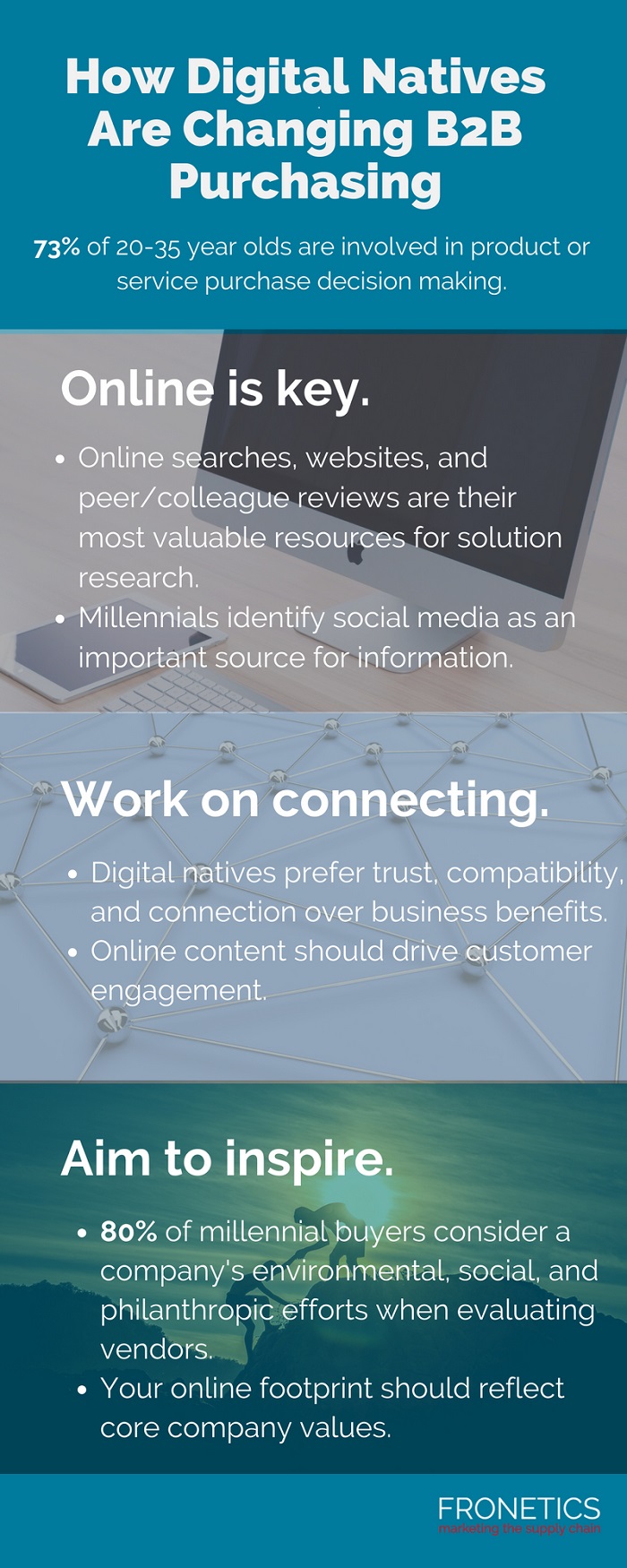
Digital natives are changing the landscape for B2B purchasing. Here’s what you need to know about the new B2B buyer.
Long gone are the days of men and women sitting around a conference table listening to a sales pitch over a free lunch. Today’s B2B buyers are younger, more technologically savvy, and more independent — they’re a generation of digital natives. And they’re making waves across the B2B buying landscape and changing how marketers must work to reach new customers.
Who are digital natives?
The term digital native describes a person that grows up in the digital age, rather than acquiring familiarity with digital systems as an adult. So, unlike the previous generation, digital natives grew up understanding how to work a computer and a mobile phone instead of picking up these skills (slowly) in our 20s, 30s, or even later.
Having grown up in a time of rapid technological advancement, digital natives are very comfortable online. These skills have carried over to their professional careers, as millennials descend upon the workforce. Organic searches have become the starting point for researching products and services, instead of looking for specific brands.
Ch-ch-changes
This new reality means marketers trying to reach new customers must make big changes in the way they target and engage today’s buyers. Marketers have had to shift their focus from outbound marketing to inbound tactics, like content marketing, to engage and connect with their target audiences.
Here’s what you need to know about digital natives and how their tech-savvy ways have changed the B2B purchasing process.
Infographic: How digital natives are changing B2B purchasing
(Made with Canva)
Final thoughts
With so much content available on the internet, first impressions are everything. Your website needs to be informative and visually pleasing. Your social media posts need to be engaging. Your blog posts need to be enlightening. Make sure your online presence accurately depicts who you are as a brand and what you stand for. Digital natives will be more likely to find and connect with you.
Have digital natives had an impact on your business? Tell us about it.
Related posts:


by Elizabeth Hines | Sep 5, 2018 | Blog, Content Marketing, Logistics, Marketing, Strategy, Supply Chain
When your content marketing and sales forces align their efforts, they form a powerful symbiotic relationship that grows your brand and your bottom line.
There’s a big misperception out there that content marketing represents some kind of threat to the job security of sales personnel. It’s absolutely true that content marketing is an inbound approach, contrary to the traditional outbound approach of a B2B sales force. But make no mistake: Content marketing is not a substitute or replacement for an expert sales staff.
In fact, it’s when marketing and sales work in tandem that they’re most effective. They can help each other out to generate more leads, nurture current leads more effectively, and even help close more deals.
Content marketing helps generate a steady flow of quality leads, and it provides targeted information to usher prospects down the sales funnel. But even quality leads don’t turn into sales on their own. This is where a sales staff comes in, to take those leads and cultivate them into new business.
Content marketing and sales: Division of labor
For content marketing and sales to work seamlessly together, it’s important to have a clear idea of the role of each. They provide different touch points for leads at each stage of the buying cycle. Here’s a quick primer:
1. Forming a relationship
In this early stage of the buying cycle, your content marketing efforts go toward opening up a dialogue with potential customers. Often, potential leads’ first engagement with your brand comes when they read one of your blog posts, come across your website while searching for product solutions, or see one of your social media posts through their network.
This is when your sales staff picks up the ball, keeping that positive contact going by developing it into a conversation. It’s your sales team’s job to cultivate an ongoing personal relationship with that prospect.
2. Providing information
Now that you’ve established a relationship and your sales team is continuing a dialogue with your prospect, content marketing can step in. B2B buyers report spending more time than ever conducting research, using expert content such as vendor websites, user reviews, and social media before making purchasing decisions. The content that you share with prospects at this stage of the buyer’s journey should be designed to answer informed questions and tip the scales in your favor.
At this stage, your sales staff should be directly answering questions from prospects. When a potential customer reaches out with a query, it’s likely that he or she has done a fair amount of research. So your sales reps need to speak specifically to the customer’s needs in a way that content alone can’t do, to keep them interested and moving down the funnel.
3. Advocating for your brand
Content marketing increases brand awareness for your business. It helps elevate your brand position within the industry and keeps your business top-of-mind, even at a time when potential customers aren’t ready to make a purchase.
When a customer is preparing to make a purchase, your sales staff is the primary advocate for your brand. They should be proactive in pursuing business when customers show interest in your content or when they reach out with questions. They drive dialogue and get to know customers and how your business can help them.
A match made in heaven
When content marketing and sales work together, you’ll see the results hit your bottom line. Curating and creating great content will generate quality leads for your company. And it also empowers your sales force to build relationships with potential customers — and close the sale.
Related posts:


by Elizabeth Hines | Sep 4, 2018 | Blog, Content Marketing, Logistics, Marketing, Social Media, Supply Chain
Live video is a powerful tool that can help your supply chain business grow its social media footprint, build brand awareness, and generate leads.
Live video is the super-hot new thing when it comes to generating leads and selling. But the supply chain has, so far, been hesitant to embrace it whole-heartedly as a marketing tool.
I can understand how you might find this new content format too “young” or consumer-facing for B2B sales. But at Fronetics, we think if done right, live video can be really effective.
What is live video?
Maybe you’ve gotten a notification on Facebook to let you know that your nephew is live streaming his piano recital, or a college friend is “live” at a wedding. But, let’s face it: Not many supply chain companies are using live video in their social media marketing. So you may not have thought about it in a professional context.
This “it’ trend in social media has really taken off in the past two years, and marketers are starting to jump on the bandwagon. With today’s emphasis on corporate transparency and putting a real, human face behind business social media accounts, live video is a perfect fit. In fact according to the 2017 Social Media Marketing Industry Report, 61% of marketers plan on using live video services, and 69% are interested in learning more about it.
These are the 4 live video platforms you should be aware of.
1. Facebook Live
Facebook’s live streaming platform lets you broadcast for up to 90 minutes per session, and notifies your audience that you’re streaming live. It also allows viewers to comment and react during your broadcast, and you can read and respond to their remarks immediately.
2. Periscope
Twitter’s answer to live video, Periscope has more than 10 million users, and lets user live stream from their mobile devices and push those streams directly onto Twitter.
3. Instagram Live
Instagram lets users connect to their followers in real time, through its Stories feature. Like Facebook, Instagram lets viewers add real-time comments that are visible to you and the rest of your audience.
4. YouTube Live
Online streaming video juggernaut YouTube makes it incredibly easy to aim, shoot, and post live video.
How to use live video
Michael Stelzner of Social Media Examiner recently interviewed income strategist and Facebook Live-guru Nicole Walters on the Social Media Marketing Podcast. Walters gave listeners clever tips for using live video to build a following and generate leads. We recommend giving the podcast a listen, but read on for our key takeaways.
Walters advocates for spontaneity in live video but suggests having a format or framework to give you structure and ensure that you’re sticking to your goal of generating leads. Her format is in three parts:
Part One: The Opener
In your introduction, which should be about 30-45 seconds, Walters suggests starting with your name, website, and a brief sentence to give your audience an overview of who your business is and what your video is about. Next, be sure to welcome your audience, perhaps with a special shout-out to new viewers, as well as regulars. Walters also encourages viewers to share her video and to interact with her as she broadcasts.
Part Two: Instructional Content
This is the meat of your video and typically lasts up to 30 minutes. Start by introducing the topic you’re presenting on and why it’s important. Walters also suggests encouraging viewers to take notes, with the rationale that notetaking leads to engaged viewers. If you’re launching a product or service (a great use of live video), you’ll want to cover the need you’re answering with your launch and how your product or service will solve it.
Walters points out that while she prepares extensively for her broadcasts, she avoids reading directly from a piece of paper, as it could easily get impersonal and boring. Instead, she gives herself a cheat-sheet of bullet points to keep her on track.
Part Three: Call-to-Action
This is the final stage of your live video, in which you send your viewers to a page where they can either pay or submit information to receive additional, high-value content (like e-books, webinars, etc.). Walters might say, “If you love this and want to dive in and get the details you need, then head over to NicoleWalters.tv. If you click the center of the page, you’ll find the product… I’ll be right here if you have questions. But come back and tell me you grabbed it.”
Live video offers all kinds of potential value for supply chain marketing. From customer engagement and feedback to transparency and brand awareness, this is a tool for the future of supply chain marketing.
Related posts:

by Jennifer Hart Yim | Aug 30, 2018 | Blog, Leadership, Logistics, Supply Chain, Talent
Bad leadership in procurement has the potential to sink a company’s reputation, making it difficult to hire at all levels below it.
This guest post comes to us from Argentus Supply Chain Recruiting, a boutique recruitment firm specializing in Supply Chain Management and Procurement.
Everyone knows that a bad hire can be really costly to a business. When you account for hiring, training, and onboarding costs, plus the opportunity cost of not hiring a successful employee – not to mention the impact on workplace culture – hiring the wrong person can set a company back tens of thousands of dollars. This is something that people have written about widely across the vast array of blogs about talent.
But what are the costs of hiring the wrong employee (or employees) at the leadership level of a business?
It’s something we’ve been thinking about recently at Argentus. As a firm that helps companies hire at all levels, we have our ears to the ground about the costs that companies bear when leadership issues have hurt their reputations in the marketplace. So particularly in Procurement – one of our core areas of recruitment expertise – what’s the cost of hiring the wrong leadership?
In short, it’s this: a bad hire at the junior level costs lots of money, but a bad hire at the leadership level has the potential to upset the apple cart and sink a company’s reputation, making it difficult to hire at all levels below it. Having the wrong leader in place can create a noxious effect that filters down into senior managers, managers, sole contributors, and junior employees. Procurement sometimes struggles to get buy-in from executives and stakeholders, and having mishandled leadership can make this task even more difficult for everyone in the organization.
Even if it’s a company with a storied history and a powerhouse brand as an employer, word always gets out if the wrong leadership is in place within any specific function. It means that individuals won’t apply for jobs. They won’t respond when recruiters contact them about certain opportunities. At a certain point, it becomes hard to find recruiters who are even willing to help hire for open roles at the company. Given that recruiters, especially those who work on a contingent basis, are usually all over clients trying to send them candidates, if a recruiter won’t work with a company, you know something must be wrong.
As we’ve written about a lot, the marketplace for talent in Procurement and Supply Chain is particularly tight in this strong economy. Companies are battling to bring in star performers who can enact business transformations, implement total cost of ownership models, boost their vendor and risk management, and modernize their Procurement as the function evolves for the future. And if your Procurement leadership develops a negative reputation in the marketplace, attracting those individuals becomes simply impossible.
We should clarify what we mean by bad leadership in Procurement.
We all know it when we’ve seen it, but there are a few traits that ineffective leaders have in common: quite often, they’re individuals tasked with leadership of a Strategic Sourcing organization who don’t have boots on the ground experience in Procurement. They often don’t have the war wounds to understand the function from bottom to top. Strategy and vision are important, but subject matter expertise helps leaders gain credibility with the managers and analysts who are expected to execute that vision.
It’s not absolutely necessary for a CPO or VP of Procurement to have done every job in the function. But if they haven’t, it’s important for them to be able to be humble enough to recognize the subject matter expertise of the people they’re working with – especially if they’re expected to bring changes to the organization. A great leader will admit the gaps in their own knowledge, and work to figure out how they can combine their strengths with those of their team. A bad leader will act like they understand every detail of every Procurement process and category – even if they don’t.
Beyond that, in our experience, the biggest issue with troubled Procurement leadership often comes down to soft skills. For a function that often comes down to negotiation, relationship-building, and getting buy-in, people skills are everything. Ineffective leaders will micromanage, yell, and show a lack of respect for junior employees. How can a leader expect to get buy-in from executives if they can’t build relationships with their own team members? The best leaders in Procurement will empower their teams to pursue cost savings, minimize risk, and increase value without watching them like a hawk.
Leadership is a topic so complex it’s inspired a cottage industry of books and academic research – so we can’t hope to address everything about how to hire effective leaders. But what can companies do to make sure they don’t risk the almost-priceless commodity of their employer brand by installing bad leadership? Be very careful about the leaders that you hire. These individuals should either be subject matter experts, or be very willing to learn from their team-members. When interviewing prospective hires, try to assess their ability to be empathetic and build consensus, and be wary about boasts that they can enact sweeping changes through their force of will alone.
If you can’t, you might be risking more than just the time it took to hire.
Related posts:

by Elizabeth Hines | Aug 29, 2018 | Blog, Content Marketing, Current Events, Marketing, Social Media
Also in social media news August 2018: Twitter releases an ads playbook, Snapchat introduces a private ads marketplace, WhatsApp launches a Business API, and Facebook makes updates to its video metrics.
As kids gear up for back to school, social media platforms are busy making updates with a focus on business pages. Facebook, Twitter, and WhatsApp are all releasing updates and features, including playbooks, to help advertisers increase their brand awareness and user reach. Facebook even created updates to its metrics to help advertisers produce better reporting around usage.
Here’s what’s been happening in August with the hottest social media platforms and how the latest updates are aimed at helping businesses gain exposure and new audiences.
Your social media news for August 2018.
Facebook Q2 earnings show increased user growth but slow revenue growth
Facebook just released their Q2 earnings report showing that the social media giant now has more than 2.5 billion people using at least one of its apps (including WhatsApp, Instagram, and Messenger) monthly. The report also showed declining revenue growth, despite efforts to rebuild trust among users. Mark Zuckerberg reiterated his commitment to user privacy and security. “We continue to invest heavily in safety and security. This quarter, our systems identified and removed thousands of fake accounts, pages, and groups.”
Snapchat drops user count in Q2
Snap Inc. released its Q2 2018 Financial Results revealing a three million daily active user drop in its user base. With a recent redesign to the app, Snap Inc. was aware usage would be down. Co-founder Evan Spiegel states that “the company has been working to improve Snapchat based on user feedback” and is “eager to make more progress on the tremendous opportunity we now have to show more of the right content to the right people.”
Facebook’s Workplace acquires Redkix
Workplace for Facebook, an interactive tool for coworkers, acquired Redkix, an email software that combines email, messaging, and calendar features into one app. Recode reports the acquisition took place so Facebook could create its own communication system within Workplace. Facebook has been working overtime to beef up its Workplace platform to compete against Slack, a messaging app with almost 100 million paid users.
Twitter Business created an ads playbook for businesses and brands
Twitter Business released a Playbook for Agencies, a new document created to answer the most frequently asked questions by businesses about Twitter ads, client strategy, and more. “We compiled the most asked questions from agencies, partnered with our customer service team, and synthesized six months of Twitter research to create this guide which will help agencies guide their clients toward Twitter success,” writes Twitter.
Snapchat creates private ads marketplace
Snapchat is offering more ad tools to “premium publishers and advertisers – offering brands ‘unskippable’ slots and experimenting with a private marketplace (PMP) that lets Discover media partners take greater control over their inventory.” Starting in August, the app will give 100 randomly picked brands the ability to buy ad programming against TV-style content, including a wide variety of programming from scripted drama to comedy.
Facebook updates video metrics
Updates in the past year gave users the ability to rewind and re-watch parts of video ads, leaving advertisers with skewed reporting numbers. Facebook recently updated its video ad metrics to account for re-watched ads, removing any redundancies in reporting. The new metrics will automatically remove any three or ten-second views that are watched after rewinding.
WhatsApp launches Business API
Looking to expand its business tools, WhatsApp launched Business API, allowing medium to large business to manage and send non-promotional messages to customers. These messages include appointment reminders, shipping information, event tickets, and more for a fixed rate. VentureBeat reports all messages sent through the API will be free for the first 24 hours, messages sent after that will be charged. Though currently only available to select businesses, including Uber, Booking.com, and KLM Airlines, Business API will eventually be available to all more customers.
Facebook no longer permits cross-posted tweets
In light of recent Facebook platform and policy updates, users can no longer automatically cross-post their tweets or retweets to Facebook. As of August 1, users will have to copy a tweet’s URL to post a tweet to Facebook.
Related posts: