by Elizabeth Hines | Jun 3, 2014 | Blog, Marketing, Social Media, Strategy, Supply Chain, Transportation & Trucking
Many companies within the logistics and supply chain industries are stuck on the social media starting line. The reason – “they can’t get past the word ‘social’ and the perception it creates.” The reality is that social media is a tool that can be utilized to create value and grow your business.
Over the next four weeks I will be providing examples of companies within the logistics and supply chain industries who have moved beyond the social media starting line and have realized the business value of participating in social media.
Using social media to move freight
Transportation logistics is vital to the supply chain and logistics industries. For companies within these industries; however, transportation logistics can prove to be challenging to navigate and can prove challenging to the bottom line.
MercuryGate International Inc. and Con-way Inc. are two companies that have used social media to turn transportation logistics on its head – they use social media to move freight.
TweetLoad
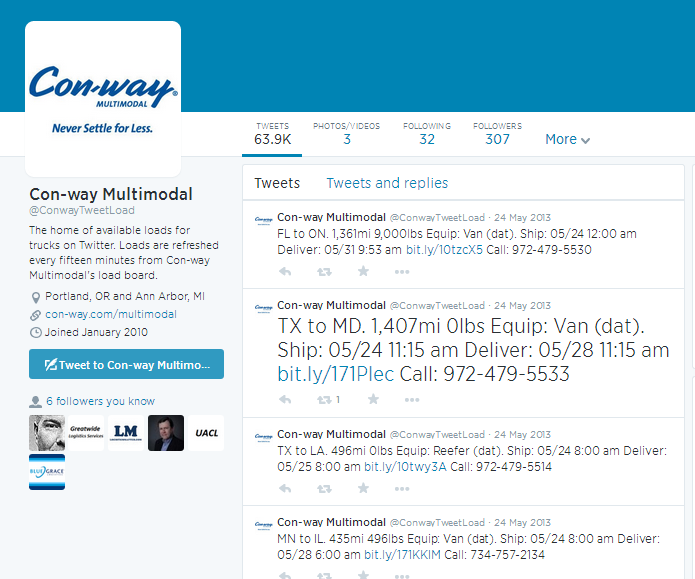
Con-way Multimodel, a division of Con-way Inc., launched TweetLoad™ in 2010. TweetLoad enables carriers to access available loads from Con-Way Multimodel via Twitter. Carriers who follow @ConwayTweetLoad on Twitter are able to see the latest available shipments as well as links to additional information on the company’s link board. Load information is updated on Twitter every 15 minutes, meaning that carriers who follow @ConwayTweetLoad have real-time information on available loads.
Figure 1: Conway TweetLoad
Bill Graves, president, American Trucking Associations (ATA): “With this novel use of Twitter, Con-way Multimodal is leading the industry in maximizing the best features of new technology to improve their processes. This is a great example of how innovative transportation companies can make it easier for carriers to do business with them, which will be a benefit to our industry overall.”
View a YouTube demonstration of TweetLoad at www.youtube.com/watch?v=0zL7h7kTU1M.
Freight Friend
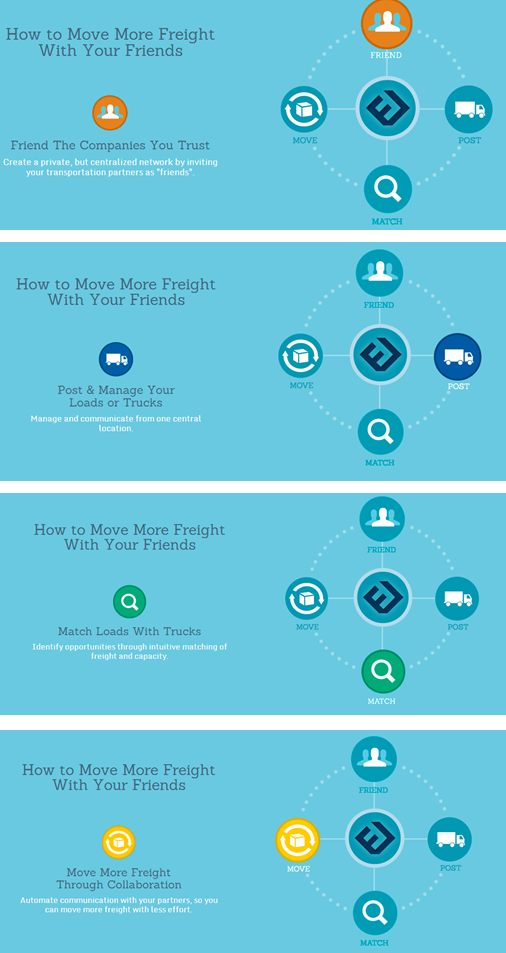
In 2011 MercuryGate International Inc. launched Freight Friend. Freight Friend is a free relationship-based full-featured load and truck internet posting service for shippers, brokers and carriers. Freight Friend creates a private network between transportation partners, and utilizes technology to automatically identify appropriate matches. The combination of the technology utilized and the relationship-based nature of Freight Friend allows companies to have real-time visibility to book trucks and find freight with companies they trust.
The Freight Friend concept is shown in Figure 2.
Figure 2: Freight Friend
“FreightFriend is perfect for carriers, shippers, brokers, 3PLs and freight management firms who only want to share information with companies they trust. They can keep their current information in one place, knowing that friends – and only friends – will have constant access. While public load boards fill a real need, they come at a cost – a lot of unknown companies bidding to carry the freight. Private boards are often useful too, but they’re inconvenient to carriers with multiple clients asking them to check their bid portals. FreightFriend solves the dilemma with a single service where carriers can easily communicate with all of their clients and brokers can find available capacity from carriers they trust.”
Freight Friend is fully integrated into MercuryGate’s TMS and Carrier Management System (Carma). Freight Friend is also available to integrate with other TMS providers.
by Jennifer Hart Yim | May 28, 2014 | Blog
This article is part of a series of articles written by MBA students and graduates from the University of New Hampshire Peter T. Paul College of Business and Economics.
In an increasingly globalized world the complexity in a firm’s supply chain has been getting bigger as it has spread over the whole globe. The risks of such a large supply chain have increased exponentially as the exposure to unforeseeable events, natural and man-made, have multiplied. Investing time and money in a Business Continuity Plan and hence building a resilient and flexible supply chain can not only become a competitive advantage but it is also critical for a firm’s survival.
Supply Chain Disruptions
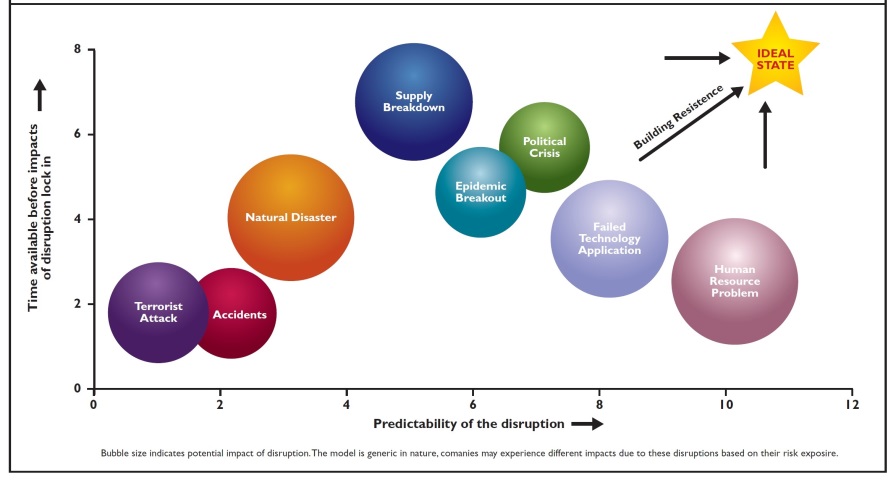
Supply chain disruptions happen for various reasons but always cause and end in an imbalance of the supply and demand of products. The magnitude of such events can go from insignificant to the size where the existence of the business is threatened. As shown in Graph 1 the disruption can have immediate impact, such as a power outage or fire in a factory, or take more time to set in. A union labor strike or the outbreak of an epidemic virus in a certain region could describe more predictable examples.
Graph 1: Supply chain disruptions categorized by predictability and time available after impact.
Where disruptions in tier one suppliers always have a direct impact of a firm’s supply chain, tier two and three disruptions can be buffered and show their effects only when the disruption gets to a certain size and reach. As an organization can never be fully in control of its business environment and supply chain it is safe to say that every business will sooner or later face some sort of disruption. Disruption can be costly. In 2013 15% of the disruption cost more than one million US dollars. Knowing this, businesses will benefit from developing a Business Continuity Plan.
Business Continuity Plan
A Business Continuity Plan is a road map for continuing operations after and/or during a disruption. The main components of a Business Continuity plan are:
- Business impact analysis
- Design of solution/remedy
- Implementation
- Testing
- Maintenance/feedback
Business Impact Analysis
The analysis of the severity of the impact to the business will help prioritize further action and the design of the solution. The analysis differentiates the critical and non-critical events and lists them accordingly. The criticality can be based on cost, ability to continue the operation, brand reputation and also laws. A threat and risk analysis combined with various impact scenarios will be the basis for the design of a solution.
Design of a solution/remedy
The solution design part of the Business Continuity Plan comes up with the most cost-effective recovery solution. Additionally, it identifies authorities for decision making during disruptions (crisis management command structure) as well as which contracts, documents and contact lists have to be available as a hard copy outside the facility. On the operational level this includes but is not limited to:
- Backup power
- Logistic routes
- Back up suppliers and lead times
- Warehouse/distribution center locations
- IT back ups
- Talent and skill succession planning
Implementation
The implementation phase involves strategic decisions, such as policy changes and training of the company’s own staff, as well as the communication of the Business Continuity Plan to suppliers and customers. The acquisition of materials and systems are part of the implementation. IT infrastructure can be moved to cloud computing for data safety and modern systems are extended to allow visibility into the supply chain. This can go as far as the second or third tier.
Testing
Testing will show if the elaborated solutions will satisfy the requirement. Testing can be as simple as an evacuation drill or as complex as a mock recall.
Maintenance/feedback
The first step of maintaining the Business Continuity Plan is to constantly monitor the situation around the identified risks and threats in the Business Impact analysis. This will also help foresee possible disruptions and might allow acting ahead of time to prevent a bigger impact. The Business Continuity Plan must evolve with the threats and the company development/growth. This requires constant updating and testing as well communicating to the staff, important clients and suppliers. More significant changes might even require updating of organization structures.
Feedback after a disruption event can be as vital to a Business Continuity Plan as its design. The reevaluation of the supply chain will allow assessing the effectiveness of the plan, the resilience of the system as well as the validity of the sourcing strategy. Collecting all these findings in a report will allow making sustainable changes. Such reports can also be helpful when negotiating terms and conditions with suppliers and/or insurance providers.
Summary
The design and implementation of a Business Continuity Plan is a big undertaking for a firm. The likelihood of disruptions in the supply chain and in other business processes is increasing with globalization. It is recommended that the firms start somewhere and attack the low hanging fruit. With a Business Impact Analysis the risks to the business can be categorized and prioritized. This knowledge can be used for the development and growth of the company as preventive measures can be built in new structures. The importance of monitoring the threats and learning from disruptions can become a competitive advantage and secure the existence of the business. While Business Continuity Plans can be structured simple and still cover the five components there is also professional education and training as well as certifications to support the continued success of the business.
Dario Cavegn hold a Master’s of Science degree from ETH Zurich in Switzerland. Currently he is working as a Manufacturing Manager for Lindt & Sprungli (USA) Inc., and is an MBA candidate at the Peter T. Paul College of Business and Economics. He can be reached via email at [email protected].

by Elizabeth Hines | May 25, 2014 | Blog, Logistics, Marketing, Social Media, Strategy, Supply Chain
Some companies within the logistics and supply chain industries have chosen to participate in social media while others have not. Why have some companies chosen not to participate while others have decided to participate? What social networks do companies within the logistics and supply chain perceive to provide the most value to their business? What challenges do companies face with respect to social media?
Fronetics Strategic Advisors aims to gain insight into these questions and more. We are conducting a survey on social media within the logistics and supply chain industries. The objective of the survey is to learn about the participation and use of social media within the logistics and supply chain industries.
The survey is aimed at companies within the logistics and supply chain industries, and takes only about 5 to 10 minutes to complete.
This survey is confidential. Responses will be reported in aggregate and no individual- or company-identifiable information will be shared with anyone.
If your company is part of the logistics or supply chain industries please take the time to take the survey.
by Elizabeth Hines | May 21, 2014 | Blog, Talent
According to R.J. Bowman, author of The Secret Society of Supply Chain Management, demand for supply chain professionals exceeds supply by a ratio of six to one. Looking forward, it appears that demand for supply chain professionals will only increase. The U.S. Bureau of Labor Statistics estimates that demand for supply chain talent will increase by 26 percent between 2010 and 2020 – a growth rate that is twice as fast as 14 percent of all occupations.
In response to the demand for supply chain professionals, universities have introduced undergraduate majors, M.B.A. concentrations and even entire degree programs dedicated to procurement, inventory management and global supply-chain strategy. The Wall Street Journal has even gone so far as to declare supply chain management the “hot new MBA.”
The University of New Hampshire Peter T. Paul College of Business and Economics is one university which offers MBA courses focused on supply chain management. This semester Fronetics has had the opportunity to work with students in one of the school’s supply chain management courses. Students in the school’s Supply Chain Management MBA course learn how to design, plan, and operate supply chains for competitive advantage; develop an understanding of how the key drivers of supply chain operations can be used to improve performance; and develop knowledge of logistics and supply chain methodologies and the managerial context in which they are used.
Over the next several weeks Fronetics will share topical supply chain management articles written by several of the MBA students. The students are inclusive of full-time graduate students and professionals who attend the MBA program part-time. The articles point to the diversity of this group of students as well as the student’s breadth of knowledge on supply chain issues.
A full list of the students’ articles follows below:
by Elizabeth Hines | May 20, 2014 | Blog
Here’s why you need to consider culture when expanding your reverse logistics operation.
Reverse Logistics Magazine Edition 63

by Elizabeth Hines | May 19, 2014 | Blog, Content Marketing, Marketing, Social Media, Strategy
The internet is a fire hose stream of content. Being able to navigate the deluge of content and identify the content that is valuable to your customers and to your business is essential; it can also be incredibly time consuming. Content curation tools can save time and increase productivity.
Here are 11 content curation tools that will help you establish your business as a thought-leader and trusted resource.
Bundle Post
With Bundle Post you connect and control Alerts and RSS feeds based on keywords. Bundle Post saves the content from your feed channels as a social media post, allowing you to view, edit or delete the content within the channel, all in one place, then merge selected curated content with scheduled posting times you create for each of your social media accounts and networks. Bundle Post offers a free 30 day trial. After that subscriptions start at $19.99 per month.
ContentGems
ContentGems monitors more than 200,000 news sites, blogs, and social media accounts. With ContentGem you can filter content a number of different ways including: custom keywords, sources, and media types. With ContentGems it is easy to share content via social media (one-click publishing and the ability to schedule posts). Freemium and premium options available.
feedly
feedly enables you to organize, read and share the content of your favorite feeds, blogs and news sites. If you liked Google Reader, feedly fills that gap. Free and premium versions available.
iFlow
iFlow allows users to discover, create, and curate ‘flows’ on any topic. Flows are topic-based streams that let users stay connected and updated with selected topics. These ‘flows’ may be followed, which results in users being continually updated with content relevant to selected topics. Flows can be set up to include detailed filters to provide for high quality of content curation. iFlow also allows users to create their own private flows. Users may invite others to contribute on their flows or can even keep their flows private. iFlow is free.
Individurls
Individurls is quite similar to feedly. One of the strengths of this content curation is how easy it is to use on your mobile phone. Individurls is free.
Netvibes
Although Netvibes is one of the original content curation tools, it remains a solid (and not outdated) solution. Netvibes offers a number of ready-made feeds and widgets. Both freemium and premium versions are available.
Newsle
Newsle is a great tool to keep you on top of what is happening with people within the industry and within your social network. It is also a great tool if there are specific writers or journalists whose content you want to keep track of. With Newsle you identify the people and Newsle sends you an email when those individuals are mentioned in the news.
paper.li
paper.li enables you to create your own online newspaper based on content you select. You add various sources and specify filters on these sources and a paper is produced. You can then add or remove “articles” from the paper. While paper.li can be used for free, the paid version allows you to brand your newspaper.
Post Planner
Post Planner is a solution for those who are avid Facebook users; PostPlanner is a Facebook app. With PostPlanner you enter in keywords and search for trending content within your niche. You can then sort this content to view the content with the most likes or shares so you can see the most popular content. While PostPlanner does offer a free version, to get the most from this tool you will need to upgrade to one of the premium packages.
Scoop.it
Scoop.it offers users a great experience and a constant stream of content. Scoop.it automatically finds and features comment from places like Twitter and Google blogs based on your target keywords and interests. It is also customizable, allowing for additional sources to be added to your stream(s). In Scoop.it you create boards of content around specific topics and then add content to these boards. Scoop.it allows for one-click publishing to your blog and social networks. Scoop.it offers a free trial, after that plans start at $12.99 per month.
Trapit
Trapit positions itself as a “smart” curation tool, increasing in intelligence and relevance the more you use it. It features more than 100,000 vetted content sources and includes “hidden gems” that have the potential to make your presence stand out. How does it do this? Trapit uses the same Artificial Intelligence and Machine Learning Technology from which Siri is derived.