by Elizabeth Hines | Jul 23, 2014 | Blog, Marketing, Social Media, Supply Chain, Talent

With more than 300 million active users, LinkedIn is one of the largest social media networks. LinkedIn is an incredible tool for networking and professional development. LinkedIn is also an essential component in a job search strategy. Optimizing your LinkedIn profile is crucial to your success.
Here’s how to optimize your LinkedIn profile:
Look the part. Upload a photo. LinkedIn profiles with photos get viewed 14 times more than profiles without photos. When selecting a photo to use for your profile, choose one that is professional. A photo of you with your friends, children, or pets is not appropriate. And don’t fall victim to the cropped arm/hand – the photo should be of you, and only you.
Create a URL. LinkedIn allows you to customize your URL. Do it! A customized URL is easier to remember than the default, it makes your profile more searchable, and it just plain looks more professional.
Headline. By default most people have their headline as their current job title and employer. To optimize your profile don’t rely on the default. Why? As The Muse points out: “Because this little 120-character section is prime marketing real estate.”
Write headline that speaks to your audience, showcases your specialty/value, uses keywords, and is creative.
Summary. Your summary should be between 3 and four short paragraphs in length. When creating your summary use target job descriptions to your advantage. Use keywords that not only enable your profile to be found in searches, but will also catch the eye of recruiters and prospective employers. Keep in mind that keywords are not buzzwords. Steer clear of buzzwords.
Experience. This is the section where you showcase your skill set and achievements. Be precise and include detail that will add value. If appropriate, include rich media.
Like the summary section, your experience should include keywords that speak to your target industry and to the type of job you are hoping to land.
Skills. Profiles that include skills are around 13 times more likely to be viewed than profiles that don’t list skills. Include your skills and order them so that more important skills are listed at the top.
Education. Profiles that include education are 10 times more likely to be viewed than LinkedIn profiles that don’t include education.
Certifications. List certifications that you have received. Certifications not only show your commitment and drive, they can also increase the number of times your profile is found and viewed.
Volunteer experience and causes. Include your volunteer experiences in your profile. Forty-two percent of hiring managers surveyed by LinkedIn say they view volunteer experience as equivalent to formal work experience.
Samples of work, patents, awards, publications, etc. As appropriate, include samples of your work, patents awarded, awards received, publications, etc. Again, this speaks to who you are, your interests, skills, and what you can bring to the table.
Recommendations. Recommendations can be a great addition to your profile when done right. Want to know how to do it right? Check out Jörgen Sunberg’s piece on the Undercover Recruiter.
Groups. Join LinkedIn groups that are relevant to your interests and industry. Joining groups and becoming active in these groups have many benefits – optimizing your LinkedIn profile is just one of them.
Housekeeping. Make sure that your profile has no typos or mistakes. Make sure all dates align and are accurate. A sloppy profile will turn off recruiters and prospective employers.

by Elizabeth Hines | Jul 22, 2014 | Blog, Supply Chain, Talent
Hiring the wrong person is a costly mistake not only financially, but also in terms of team morale and productivity. Making the right hire is crucial.
Research conducted by the PewResearch Internet Project found that in 2013 73 percent of online adults used a social networking site of some kind. The percentage is even higher for job seekers – 89 percent. Given the high prevalence of use, it is likely that your talent pool is on at least one social networking site. Hiring managers and HR professionals within the supply chain industry should use this reality to hire great supply chain talent.
Social media is increasingly being used by hiring managers and HR professionals in their hiring process. More than one third of employers use social media in their hiring practices, here’s why you should follow suit.
A study conducted by CareerBuilder.com found that 65 percent of employers who use social media to screen candidates do so to see how the candidate presents themselves professionally. Fifty-one percent of employers used social media to see if the candidate would be a good match for the company’s culture, and 45 percent reported that they used social media to further research the candidate’s qualifications.
Of those employers who use social media in their hiring process, 34 percent reported that they found content that resulted in them not hiring a candidate. Close to 50 percent of reported that they did not hire a candidate because of inappropriate material in their profile, and 45 reported they did not make the hire because of indications of drinking and/or drug abuse. Other negatives found by the employer were poor communication skills, criticizing former employers, and making prejudicial comments.
A candidate’s social media profile and use can also provide employers with information that can push a candidate to the top of the list. Approximately 29 percent of employers reported that they hired a candidate because their social media profile supported professional qualifications and/or contained a great reference about the candidate. Additionally, employers reported that they hired a candidate because their social media profile showed that the candidate was creative, well-rounded, or had great communication skills.
One thing to keep in mind – all information found online and via social media needs to be treated in the same manner as information found via traditional sources. All hiring practices must abide by state and federal laws relating to fair and equal hiring.
Social media is a great tool that can assist hiring managers and HR professionals hire great talent.

by Elizabeth Hines | Jul 17, 2014 | Blog, Leadership, Supply Chain, Talent
Because great talent doesn’t look like Waldo, here is how to spot great great supply chain talent.

Wouldn’t it be nice if great talent looked like Waldo?
If great talent looked like Waldo we could simply look at the pool of candidates and be able to identify them by their telltale red and white striped shirt.
Unfortunately, great talent doesn’t show itself like our friend Waldo. Given this, how can the supply chain industry spot great talent?
Smart companies realize that it is not the skills the candidate possesses today, but rather the candidate’s personality. This may seem counterintuitive, but consider this – skills can be taught, personality cannot.
Here are five traits that great employees share. When making your next hire look for candidates who possess these traits.
Smart – Smart doesn’t necessarily mean a high IQ. Rather it means having good judgment, being quick to comprehend, and having the faculty of reasoning and understanding.
Ambitious – Ambition drives innovation and productivity. An ambitious individual has high expectations for themselves and for their career. Their drive to succeed will positively impact your company.
Honest – Integrity is everything.
Gracious – A person who is able to admit failure, thank others, and able give credit where it is due will prove to be an indispensable member of your team.
Exceptional communication skills – Communication is the basis of success.
In addition to looking for these traits, also consider whether or not the individual is a good match with your company’s culture.
You can’t train personality
In the end, it is important to remember that you can train an individual to perform the tasks needed for the job, but you can’t change (or train) personality. Be flexible when it comes to specific job requirements, but be rigid when it comes to personality traits.
by Elizabeth Hines | Jul 16, 2014 | Blog, Manufacturing & Distribution, Marketing, Social Media, Strategy, Supply Chain, Talent, Warehousing & Materials Handling
According to the 2013 CareerBuilder Candidate Behavior Study, job seekers looking for a position with the manufacturing, transportation, and warehousing industries are using the internet and social media not only to look for jobs, but also to research companies within these industries.
Candidates use the internet and social media throughout their job search
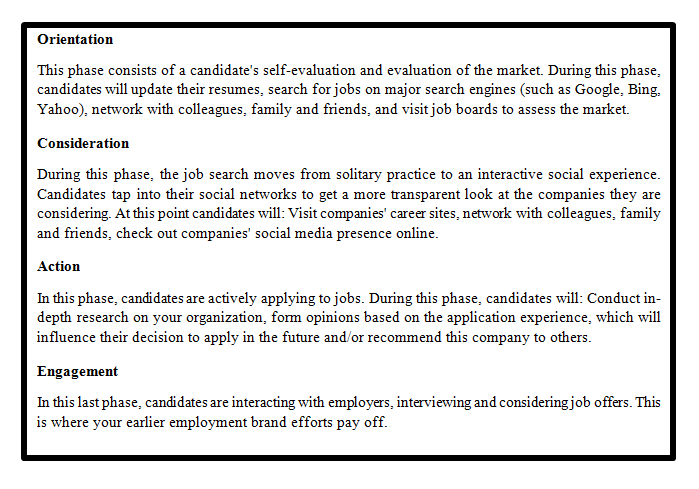
The CareerBuilder study looked at the behavior of candidates throughout the four phases of their job search (orientation, consideration, action, and engagement) and found that the internet and social media were used throughout each of the phases. (See Figure 1 for a definition of each of the four phases.)
Figure 1: The four phases of the the job search
Source: 2013 CareerBuilder Candidate Behavior Study
Job seekers in the orientation and consideration phases have not yet applied for a job at your company. Instead they are assessing the market, learning about an industry, and learning about companies within the industry. These stages are very much knowledge seeking phases for the candidate. Companies who are positioned right can attract great talent during these phases. However, companies who do not have a strong online presence and who do not participate in social media will not catch the eye of job seekers. Think of it as speed dating – you only have a short period of time to make an impression. According to the Neilson Norman Group you have 10 to 20 seconds to make that great impression. If you don’t make a great impression during those few seconds the user will navigate away from your website. Therefore you need to make sure that your website is visually engaging, easy to navigate, and contains quality and informative content.
When a candidate reaches the action stage they not only apply to jobs, they also conduct more in-depth research about a company, and form opinions based on the application experience. Candidates are not afraid to share their experience with the application process. Fifty percent of candidates share bad experiences with others and 64 percent share positive experiences.
In the engagement stage candidates interact with employers, interview for positions, and consider offers. Ninety-one percent of candidates believe employment brand plays a role in their decision whether or not to apply – therefore it is at this stage where your company’s online presence and participation in social media pays off.
How do candidates looking for a position within the manufacturing, transportation, and warehousing industries approach their job search? Let’s look.
Manufacturing industry
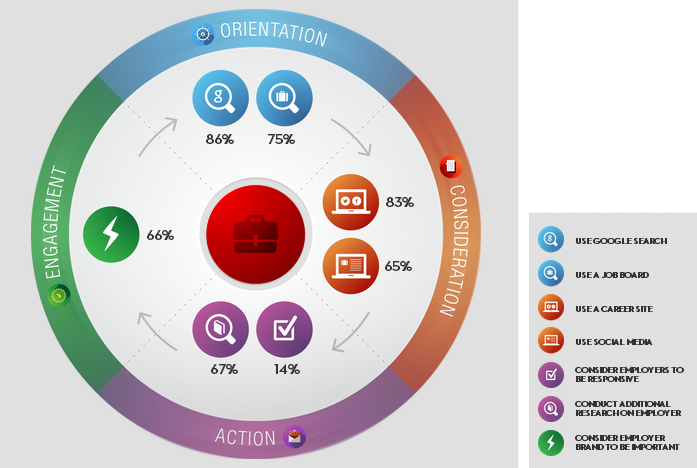
As shown in Figure 2, within the orientation stage, 85 percent of candidates looking for a job within the manufacturing industry turned to Google and 75 used a job board. In the consideration stage 83 percent used a company’s career site and 65 percent used social media to learn more about the company.
In the action stage 67 percent of candidates reported that they conducted additional research on an employer. In this stage only 14 percent of candidates reported employers in the manufacturing industry to be responsive.
Finally, looking at the final stage of the candidate’s journey, 67 percent reported that they felt the employer brand to be important.
Figure 2: The four phases of the job search; manufacturing industry
Source: 2013 CareerBuilder Candidate Behavior Study
Transportation and warehousing industries
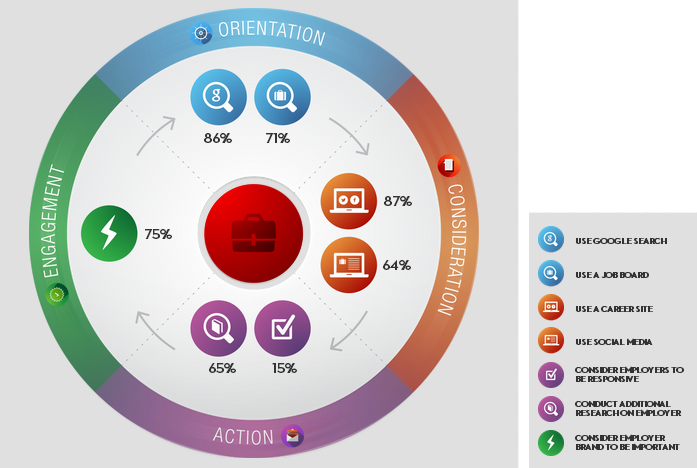
Figure 3 shows that within the orientation stage 86 percent of candidates looking for a job within the transportation and warehousing industries turned to Google and 71 percent used a job board. In the consideration stage 87 percent used a company’s career site and 64 percent used social media to learn more about the company.
In the action stage 65 percent of candidates reported that they conducted additional research on an employer. In this stage only 15 percent of candidates reported employers to be responsive.
In the engagement phase, 75 percent of candidates reported that they felt the employer brand to be important.
Figure 3: The four phases of the job search; manufacturing industry
Source: 2013 CareerBuilder Candidate Behavior Study
In the end
Candidates looking for jobs within the manufacturing, transportation, and warehousing industries are using the internet and social media. They are researching these industries and researching companies within these industries. They are forming opinions, acting on these opinions, and sharing their opinions with others.
If the manufacturing, transportation, and warehousing industries want to attract great talent and retain their interest throughout a candidate’s job search they need to invest in their online presence and become active in social media.

by Elizabeth Hines | Jul 15, 2014 | Blog, Marketing, Social Media, Strategy, Supply Chain, Talent
If the supply chain industry is going to attract new and qualified talent, it needs a face lift. The industry needs to be proactive. It needs to communicate what it is, what is currently happening within the industry, and what is in store for the future.
Who is responsible for making change possible? You.
Job seekers turn to the Internet for information. Job seekers not only use the internet to search for job openings, they also use the Internet to research industries, companies, and key players. The information job seekers gather by looking at websites, blog posts, articles, and social media shape their opinion and knowledge. According to the 2013 CareerBuilder Candidate Behavior Study 63 percent of job seekers turn to social media to learn about the employment brand of a company. Specifically, job seekers look to social media to learn about the culture of a company, to learn if the company is a thought leader, and to determine the authenticity of the employment brand.

Job seekers are likely seeing sensational headlines like this recent one from Forbes: Wanted: 1.4 million new supply chain workers by 2018. But what do they find when they move forward with their search for information on the supply chain industry and on your company?
The reality is that the supply chain industry has been slow to participate in social media and has been remiss when it comes to blogging. Even more basic, many companies within the supply chain industry do not recognize the value of their website and have created sites which provide little to no helpful information, are difficult to navigate, and are not up to date.
According to the CareerBuilder Study, 91 percent of candidates believe employment brand plays a role in their decision whether or not to apply.
If your company is going to attract great supply chain talent you need to step up to the plate. Make changes to your website, create and curate great content, and get active on social media.
Great talent is on the Internet. If you want to attract great talent you need to be there too.

by Elizabeth Hines | Jul 10, 2014 | Blog, Marketing, Social Media, Strategy, Supply Chain
Kale is the hippest and trendiest of vegetables.
The dark leafy vegetable has received Bon Appetit’s dish of the year award, it was served at the White House Thanksgiving, and it has received ringing endorsements by celebrities and celebrity chefs. Kale also has its own T-shirt, lawsuit, and day. Did I mention the book? 50 Shades of Kale is an Amazon bestseller.
The appearance of kale on restaurant menus has increased by 400 percent since 2008. A recent Guardian article reported that sales of kale at Marks & Spencer are already up 32 percent on the same period last year and that it expects this rise to continue in the longer term. Similarly, at Waitrose, sales of kale are up 20 percent year on year.
How is it that kale is cool? Much of it has to do with re-branding – communicating a new image for the vegetable and communicating new (and more flavorful) uses.
The supply chain is suffering from an image problem. If we are going to attract new talent we need to make an effort to make the supply chain hip. The supply chain should look to kale for inspiration. If a leafy green vegetable can realize such a rapid ascent to popularity, so too can the supply chain industry.