by Elizabeth Hines | Sep 3, 2014 | Blog, Content Marketing, Marketing, Supply Chain
Before personal computers became ubiquitous, my family’s desktop computer served as our sole connection to the digital world. It wasn’t uncommon for someone to rush through dinner so they could be the first to claim their spot in front of it for the evening. On any given night you could find my mom scouring the web for new dinner recipes, my dad waiting his turn to research ways to improve his golf swing, and my sister bemoaning her wait to explore something decidedly less practical. Regardless of subject matter, though, each one of them sought the same thing – information.
Many years later, that same unbridled access to information has shaped a new environment. Companies are taking note and are reexamining the way they target and interact with consumers. As marketers, we are well aware that this new landscape, driven by changes in buyer behavior, looks far different than it did before. What’s less apparent though, is how we should develop our marketing strategy to reflect these changes.
By leveraging advances in technology and using what we know about current buyer behaviors, we can begin to think about implementing an information-driven marketing strategy. That is, empowering buyers through thoughtful content curation and publication.
So, how can your company start putting some of these ideas into practice? Well, here are the basics.
You need a content strategy.
In a marketing environment where direct messages are being largely ignored by consumers, it’s essential that companies provide real, meaningful value through the materials they publish. Just like my family, consumers are seeking to be educated. Gleanster Research found that 50% of leads are qualified, but not yet ready to buy. However, the odds are that someday they will be, and the content they’re reading today will inform their decision to look to you – or not.
Publish and align your content thoughtfully.
Identify when and where your prospects are most likely to want or access your expert content. What kind of content will attract visitors, convert leads, close customers, and delight promoters? Where will they likely look for this information? Aim to deliver relevant content to the right people in the right places, at the right time. Consider that a recent study by Forrester found that a full 85% of business decision-makers said at least one social media channel is very important in the consideration of business technology purchase decisions. It’s not just simply good business for your company to align content correctly – it’s essential.
Consider the Buyer’s Journey.
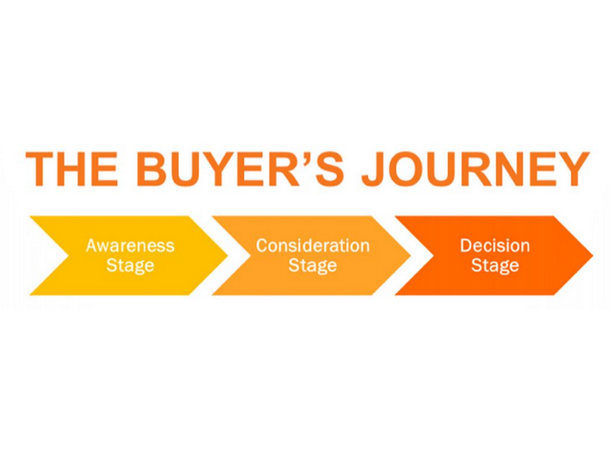
Gone are the glory days of the Sales Funnel. Enter the buyer’s journey. This (relatively) new concept suggests that buyers follow a linear path as they move through the sales process: first the awareness stage, then the consideration stage, and finally the decision stage. Each of these stages in the buyer’s journey necessitates corresponding content. Want to raise awareness of your brand and attract visitors? Try offering a free eBook that addresses a key pain point of your ideal buyer. Looking to close that almost-there sale? Propose a free trial. By considering the journey of your buyer, you are more likely to provide relevant content at the precise moment your buyer needs it.
Considering the characteristics of this new environment, it’s very unlikely that our prospects come to us completely uninformed. With more knowledgeable buyers, businesses must stay one step ahead. Implementing an information-driven marketing strategy gives us an attainable and inclusive way of achieving that.

by Elizabeth Hines | Sep 2, 2014 | Blog, Content Marketing, Data/Analytics, Marketing, Supply Chain

To grow your B2B business you need to take a comprehensive data driven approach to marketing. Metrics enable you to measure success, drive strategy, and demonstrate the ROI of your marketing efforts.
What metrics should you track?
Given that your objective is to attract, acquire, and retain customers, the most effective metrics to track are those where the unit of focus is the prospect, lead, or customer. These include the following:
Visits
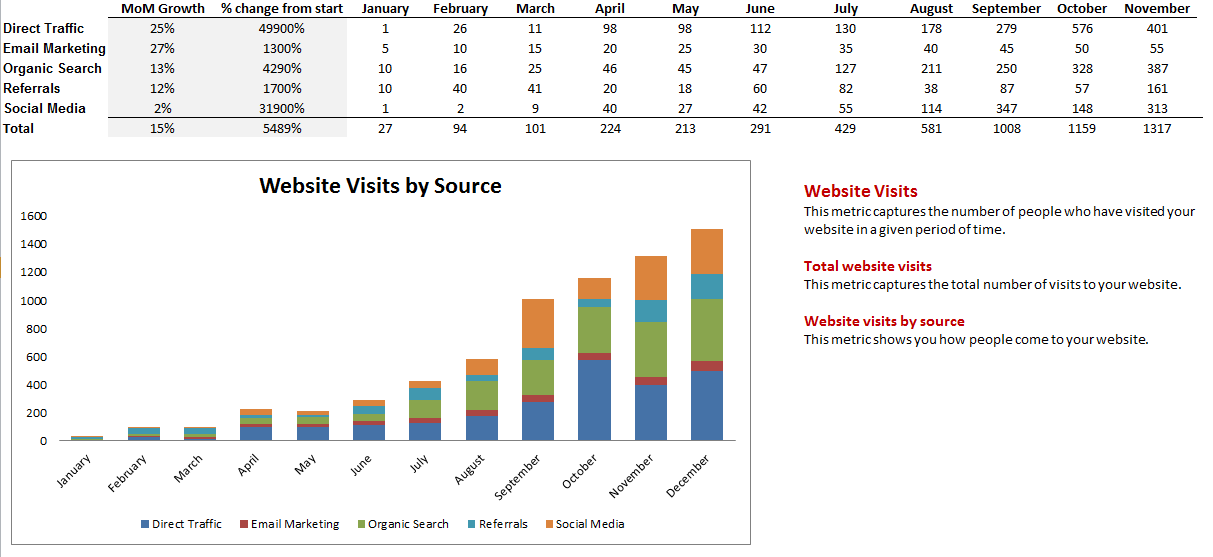
Visits capture the number of visitors to your company’s website in a given period of time. In addition to tracking the total number of visits, it is also important to track visits by source. That is, how visitors come to your website. Sources typically include direct traffic, organic search, referrals, social media, and email marketing.
Reach
Reach is the number of people who can be reached through your marketing channels (e.g. LinkedIn, Twitter, and Facebook). This metric is a good indicator of how well the content you are publishing attracts new people to your network, and how well the content engages people within your network. In addition to tracking your company’s total reach (the total number of people you can reach across all channels), you should also track reach by channel.
Leads
Leads are one of the strongest indicators of ROI. By tracking leads by source, you can identify where your marketing efforts are most effective, areas where you can improve, and areas you could eliminate from your strategy.
Customers
Customers are also a strong indicator of ROI. Like leads, customers should be tracked by source.
Conversion rates
Conversion rates measure the percentage of people who are moving from one marketing stage to the next. An increase in your conversion rates implies an improvement in the quality of your content and/or traffic. You should track the visit-to-lead conversion rate (How many of your website visitors are becoming new leads?) as well as the lead-to-customer conversion rate (Are you generating sales-ready leads?).
Ranking
Ranking matters. The top listing in Google’s organic search results receives 33 percent of the traffic compared to 18 percent in the second position. Two metrics you can track are your domain authority and your marketing grade.
Domain authority is a score ranging from 1 to 100 that represents how well a website will perform in a search engine ranking. The lower the score – the less likely it will be found. Marketing grade is a holistic measure of a site’s online presence as measured by HubSpot’s Marketing Grader on a scale of 0-100. A higher score is better.
How to track metrics for success
Having an established database to capture your marketing metrics is critical to success. We created a template that you can download and use to track your metrics, measure success, and drive strategy. One of the great features about this template is that it generates graphs that can be used in your reports and presentations.


by Elizabeth Hines | Aug 28, 2014 | Blog, Leadership, Strategy, Talent
Most teams are able to fairly easily decipher what needs to be done. However, when it comes to the how, new or weak teams fall flat. Here is how you can optimize your team for success.
Define roles
Clearly define roles and make sure every team member understands not only their role, but the roles of others on the team. When roles are defined and understood the team can avoid overlap and can avoid the trap of “I thought someone else was doing that.” In short, by defining roles your team can be more efficient and more effective.
Establish a communication protocol
Take the time to establish a communication protocol. This protocol should not be a rulebook, but rather it should outline a set of decisions about how the team will message each other and stakeholders on the progress and needs of the team. If you leave this to chance you are, well — taking a chance. If you establish a communication protocol up front you will achieve better communication and it will be less likely the ball will be dropped.
Develop performance metrics
Develop performance metrics up front. If you don’t take the time to do this, how will you know if you are making progress? How will you know what to do if you are not making progress? How will you know when goals are achieved? How will you be able to reward team members? Take the time to develop performance metrics up front — and get everyone on the same page.
Provide your team with necessary tools
Provide your team with the tools that they need to succeed, or you will set them up for failure. For example, give them the go-ahead to make certain decisions without needing to go through 11 bureaucratic steps. Similarly, give the team access to the people and information that they need to get the job done.
By focusing on the best path forward, rather than the end goal, good teams can get even better.
A version of this post previously appeared on EBN.

by Elizabeth Hines | Aug 27, 2014 | Blog, Leadership, Strategy, Talent
Look across business, sports, entertainment, and the military, and identify the top performers. Next, take a step back at look at the characteristics of these individuals. What you will find is that there are at least three elements that they all have.
They know how to maximize through self-knowledge. Top performers have intimate self-knowledge. They know themselves — their strengths, weaknesses, challenges, and vices. They know how to use this knowledge to stretch and apply themselves. Furthermore, they know how to sustain themselves.
They know how to work with the environment. Top performers know and understand their environment. This enables leaders to work with and within the environment effectively, shape it, and be in tune with it.
They know (and use) the ingredients for a top performance. Top performers know what makes a top performance. They know that it requires planning, preparation, delivery, and evaluation. And they execute — each time.
They understand emotion. Top performers understand when and how to remove emotion from the equation. On the flip side, they know when not to table their emotions.
By focusing on these characteristics, you can be a top performer and encourage your team to do the same. In the end, maximizing the performance of each individual will maximize the performance of the team and, eventually, your company.
A version of this post previously appeared on EBN.

by Elizabeth Hines | Aug 26, 2014 | Blog, Content Marketing, Marketing, Strategy

A 2013 survey of B2B marketers by LinkedIn found that when it comes to lead generation, customer testimonials and case studies are considered the two most effective content marketing tactics. Why are customer testimonials and case studies so effective? Because they are content that is valued and trusted by B2B buyers.
How can you write a B2B case study that generates leads?
Here are five elements of an effective case study.
- A case study is a story. Case studies that read like a story succeed. Case studies that are written, for example, as a sales pitch fall flat and fail to attract and engage prospective buyers.
- Case studies are not a sales pitch. Inform and educate through the sales pitch, but do not “sell.” An effective case study will generate new customers and sales.
- Prospective buyers turn to case studies for concrete examples. Make it easy for the reader to obtain the information desired. Bullet points, quotes, and lists are all examples of how you can deliver the highlights.
- Keep it short and sweet. A case study should provide the prospective buyer with enough information, but should not go into the minutia.
- Include these three components: the challenge, the solution, and the results.

by Elizabeth Hines | Aug 21, 2014 | Blog, Leadership, Strategy, Talent
Want to advance? Stop whining. Whining won’t get you to the top.

Whining. Just writing the word makes me cringe. Whining is a truly unattractive characteristic. It is unattractive in children and it is even more unattractive when adults partake. One of the reasons why whining is just so unattractive is that it is ineffective and it can make a brilliant leader look like, well, like a blithering child.
Given this, why is there so much whining in the office? Ron Ashkenas, a senior partner at Schaffer Consulting and author of several books on organization change and effectiveness, wrote in a post for the Harvard Business Review:
The reality is that all of us whine, complain, blame others, and try to avoid responsibility. It’s part of the human condition. Nobody likes to clean up problems caused by others — or admit that they’ve created problems themselves. We also try to preserve a positive self-image and we go to great lengths to get others to perceive us positively as well. Given these basic human dynamics, most of which are unconscious, it’s often easier to talk to colleagues about what somebody else is doing wrong. At worst we’ll get sympathy. At best, we’ll convince someone else to take care of the problem.
Ashkens continued, noting that the current economic environment and organizational structures have made it so that “it’s tough to get things done — which leaves people feeling frustrated and in need of a sympathetic ear.” But let’s be honest. When your co-worker comes up to you whining (again) about this or her workload — do you really feel sympathy?
Let’s look a little closer at what Ashkenas said. Essentially, whining is used as a tool to “blame others” and “to avoid responsibility.” Neither blaming others nor avoiding responsibility are positive traits. Neither of these traits will get you hired nor will they get you promoted. The qualities that will get you that next job, which will get you recognized, and will get you promoted are stepping up, taking responsibility, and taking action — the antithesis of whining.
In his book The Last Lecture, Randy Paush astutely wrote:
If you took one-tenth the energy you put into complaining and applied it to solving the problem, you’d be surprised by how well things can work out… Complaining does not work as a strategy. We all have finite time and energy. Any time we spend whining is unlikely to help us achieve our goals. And it won’t make us happier.
Want to be taken seriously? Want to be effective? Want to be successful? Stop whining.