by Elizabeth Hines | Dec 3, 2014 | Blog, Strategy, Talent
Where is your career going? If you feel like you are stuck in a career rut, here are five tips to pull yourself out:
1. Focus on the short-term, not your career path.
When it comes to a career path, one plus one doesn’t necessarily equal two anymore. The nature of business and the career landscape is evolving at lighting speed and making it nearly impossible to map out a five- or 10-year career path. So rather than trying to map out a long-term plan, optimize for one to two years.
Dara Khosrowshahi, CEO, Expedia, Inc., offers this sage advice: “Look for the right opportunities, stay flexible, have some idea of what direction you are headed in, but don’t lock into a long-term direction because chances are that the world will change up on you.”
2. Speak up.
Does anyone know you want to switch department or roles, or is it your secret? Are you the only who knows that you want to move up the ladder within your company? If so, you need to speak up and let people know what’s on your mind. Talk with your boss, talk with the manager in the role/department in which you are interested, and talk with HR. If you let people know your desires, your desires will be much more likely to be realized.
3. Prove yourself.
Don’t think — act. If you want to take on additional responsibilities, you need to show that you are capable. If you want to move into a new role, prove that you have the skills to do so. Actions speak loudly.
4. Network.
Networking opens doors. Networking begets opportunities that benefit and feed your career, professional development, and personal interests. And if you are interested in finding a new job, networking will help you do just that. Studies have shown that the majority of candidates find jobs via their networks.
5. Quit.
If you are truly unhappy — quit. When you make the mental decision that you are going to leave your job, most likely you’ll feel a weight has been lifted. With the weight gone you will be able to more easily determine your next steps and find a new position. Note I said mental decision. It is best to give your actual notice after you find a new position.
Getting your career going in a positive direction will benefit you and your organization. It’s never the wrong time to make some moves designed to get yourself out of a career rut.
![The Santa Supply Chain [Infographic]](https://fronetics.com/wp-content/uploads/2024/10/Santa-Supply-Chain-Infographic-799x675.png)
by Elizabeth Hines | Dec 2, 2014 | Blog, Logistics, Strategy, Supply Chain, Transportation & Trucking
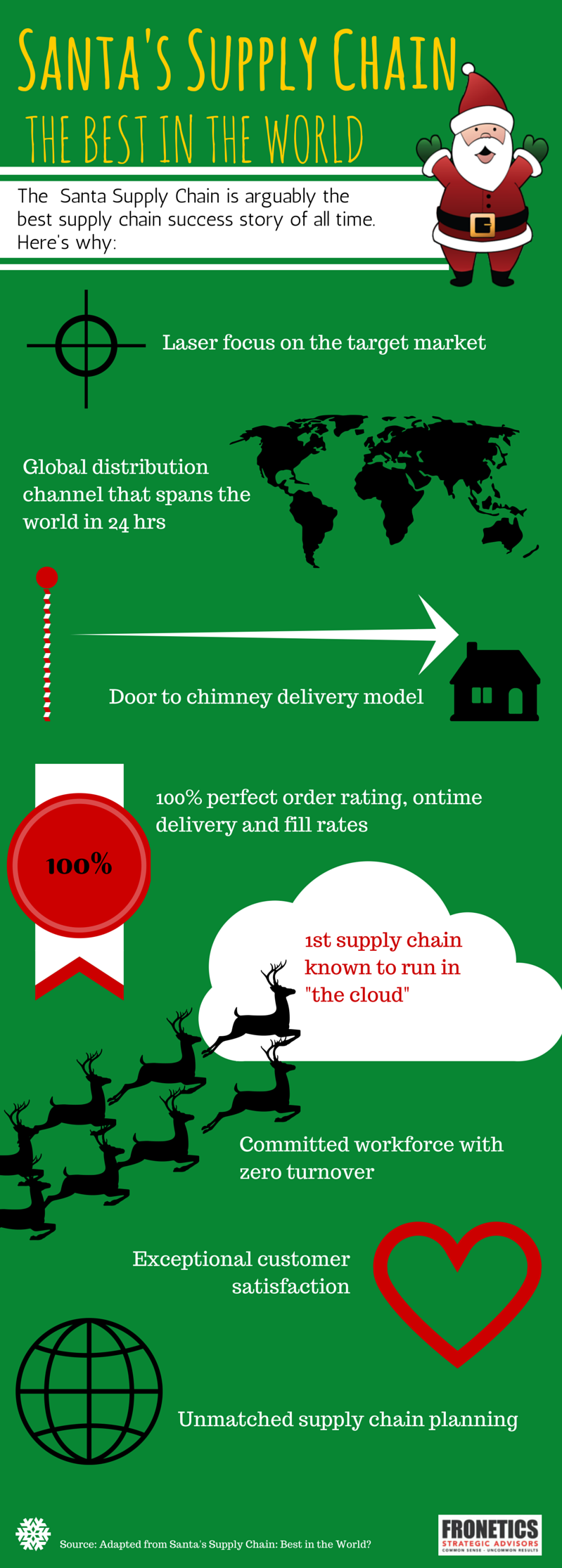
“Gartner likes to publish the Top 25 Supply Chains every year. Unfortunately, there’s one supply chain the esteemed analyst firm continues to overlook. And it just so happens to be the greatest supply chain success story of all time. I’m talking about The Santa Claus Supply Chain.”
Richard Howell’s 2011 article proposing that Santa’s Supply Chain is superior to those on Gartner’s list leaves little room for argument. Let’s be honest, is there another supply chain that can (using just one sleigh) deliver orders to 822 homes per second and has a:
- Committed workforce with a 0% turnover rate (Dasher, Dancer, Prancer, Vixen, Comet, Cupid, Donner, and Blitzen are loyal and long-serving);
- 100% order rating; and
- 100% on-time delivery?
I think not.
Check out Howell’s article for more interesting facts, and our Santa Supply Chain infographic for holiday fun.

by Elizabeth Hines | Nov 27, 2014 | Blog, Leadership, Marketing, Strategy
The Dunkin’ Donuts in Boston’s Back Bay Station is a well-oiled machine. The whole process – ordering a cup of coffee, paying, and receiving said coffee – takes seconds. The experience is something reminiscent to Seinfield’s Soup Nazi.
For customers who frequent this Dunkin’ Donuts expect this. They have timed their commute down to the minute and they know that if they can move through a line of 30 or so people in seconds – and make the train. For customers who don’t frequent this Dunkin’ Donuts the experience can be jarring.
On the other hand, there is a small coffee shop I visit in Maine. It takes minutes (think two digit numbers) to get a cup of coffee, and then more minutes to pay. Customers who frequent this coffee shop savor this time that it takes to get their coffee. The minutes waiting allow for conversations or quiet meditation.
Watching someone new enter the coffee shop is always interesting. There are those that start to wait in line and then leave when, after minutes, they are no closer to getting coffee. There are others who wait it out, checking their watch or smart phone every few seconds as if this will speed up the process. These people generally leave in cloud of frustration.
These two businesses know their customers. They have taken the time to understand what the needs are of the customer and they have tailored their business to address these needs.
To grow your business you need to take the time to determine who your target customer is, what their needs are, and how you can address these needs and bring value to the customer.

by Elizabeth Hines | Nov 26, 2014 | Blog, Manufacturing & Distribution, Supply Chain

MIT’s Julie Shah was named one of MIT Technology Review’s 35 Innovators Under 35 in 2014. In an interview with Will Knight, Shah discusses the possibility of collaboration between human robots:
“In factories there are usually physical barriers between people and robots. Originally, this was for safety—industrial robots were unwieldy and unyielding. Although robots are increasingly designed to safely share human work spaces, even in these settings, people do one set of jobs and robots do another.
Imagine if robots could be truly collaborative partners, able to anticipate and adapt to the needs of their human teammates. Such robots could greatly extend productivity. That possibility is really exciting to me.”
Shah is working companies including BMW, Boeing, and Embraer to develop robots that can interact intelligently with human co-workers.
According to Shah:
“If you can develop a robot that’s capable of integrating into the human part of the factory-if it just has a little bit of decision-making ability, a little bit of flexibility- that opens up a new type of manufacturing process more generally.”
Research conducted by Shah has found that teams made up of humans and robots collaborating efficiently can be more productive than teams made of either humans or robots alone. Shah’s experiments have shown that the collaborative process reduced human idle time by 85%. Additionally, Shah found that workers seem to be comfortable with the idea of robotic coworkers.
Are you ready for a robot to join your team? What are your thoughts on teams made up of humans and robots?
by Elizabeth Hines | Nov 25, 2014 | Blog, Internet of Things, Marketing, Social Media, Strategy, Supply Chain
The 2014 UPS B2B Buyers Insight Study found that companies need to have a strong online presence to grow their business.
Buyers are looking for information online
Buyers are conducting research on industrial suppliers online. Sixty-eight percent of buyers research supply purchases via supplier website, and 52 percent use search engines.
In their report, UPS and TNS discuss the importance of a strong online presence:
“Given buyers’ high satisfaction levels with supplier performance on key selection criteria, and considering that web-based research is most preferred, it’s reasonable to infer that many buyers consider online research essential to their supplier selection process. The use of search engines means that suppliers may be at greater risk of losing share to companies whose products are perhaps easier to find, in stock or competitively priced. On the other hand, suppliers whose products are easy to find online and meet buyers’ criteria may also stand to gain customers.”
Being able to buy online is more important to buyers than a sales rep
Being able to access information about products online and being able to make purchases online is more important to buyers than sales representatives and printed catalogs.
Respondents were asked to rate attributes with respect to deciding from which industrial supplies vendor to purchase. Seventy-eight percent of respondents rated product information on the supplier website as “extremely important” or “very important.” Seventy-four percent of respondents rated the ability to make purchases on the supplier’s website as “extremely important” or “very important.” In contrast, fifty-eight percent of respondents rated having a sales representative as “extremely important” or “very important.” Fifty-four percent of respondents rated having a hardcopy product catalog as “extremely important” or “very important.”
Buyers like to purchase through websites
Sixty-three percent of industrial supplies buyers reported that they purchase through websites (directly from suppliers or via a third-party provider).
Sixty-seven percent of buyers responded that the ability to order through a supplier’s website is considered “extremely important” or “very important”
If you think your current customers don’t care if you don’t offer the ability to purchase products online – think again. The survey found that 34 percent of buyers say that they have gone outside of their existing supply base to make an online purchase.
Meet your customers online
Having a strong online presence is an essential component to your business strategy. If you want to grow your business you need to be online. UPS and TNS sum this up nicely:
“Be in the right place when buyers are looking: Having a superior supplier website with stellar functionality means little if buyers can’t find the site or don’t know it’s available. Making sure products and supplier information can be found easily by search engines (SEO), and being visible when buyers search for products (SEM), are essential strategies for retaining and increasing customer base.”
by Elizabeth Hines | Nov 23, 2014 | Blog
Fronetics’ Kate Lee is named by Procurious as one of the 24 most influential people in procurement.
Procurious