![The Valentine’s Day Supply Chain [Infographic]](https://fronetics.com/wp-content/uploads/2024/10/Valentines-Day-Supply-Chain1-800x675.jpg)
by Elizabeth Hines | Feb 3, 2015 | Blog, Strategy, Supply Chain

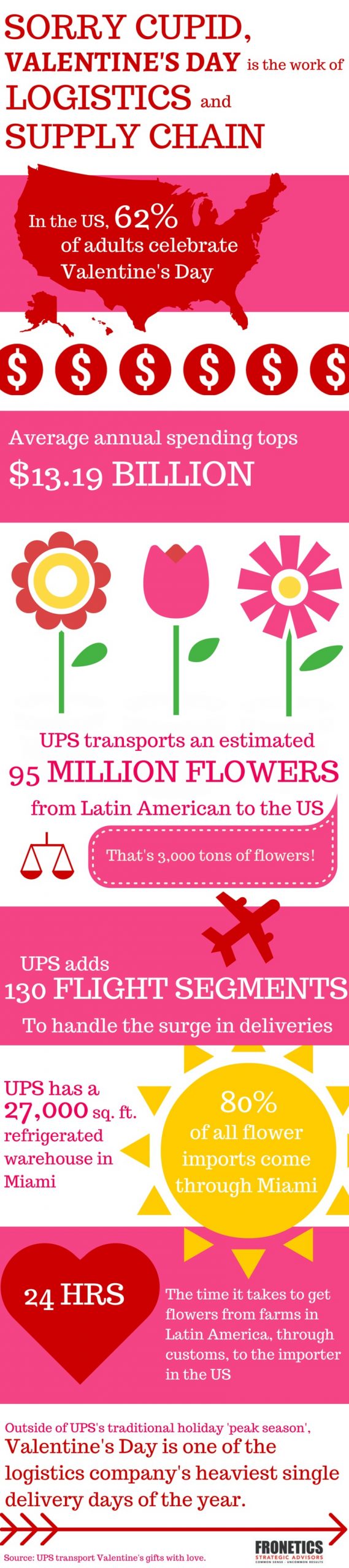
The Valentine’s Day supply chain by the numbers.
In the late 400s Gelasius declared February 14th as a day for honoring Saint Valentine. Over the years February 14th became associated with love and romance (1300s) and the exchange of cards (1600s). In the 1840s the first mass produced Valentine’s Day cards were sold in the US.
Over the years Valentine’s Day has become big business. 62% of adults in the US say that they celebrate the holiday. Spending for Valentine’s Day tops $13.9 billion. $8.9 billion is spent on sparkling wine (174,000 gallons are sold during the holiday week alone). The number of cards and gifts exchanged totals 150 million.
Cupid gets the credit for the holiday, but really Valentine’s Day is the work of logistics and supply chain. UPS alone transports more than 3,000 tons of flowers for Valentine’s Day – requiring the company to add an additional 130 flight segments.
Check out our infographic. You’ll see that Cupid really doesn’t play much of a role (sorry Cupid).

by Elizabeth Hines | Feb 2, 2015 | Blog, Supply Chain
Outsourcing fulfillment can makes sense.
Amazon has set the standard for speedy fulfillment.
Despite being both parodied (make sure to watch Netflix’s Drone to Home video) and parroted (the FAA recently clipped a brewery’s attempt to deliver beer by drone to Minnesota fishermen), Amazon insists unmanned aerial delivery vehicles will soon be as common as mail trucks.
While we wait for products to drop from the sky, outsourcing fulfillment to the right provider has never been more important for businesses vying for attention from consumers used to free two-day and next-day deliveries.
“The reality is that Amazon is so big that they are now mandating what the customer satisfaction requirements are for everyone, even if you don’t think that you compete with Amazon,” Jim Tompkins, president of Tompkins International, once told Modern Materials Handling.
If you are dealing with the following issues, you may want to take a good look at fulfillment business partners:
- You are spending a disproportionate amount of time and money on filling orders.
- The size of your warehouse is keeping your company from growing.
- You would rather spend your expertise on developing and marketing your products.
- The cost of warehouse equipment and warehouse employees is too high.
Also, keep in mind:
- Fulfillment cost: As a first step, make sure you know your exact fulfillment cost per order before you start gathering quotes from fulfillment companies.
- Proximity: Your fulfillment should be located as close to your customers as possible, not only to reduce shipping costs but also to achieve that necessary speed of delivery. Once again, Amazon has taken the lead by investing untold amounts in building distribution centers within 200 miles of major metropolitan areas.
- Scalability: Scalability is important, as well. Can the third-party distribution center grow with your business and absorb the seasonal peaks and valleys of ordering?
And finally, be diligent about researching your chosen provider. Ask targeted questions such as:
- Is the fulfillment center financially sound? Inquire about debt and ask for bank references.
- What is its reputation? Check how long the company has been in business and its credibility in the industry.
- What kind of technology does it use? The systems in place will tell you about the service that you can expect.
- How effectively does it communicate? Great communication is key when dealing with back orders, returned items, and cancellations.
Companies that cannot match Amazon’s speed of delivery run the risk of making a quick exit.

by Elizabeth Hines | Jan 29, 2015 | Blog, Supply Chain, Talent
Millennials are Poised to Change the Supply Chain Industry
This is part two in a two-part series examining the role of Millennials in the supply chain industry. Part one highlights strategies for attracting and retaining top Millennial talent.
With supply chain industry leaders lamenting a growing talent gap, tapping the Millennial generation may be key to filling that gap. But how, exactly? A closer look at the generational characteristics emerging from the influence of digital technology and pervasive interconnectedness allows us to draw inferences about the potential Millennial contributions to the supply chain industry.
Here are four areas where Millennials are poised to change the supply chain industry.
Internet of Things (IoT)
The Internet of Things (IoT), loosely defined as the growing and pervasive use of interconnected devices, is rising concurrently with Millennials entering the workforce. Born and raised during the digital revolution, they’re accustomed to products and processes that are highly integrated and interconnected. Supply chain companies should tap Millennials to leverage their unique perspective by engaging them in creative and strategic thinking about optimizing operational processes using interconnected devices, sensors, and tracking tools and soliciting ideas to grow revenue through the production of devices.
Marketing and Sales Approaches
Targeted for advertisements from an earlier age than their parents and grandparents, Millennials have been desensitized to overt branding messages. Instead, they respond to more organic marketing and sales approaches – strategies that can be expected to carry over into their work. Further, following current trends that deploy digital and social media, Millennials will seek to shift sales and marketing activities online to develop more meaningful, solutions-based relationships with buyers.
Global Partnerships
Ubiquitous and immediate virtual access to resources, information, networks, and people make Millennials the most interconnected generation. That unencumbered access, coupled with a tendency to favor collaborative decision-making in their work, creates opportunities for global work spaces and more complex industry partnerships – particularly relevant and significant advantages to companies within the supply chain industry.
Big Data
Similar to the way Millennials relate to the Internet of Things, so too will big data emerge as a tool Millennials will use to transform the supply chain industry. Their digital confidence and understanding of the types of information and data being collected and analyzed by companies will lead to gains in supply chain operational efficiency as Millennials seek to analyze robust data and apply their findings in practical ways.
With Millennials positioned to outnumber Baby Boomers in the workplace by 2020, shifts in ideas and processes are inevitable. What other supply chain elements do you see as ripe for transformation by Millennials?

by Elizabeth Hines | Jan 28, 2015 | Blog, Marketing, Social Media, Supply Chain, Talent

Strategies for attracting and retaining Millennials for the supply chain industry.
This is part one of two in a series examining the role of Millennials in the supply chain industry. Part one highlights strategies for attracting and retaining top Millennial talent.
For the college graduating class of 2015, Jimmy Carter has always been a smiling elderly man who shows up on TV to promote fair elections and disaster relief. Electric cars have always been humming in relative silence on the road. American tax forms have always been available in Spanish. There has always been an Internet ramp onto the information highway.
Since 1998 Beloit College has released its ‘Mindset List’, giving us a look at the “cultural touchstones that shape the lives of students entering college.” The List for this year’s graduating class represents a singular profile of students born in 1993 who are part of a larger, increasingly more influential generation – Millennials. With supply chain industry leaders lamenting a growing talent gap, tapping the Millennial generation may be key to filling that gap.
Who are Millennials?
To help us understand how to attract Millennials and why they could give new life to a graying profession, let’s examine who they are and what motivates them. Millennials, those born after 1981, are generally highly educated – though often saddled with debt and underemployed – digital natives who are decidedly collaborative by nature. They’re delaying marriage and parenthood and instead engaging in pursuits of higher education and travel, fueling their strong sense of optimism. Supply chain companies should be actively seeking to attract these Millennials and leverage their strengths to build a strong supply chain industry outlook.
Attracting Millennials
A growing number of university program offerings reflects a strengthening partnership between academia and the supply chain industry, a strategy many companies are relying on to attract and recruit top candidates. Joining existing programs and supporting the establishment of new programs, such as smaller supply chain certification programs, are effective ways to draw top talent. Further support of academic programs through joint curriculum building and offering internship opportunities help to build strong early relationships with students and will have a positive effect on recruitment efforts come graduation time.
Consider non-traditional channels to promote job openings. The frequent use of social media by Millennials has been well documented. Social media can be used to attract great supply chain talent. Furthermore, using social media for the promotion of job announcements establishes brand awareness and allows for more informal candidate engagement, something Millennials find particularly attractive. Similarly, creating visually appealing job descriptions will help to get more out of job postings.
Compensation plans should reflect motivations by which Millennials are incentivized. Different from their older counterparts, Millennials prioritize flexibility and work mobility over salary when considering a job offer. And, with total outstanding student loan debt topping $1 trillion in 2014, Millennials are favoring companies who offer tuition reimbursement programs.
On-Boarding and Retaining Millennials
Of importance to Millennials are an employer’s social values. They seek employers who they believe are endeavoring to accomplish meaningful work. The ability of a company to articulate, promote, and authentically operate by its core values will determine its success in retaining Millennials.
Millennials seek work environments that foster professional development and growth. In fact, according to the Young Entrepreneurs Council, almost a quarter of Millennials believe training and development to be the most valued benefit from an employer. Creating and implementing mentoring programs for Millennials allows companies to leverage the experience of more seasoned employees while creating growth opportunities for Millennials.
When asked about traditionally structured performance reviews, 80% of Millennials said they would rather receive feedback in real-time, making it clear they desire immediate feedback on job performance. Structuring projects in smaller portions and planning frequent check-ins on progress will keep Millennials on task and allow for more nimble operations.
The high percentage of Millennials reporting their desires to work abroad presents a notable advantage for international supply chain companies. Actively promoting and encouraging international work opportunities ensure the protection of human capital investments long after training ends.
The second part of this series will move beyond attracting and retaining Millennials to examining the supply chain application of Millennial skill sets and will paint the landscape for future significant Millennial contributions within the supply chain industry.
![Why you need to understand what B2B buyers think about content [Infographic]](https://fronetics.com/wp-content/uploads/2024/10/content-B2B-buyers-643x675.png)
by Elizabeth Hines | Jan 27, 2015 | Blog, Content Marketing, Marketing
If you want to attract B2B buyers with content, you need to understand what B2B buyers think about content.
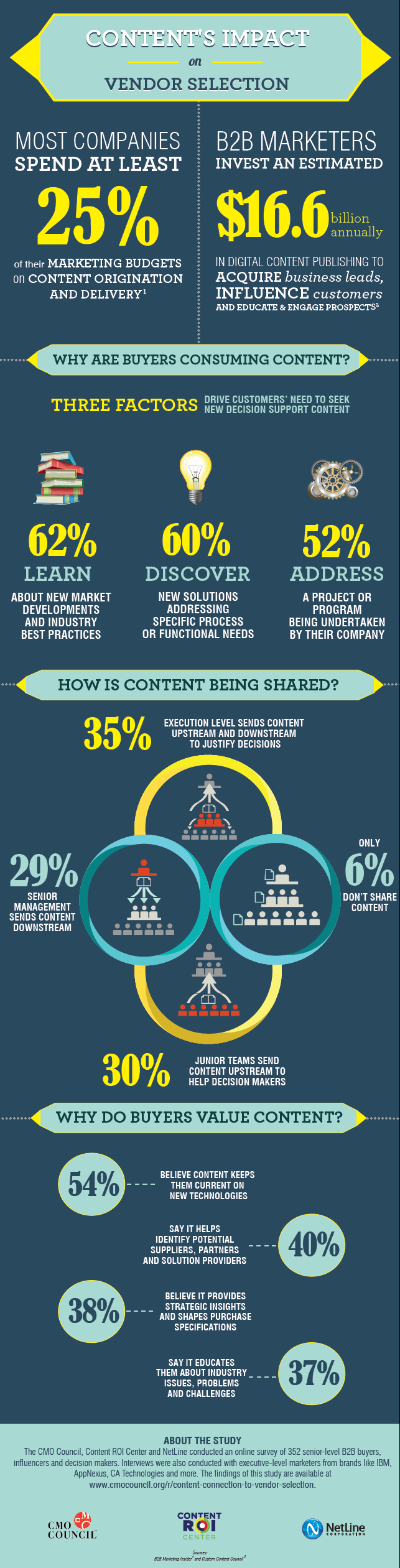
93% of B2B companies use content marketing. If you want your content marketing efforts to be effective you need to understand why B2B buyers consume and value content. When you understand what B2B buyers think about content you can create and distribute the right content – content that will help you grow your business by driving profitable customer action.
The CMO Council, Content ROI Center, and Netline conducted a survey of 352 senior-level B2B buyers, influencers, and decision makers with the objective of determining content’s role in influencing B2B buyers in the purchase process.
Why do B2B buyers consume content?
B2B buyers turn to content for a number of reasons including to:
- Learn about new market developments and industry practices;
- Discover new solutions to address a specific problem;
- Address a project or a program being undertaken by their company.
Why do B2B buyers value content?
B2B buyers value content because it:
- Keeps them current on new techniques;
- Provides strategic insights and shapes their purchase specifications;
- Educates them about industry issues, problems, and challenges.
Source: CMO Council
Understanding what B2B buyers think about content and why they use content will enable you to create, curate, and distribute content that speaks to B2B buyers and attracts new customers and engages current customers.
If you consistently create, curate, and distribute content that B2B buyers find valuable, you will realize results.
![Get SMART about your marketing goals [Free Marketing Goals Template]](https://fronetics.com/wp-content/uploads/2024/10/marketing-goals.jpg)
by Elizabeth Hines | Jan 22, 2015 | Blog, Leadership, Marketing
Want to reach your marketing goals? It’s time to get SMART.
Do you know what it is you’d like to see your business achieve this year? It’s likely you do. In fact, most people know generally what they’d like to see happen over the course of a year because they plan. But don’t be fooled, SMART goal setting is far more than just planning.
If you aren’t yet familiar with the SMART Goal concept, it’s essentially a roadmap to success. It makes our goals Specific, Measurable, Attainable, Realistic, and Time-Bound. SMART Goals are a tool that can be applied in many settings. For example, SMART Goals can be used to reduce costs associated with order fulfillment as well as to increase your website’s monthly visits and visitor to lead conversation rate.
Let’s take a look at how one marketing manager, we’ll call him Sam, might apply the SMART goals framework to his marketing efforts.
Specific – Here Sam will describe his goal in detail. He knows he wants to increase website traffic this year, but that’s not enough, so he gets specific. Sam sets a goal of increasing website traffic by 15% by the end of this fiscal year.
Measurable – How will Sam track his progress? In order to keep Sam on track to meet his goal by target date he set, he decides to use the website performance indicators he already tracks monthly.
Attainable – Sam’s goal should be challenging, but not impossible to reach. He reviews his company’s digital media strategy and prior year website traffic reports. After reviewing those, he decides that his current goal to increase sales by $250,000 by the end of this fiscal year is challenging yet achievable.
Realistic – Sam’s company expanded its product line at the beginning of the fiscal year, so it’s likely the company will experience increased marketplace exposure – an ideal situation for his goal of increasing website traffic.
Time-Bound – Sam plans to reach his goal by the last date of this fiscal year. He will track his progress monthly using website performance indicators.
By setting a SMART goal, Sam gives himself a specific focus and builds structure to his general plan of increasing website traffic. Breaking it down into more manageable parts will give him the motivation he needs to reach his goal.
What are your marketing plans for this year? Do you have a SMART goal guiding you? Increase your chances of success by downloading our free Marketing Goals Template.