by Elizabeth Hines | Nov 1, 2016 | Blog, Content Marketing, Marketing
Companies dedicate enormous resources to ramping up email marketing programs around seasonal pushes, like the holidays. But do they actually get more customers?
We all know the feeling — how the office buzzes, the anticipation starts to build. Busy season is around the corner, and your team is getting ready for the big push to make this the most successful year yet. But have you ever wondered if all the extra hours and money you pour into these seasonal marketing campaigns are worth it?
As the holidays approach, many businesses, especially retailers and e-commerce companies, are starting to ask themselves this question — or, at least, they should be. At what point will creating and sending another email to your database be detrimental, rather than beneficial? How much should your messaging change? Should you try something totally new and different to catch customers’ attention?
IBM Marketing Cloud’s 2016 Email Marketing Metrics Benchmark Study has some interesting answers to these questions.
The holiday email-marketing study
The 2016 Email Marketing Metrics Benchmark Study is an annual report that offers insight on how many people open, click, and ignore messages from email marketers around the globe. It aggregates data from messages sent by nearly 750 companies representing 3,000 brands in 40 countries. This year, the study also examined the performance of holiday messaging versus non-holiday messaging for retail/e-commerce vendors.
Most retailers send at least double the amount of emails during the holidays (defined as Thanksgiving to New Year’s) as they do during the non-holiday period. They entice potential buyers with aggressive pricing, free shipping, and deal deadlines. But do these more frequent, offer-loaded emails make a difference? Let’s take a look.
Click and open rates
In almost every respect, non-holiday emails outperformed holiday emails in a significant way. Open rates during the holidays were 18.8% lower than during non-holidays. Mean click-through rates differed by 28%. Mean click-to-open rates remained similar.
There are several takeaways here. Yes, open rates were lower during the holidays. But because the volume of emails sent during this period increased significantly, it’s likely that the total number of emails opened was greater during the holidays than non-holiday period. That’s a positive thing.
That being said, click-through rates decreased pretty dramatically. You would expect that special holiday offers would entice recipients to click through more often. But increased email volume seemed to detract from such motivating offers.
Similarly, click-to-open rates measure the effectiveness of email content (in driving a reader to take the requested action, e.g. redeem an offer). These rates remained relatively similar across both time periods, which is surprising. With more people looking to make purchases during the holidays, you would think that more recipients would act on the offers presented in the holiday emails. Again, increased email volume seemed to detract from their doing so.
List churn metrics
Increased email volume meant retailers processed more hard bounces, unsubscribes, and spam complaints during the holidays.
Here are the takeaways. Firstly, more emails equal more hard bounces. That seems logical enough.
Though unsubscribe and spam-complaint rates were slightly lower during the holidays, that doesn’t equal success. Because of the frequency math effect, retailers are losing a larger number of subscribers because they are sending more emails.
Say your company sends one email per week during the year, and two emails per week during the holidays. If you usually have 10 people unsubscribe per week during the year, approximately 20 people are unsubscribing during holiday weeks. That can deplete your database pretty quickly — especially if you’re more than doubling your email volume.
Conclusions
The folks at IBM Marketing Cloud had some interesting thoughts about their findings and how to increase the effectiveness of holiday emails.
For one, while increasing the number of emails you send during the holidays isn’t inherently a bad idea, as more emails equates to more total opens, many retailers are going about it the wrong way, as is evidenced by lagging click-through rates.
That’s because when many marketers ramp up email volume, they forget all the best practices that make their emails successful in the first place: personalization, targeted content, and offers that are relevant to the specific recipient based on his/her place in the buyer’s journey. Personalizing email content will help improve click-through and click-to-open rates, which could dramatically impact sales given the increased email volume.
Further, a courtesy head’s up about increasing email frequency could reduce the number of opt-outs and spam complaints. IBM Marketing Cloud suggests that companies should “consider sending an email to subscribers before you ramp up frequency, explaining the increased frequency, what kind of promotions they can expect, and shipping and return policies. Include prominent language about frequency options and link to your preference center. In addition, revise your preference-center language and options to encourage unsubscribers to opt down or snooze emails instead of simply opting out.”
Application across verticals
While the weeks between Thanksgiving and New Year’s are not every business’s busy season, the findings from this study are still applicable. If your prospects experience an uptick in marketing emails during a particular season from you and your competitors, you’re likely to experience similar results.
The key in ramping up emails prior to a big push is to retain quality — that is, customizing content and offers to the particular recipient. If you can’t scale, then you shouldn’t send.
Furthermore, this study speaks to the value of a strategic, year-round marketing program that builds brand awareness and customer loyalty, regardless of how close the busy season is. If prospects grow to know and trust your brand, they’ll turn to you when it’s time to buy, regardless of how many emails you send them in the weeks prior.
Related posts:

by Elizabeth Hines | Oct 31, 2016 | Blog, Current Events, Strategy, Supply Chain
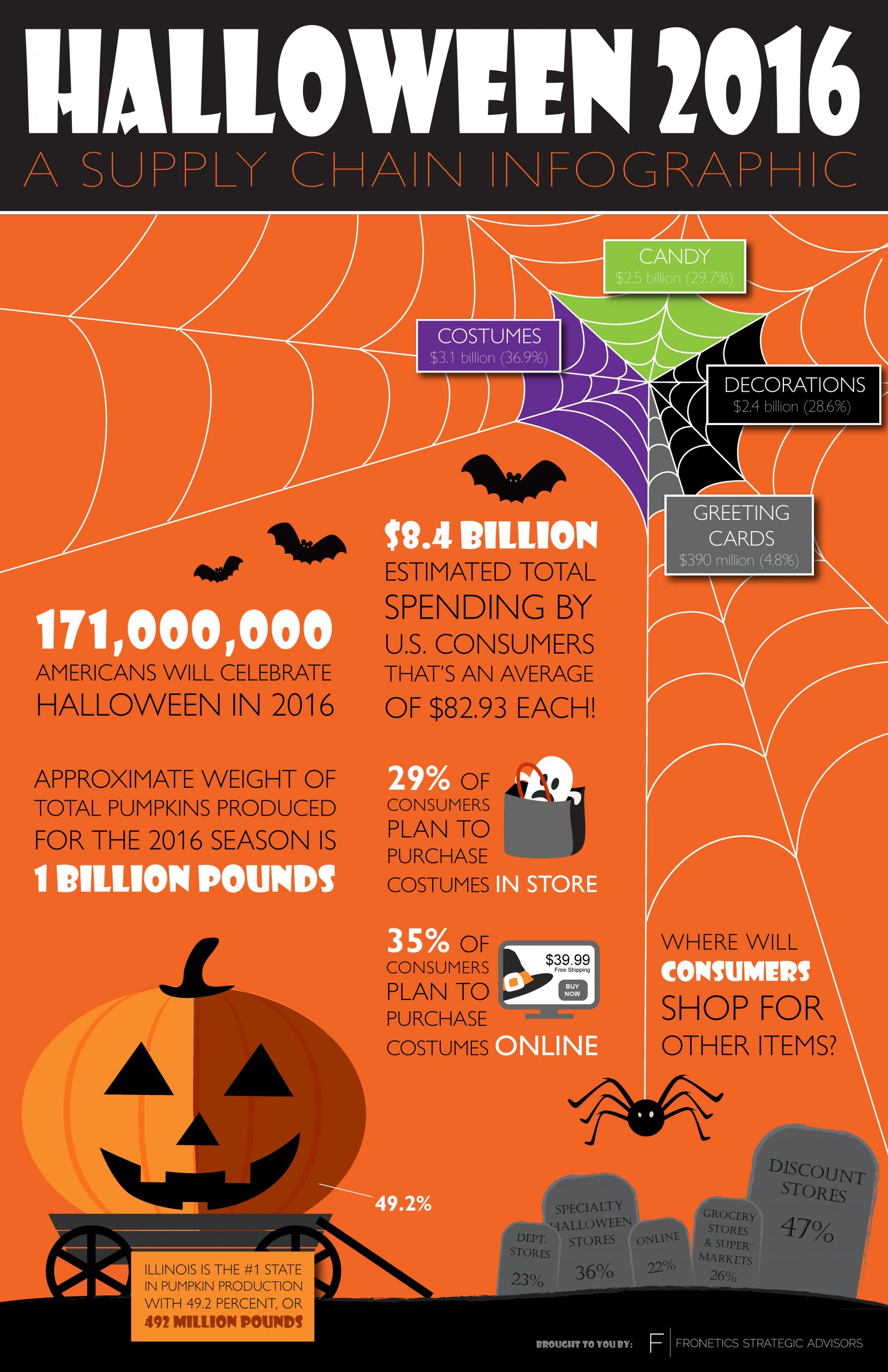
U.S. Consumers plan to spend a whopping $8.4 billion on costumes, candy, decorations, and more to celebrate Halloween 2016.
The National Retail Federation anticipates spending for Halloween 2016 will be at an all-time high.
The NRF’s annual survey found that 171 million Americans will celebrate the holiday, spending a total of $8.4 billion, the most reported in the survey’s 11-year history. Consumers plan to spend an average of $82.93 each, up from last year’s $74.34 per person spending.
As far as costumes go, NRF says to expect zombies, Minions, and characters from Star Wars and Disney’s Frozen to show up at your door. If you’re still looking for ideas yourself, try Pinterest, where 17% of consumers plan to get their inspiration for costumes this year.
Are you one of the 16% who will dress your pet up for Halloween? Take a note from last year’s top 5 pet costumes:
- Pumpkin
- Hot dog
- Batman character
- Devil
- Bumblebee
Check out our infographic of other interesting Halloween 2016 facts from the NRF’s survey of 6,791 consumers below.
Halloween 2016: A supply chain infographic
Related posts:

by Elizabeth Hines | Oct 27, 2016 | Blog, Content Marketing, Marketing, Social Media, Strategy
Company X also saw web traffic grow by 180% in 90 days by using Google AdWords and Facebook Ads.
Sometimes our clients can be a little hesitant to try pay-per-click advertising. Take Company X, for example.
Company X’s target customer fits a very particular profile, in terms of geography, income, and age. Because of those specific demographics, the client was not confident that a pay-per-click advertising campaign would be an effective way to reach those target customers. But we thought differently.
When paired with a content marketing program, pay-per-click can be one of the cheapest, in terms of cost-per-lead, and most efficient ways to reach a target audience. Thus, we convinced Company X to try PPC on a trial basis, investing just a small budget.
We developed a strategy for the client, using Google AdWords and Facebook Ads. Over the course of 90 days, the results were phenomenal.
A few key results:
- Company X acquired 54 leads.
- Traffic from paid search grew by 180%.
- The lead-to-customer conversion rate was nearly 3x the industry standard.
Needless to say, Company X will be expanding the use of pay-per-click advertising in the future.
How can pay-per-click help your business?
PPC can seem intimidating to the novice. But, when done right, it can be a highly effective way to reach the very specific kind of customer your business is looking for. A little bit of know-how can be all the difference.
As such, Fronetics has developed a quick training on the basics of pay-per-click advertising: what it is, what platforms are available, etc. If you are interested in learning more about PPC and how it might complement your marketing program, download our free guide below.

Related posts:

by Elizabeth Hines | Oct 26, 2016 | Big Data, Blog, Content Marketing, Data/Analytics, Marketing
Big-data insights can help you segment your email database to better target prospects based on where they are in the buyers’ journey.
Most companies these days are swimming in a sea of big data, the great swaths of information they’ve amassed from sales records, social media connections, website leads and contacts, and online analytics.
At first glance it’s a tangle of information that is hard to organize and even harder to learn anything from. That’s a stumbling block that forward-looking businesses need to overcome. Big data can help breathe new life into one of the most reliable yet shopworn tools of the trade: email campaigns.
Embrace Big Data
A study by the executive head-hunting firm Spencer Stuart surveyed 171 companies regarding big-data usage. Just a little over half of the companies used their big data to help guide email, SEO, and SMS marketing campaigns. That’s a fairly low rate, given the potential leg-up that big data can provide.
Consider what Walmart is doing. The company has big-data information on about 60% of all Americans, with which it micro-targets customers based on their individual interests and habits. It’s a powerful strategy that is spreading quickly to businesses of all sizes.
How can you use big data to freshen up your email campaigns?
Be a Collector, Not a Hoarder
Chances are, you are obtaining a lot of data, especially if you have an active content marketing plan in place. Not all of the data you get is equally important. Your focus should be on data that can lead to an actionable and quick response — for example, are you gathering information on your customers’ buying habits? Do you know who they are, where they are, what their interests are, what their email address is, and how your business connects with them?
Collect that relevant data and study it. Much of it will come from the buyer’s journey — the breadcrumbs that potential buyers leave for you in your big data. These pieces of information are keys to your personalized email responses.
Respond In Kind
Most experts agree that a quick and targeted email response is a good strategy for encouraging a new customer to make a purchase. The email needs to respond directly to the buyer’s interests — using information you’ve (hopefully) logged with your big data.
From this point on, it’s crucial to make sure that every email that is sent to that buyer is built around a backbone of big data. Nurture your customers with personalized emails that offer content and deals that line up with their specific interests.
Don’t Mess with the Masses
Mass emails — the generic sales pitch email — used to be the cost-effective and simple way of reaching and converting customers. Now, it’s more than likely they’ll get sent to the trash, or worse, the spam filter. The mass email is your one-way ticket to spam purgatory.
“Traditional methods of mass marketing doesn’t resonate anymore and they’re being ignored by the audience,” said Volker Hildebrand, Global Vice President of Strategy at SAP Hybris, in a recent interview with Forbes. “Data is the fuel for customer engagement, and being able to pull together all the relevant information about in real-time.”
You can do better than the mass email approach. If you’ve collected relevant data and you’ve studied your buyers’ journeys, you have the tools in place to build a smart email campaign. Tailor your campaign to personalize your approach to your customers, and more than likely they’ll open that email.
Related posts:

by Elizabeth Hines | Oct 25, 2016 | Blog, Strategy, Talent
A reduced workweek may mean better performance, talent retention, and bigger payoff for employers.
In August 2016, the Washington Post reported that Amazon plans to pilot a program in which select teams will work just 30 hours a week. The teams’ employees will be salaried and receive full benefits, as well as 75% of the pay full-time employees earn. The entire team, including managers, will work on this reduced schedule.
“We want to create a work environment that is tailored to a reduced schedule and still fosters success and career growth,” states an event posting by the company. “This initiative was created with Amazon’s diverse workforce in mind and the realization that the traditional full-time schedule may not be a ‘one size fits all’ model.”
The program comes just a year after a New York Times report depicted Amazon encouraging marathon workweeks while discouraging vacation — and even unfairly evaluating employees in the wake of personal crises like cancer or miscarriages.
Will the new part-time program help combat that image? Will the 30-hour workweek model impact Amazon’s productivity? While Amazon does not plan to roll the program beyond the select teams, research suggests that the company might reap some positive benefits from employees’ working less.
A reduced workweek benefits employees and the employer
Let’s look at how working fewer hours might result in healthier, more productive employees.
1. Shorter hours improve the physical and emotional health of the worker.
A National Bureau of Economic Research study examined manufacturing companies that experienced an unexpected spike in exports, meaning longer working hours, and the resulting toll on employees. The findings revealed that long hours on the job increase an employee’s risk for heart attack, depression, and injury. But despite more health concerns, employees took fewer sick days. The impact on productivity when a company has more sick, injured workers is self-evident.
On the contrary, a shorter workweek correlates with better physical, mental, and emotional well-being. That translates to more alert, adjusted, happy employees who have more stamina to complete their jobs. In fact…
2. A reduced workweek does not decrease productivity — rather, it often increases it.
There’s a reason 43% of companies offer shorter workweeks to some employees: It has a positive impact on their bottom lines. Just how much? Tax services firm Ryan saw revenue and profits almost double and client satisfaction reach an all-time high. KPMG goes as far as to say it uses flexible work hours as a “strategic business tool” that “allows us to accomplish our business goals and become more successful.”
Well employees leading balanced lives are able to accomplish more in a shorter amount of time, and that pays off for their companies.
3. Shorter hours may increase employee engagement and decrease turnover.
All the extra hours workers are putting in actually drive disengagement. Left wholly left unchecked, the culmination of issues arising from an unbalanced work-home life can increase absenteeism and turnover. Simply put, employees logging long hours are significantly more prone to burnout.
And turnover can be costly for employers. The U.S. Department of Labor currently estimates the average cost of a bad hiring decision to be as much as 30% of an individual’s first-year potential earnings. Think about how that adds up as employees put more time with the company and earn higher salaries.
Going back to Ryan, the tax services firm, implementing a shorter workweek reduced the company’s turnover rate from 30% to 11%. That’s huge.
So, Amazon is definitely onto something with its 30-hour workweek experiment. The question is, what will happen when it succeeds? Will more businesses try reducing working hours? Could something like this work for your business?
Related posts: