by Elizabeth Hines | Jun 28, 2017 | Blog, Current Events, Marketing, Social Media
In June’s social media news, more social media platforms are making changes to benefit businesses who advertise.
June has seen a lot of recent changes in big-name platforms, like Facebook, Instagram and Twitter, that will directly impact the engagement between businesses and potential customers. The trend is to create apps that work harder for paid advertisers, increasing brand awareness for businesses and proving their worth through built-in tracking.
Apple has also been working overtime to keep their products competing with the big players in the social media game. New analytics and introduction of Business Chat are keeping the fruit relevant.
Facebook Rolls Out Two New Ad Campaign Tools for Marketers
Facebook delivered two new options for helping businesses grow: Valued Optimization and Lookalike Audiences. The first, Valued Optimization, “works by using the purchase values sent from the Facebook pixel to estimate how much a person may spend with your business over a seven-day period. The ad’s bid is then automatically adjusted based on this estimation, allowing campaigns to deliver ads to people likely to spend more with your business at a low cost.” The second, Lookalike Audiences, helps marketers reach people likely to be interested in a business based on people who have visited their site. Read more
Facebook Expands Click to Messenger Ads to Instagram
Facebook continues to expand ways for users to connect directly with businesses. The Click to Messenger ads have been available through Facebook for a while, and now they’re expanding to Instagram. “Instagram Click to Messenger ads let you reach the people you care about on Instagram and engage with them on Messenger.” Read more
Instagram Makes Sponsored Content More Transparent
Last week Instagram introduced a new “paid partnership tag” that will clearly identify sponsored posts on its app. “Partnerships between community creators and businesses are an important part of the Instagram experience, and a healthy community should be open and consistent about paid partnerships.” This new tag will help users determine when posts are influenced by commercial relationships with businesses. Read more
Apple Rolls Out Analytics to Podcast App
During a podcast session at WWDC, the Apple developer conference, Apple announced that its podcast app will now have the ability to give publishers data that tells them just how much of their episodes are actually being listening to. Apple Podcasts app will allow creators to track aggregated data about when users start, stop, and skip within an episode. This data will give podcasts tangible results that were once estimated from the number of downloads a podcast received. Read more
Apple Debuts Business Chat
Business Chat allows real customer service representatives to communicate directly with users through iMessage. According to the Apple Developer site, customers can use this new feature to “find your business and start conversations from Safari, Maps, Spotlight, and Siri.” The Verge reports that “there will be built-in features like Apple Pay and calendar integration, which will allow Business Chat to facilitate purchases without requiring the user to exit the chat.” Read more
Twitter Experiments with New Promotional Features for Sponsored Live Video
After entering into an exclusive partnership with Live Nation, Twitter is experimenting with new features to help promote events featured on LN. New features like an alert that users can set to remind them of the live event or a branded timeline that will put all tweets about the event on one landing page will help strengthen the relationship between Twitter and Live Nation, paving the way for more partnerships with big brands. Read more
Related posts:
![The 2017 4th of July Supply Chain [Infographic]](https://fronetics.com/wp-content/uploads/2024/10/4th-of-july.jpg)
by Elizabeth Hines | Jun 27, 2017 | Big Data, Blog, Current Events, Data/Analytics, Logistics, Supply Chain
U.S. Consumers plan to spend a whopping $7.1 billion on cookouts for 4th of July celebrations.
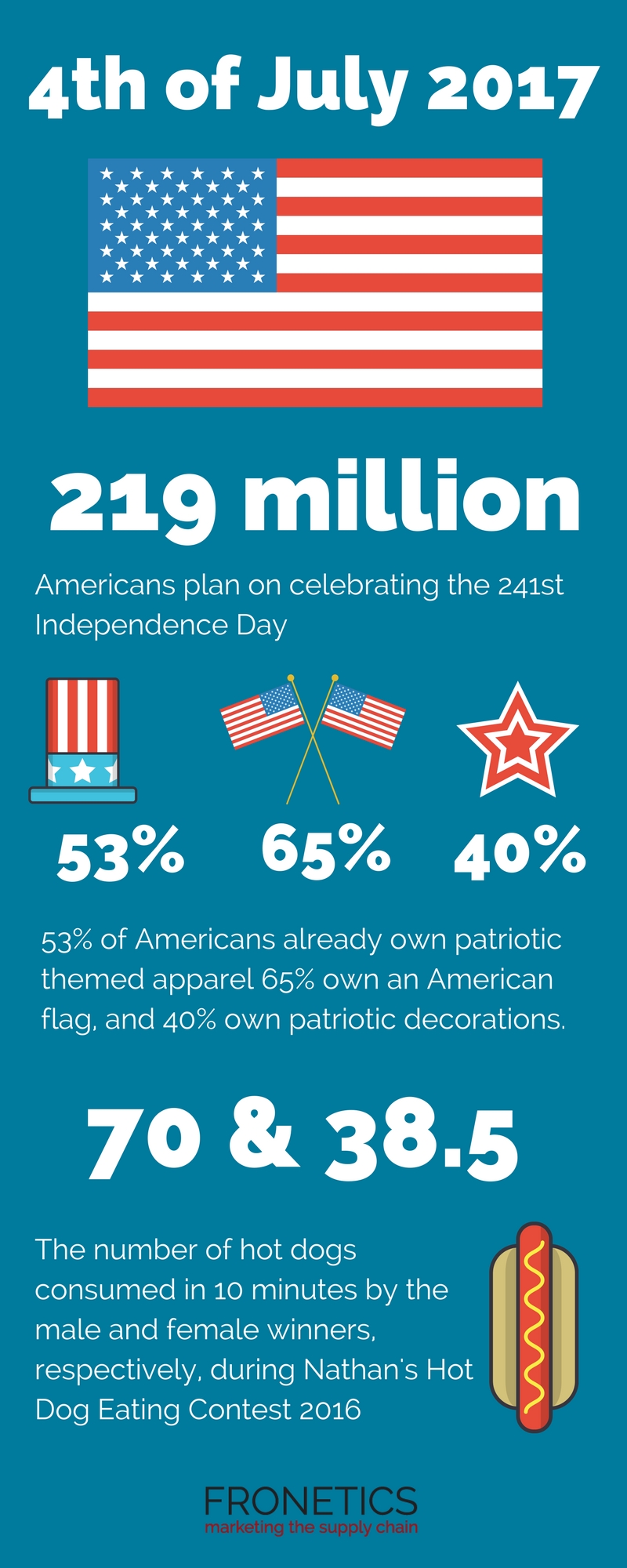
The National Retail Federation reports that 219 million Americans plan to celebrate the 241st Independence Day. Two-thirds plan to attend a cookout, barbecue, or picnic, spending an average of $73.42 per household on food items, up from last year’s $71.34. That’s a lot of hot dogs!
And what’s a Fourth of July celebration without fireworks? 44% of Americans plan to attend a fireworks show or community celebration. The U.S. will use approximately 285.3 million pounds of fireworks, totaling $1.09 billion dollars. More than 15,000 firework displays will glitter the skies to mark the special occasion.
Recognized as the nation’s largest Independence Day celebration, the Macy’s 4th of July Fireworks display attracts more than 3 million spectators live and over 10 million TV viewers. The firework display in Washington, D.C., comes in second with over 700,000 viewers from the nation’s capital.
And due to a number of factors — including strong employment and the low price of gasoline — a record number of people will travel out of town this year to celebrate the holiday. NRF estimates 32.9 million, while AAA estimates it will be closer to 44.2 million travelers.
At Fronetics, we wish you and your family a safe and fun Fourth of July celebration. Here are a few more fun facts to get you into the patriotic spirit.
A 2017 4th of July Infographic for the Supply Chain
(Made with Canva)
Related posts:
![12 Steps to an Effective Content Strategy for the Supply Chain [Slideshow]](https://fronetics.com/wp-content/uploads/2017/06/12-steps-to-an-effective-content-strategy-1.jpg)
by Elizabeth Hines | Jun 26, 2017 | Blog, Content Marketing, Marketing, Strategy, Supply Chain
Learn how to stand out from the crowd with a content strategy that drives profitable customer action.
According to a survey of supply chain and logistics marketers by Fronetics, 86% are using content as a marketing tool. Respondents report using content marketing primarily in order to:
- Increase brand awareness (96%)
- Generate leads (83%)
- Establish the company as an industry leader (74%)
- Engage customers (74%)
By consistently creating and distributing valuable, relevant content, you can attract a clearly defined audience — and, ultimately, drive profitable customer action. But how do you know what your audience will find valuable and relevant?
Throwing spaghetti at the wall to see what sticks certainly won’t get your desired results. Since 3 billion pieces of content are shared online everyday, you have to be strategic and thoughtful about your content in order to stand out from the noise (and your competitors). It takes time, careful research, and strategy to build a content marketing program that helps achieve your business goals.
At Fronetics, we specialize in helping supply chain and logistics companies create and execute digital and content marketing strategies. So we’ve learned a few tricks of the trade over the years. For example, did you know that explicitly designating a specific person to lead your content strategy can improve its effectiveness by 40%? Or that documenting your strategy can make it three times as effective?
We’ve put together a quick slideshow specifically for supply chain and logistics businesses who are looking to learn about content marketing and build a content strategy that will be effective in growing brand awareness, generating leads, engaging customers, and establishing their brands as industry leaders.
12 Steps to an Effective Content Strategy will help your business identify the key steps to getting the most out of your content marketing efforts. Download the slideshow to get started growing your business with content!

Related posts:

by Elizabeth Hines | Jun 22, 2017 | Blog, Content Marketing, Marketing
Email list segmentation is the one of the simplest and most critical practices to improving marketing email performance.
Marketing emails are an important part of lead nurturing: They can make or break whether a lead becomes a sale. So marketers spend a lot of time and money thinking about how to perfect their messages.
While many marketers focus on better design, higher frequency, or perfect timing as a means of increasing open rates and click-throughs. But, really, one of the best ways to improve the success of your email campaigns is through list segmentation.
And when I say success, metrics like click-through and open rates are part of that. But, there’s more. In fact, marketers have found a 760% increase in email revenue from segmented campaigns.
What is email list segmentation?
Email list segmentation simply means separating the contacts in your database based on certain criteria. For example, you can create separate lists for different buyer personas or for contacts in different industries or sectors.
The more specific you can get with your list segmentation, the more you can personalize the content of your emails — and the more relevant they will be to your recipients (which means they’ll be more likely to engage with them).
Other list segmentation ideas include:
- Demographics
- Company size
- Content downloaded from your website
- Geography
- Purchase history
- Content consumption (which blog posts they typically read)
- Interest level
- Purchase channel preference (online, via sales rep, etc.)
How does it work?
Most CRM or email platforms make list segmentation easy. But how you collect and determine criteria for segmentation is a little more complicated.
Collecting prospect information via forms on your website is one way. You can ask for name, email address, business name, interests, budget, demographic information, etc. Of course, the more fields on the form you require — or even allow for — the more prospects will turn away. It’s a delicate balance of encouraging form submissions while getting all the information you need.
Sales representatives can also enter information about leads as they communicate with them. Also, platforms like HubSpot collect information about contacts’ browsing history and content consumption that can be very helpful in determining what kinds of content they prefer or products they might be interested in.
Once you determine how you want to segment your email lists, it’s important to devise a different strategy for each list. What are your goals for each type of customer or prospect? Based on your existing data, how does that particular persona typically move down the sales funnel? How frequently should they be contacted? Answering these questions will help you build an email marketing strategy for each list that improves your chances of success with each.
What are the benefits?
Segmentation allows you to send the most pertinent content to the right people at the right time. And B2B buyers want and expect relevant content when making purchase decisions.
That sounds obvious, but I bet examples of companies violating this practice abound in your life. For instance, say you subscribe to the vegetarian plan of weekly meal-delivery service. Despite the fact that the company has a very valuable piece of information about your preferences (you’re a vegetarian), they send you a marketing email about upgrading to premium meats. Not only are you probably not interested in this offer — and are maybe even annoyed (or disgusted) by it — it leaves you with the feeling that the company doesn’t understand or value you as a customer.
It’s the same in B2B: 94% of B2B buyers say they chose a particular vendor because they demonstrated the strongest knowledge of the company and its needs. If your shipping business sends an e-commerce cookie company information about a special on shipping reefs and corals, you lose credibility in terms of how well you know and understand that customer.
But recall a time when you’ve browsed a company’s website and received an email shortly thereafter with FAQs about the exact products you were researching. Or, you have been in talks with several businesses about a major purchase, and just before making a decision, one sends you information helping you calculate ROI. That’s the kind of timely content delivery that can sway you in a particular direction.
Hyper-targeted marketing emails will give you the most success with your lead nurturing email campaigns. You’ll deliver the most relevant and pertinent information to the right people at the right time, encouraging them to move down the sales funnel and to make purchases.
Related posts:

by Elizabeth Hines | Jun 21, 2017 | Blog, Current Events, Logistics, Manufacturing & Distribution, Supply Chain, Transportation & Trucking
This post comes to us from Kevin Jessop of Cerasis, a top freight logistics company and truckload freight broker.
The Paris Climate Agreement. Let those words hang for a moment.
Throughout the course of the 2016 election and now the Trump Administration, many Americans have expressed dissatisfaction with the Paris Climate Agreement. True to campaign promises, the new Administration has started the process of removing the U.S. from the agreement, which has major implications for supply chains and shippers around the globe. While the Trump Administration’s impact on supply chains has been discussed previously on Cerasis’ blog, the president’s decision to leave the agreement has shocked the industry, and you need to understand why and what is really going to happen over the next four years.
What Is the Current State of the U.S. in the Paris Climate Agreement?
This may come as a shock, but the Paris Climate Agreement has only been in force since November 4, 2016. As a result, the U.S. has not yet enacted changes under the agreement. The only measure that would have fallen under the Agreement’s terms is the continuation of Customs and Border Protection’s (CBP) rules for maritime statutes.
Lawmakers would have likely passed new legislation to increase environmental scrutiny of supply chains and shippers over the next few years. Moreover, the U.S. would have sent monies to Convention of Countries within the Agreement to help fund eco-conscious goals. The Administration’s actions indicate such changes are not likely to occur, but they could still happen. But, how?
What Is the Timeline for Withdrawal?
The full text of the Paris Climate Agreement is available online through the United Nations Framework Convention on Climate Change (UNFCCC). Article 28 defines the process through which a member of the original Convention may withdraw from the Agreement, and it is a surprise to many to learn that the new Administration cannot simply flip a switch.
Article 28 states that any country wishing to withdrawal may only do so after three years have passed since the agreement went into force. Since the enforcement date was November 4, 2016, a country cannot submit a notification of withdrawal until November 4, 2019. Now, there is another side of the withdrawal.
To prevent countries from withdrawing due to political changes and safeguard the longevity of the planet, any withdrawal still requires a one-year term from the date of notification. In other words, the Administration cannot effectively withdraw from the agreement until at least November 4, 2020.
The 2020 Presidential Election is scheduled for November 3, 2020. This means that if President Trump follows through with submitting a notification of withdrawal in 2019, actual withdrawal will not occur until the day after the 2020 election. Therefore, the question becomes, “How would a notification of withdrawal play out during the election? And if so, will it help or hurt his chances or re-election?”
The precedent for polarization during the previous election cycle indicates President Trump will proceed with plans to withdraw the U.S. from the Agreement when the time comes. The June announcement is merely a call to action to prepare for withdrawal over the next few years. So, what does that mean to both domestic and international supply chains?
The Impact of Withdrawal on Supply Chains.
There are only three countries on the planet, counting the U.S. intention to withdraw, that are not part of the agreement now. This means that every foreign-originating business transaction with U.S. manufacturers, distributors or other partners, except for Syria and Nicaragua, will be at risk. The governments of other countries may look unfavorably at working with U.S. companies due to the new Administration’s plans.
Multiple big-business empires, ranging from Facebook to Goldman Sachs, have condemned the move to withdraw. According to BBC News, part of their rationale is simple. The changes the Agreement dictates reflect existing concerns and actions that many U.S. businesses, including shippers, have already undertaken. Even ExxonMobil, a company whose previous CEO holds the title of Secretary of State, urged the new Administration to remain in the Agreement.
These major companies have already invested time and money in energy-efficienct, eco-conscious programs, and many of their business-to-business partners have followed the same pattern. With the overwhelming majority of the world’s countries committing to this cause, there will be an opening of the “floodgates for businesses, scientists and engineers to unleash high-tech, low-carbon” technologies. As a result, the U.S. could fall further behind the global engineering and science goal, which helps all businesses succeed. In other words, domestic companies may have a more difficult time finding the labor or technologies needed to maintain profitability in the interim.
Is There a Much Darker Side to Withdrawal?
Without getting into a discussion on the science behind global warming, it is important to note things that have happened that may continue if global warming continues. For example, sea levels had risen 2.6 inches from 1993 to 2014, reports the National Oceanic and Atmospheric Administration (NOAA). If left unchecked, numerous ports, businesses, cities and whole seaboards could be lost in the next few decades. To ensure stability and growth along long-term goals, this is a risk that must be mitigated immediately.
The rising sea level is a fact in the heavily disputed conversation about global climate change.
For shippers and supply chains, the risk of not doing anything is too great. Thus, the new Administration means well, but withdrawing from the Agreement is not a change that will impact businesses before 2020. Furthermore, the backlash from the public toward companies that abandon eco-conscious goals could be severe. Shippers could face higher tariffs and additional troubles in shipping goods domestically or abroad.
It is in your company’s best interest to pursue energy-efficiency goals, including working with well-known partners, like Cerasis, to help you reduce waste, eliminate redundancy and continue making healthy profits throughout the future, regardless of who sits in the Oval Office.
This post originally appeared on Cerasis’ blog.
Related posts: