by Elizabeth Hines | Oct 23, 2017 | Blog, Current Events, Supply Chain
Consumers will spend a record $9.1 billion during Halloween 2017.
U.S. consumers will take to the retail markets Halloween 2017 and spend a whopping $9.1 billion on Halloween costumes, decorations, candy and more, making it the largest spending for the spooky holiday to date.
The National Retail Federation reports that consumers are preparing to be the baddest witches on the block, spending almost a billion more dollars this year on supplies than in 2016 ($8.4 billion). And the men are really stepping up their game, spending on average $20 more per costume than women.
“Americans are planning to spend more than ever as they gear up for Halloween,” NRF President and CEO Matthew Shay said. “Retailers are helping customers celebrate in style with a huge selection of costumes, candy and decorations to cater to ghosts and goblins of all ages.”
From 2017 blockbuster hits like Wonder Woman and Spiderman, it’s no wonder the most popular costumes for kids are superheroes. And let’s not forget about Fido — the most popular costume for pets for Halloween 2017 is a pumpkin.
Still need inspiration for the boo bash you’re attending? Try heading over to Instagram, a source of inspiration growing 12% year-over-year. Other consumers will get ideas from online search (35.2%), a retail store (30.3%), Facebook (18.2%), Pinterest (17.9%), and pop culture (17.2%).
Need more fun facts about Halloween to get you into the scary spirit? Check out this year’s infographic from the NRF’s survey.
Halloween 2017 supply chain infographic
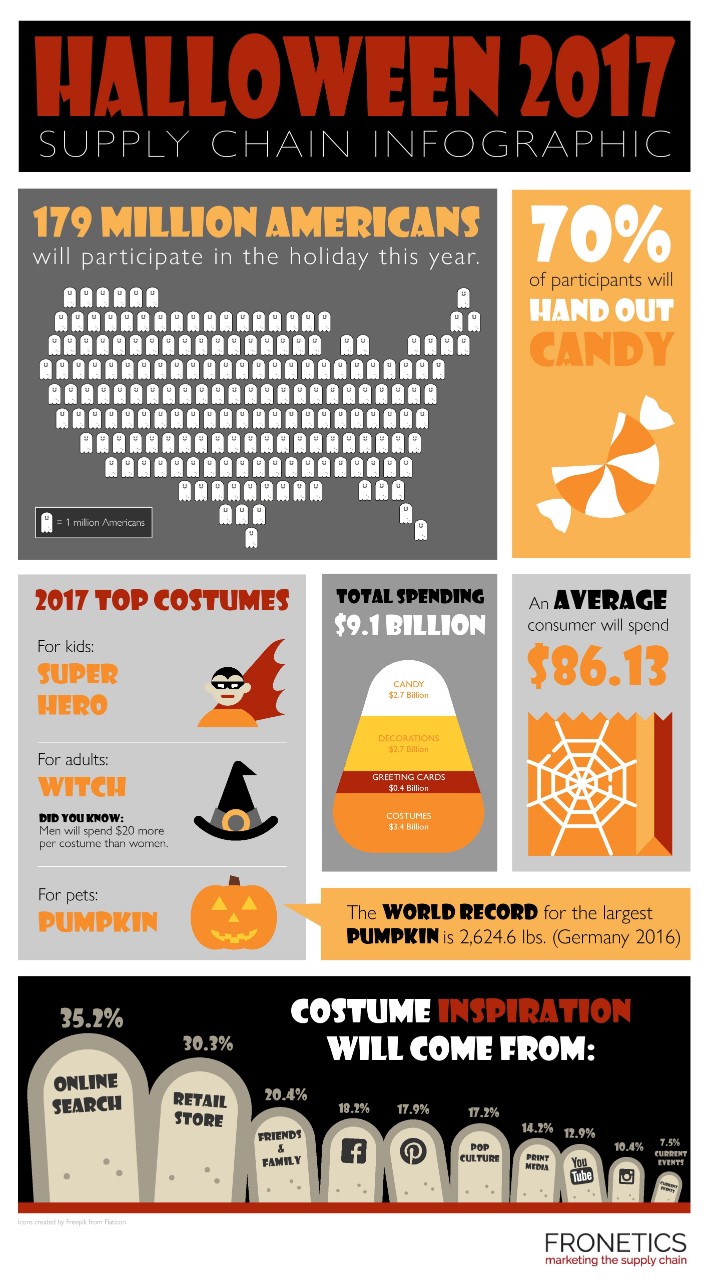
(Made with Canva)
Have a safe and happy Halloween 2017, everyone!
Related posts:


by Elizabeth Hines | Oct 19, 2017 | Blog, Leadership, Strategy, Talent
Investing in your employees through wages, time and energy can have a big impact on your company’s productivity.
Successful companies understand that employees’ job satisfaction and engagement affect productivity. After all, employees are an extension of your business. Keeping them challenged and encouraged is key to their success, as well as the overall success of your company. In research for their book, Time, Talent, and Energy, Bain partners Michael Mankins and Eric Garton discovered that investing in your employees does, in fact, pay off for companies. “The top-quartile companies in our study unlocked 40% more productive power in their workforce through better practices in time, talent and energy management,” says Garton.
Here are the 3 investments that Mankins and Garton found most impactful to productivity.
3 investments that will invigorate productivity
1) Wages
Three economists studied OECD data representative of the whole population of businesses in 16 countries around the world. They found that firms paying higher wages were reporting higher productivity. The link between the two seems pretty basic: Pay workers higher wages and they will feel valued and be more productive at their jobs.
But many companies believe that higher wages come at the cost of their consumers. This doesn’t have to be the case. Dan Teran, chief executive of Managed by Q, is a thought leader in higher wages creating a culture of respect and productivity.
“Teran believes that most American businesses, and especially fast-growing start-ups like Uber, have mistaken short-term gains for long-term value, undercutting the share of revenue that flows to workers in a way that will perversely hurt their bottom line. He believes, even more radically, that decades of rising inequality and stagnant wages in America are not an inevitable byproduct of capitalism; instead, they come from a simple misunderstanding about how best to deploy workers and recognize the value they bring to a company.” Managed by Q’s ‘Good Job’ Gamble, Adam Davidson
From small businesses like Managed by Q to retail giants like Walmart, the ideology behind better wages and benefits is catching on. Companies are understanding the relationship between production and pay and trying to narrow the gap.
2) Time
The pressure of working long hours and being available around the clock has a lasting effect on employees. Such practices often lead to burnt out, overworked team members. In fact new research suggests that, on average, managers have fewer than 7 hours per week of uninterrupted time to do deep work. Their days are filled with meetings, responding to emails, and having short increments of time to complete tasks.
The average company loses more than 25% of its productive power to organizational drag, processes that waste time and prevent people from getting things done. Meetings that last too long and processes that move too slowly contribute to lower productivity, less quality work, and low employee morale.
Allowing employees the time to feel creative and focused on their projects will lead to breakthroughs in productivity. Try establishing quiet hours for certain times of the day to encourage workers to spend more uninterrupted time deep thinking, which can lead to innovative and fresh ideas.
3) Energy
An inspired employee is more than twice as productive as a satisfied employee and more than three times as productive as a dissatisfied employee. Yet, only one in eight employees are inspired. One of the most beneficial things a company can do is to inspire its employees. Engaged working environments and positions that allow creative and innovative thought will lead to increased employee engagement and productivity.
Companies like Apple, Netflix, Google and Dell are 40% more productive than the average company. Why is that, you ask? These companies invest in inspiring their employees.
“Inspirational leadership can be taught. Companies that recognize that and invest in making it happen create meaningful impact on the productivity of their company,” says Mankins. Studies have shown that employees that feel satisfied with their jobs are more productive.
Give your employees the autonomy to feel engaged in their work. This freedom will give them the opportunity to get creative and involved in their projects.
The opportunity exists for all employers to positively affect worker happiness while simultaneously increasing productivity. If your company is interested in exploring the benefits of investing in their employees, focusing on wages, time and energy is a good place to start. You might be surprised to find currently untapped financial gains just by putting investment in your employees at the top of your priority list.
Related posts:

by Elizabeth Hines | Oct 18, 2017 | Blog, Content Marketing, Leadership, Marketing, Social Media
Supply chain and logistics executives should be using their celebrity on social media to be the public face of their businesses and an extension of their brands.
Here at Fronetics, we talk a lot about the importance of a social media presence for supply chain and logistics businesses. Most companies use social media to build brand awareness, communicate with a target audience, and, of course, attract new leads and customers. It’s highly effective.
But I am a strong believer that executives should also be on social media, as themselves, representing their brands and establishing themselves as thought leaders in the industry.
With their relative celebrity, supply chain and logistics executives are uniquely positioned to attract a following of customers, prospects, potential talent, industry peers, and admirers. They can use social media to connect with these people, share their ideas and industry news, and become the human face of their brands. It amplifies the company’s social media efforts in a way brands can’t do themselves. After all, social media is about connecting with people.
It makes sense, right? But in reality, 61 percent of fortune 500 CEOs have no social presence whatsoever. It’s an enormous missed opportunity.
Think of what these 3 CEOs’ social media presence has done for their brands.
With almost 12 million Twitter followers, the founder and owner of Virgin Group was named the top CEO on social media. Branson insists on creating his authentic content — from funny, personal stories to pictures — himself, and his commitment to posting daily keeps followers engaged. The resulting dialogue and relationship with followers has helped elevate his personal brand and Virgin as well.
Co-founder, president and former chief editor of the Huffington Post, Huffington was an early adopter of social media as a marketing tool. She has used her success at Huff Post and her personal social media presence to increase visibility to her newer projects, including Thrive Global.
Musk has committed to being authentic and open about the ups and downs of his business ventures, and his followers have responded favorably with an almost cult-like following. His personal account’s audience is more than double the number of followers combined for his three companies. Taking a page from Apple’s play book, Musk has used the reveal of new Tesla models and Space X rockets to stir up a buzz about projects. These live stream reveals are flashy, yet cool and casual, and have garnered over a million views.
Supply chain and logistics executives killing social media
This is not to say that there are not some supply chain and logistics executives who are capitalizing on using their personal brands on social media. Here are some as an example:
- Kelli Saunders, Morai Logistics
- Peter Tirschwell, IHS Markit
- Hailey McKeefrey, EBN
Which executives do you follow on social media?
Related posts:

by Elizabeth Hines | Oct 17, 2017 | Blog, Content Marketing, Marketing, Strategy
Use these strategies to help your business generate revenue with content.
One of the biggest challenges inherent to content marketing is measuring how writing blog posts and posting on social media equals a revenue stream. I know I write over and over again in this space about how content marketing is one of the most effective strategies for growing business and generating revenue. But many in the supply chain industry still struggle to understand the connection.
I highly suggest listening to this podcast interview with Content Marketing Institute founder Joe Pulizzi. He talks about monetizing content. In summary, businesses need to be about more than just their products and services — they need to be a valuable resource for their customers. This is why content marketing works. It’s a move away from the promotion of products toward branding oneself as a source of knowledge.
But back to monetization. Here are some key takeaways from Joe’s interview about how to generate revenue with content.
Revenue models
Once you’ve established your outlets for content distribution (blog, podcast, YouTube channel, social media platforms, or other publishing outlets) and built an audience, how do you go about generating revenue? According to Joe, there are 10 different revenue opportunities.
The traditional opportunities that most companies think about are:
- Selling products
- Selling services
- Keeping customers longer
- Increasing yield
- Selling different products
But Joe says that there are five additional revenue-generating activities:
- Sell advertising on your site
- Create a sponsorship deal
- Launch a conference or event
- Sell premium content
- Ask for donations
Joe advises that business new to these ideas not try everything at once. “Try one revenue model every six months,” he suggests.
Rethink your marketing department structure
Chances are, your marketing department is set up far less efficiently than it should be.
Joe sees a trend of businesses setting up their marketing departments primarily as an opportunity for the sales team — in other words, they are leading “product-first.” “Yes,” he says. “Selling products is important. But you can’t lead product-first anymore. The only competitive advantage people have today is communication.”
It’s time for marketers to refocus on making markets and creating opportunities for organizations. It’s about creating and developing trusted relationships with your audience, and monetizing those relationships by doing more than selling products. Adopting a new vision for your marketing can turn it from a cost-center into a profit-center, with marketing being “profitable in and of itself.”
Related posts:

by Elizabeth Hines | Oct 16, 2017 | Blog, Leadership, Talent
Google trains new managers in these six areas to make them highly effective leaders.
When you think of the word “manager,” you associate it with leadership. (Or, at least, I do.) But the two don’t necessarily go hand in hand.
Being a manager is just a position; a leader is something more. Oftentimes the skills that get people promoted to the managerial level don’t necessarily make them effective leaders. Then you’re stuck with managers that can’t lead, and that’s a problem. (See How to Be a Bad Leader: 6 Common Characteristics of Poor Leadership.)
Lucky for us, organizations like Google have spent years researching what makes an effective manager. Using Project Oxygen, an internal study analyzing more than 10,000 manager impressions, Google identified 8 habits of highly effective managers, which the company now uses to train new managers. Google shares this presentation through the re:Work website, which focuses on 6 key attributes.
6 key attributes of highly effective managers
1. Mindset and values
Dr. Carol Dweck, a professor of psychology at Stanford University, studied the science of growth mindset, the belief that intelligence can be cultivated. Project Oxygen showed that productive leaders live this philosophy at work. They are eager to learn, take risks, and challenge themselves — all of which ultimately boost their performance.
Also, Google empowers new managers to leverage their individual values in their management styles. This drives deeper meaning into their work and supports them when they, inevitably, need to make tough decisions.
2. Emotional intelligence
Emotional intelligence is the ability to recognize emotions in yourself and others, and leverage this awareness to manage behavior and relationships. Managers who are emotionally intelligent make better decisions, communicate more effectively, and seem more relatable to employees. They can better control the emotional climate of the workplace by anticipating employees’ needs and creating an environment that supports them.
3. Manager transition
Google has new managers share the challenges, surprises, and frustrations of their transition from individual contributor to supervisor. This not only teaches that it’s ok to be vulnerable and honest, but also encourages others to offer advice and to help devise actionable new strategies.
4. Coaching
A good coach nurtures and grows the talent on his/her team. The positive effects impact more than just team performance. Research by the Human Capital Institute and the International Coaching Federation shows that a strong coaching culture increases employee engagement and revenue growth.
Google defines good coaching as:
- Timely and specific feedback
- Delivering hard feedback in a motivational and thoughtful way
- Tailoring approaches to meet individual communication styles in regular one-on-one meetings
- Practicing empathetic “active” listening and being fully present
- Being cognizant of your own mindset and that of the employee
- Asking open-ended questions to discover an employee’s acumen
5. Feedback
“Embrace bad news to learn where you need the most improvement.” — Bill Gates
The purpose of feedback is to improve performance and foster professional growth. But words can hurt, and employees can interpret constructive criticism as an attack. Thus, the ability to provide feedback effectively is essential for any manager.
Google teaches new managers to be consistent across their teams when delivering feedback, and to balance the negative with positive. It’s also important to treat these conversations as a dialogue, not a monologue. Being authentic and stating growth opportunities in a clear and compassionate way will build trust between new managers and their employees.
6. Decision making
Effective leaders take on the tough task of making decisions and, often, with little time to deliberate. Managers make decisions taking into account their personal values, as well as the values of their organization, and they must be consistent over time.
It’s also important that managers occasionally throw their ideas out to their team and ask for feedback. By creating solutions that are based on a comprehensive understanding of the issue, managers are able to make decisions based on their internal compass, as well as the feedback from others.
After implementing this new-manager training program, Google saw statistically significant improvement in 75% of its underperforming managers. That speaks to the impact these 6 areas have on the effectiveness of new managers. And managers have a major impact on the effectiveness of their teams. So a great new manager can be all the difference for a company. In the words of Andrew Carnegie, “People don’t like to follow leaders who are dedicated only to their own personal glory, but they will sacrifice everything for leaders and communities who give them a higher calling, a greater purpose.’”
Related posts: