by Elizabeth Hines | Jan 3, 2018 | Blog, Content Marketing, Marketing
In part one of a four-part series on writing for SEO, we address how search engines and the search landscape have changed recently.
Content marketing has seen a lot of changes in the past few years. These changes are largely results of the rapidly evolving search landscape, as well as a seismic shift in the way people are actually discovering content. New, more sophisticated search algorithms, changes in the way people use search engines, and new ways that marketers develop their content are just a few of the contributing factors and outcomes.
Over the next few weeks, we’ll be writing a series of posts examining how marketers should approach writing for SEO in this new landscape. Today, we’re exploring specifically how search engines have evolved — something they are always doing, as they improve to help searchers find the content that best answers their queries.
Are keyword rankings still important?
It’s important to recognize that as search engines change the way they process and evaluate content, older metrics of SEO success aren’t as reliable as they used to be. Take keyword rankings for example. While conventional wisdom tells us that it’s absolutely necessary for content marketers to check their Google keyword rankings for target keywords, debate has swirled recently about the actual reliability of this metric.
Why is this once-standard metric being called into question? The answer is largely about context: Search engines have evolved beyond the point where everyone gets the same results of a query, and therefore rank can change drastically depending on context.
Location-based searches are one of the most obvious and important contextual variables. Simply put, depending on where you’re searching from, you’ll see different search results. This makes it difficult and unreliable to evaluate success based on keyword rankings alone.
Featured snippets
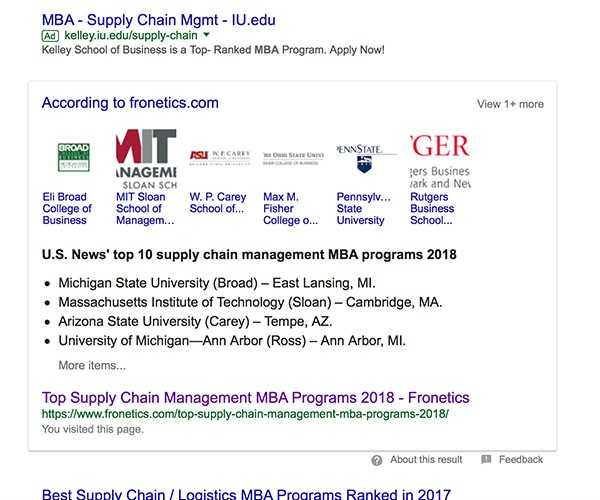
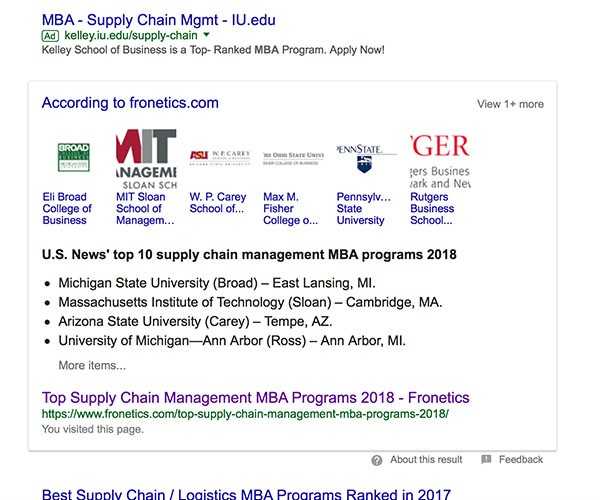
In addition to keyword-ranking problems, search engines are starting to dictate how content should be structured — particularly with the increased appearance of featured snippets. These snippets typically display content from within one of the pages ranking on page one of a question-based query, directly answering the question searched for without the user ever having to visit the actual page.
Fronetics has the featured snippet for Supply Chain Management MBA Programs.
A recent study found that of 1.4 million queries, 30% showed a featured snippet — that’s big growth. This means that content that ranks within the featured snippet section often gets a much greater share of the traffic for the given query. For content creators, this points to a need to restructure content to try to appear within these featured snippets.
Changes to the way search engines work do present a challenge for content creators writing for SEO. But keeping pace with the ever-changing technology is key to keeping your content relevant.
Make sure to check out part 2 in our series, Writing for SEO: People Are Changing How They Search, part 3, Writing for SEO: Topic Clusters and Pillar Content (NOT Keywords), and part 4, Writing for SEO: Measuring the Success of Your Content.
Related posts:
SaveSave

by Elizabeth Hines | Jan 2, 2018 | Blog, Content Marketing, Logistics, Marketing, Social Media, Supply Chain
It’s time to cast your vote for the top logistics and supply chain blogs of 2018!
We love hearing about your favorite logistics and supply chain blogs. We’re conducting our 4th annual survey to uncover the top industry blogs of 2018. Help us by voting for your favorite. Responses will be collected through Friday, January 26, 2018.

All responses are confidential and will be reported in aggregate. No identifiable information (individual or company) will be attached or included. Please contact [email protected] with any questions.
Interested in our past winners? Here they are!

SaveSave

by Elizabeth Hines | Dec 20, 2017 | Blog, Talent
Here are our most-viewed blog posts from 2017 about talent, including tips on retaining your top talent and helping turn your employees into brand ambassadors.
The start of the new year brings along a host of resolutions. Finding a new job or advancing in a current position are common new year’s resolutions for individuals. For companies, identifying new strengths and interests within your employees and hiring and retaining great talent are common goals.
We’ve assembled our top 10 talent posts of 2017. We hope these posts help you and/or your company overcome challenges, and achieve your goals for next year.
Top 10 most popular talent posts of 2017
1. Gender Diversity is Not a Women’s Issue: It’s an Economic Issue
Gender diversity is generally viewed as a women’s issue. It is not. Research conducted by McKinsey & Company and LeanIn.org finds that despite corporate America’s stated commitment to gender diversity, outcomes are not changing. Moreover, the research finds that employees do not believe companies are taking the necessary steps to enact change. Read more.
2. Top Supply Chain Management MBA Programs 2018
Looking for talent? Try recruiting from these top-rated supply chain management MBA programs and schools. We have written before about the importance of recruiting and strengthening the relationship between academia and the supply chain industry as means to solve the growing supply chain talent gap. If your company is looking to hire, consider strengthening your rapport with schools that offer supply chain programs or specialties. Read more.
3. Are We Thinking About “Soft Skills” All Wrong?
By calling them “soft skills,” are we shortchanging competencies that are critical for supply chain and procurement professionals to succeed? One of the biggest stories in the world of Supply Chain and Procurement talent over the past few years has been the emerging importance of Soft Skills. As the field has become more strategic — with a greater impact on wider areas of business — professionals in the field have had to become stronger at advocating for it. Read more.
4. Great Supply Chain People Are Getting Harder to Find, But Do Companies Have a Talent Management Issue?
Is the Supply Chain talent gap problem really a talent management problem? This guest post from Argentus explores the so-called “talent deficit” in the field from all angles and perspectives. The fact is, it’s becoming harder for companies for find the talent that they need for these positions as baby boomers retire and the function evolves. Read more.
5. Employee Brand Ambassadors Can Influence B2B Buying Decisions
As peer influence becomes increasingly important in B2B buying decisions, empowering employee brand ambassadors will benefit your bottom line. I’ve written lately about the rise of influencer marketing. It’s a strategy B2B businesses are starting to understand and use to their advantage. But you don’t need a Kardashian or even an important industry professional to get started. Employees are your most natural, ready-made influencers. Read more.
6. Freight Driver Shortage Update: Will 2017 Come to a Head and Cause Issues for Shippers?
Growing woes over a forthcoming capacity crunch are not going away anytime soon. But, the capacity crunch may have a major impact on the freight driver shortage and vice versa. In a sense, fewer drivers mean that capacity will grow tighter. Yet, as capacity shrinks, the incentive for drivers increases. Read more.
7. 3 Ways to Attract Millennial Talent for the Supply Chain
Hoping to draw more millennials to your talent pool? Implementing these three ideas might help win them over. By the year 2020, millennials are estimated to make up a majority of the workforce. In addition, a 2014 study found that 46% of B2B buyers were millennials, and that number is on the rise. This seismic shift in workplace demographics calls for a new approach to attracting and retaining talent. Read more.
8. 3 Questions to Ask before Making a Professional Change and Overcommitting
Thinking of making a professional change? Here are some questions to consider before taking the plunge and overcommitting. We’ve all been asked to take on new projects at work when we’re already completely swamped. In the moment, it can be very hard to say no. And we’ve all jumped on LinkedIn to see what other opportunities are out there. More money, less headaches. The grass is always greener. Read more.
9. Could Liberal Arts Grads Fill the Supply Chain Talent Gap?
Mark Cuban thinks liberal arts grads will be the next in-demand employees. Could they be the answer to the supply chain talent gap? The supply chain talent gap has been called a “perfect storm.” Every report cites doomsday statistics of the impending crisis when, by 2025, 60 million baby boomers will exit the workforce, leaving only 40 million millennials to take their place. Read more.
10. Three Tips for Retaining Your Top Talent
Investing in your top talent and playing an active role in developing their careers will motivate them to stay around. Company loyalty is a thing of the past. In today’s day and age, everyone is looking for the next best thing, and that is true in the workplace as well. But this doesn’t mean that retention of top talent is hopeless. Read more.
Related posts:

by Elizabeth Hines | Dec 19, 2017 | Blog, Marketing
Email is one of the most utilized tools in your marketing toolbox, but marketers need to continuously develop their email practices to keep up with the rapidly changing interests of audiences.
Email marketing is a powerful tool for growing and developing your business. You probably get hundreds of marketing emails from all kinds of companies you patronize (and even those you don’t) every day. So you know as well as anyone that not all email marketing is created equal.
Especially in B2B culture, there is a right way — and many wrong ways — to do email marketing. Our blog hit on many best practices in 2017 that are important for B2B marketers to keep in mind as they create marketing emails.
Here are the top 7 email marketing posts for 2017.
1. 7 Email Marketing Tips for Manufacturers and Industrial Companies
Here are seven tips for manufacturers to improve your email marketing strategy in the manufacturing and industrial sector. Many manufacturers and industrial companies are still stuck in the one-off batch and blast mode of email marketing. That strategy is not likely to work very well in industrial marketing, where most of the purchases include complex products with long sales cycles, multiple decision-makers, and stakeholders are involved. Read more.
2. 7 Techniques for Personalizing Marketing Emails and Boosting Engagement
Personalizing marketing emails increases open rates, click-throughs, and revenue, but it takes so much more than addressing recipients by name. Marketers can use information they have about subscribers to tailor email content for individuals, based on who they are or where they are in the buyer’s journey. Read more.
3. 4 Email Marketing Stats that Prove You Spend Too Much Time Creating Emails
Email marketing can be a challenge — to say the least. The constantly changing email landscape, marketing trends, and privacy regulations can make staying on top of your email game very tough. Take a look at these 4 statistics and why streamlining and automating certain aspects of your email marketing program might free you up to focus on factors that can make a difference. Read more.
4. Increase Revenue from Marketing Emails by 760% with This One Trick
Email list segmentation is the one of the simplest and most critical practices to improving marketing email performance. Marketing emails are an important part of lead nurturing: They can make or break whether a lead becomes a sale. So marketers spend a lot of time and money thinking about how to perfect their messages. Read more.
5. 5 Biggest Email Subject Line Mistakes to Avoid
Email marketers, beware: If you’re tasked with writing compelling emails to capture online customers, the subject line — the headline of your message — is the first and main spot to grab the viewer’s attention. But, while a cleverly written subject can boost open rates and click-throughs, a poorly written one can have the opposite effect. Read more.
6. Three Marketing Email Crimes to Avoid
Are your marketing emails annoying your customers and prospects? We’ve all felt it: the visceral annoyance on opening an email — because it’s the fifth one from the same company in two days, or because it’s packed with hyperbole or an off-putting sales pitch. As it turns out, recent research has shown that this reaction is only too natural. We’re predisposed to view the tone of email more negatively than it was written. Read more.
7. Mobile-Friendly Emails: 6 Tips for Success
Use these 6 tips for more mobile-friendly emails to improve recipient engagement rates and to promote profitable customer action. When a majority of your audience is reading your marketing emails on their mobile devices, it’s imperative that you’re creating emails that are optimized for mobile viewing. Here are 6 essential tips for creating mobile-friendly email campaigns. Read more.
Related posts:

by Elizabeth Hines | Dec 18, 2017 | Blog, Leadership
Our most-viewed leadership posts from this year cover positive and negative leadership characteristics and provide examples of exceptional industry leaders.
One of my favorite experiences from 2017 was interviewing Ellen Voie, the CEO of Women In Trucking. A true inspiration, Voie exhibits tangible passion for promoting more gender diversity into the transportation space, but her practical, strategic approach is the hallmark of her success. She is an exceptional leader, and I feel privileged to have gotten this opportunity.
Our top leadership posts from 2017 examine what makes a good leader, as well as what makes a bad leader. They also look at some executive thought leadership about industry trends, and talk about graduate programs from which future leadership may be matriculating.
Top 10 leadership posts
1) 80% of Executives Say Procurement Isn’t Strategic Enough
Tis guest post from Argentus Supply Chain Recruiting looks at insights from the Procurement 2020 Survey. The survey of 200 C-Suite executives from a variety of industries and functions presents a rather dispiriting picture of the Procurement function today — or at least how it’s perceived. The majority of executives don’t think procurement is crucial to business leadership, and that it isn’t a key input when making high-level strategic decisions. Read full post
2) Women In Trucking’s Ellen Voie Paves the Way for Women Drivers & Managers
Ellen Voie is successfully breaking down barriers and changing the perception of the trucking industry. As founder and president of Women In Trucking (WIT), Voie and her team work to promote the organization’s mission “to encourage the employment of women in the trucking industry, promote their accomplishments, and minimize obstacles faced by women working in the industry.” I spoke with Voie about her experiences in the transportation industry, as well as her hopes for WIT and the future of women truckers. Read full post
3) Top Supply Chain Management MBA Programs 2018
We write frequently about the importance of recruiting and strengthening the relationship between academia and the supply chain industry as means to solve the growing supply chain talent gap. If your company is looking to hire, consider strengthening your rapport with schools that offer supply chain programs or specialties. The U.S. News & World Report annual rankings give companies in the supply chain and logistics industries an idea of where some of the brightest graduates, who will be seeking employment in the upcoming months, will be coming from. Read full post
4) 5 Ways to Push Employees to Be Their Best without Stressing Them Out
Management works to create a balance between pushing employees and pushing them past their limits. Leaders should create a safe and supportive environment where employees feel respected and, in turn, cooperative and productive. With this is mind, it’s important to incorporate tangible ways of reducing stress for your employees. This post offers some ideas. Read full post
5) How to Be a Bad Leader: 6 Common Characteristics of Poor Leadership
What’s the number one reason talented employees quit? Gallop polls show that 50% of employees cite their managers as the reason for leaving. A bad leader can cost your company. And poor leadership at the highest levels of a company can be detrimental to a business. This post outlines 6 common characteristics of poor leadership that should be red flags to all companies. Read full post
6) Should You Get an MBA in Supply Chain or a Designation?
Again, our friends at Argentus Supply Cain Recruiting ask an important question: What value do you see in getting a Master’s Degree in Business/Supply Chain vs. some of the designations out there? The recruiting experts speak to what companies are looking for in hiring, and how graduating from these programs builds your personal brand. Read full post
7) Should You Freeze Hiring During Uncertain Economic Times?
Despite an 8-year bull market, many businesses are still licking the wounds caused by the 2007 financial crisis. Add a volatile political climate and predictions of impending economic turbulence, and you can’t blame those growing wary of rapid growth or expansion opportunities. But, as the supply chain is already suffering from a talent gap, can companies afford to slow or freeze hiring — or, even, to downsize? Research suggests that organizations that balance caution with a forward-looking talent-acquisition strategy may fair best through difficult economic times. Read full post
8) Why Supply Chain and Logistics Executives Should Be Active on Social Media (as Themselves)
With their relative celebrity, supply chain and logistics executives are uniquely positioned to attract a following of customers, prospects, potential talent, industry peers, and admirers. They can use social media to connect with these people, share their ideas and industry news, and become the human face of their brands. It amplifies the company’s social media efforts in a way brands can’t do themselves. Read full post
9) Women Leaders Who Make the Supply Chain Flow
We have had the opportunity to interview 6 supply chain leaders about their professional experiences, as well as their thoughts on gender diversity in the industry and beyond. Interviewees include: Kendrea Durr-Smith, Director of Global Trade Compliance, Arrow Electronics; Barbara Jorgensen, Co-Founder and Managing Editor, Electronics Purchasing Strategies; Hailey McKeefrey, Editor-in-Chief, EBN; Cathy Morris, Senior Vice President and Chief Strategy Officer, Arrow Electronics; Mickey North Rizza, VP of Strategic Services, BravoSolution; and Kelli Saunders, President, Morai Logistics. Read full post
10) There Are Lessons in Success, Not Just Failure
Companies have a responsibility to ask the tough questions when things go awry. We have all been in these meetings: we diagnose failures, and we dissect the process, tools and staff involved to get to the root of the problem. Unfortunately, most companies only step back and really dive into what happened when something bad happens. But what if companies took the same approach when something went right? Read full post
Related posts:
SaveSave