by Elizabeth Hines | Jul 5, 2018 | Blog, Content Marketing, Current Events, Logistics, Marketing, Social Media, Supply Chain
The latest social media statistics show growth of Instagram, social messaging bots, and video content.
We joke around here that one thing that will always stay the same is that social media will always be changing. 2018 has been a remarkable example of that thus far, particularly in regards to platforms like Facebook.
Every so often, we like to take a step back and look at what the data is telling us about where social media is heading and what that might mean for B2B marketers.
Social Media Examiner’s 10th annual study, 2018 Social Media Marketing Industry Report, surveyed more than 5,700 marketers from across the world in a variety of industries — including manufacturing, industrial goods, and a variety of other B2B verticals. It offers a really comprehensive view of what’s going on in social media in our industry and beyond.
I’ve pulled out 10 social media statistics from this report that I want to talk about in more depth. I think they say a lot about where social media is headed and what supply chain and logistics marketers should be paying attention to.
10 social media statistics for B2B marketers
1) For 64% of marketers, social media management is just one of their job responsibilities.
This one blows me away, knowing how much time and effort it takes to run a company’s social media program. Only about one-third (36%) of marketers manage social media full time. The other two-thirds have to do that on top of their other responsibilities. That’s crazy!
Supply chain, it’s time to recognize how important social media is for your business and dedicate the appropriate resources to social media management. If you can’t afford to hire someone to do it full time, consider outsourcing this task.
2) Only 44% of marketers agree they can measure their social media ROI.
Only 10% of survey respondents “strongly agree” and 34% “agree” with the statement, “I am able to measure the return on investment (ROI) for my social media activities.”
Again, I’m kind of blown away. As a firm that relies on data and analytics to inform our processes and strategies, including social, it seems irresponsible to not know if your efforts are effective.
Ok, on one hand, it’s actually really difficult to measure social media ROI. That’s in large part because so many of the benefits are intangible. You should really be thinking of social media investment in terms of potential, not dollars.
BUT there are some ways to calculate social media ROI and all your content marketing efforts. Here are a few resources:
3) 75% of marketers have seen a decline in organic Facebook reach over the last year or don’t know if they have.
A significant 52% of marketers surveyed said they saw their Facebook reach decline in the last year. Plus, 23% of marketers surveyed were unsure if it had or not — probably not a good sign. Yet 91% of B2B marketers are still using Facebook. Something’s not adding up for me here.
As we’ve written about a lot recently, businesses need to be keeping a close eye on Facebook in light of all the recent changes. While we at Fronetics are not ready to write off Facebook for business completely yet, it’s time to start doing things a little differently.
Here are four things your business should do in light of Facebook News Feed changes, for example. Stay tuned to the Fronetics blog as we continue to gather information and offer suggestions.
4) 87% of marketers rank more exposure for their businesses as the primary benefit of their social media efforts.
Building brand awareness is a key benefit of social media use for business. The Social Media Examiner survey respondents said that increased traffic was the second major benefit, with 78% reporting positive results. These top two benefits have remained virtually unchanged for 4 years.
That’s because, increasingly, more B2B buyers are using social media in their purchasing research. If your business is not on social media, you’re missing an opportunity to get your brand name in front of these buyers.
5) 78% of marketers who have used social media for 2 years or more report increased traffic to their websites.
Also to note, 83% of those who have used social media for 5 or more years “strongly agree” or “agree” that traffic has increased to their websites because of social media activity.
I wanted to pull these social media statistics out because they reinforce the time-honored truth that content marketing (including social media management) is a long-term solution — not an overnight fix. The benefits, especially in terms of metrics like traffic, grow exponentially over time.
You have to allow time for prospects and customers to find you and for your audience to grow organically. Use your social media platforms as a means to distribute meaningful information to your target audience, to communicate with customers and prospects, and to share thought leadership, and it will pay off.
6) 66% of marketers are now using Instagram.
In 2016 and 2017, we answered a lot of questions about Snapchat. Founder of the Content Marketing Institute Joe Pulizzi named Snapchat one of the next big trends in content marketing for 2017. Everyone thought this platform was going to be our new social media darling.
Instead, Instagram has surpassed Twitter and LinkedIn to be the second-most-used social media platform. (It was fourth in 2017.) Use is up dramatically from 54% in 2017. Those are numbers worth paying attention to.
We don’t have a lot of supply chain and logistics clients that currently use Instagram, but we know it to be a great platform for brand building, especially in terms of recruiting and developing corporate culture. Stay tuned for more on Instagram for the supply chain in the near future!
7) 63% of marketers use video content in their social media marketing.
One content marketing trend everyone got right? The growing prevalence of video.
Not only do nearly two-thirds of marketers use video content in their social media marketing, 23% use live video. What’s more, 77% plan to increase video content and 63% plan to increase live video in the next year.
Here are some helpful resources to get you started:
8) 70% of marketers want to learn more about messenger bots.
Here’s a big takeaway from the survey: Everyone’s talking about messenger bots/social messenger apps. While adoption is still pretty low (only 15% are using Facebook messenger bots now), 51% of survey respondents plan to include them in future marketing.
It’s time to start reading up on social marketing automation tools like chatbots and social messenger apps. We’ve got a lot of information about these things scheduled on our blog in the next few months, so keep coming back for more information on how these tools apply to supply chain and logistics marketing.
9) 39% of marketers are working with influencers.
Influencer marketing is another trend we’ve been talking about lately. It makes sense: Buyers value the opinions of peers and colleagues. In fact, B2B buyers rank it among their top three resources for information. And, in general, 82% of Americans seek recommendations when making a purchase of any kind.
Here’s my original post on influencer marketing for the supply chain. Keep in mind, influencers can be your executives, employee brand ambassadors, and any other experts and thought leaders associated with your brand.
For some more information, start with these 3 Tips for Creating an Influencer Marketing Strategy for the Supply Chain.
10) Only 21% of B2B marketers are using LinkedIn ads.
Social media advertising is another huge trend right now. Yet, this social media statistic tells an interesting story.
Though LinkedIn is considered the business social media network, less than one-fourth of B2B marketers are using it to advertise. Compare that to 66% of B2B marketers that use Facebook ads.
There are many reasons for this, of course. LinkedIn advertising is quite expensive, whereas Facebook advertising is relatively inexpensive, for one. But, as Facebook continues to elude businesses, might this be an opportunity to rethink this strategy?
If you’re interested, I recommend reading the whole 44-page report from Social Media Examiner. There are a ton of really interesting social media statistics that offer great insight into how marketers are using social media and how it’s changing — both over the the last few years and in the short-term.
What social media statistics are most interesting to you?
Related posts:

by Elizabeth Hines | Jul 3, 2018 | Blog, Content Marketing, Logistics, Marketing, Supply Chain
Getting lots of web traffic but short on leads? Here are five tips to help create strong landing pages that convert visitors to leads.
We hear it all time: “My website is getting great traffic, but we’re not converting those visits to leads.”
We compare it to the Patriots getting the ball all the way down the field but then not being able to score a touchdown. Chances are your landing pages are the problem.
Landing pages are a fundamental tool in converting website visitors into leads. They’re what convince your visitors that they absolutely must download your fabulous resource offer. Yet oftentimes they’re treated as the annoying little sibling to high-value content pieces — tagging along almost as if an after-thought.
In reality, landing pages have just as much, and possibly even more, importance than the content offer. What good is your best resource if your landing page doesn’t do its job? You don’t want people to just visit your website. You want them to take action while they’re reading your content.
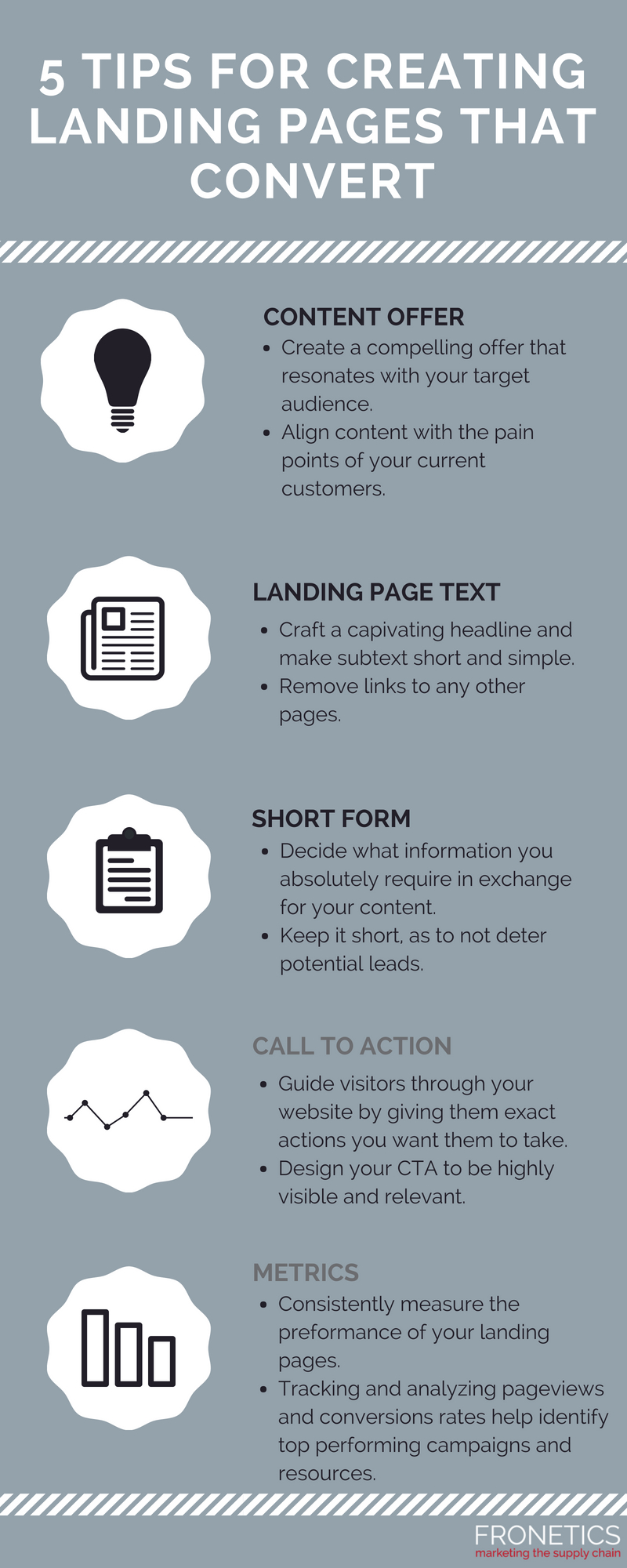
Here are five tips for supply chain marketers who are looking to generate better conversion rates from their landing pages. These tips make it easy — and tempting — for visitors to take action.
Infographic: 5 tips for creating landing pages that convert
(Made with Canva)
Key takeaway
It comes down to basically one objective: Be clear about what you want your visitor to do on your landing page. All of these recommendations help to create a landing page that makes it easy — and beneficial — for visitors to take a specific action.
Once you’ve made adjustments to your landing page, don’t forget to test, test, test! Still not getting the conversions you’re looking for? Go back and continue to tweak. Soon enough, you’ll have solid landing pages that convert those visitors to leads.
Related posts:


by Elizabeth Hines | Jul 2, 2018 | Blog, Content Marketing, Logistics, Marketing, Social Media, Supply Chain
The growth of social messaging platforms is a big opportunity for your business to reach your audience with targeted content.
Gone are the days when social messaging platforms are just about chatting or making plans with family and friends. You might be surprised to learn that “the combined total monthly active user count of the top 4 messaging apps has grown to 4.1 billion in 2018.”
Just to put that in perspective, that’s well over half of the world’s population and — perhaps even more strikingly — dwarfs the 2.19 billion monthly active users that Facebook reported in the first quarter of 2018.
It’s official: Social messaging platforms have surpassed “traditional” social media when it comes to active users. Not only that, marketers are taking notice, and beginning to think about how to leverage messaging platforms to deliver content to target audiences.
Conversational content
As you might expect, a key element of successfully using social messaging platforms is to tell your story conversationally. This means tailoring your content to the specific wants or needs of your target audience, creating a compelling narrative with your content, rather than an overt sales pitch.
This kind of storytelling is fundamental to content marketing.
“Messaging and chatbots represent the next logical extension of the content marketing mission,” writes Chris Frascella of the Content Marketing Institute.
According to Thomas Husson of Forbes, “Messaging apps will introduce a paradigm shift for marketers where interactive and contextual conversations will replace ad broadcasting. New conversational interfaces will drive deeper relationships between consumers and brands.”
You may be thinking that this is all well and good for B2C marketing, but how does it apply to B2B marketing? But the truth is, if you have a content marketing strategy in place, chances are, you have a story to tell, and these are tools to help you do it.
Chatbots
Enter chatbots, the technology to turn your content into conversations. Chances are, you’ve already come face-to-screen with a chatbot and may not have even known it.
These computer programs simulate human conversation using auditory or textual methods. Basically, it’s software that communicates with your target audience inside a messaging app. Chatbots are already changing the way businesses interact with their customers — and with each other.
If you’re thinking that you’re about to be replaced by a robot, relax. We’re extremely far from AI technology replacing human interaction. Chatbots are a tool, and they need to be fed content and trained by human marketing professionals.
Tips for using chatbots
The first step is adapting your content for use in a chatbot conversation. “You can’t just duplicate existing content in your conversational scripts,” says Frascella. While the goals for your content are the same, the way it is delivered is different. That requires a shift in how it’s structured.
It’s also important to be mindful of timing. Because chatbots require users to opt into conversations, retaining permission to access your audience in this way depends largely on content and timing. This means delivering engaging, meaningful, and valuable content at regular intervals, but not intrusively.
For more ideas on creating a chatbot, check out this post.
Social messaging platforms are opening new doors for you to deliver personalized content straight to your target buyers. Make the most of this opportunity!
Related posts:

by Elizabeth Hines | Jun 28, 2018 | Blog, Content Marketing, Current Events, Marketing, Social Media
Also in social media news June 2018: Instagram released ranking criteria for its algorithm, Apple expands advertising businesses with a new network for apps, and Facebook is cracking down on new requirements for custom target audiences.
Summer is in full swing, and so are the most popular social media platforms. Facebook, Instagram, Snapchat, and even Apple are rolling out updates to make their platforms more user- and, more importantly, business-friendly. After a rocky spring with the Facebook scandal, social media apps are working overtime to make their relationships with businesses more transparent and overall user experiences more personalized.
With transparency on the forefront, this month’s social media news is heavy with social media apps making updates that increase user privacy and subsequently, increase user engagement. Here’s what’s happening with your favorite platforms this month.
Here’s your social media news for June 2018.
Facebook enforces new requirements for custom target audiences
Facebook has released new requirements for advertisers creating custom audiences from user files. Advertisers will now have to identify where their audience’s information was obtained when they create new customer files. “Starting July 2, we will require advertisers to specify the origin of the audience’s information when a business uploads a new audience. When uploading a customer file, advertisers will need to indicate whether the information was collected directly from people, provided by partners, or a combination of the two,” writes Facebook. These new updates will help advertisers provide more transparency for users and increase advertising efficiency.
Google increases transparency over Google Ads
Google rolled out new settings to its ad features, making it clearer to users how Google Ads are customized specifically to them. Google is also sharing why users see certain ads by introducing “Why this ad?”, a new link that appears on ads. “The new Ad Settings and updates to Why this ad? provide you with more transparency and control over your Google ad experience than ever before. With these improvements, you can browse the web confidently knowing that you have the information and control to make Google work better for you.”
Instagram announces criteria for its algorithm
Instagram revealed the three most important factors that feed into its algorithm to determine which posts appear in a user’s feed. According to TechCrunch these factors include: interest, recency, and relationship. After ditching its ranking system in 2016 for an advanced algorithm, Instagram now says the new system has contributed to the platform’s soaring popularity, allowing users to see 90% of their friends’ posts.
Apple expands advertising business with new network for apps
Apple is looking to grow its advertising business by working with social media apps to distribute ads across their collective platforms. “Apple would share revenue with the apps displaying the ads, with the split varying from app to app,” MarketWatch shares on its website. Apple is hoping these partnerships will increase its advertising business by selling promotional ads in its App Store.
Facebook is expanding ads to include Marketplace
Facebook’s Marketplace is a part of Facebook that allows users to buy and sell products and recent updates allowed businesses to get in on the action. Facebook’s newest update allows businesses to purchase product ads that will appear in the Marketplace along with similar products and services. The ads have been tested among specific brands in the past few months and the results show increased purchases and year-over-year returns on ad spending. “Thread Wallets, an accessories company, generated more than 300 purchases while increasing its year-over-year return on ad spend by 41% after adding Marketplace as a placement for its conversions campaigns,” writes Facebook on its business site. In the coming weeks, advertisers targeting audiences in the U.S. and Canada can start using Marketplace ads.
Instagram introduces long-form video
Until now, all Instagram videos were limited to one minute, and Stories were limited to 15 seconds. But the Wall Street Journal reports that Instagram is looking to expand into long-form video, up to one hour in length. Though this hasn’t been confirmed by Instagram or Facebook, the WSJ writes the expansion will initially only be available in vertical video, meaning a video shot by a phone camera or on a computer, but eventually the app could include production videos and even programming.
Related posts:

by Elizabeth Hines | Jun 26, 2018 | Blog, Content Marketing, Logistics, Marketing, Strategy, Supply Chain
More and more supply chain marketers are realizing the benefits of inbound marketing (over outbound marketing) including cost savings and increased lead generation.
Marketers are constantly coming up with new and trendy ways to attract leads. With endless platforms available to us, it can be overwhelming for even the most seasoned marketers to know where they need to focus their efforts.
In order to find the right solutions for your supply chain marketing needs, you first have to understand the difference between inbound and outbound marketing. And more importantly, how they can help — or hinder — your marketing efforts.
Outbound marketing
Outbound marketing describes any marketing approach that pushes a message onto a buyer. Traditional marketing — tv and radio ads, telemarketing, banner and display ads — are all examples of outbound marketing.
Another name for this marketing tactic is interruption marketing, as it typically tries to take “attention away from what your buyer is doing and bring it, forcibly, on to your product or service.”
Inbound marketing
Inbound marketing focuses on audiences finding you. Instead of pushing a message onto buyers, inbound marketing allows you to establish your brand as an industry leader and let interested audiences come to you. This type of marketing attempts to draw in potential customers through interesting and engaging content.
Content marketing is a type of inbound marketing. Examples include blog posts, social media, infographics, white papers, and videos.
Why is inbound marketing better for the supply chain?
Outbound marketing used to be the ‘go to’ for generating leads, but this is simply no longer the case. Marketers across industries have found that inbound marketing has many advantages over traditional marketing practices. In fact, almost three-quarters (68%) of inbound organizations believe their marketing strategy is effective, while more than half (52%) of outbound marketers don’t believe their strategy is effective.
Here’s why we think inbound marketing is better for supply chain marketers than outbound marketing.
Video: Why supply chain marketers need inbound marketing
Related posts: