by Elizabeth Hines | Oct 31, 2018 | Blog, Content Marketing, Current Events, Marketing, Social Media
Also in social media news, October 2018: Snapchat partners with Amazon on visual search tool, Google Plus is shutting down, and Instagram adds Quick Replies for business accounts.
With the arrival of Halloween, we know that the holidays are quickly approaching. Consumers will be busy making plans and diving into holiday specials. But social networks will also be hard at work trying to stand out against brick and mortar stores as an alternative for holiday preparations.
Businesses looking to gain traction during the holiday season will reap the benefits of social networks, which are including new features and updates that will help brands connect with new (and existing) users. With a heavy focus on customer engagement, these new options help businesses stay connected with new features like Quick Replies on Instagram. These small but helpful updates will allow companies to have a greater reach without extra work for their marketers.
Here’s your social media news for October 2018.
Instagram founders leave Facebook
Kevin Systrom, CEO, and Mike Krieger, CTO, resigned from Instagram this week amidst rumors of tension with Facebook founder and CEO, Mark Zuckerberg. “We’re planning on leaving Instagram to explore our curiosity and creativity again. Building new things requires that we step back, understand what inspires us and match that with what the world needs; that’s what we plan to do,” writes Systrom in a statement for Instagram. Bloomberg News reports that tension between co-founders grew over the direction of Instagram. These departures create an opportunity for Facebook to oversee Instagram more directly.
LinkedIn updates Groups
LinkedIn Groups now offer more engaged conversation tools including embedded videos, images, and updates to posts, alerts, and much more. “Over the past year, we’ve focused on bringing conversations to the forefront on LinkedIn, adding new features to make it easy for you to talk to your professional communities. The new Groups experience helps you take advantage of all these conversations tools with a seamless, faster experience so you can easily participate in your groups,” writes Mitali Pattnaik for LinkedIn’s blog. All groups are currently being updated with these features.
Snapchat Partners with Amazon on visual search tool
Snapchat users are going to have a new way to search for products on Amazon, one of the world’s biggest e-commerce corporations. Using the Snapchat app, users can point their camera at a product or barcode and, once recognized, a link will appear to that product (or a similar one) on Amazon. Though the update is currently only available to a small group of users, Snapchat is hoping to roll out the new feature to all users shortly.
Instagram rolls out Quick Replies for business accounts in direct messenger
Instagram introduced Quick Replies for business accounts in direct messenger this month. The new feature allows businesses to create quick responses to frequently asked questions, like shipping rates and contact information. Quick Replies will help businesses communicate quickly and efficiently with users. Instagram tested the new functionality back in May, but just made the update available on all devices and the web.
Google Plus shuts down
Google Plus, Google’s social network, is shutting down for good after a security breach that exposed up to 500,000 users between 2015 and 2018. Ben Smith, Google’s vice president of engineering, acknowledged that Google detected a security issue back in March, but immediately addressed it. In a blog post on October 8, Smith writes, “A review did highlight the significant challenges in creating and maintaining a successful Google+ that meets consumers’ expectations. Given these challenges and the very low usage of the consumer version of Google+, we decided to sunset the consumer version of Google+. “
Related posts:

by Elizabeth Hines | Oct 29, 2018 | Blog, Content Marketing, Logistics, Marketing, Strategy, Supply Chain
What’s more important: prioritizing conversions or building traffic? The simple answer is both. Here’s why you need to balance your efforts for the best results.
The argument for building traffic or optimizing for conversions has no end. Like we stated in our earlier post, it’s a chicken-and-egg style debate. If you don’t optimize for conversions, what is the point of directing traffic to your site? On the flip side, if you don’t build traffic, who is visiting (and converting) on your site?
The problem is countless variables affect which of these goals you prioritize and when. Determining what you should be investing more energy into is dependent on your business, your strategy, and your target audience. Make sure you’re considering all factors when determining what makes the most sense for your brand and its online presence.
Why focus on conversions?
There are three main arguments for prioritizing conversion optimization:
- Low investment, high yield: The return on investment is significant, especially given the low cost of entry and easy process.
- Traffic optimization: while you may not increase traffic, by focusing on conversions you can increase the value of visitors to your website.
- Reinvestment potential: conversions will help generate funds to reinvest in your marketing effort.
All of these arguments focus on quality over quantity. By prioritizing conversions, every visitor becomes more valuable. Even with lower numbers of visitors to your website, if your conversion rates are high, you still realize a substantial return on your investment. The low cost of conversion optimization also makes it easy to implement without breaking the bank. We’ve even done some of the work for you, giving you tips when creating your landing pages.
Why focus on building traffic?
If you aren’t getting visitors to your website, there’s no point in worrying about conversions, right? But that’s not the only reason building traffic should be a priority. A few benefits of focusing on traffic include:
- Brand recognition: visitors will become familiar with your brand and content
- Momentum: concentrating on traffic is a long-term strategy and committing to the long-term gives your marketing efforts time to build momentum.
- Optimizing for value: there are a lot of metrics affiliated with building traffic, this allows you to collect and analyze data to see how you’re doing and to constantly improve.
By increasing traffic to your website and familiarizing new audiences with your brand, you have more opportunities to generate leads and those leads can turn into sales.
Why balance is the answer
The most important thing to remember is that your content marketing strategy is a work in progress that is continually being tweaked. You’ll need to spend time and money prioritizing both building traffic and optimizing for conversions. Here’s Jennifer Hart Yim, Director of Strategy at Fronetics, to explain why we think you need to focus on both to maximize your efforts.
Video: Focus on Conversions or Building Traffic First?
Related posts:


by Elizabeth Hines | Oct 25, 2018 | Blog, Current Events, Supply Chain
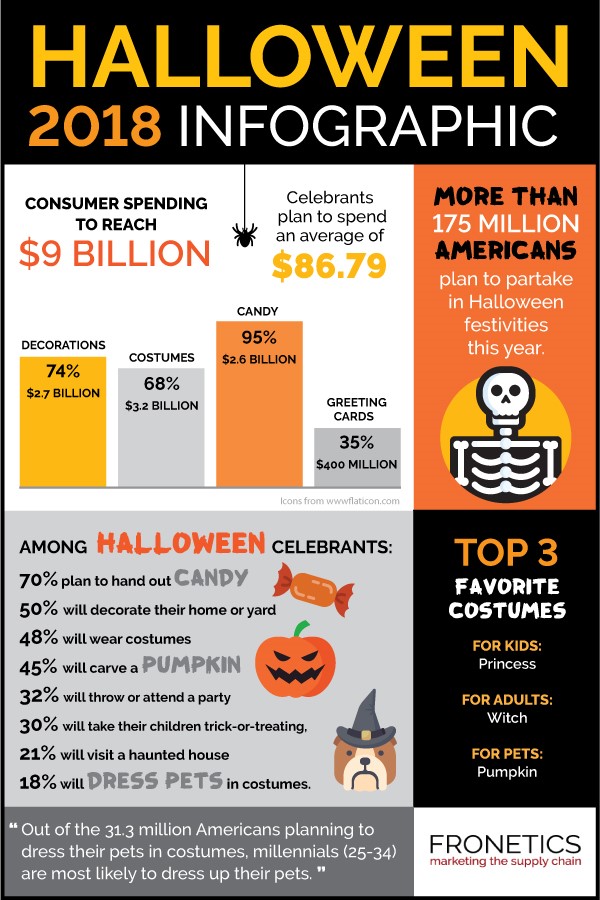
U.S. Consumers plan to spend a whopping $9 billion, the second highest spending amount in 14 years, on costumes, candy, decorations, and more to celebrate Halloween this year.
The National Retail Federation anticipates spending for Halloween in 2018 will come close to last year’s $9.1 billion all-time record.
“The economy is good, and consumer confidence is high, so families are ready to spend on Halloween this year,” NRF President and CEO Matthew Shay said. “Retailers are stocking up to supply children, pets, and adults with their favorite decorations, candy, and costumes for the season.”
The NRF’s annual survey found that 175 million Americans will celebrate the holiday, with over half of celebrants planning on dressing in costume. Expect to see plenty of Disney princesses, Star Wars characters and superheroes at your door.
Pet costumes are still the rage with nearly 20% of celebrants planning to dress up their pet this year. “Out of 31.3 million Americans planning to dress up their pets in costume, millennials (25-34) are most likely to dress up their pets, the highest we have seen in the history of our surveys.”
Pumpkin won out as the top pet costume (11%), with hot dog not far behind (7.6%). Will you be dressing up your dog or cat this Halloween?
Check out our infographic of other interesting Halloween 2018 facts from the NRF’s survey of 6,961 consumers below.
Infographic: Halloween 2018
(Made with Canva)
Related posts:

by Elizabeth Hines | Oct 24, 2018 | Blog, Content Marketing, Logistics, Marketing, Social Media, Supply Chain
Brands need to focus on the awareness and consideration stages of the buyer’s journey to build relationships and boost social media ROI.
Are you focusing on the right phases of the buyer’s journey in your social media strategy? The 2018 Sprout Social Index shows that customers prefer businesses to provide social media content that aids in awareness and consideration, not the end sale.
Misaligned priorities
Sprout Social’s 2018 Index found that users “want brand awareness and consideration stage content from brands on social, but 80% of social marketers are hyper-focused on awareness activities, leaving out the consideration piece of the puzzle.” When brands don’t meet the needs of their audience with consideration stage content, they’re missing out on building relationships and ultimately cutting into social media ROI.
Sprout Social found a great deal of misalignment when it comes to what marketers post versus what consumers want to see on their social media platforms. Part of the issue is a failure to define ROI in the most productive way. Thinking about social media’s value in terms of direct attribution leads to a skewed focus on sales, and erodes the effectiveness of brands’ social media efforts. According to Sprout Social, “social’s true value isn’t in direct attribution — it’s in the awareness and consideration stages of the funnel.”
The right kind of content
Despite the misalignment, there is one area of overlap between what marketers focus on and what users want to see: “posts that teach.” Which brings us back to consideration stage content. “If you aren’t already, meet consumers in this sweet spot in the consideration stage,” suggests Sprout Social. This means taking users beyond recognizing your brand and into knowing where your expertise and thought leadership lies.
Educational content is key in the consideration stage. It’s important to remember that this kind of content doesn’t necessarily need to showcase your product to be valuable — it’s all about offering your audience the information and expertise they’re looking for. For B2B businesses, particularly the supply chain, this could mean anything from product demonstrations to think pieces about how to optimize production.
“The most enlightened social marketing strategy integrates awareness and consideration stage content — opening the door with entertainment and inspiration, then carrying audiences across the threshold with education, information about new product offerings, and discounts and sales,” says Sprout Social.
Diversifying focus between awareness and consideration is crucial to getting the most out of your social media efforts. As social networks home in on preserving the social aspects of their platforms, it’s all the more important for brands to align their activities with what users actually want to see, to stay relevant.
Related posts:

by Elizabeth Hines | Oct 23, 2018 | Blog, Content Marketing, Logistics, Marketing, Social Media, Supply Chain
As social networks reaffirm their commitment to keeping their platforms truly social, brands need to evaluate their social media marketing strategies and ensure that they align with what users want to see.
This year, we’ve seen social networks attempt to take back the “social” element of their platforms by decreasing the reach of brands and businesses (think Facebook News Feed changes). We’ve thus seen a decline across the board in social media reach.
The 2018 Sprout Social Index shows that people are still using social media primarily for connecting with friends and family. As brands put together campaigns and messaging, they must remember that they are “guests at dinner, not members of the nuclear family: their role in user feeds is delicate, valuable, and to be treated with great care.”
The task for brands is to carry out the necessary disruption of the user experience in the most relevant, and least disruptive way. Sprout Social’s data gives a clear answer: awareness and consideration stage content. This means thinking long-term and prioritizing relationships, not quick fixes and attribution.
Give the people what they want
As part of its 2018 Index, Sprout Social researched the types of content that users prefer to see from brands on social media. 30% of users expressed a preference for links to more information, while 18% prefer graphics/images, 17% want produced video, 11% value text/conversations, and 7% said produced/edited photos.
The obvious answer for brands is to cater to the expressed wishes of the public. Building lasting relationships with prospects on social media means presenting your brand in a visually engaging way while linking them to useful and relevant information. Furthermore, it means placing focus and resources on authentic engagement. “This is the content that consumers, who use social primarily to interact with friends and family, are most interested in from brands,” reports Sprout Social.
Redefining success
Marketers naturally place a premium on ROI, though measuring social media ROI remains difficult. In fact, 55% of social marketers reported it as their biggest challenge. Conventional wisdom when it comes to ROI for social media has focused on direct attribution to sales. But according to Sprout Social, “that model doesn’t actually reflect where social marketers are focused.” In fact, 80% report increasing brand awareness as their primary social media goal, and just as many point to increasing engagement across their social channels.
A meager 14% of marketers report being able to quantify the revenue from social media. This is a problem — one that’s caused by looking at social media primarily as it relates to sales. According to Sprout Social, this “breeds an overly microscopic perspective.”
It’s time for social marketers to redefine ROI, and put an end to wasted time and resources on content and campaigns that don’t resonate. Realigning priorities from sales to what users actually want to see on social media is key to cultivating strong, lasting relationships with prospects, and being a helpful rather than invasive presence online.
Related posts: