by Elizabeth Hines | Mar 29, 2016 | Blog, Strategy
Firing a client can help you make way for others who better suit your business.
Letting someone go can be hard to do. But when it comes to certain clients, it may be necessary to ease them out of your business portfolio.
Fire a client? Who does that? Well, successful companies committed to providing the best service possible and maximizing their energy for future growth do it whenever necessary.
Let’s face it: We all have had all-encompassing clients with whom the payoff does not correspond to the hours spent catering to their needs. These clients just may not be a good fit for your business. Essentially, if what you give far outweighs the return, or if you struggle to meet your client’s needs and expectations, it is probably time to fire that client. You are not doing what is best for them (or you) by keeping them in your portfolio.
This may seem counter-intuitive to growing your business, and the thought of giving up hard-earned clients may make you cringe, but, in fact, it better supports your success.
Why? If you have clients who are overly demanding, temperamental, or requiring skills or services you do not wish to provide — especially if they do not pay you what you’re worth — perhaps it is time to cut ties to make room for new clients.
According to the Forbes article “4 Reasons to Fire a Client,” sometimes a business will discover that focusing on a different set of services is far more profitable than some other services they offer. So, the business focus shifts, and the client portfolio should shift with it.
Firing those ill-fitting clients allows time to acquire new clients who align with your top skills and practices, and who will pay you what you’re worth for them. Essentially, you set yourself free to work with those that can fully benefit from your services. And focusing your time on clients that fit your business model will better support growth and happy clients who recommend your services to others.
How do you decide?
You may have a client that comes to mind as you read this. You are always making adjustments to provide them the best service. You second guess yourself and your quality of work. Quite simply, the relationship is exhausting.
First, you should do a thorough audit of your relationship with this client. Identify why the client doesn’t seem to fit your company’s business model. Essentially, try and identify why your client’s needs and your company’s services do not seem to align.
Perhaps your business and theirs were once a good fit, but now you have grown apart. According to the Harvard Business Review article “A Consultant’s Guide to Firing a Client,” business owners typically learn exactly where they excel, and where they’d like to focus their attention, over time, so perhaps your focus has changed or grown. Maybe this client has never been a good fit, and hindsight is 20/20. Examine the entire business relationship from the time you first acquired the client, and document everything.
How do you fire a client?
Once you determine that you will fire a client, the approach must be done either by phone conversation or in person. Never leave a message, send an email, or text a client to accomplish this. You need to do it with tact and professionalism.
Discuss and illustrate the basic reasons why the client and your services are no longer a great fit for either of you. Recommend another company to take your place if you can, and thank them for the time you worked together.
You need to keep your company’s strengths in the forefront of what you do and the services you provide. Some clients mesh with your particular expertise, interests, ethical practices, and work style. Other clients will make you feel like it is a constant struggle to provide them what they need and deserve. Sometimes firing a client is the best thing you could do for both your business and theirs.
Related posts:
by Elizabeth Hines | Mar 28, 2016 | Blog, Marketing, Social Media
 A recent collection of social media facts and stats offers an interesting look at B2B company and buyer behavior.
Last month, Webbiquity published a list of 49 social media facts and stats about user behavior on Facebook, Twitter, LinkedIn, Pinterest, Instagram, and Google+. These figures, collected from various studies, offer insight into how people and businesses are using social networking in recent times.
B2B companies may find several of the stats particularly interesting, and it may influence the way they think about social media marketing. I have pulled out some of the most applicable and offered some thoughts below.
Social media facts and stats from Webbiquity
88% of B2B companies use Facebook for marketing (and 96% of all B2C companies )
If you are not using Facebook in your marketing efforts, you are in a quickly growing minority. With 968 million active daily users, the largest social networking site offers a huge opportunity — actually, the most expansive opportunity available — for your business to attract, court, and convert potential customers. Here are some of our top tips for using Facebook to market your business.
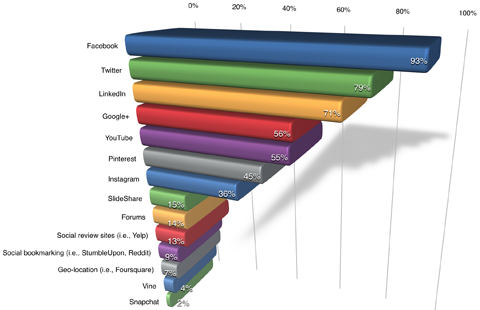
93% of small business owners and marketers use Facebook.
Small businesses don’t have the time or budget to compete with large brands when it comes to marketing — but social media can level the playing field. Social media, and Facebook especially, is an ideal marketing platform for small businesses because it can be relatively inexpensive but have a high impact on growth. Your company can cultivate your brand, engage with customers, and form business relationships. Learn how two small companies saw enormous growth thanks to social media.
21% of consumers say they unfollow brands that post repetitive or boring content. 19% say they would unfollow a brand on Facebook if the brand posted too often — more than six times a day.
We know that creating good, original content is key to a successful inbound marketing strategy. But knowing how often to post to the various social channels can be one of the more intimidating obstacles to overcome. How do you know what’s too much and what’s too little? Learn how often you should post on social media.
74% B2B decision makers use LinkedIn to help make purchasing decisions.
Don’t let anyone convince you that social media channels are for personal use only: customers are online, and if you aren’t, you’re at a disadvantage. And since nearly three-quarters use LinkedIn for purchasing decisions, it’s critical that your business is strategic about your presence on the network. Check out this guide for creating the perfect LinkedIn company page to get started.
88% of B2B marketers in North America use Twitter for content distribution.
Twitter is one of the more effective channels for gaining business, and the numbers prove it. A Market Probe International survey found that 72% of those who follow a business on Twitter are more likely to make a purchase from that business, and that 82% of followers are more likely to recommend a product or service to friends and family. Additionally, 85% of respondents reported feeling a closer connection to a small business if they follow them on Twitter. Learn more about Twitter for business.
Pinterest has 47 million active monthly users worldwide, 80% of whom are women.
While Pinterest use is rapidly growing among B2C marketers, the B2B world still hasn’t quite figured it out yet. I pulled out the two above stats to show the enormous potential this channel has, particularly for businesses whose customer base is primarily women. Fronetics’ social prospecting workbook has some ideas on how to get started using Pinterest.
32% of U.S. companies with 100+ employees used Instagram for marketing activities in 2015. eMarketer predicts that number will jump to 70.7% by 2017.
The importance of Instagram for B2B companies will continue to grow. Here’s why: 90% of Instagram users are under age 35. A recent Google study showed an increasing number of Millennials on the B2B purchasing path — up to 46% of potential buyers were of this generation in 2014. Their preferences and behaviors are having a noticeable impact on B2B buyer behavior as a whole. So if your business wants to capitalize on the nearly 300 million active monthly users, Instagram should be on your radar.
64% of North American B2B marketers use Google+ to distribute content, but just 17% use it for new product launches (vs. 81% who use LinkedIn).
Americans may use Google+ less frequently than some of the other networks, but don’t count it out entirely. More people check the site than people realize, including die-hard fans of Google products and the many businesses who use the Google suite professionally.
Related links:

by Elizabeth Hines | Mar 24, 2016 | Blog, Marketing, Social Media, Supply Chain
These four supply chain companies constantly post fresh, quality content to their social media accounts.
When it excels at social media, a company’s opportunity for growth is as vast as the web itself. Today, even small businesses can compete shoulder to shoulder with their biggest competitors if leveraging social media properly.
It is estimated that for every 5 minutes people spend online, 1 minute of that is spent on some kind of social media network. And most of your customers are on social media — statistics indicate that more than 79% of adults in the U.S. use social media each day. As the popularity of sites like Facebook, Twitter, Instagram, and company blogs continues to grow, it is vital to utilize these tools to your own marketing advantage.
When you think of social media masters, you may not think of companies in the supply chain industry. But there are a few excellent examples, and much can be learned from what they do. Here are four supply chain companies that excel at social media and the reasons why they stand out above the crowd:
1) Cerasis
Cerasis, a top freight logistics company and truckload freight broker, excels at social media because their content is fresh, posted daily, and of high quality. Simply put, they create engaging, informative content and are consistently active across all of the major social networks.
2) Kinaxis
Kinaxis, a global company offering advanced supply chain management systems to customers in a variety of discrete manufacturing industries, offers in-depth blog posts and is consistently active in social media channels such as Twitter, Google+, and LinkedIn.
3) Transplace
Transplace, a provider of transportation management services, posts informative articles and incites topics of conversation on Twitter several times per day. The company is active across all social media platforms, including their own YouTube channel.
4) UPS Longitudes
Longitudes is a blog with insights on the trends reshaping the global economy by United Parcel Service, a global leader in shipping. The blog also engages true thought leaders on topics ranging from trade to transportation and ecommerce to emerging markets. Posts are consistently new, innovative, and informative. Longitudes also has its own social media accounts, separate from UPS’s primary accounts, which distribute the blog’s content and engage in related discussions.
Why do these four supply chain companies excel at social media? Here are three commonalities that help these businesses rise above the rest:
Consistent daily posts and content
Having consistent, reliable, fresh social media posts is essential. The more active you are, the greater your outreach to potential new customers.
Think of it this way: search engines pick up on social media activities — like when someone shares content from your website on Twitter or Facebook, for example. Search engines use this to weigh the relevancy and validity of your website and your company. So, fresh daily or weekly content gives people a chance to read and share every time you publish a blog post, ebook, buying guide, case study, testimonial, and other interesting content to your social media accounts. Your marketing efforts reap the benefits of better search engine rankings as a result.
Engaging readers
You want readers to connect and engage with your social media posts. Every time they leave a comment or share or like a post, your social media presence — and your digital footprint — grows.
Quality content
Posting anything just for the sake of posting is not a good social media strategy. Content that is boring and basic will not help your business grow. Content needs to capture the interest of readers and engage them to read, share, and follow your business. Posts should be timely and relevant. This is what builds your following and your brand and generates new customers.
With social media you can find new customers and fans, connect with existing customers who can help spread the word about how great your product or service is, and drive more traffic to your website, which creates new avenues into the digital realm of marketing, company branding, and lead generation. The most successful companies today work daily to improve their social media content and reap the benefits of consistent, quality content marketing.
Related posts:

by Elizabeth Hines | Mar 22, 2016 | Blog, Content Marketing, Leadership, Marketing
Meet five women who are changing the face of digital marketing at their big brands.
March is National Women’s History Month, and thus we’ve been talking a lot about female leadership, the gender gap, and related issues. Today I’d like to call attention to five outstanding women behind big brands who are taking the digital marketing world by storm.
Here they are, in no particular order:
 Yin Woon Rani
VP Integrated Marketing
The Campbell Soup Company
Camden, NJ
You may have seen the commercial where a mom, pushing two wild kids in a shopping cart, exasperatedly grabs a bottle of wine and a few cans of soup as the report of an epic, school-canceling snowstorm plays over the loudspeaker. It’s part of Campbell’s Soup’s Made for Real, Real Life campaign (#RealRealLife), the brand’s first integrated advertising campaign in more than five years. The collection of 11 ads has run across TV, digital, and social channels over the last five months. As VP of integrated marketing, Yin Woon Rani has helped drive the campaign’s success as part of her efforts to modernize the marketing program.
Rani has helped reposition several of the Campbell’s Soup Company’s brands to better resonate with a contemporary audience. Overseeing the advertising, media, design, digital, and social media disciplines, she has helped accelerate the company’s digital and content marketing program. Rani also championed an increase in digital investment — which will shift to be around 40 percent of the media buy, up from 22 percent last year.
 Pamela Vaughan
Principal Marketing Manager, Optimization
HubSpot
Boston, MA
As principal marketing manager for optimization at HubSpot, Pamela Vaughan helps grow traffic and conversions from the company’s various marketing assets, with a special expertise in blog optimization. She has played a leading role in optimizing the HubSpot blog, which receives 1.5 million visitors and generates 14K+ new leads each month.
Vaughan’s recent post, Why We Unsubscribed 250K People From HubSpot’s Marketing Blog & Started Sending Less Email, illustrates her marketing-savvy and commitment to user experience. She’s definitely one to watch as content marketing continues to evolve.
 Adrienne Lofton
SVP Global Brand Marketing
Under Armour
Baltimore, MD
Adrienne Lofton leads the team that serves as Under Armour’s brand compass and communicates the company’s “underdog” attitude to millions of athletes across the globe. A former captain of the Howard University NCAA Division I women’s volleyball team, Lofton has championed the company’s focus on the athlete, rather than the apparel outright. This ethos permeates the brand’s digital presence, and is a main part of the strategy that, no doubt, has helped Under Armour become the second largest sports apparel company in the U.S.
Pushing for confident and inspirational messaging, particularly for women and young girls, Lofton has driven several marketing campaigns that have taken the company’s digital presence to new levels. Videos from the “I Will What I Want” and #RuleYourself campaigns — created in collaboration with agency Droga5 — have reached viral status on social platforms. In particular, the #RuleYourself video featuring the USA women’s gymnastics team had nearly 10 million views on Facebook in just 3 weeks.
 Alex Hisaka
Head of Global Content Marketing
LinkedIn
San Francisco, CA
Alex Hisaka has scaled LinkedIn’s content marketing efforts to impressive proportions. Her team plans, creates, and markets content for all stages of the buying process, producing daily blog posts and almost-weekly ebooks, which has had a massive impact on business. With a background in copywriting, design, and social marketing, Hisaka oversees much of the work herself — and her high standards are well known and much praised by her colleagues.
Hisaka adamantly believes in the social value and authenticity of content marketing and how it can bring audiences together in a mutually beneficial relationship. She has become a leading voice in content-led lead generation and strategy. We look forward to hearing more from this talented marketer.
 Alexandra Wheeler
VP Global Digital Marketing
Starbucks
Seattle, WA
As vice president of global digital marketing over the last decade, Alexandra Wheeler has helped Starbucks strengthen the connection between the physical and digital worlds. This bridge is a key part of the brand experience, and one that Wheeler believes deepens the company’s relationship with its customers. Starbucks is recognized as one of, if not, the most socially engaged brands in the world, and business performance has mirrored digital growth.
Wheeler cites authenticity as central to the company’s success in the digital space. For example, when the team noticed customers posting selfies with their frappuccinos, they encouraged the #sipface campaign, which boasts over 15K posts on Instagram. Leveraging an authentic customer sentiment on the platform where they were already engaging is right up Starbucks’, and Wheeler’s, alley.
Who do you admire in the digital marketing world?
Related posts:

by Elizabeth Hines | Mar 21, 2016 | Blog, Leadership, Strategy, Supply Chain
When Arrow Electronics came across Kendrea Durr-Smith, senior leader of export control audits, training, and communications at Honeywell Aerospace, on LinkedIn, the company was impressed with what she had accomplished in her nine years there. Now Arrow’s Director of Global Trade Compliance for the last four years, Durr-Smith has led a group that is both unique and diverse, and has helped to shepherd in significant changes.
Durr-Smith’s department is unique. “The majority of functional departments at Arrow are regional- or site-specific,” she says; “however, because trade compliance is global by nature, our department is global in scope.” This means that Durr-Smith’s team is diverse, and “not just in terms of gender, but also in terms of background and culture. Learning about these differences and learning how we can best work together has, at times, proven challenging, but is critical to success,” she explains.
Success is something Durr-Smith has achieved. Arrow has made significant changes in the last few years in an effort to better support the needs of customers and suppliers. Durr-Smith and her team have assumed new responsibilities with respect to trade management and compliance in order for these new efforts to be ushered in.
To support these corporate changes and her department’s new responsibilities, Durr-Smith’s department has changed. Three of the most recent hires are women. What is exciting to Durr-Smith is how these women got to where they are today.
“Two of the three women we recently hired are self-educated,” she says. “They were interested in trade compliance, and they educated themselves on the field and took steps to make a career change. This is exciting — exciting that they actively wanted to be involved in this field, and exciting that they were proactive in getting to where they are today.”
Durr-Smith’s enthusiasm for these women’s accomplishments is genuine and speaks to her general ethos. When asked what leadership advice she could provide to others, she offered the following:
“Take on new or different responsibilities whenever possible. Place individuals in different functional areas, and focus on the benefits afforded to both the company and the individuals. Also, focus on helping people grow, and focus on supporting others.”
Thinking about pursuing a career in trade management and compliance? Durr-Smith offers this advice:
“Be flexible. Be patient. Have a good sense of humor. In the field of trade management and compliance, these characteristics are essential.”