by Elizabeth Hines | Oct 4, 2016 | Blog, Content Marketing, Logistics, Marketing, Social Media, Supply Chain
This list of social media articles includes useful information for both people who rarely use social networking sites and for more advanced users.
We’ve been using this space to write about social media a lot lately. That’s partly because so many exciting new developments and enhancements keep popping up. It’s also because we can’t underscore enough how important it is for companies in the supply chain industry to participate in social media.
I thought it would be helpful to revisit some of our recent information, guides, and tips and tricks regarding social media use for B2B marketers. The following list encompasses both general, how-to-type instruction and more detailed advice for more advanced users.
I’ve segmented articles by platform and included a catch-all category at the bottom as well. Don’t see what you’re looking for? Shoot me an email to let me know what social media-related content you’d like to hear about on our blog.
LinkedIn
LinkedIn is the most popular social network for B2B companies. Here’s what you need to know to get started.
Learn about the free and paid methods LinkedIn offers to help you find and recruit new employees.
LinkedIn’s 433+ million member base presents an enormous opportunity for your company to earn new business. Start attracting those members to follow you.
Twitter
One of the top social media sites for B2B marketers, Twitter can help businesses spread brand awareness and communicate with customers.
You may find yourself frequently strapped for quality tweeting material. Here are some ideas to not only fill your feed but to keep your followers interested and engaged.
Leverage insights from Twitter’s analytics dashboard to improve audience engagement, reach, and content development.
We did an experiment to determine the ideal frequency for posting on Twitter. The resulting numbers were abysmal. But that means the experiment worked.
Add stickers to your photos on Twitter to join in on real-time conversations about trending topics and to grow your audience.
Twitter is changing its rules on the 140-character limit for your tweets. Learn what’s going to be different.
Facebook
Facebook Live offers businesses a new, creative platform for engaging customers. This article describes what marketers need to know about it and how to use it.
YouTube
YouTube is a useful engagement tool for B2B marketers who want to reach the social network’s more-than-3-billion users. Learn how to get started in this article.
Get started creating YouTube videos for your business with these easy-to-use tools and ideas for content.
Learn how to improve the reach of your YouTube videos with these strategies for distribution.
Reddit
Reddit is a gold mine for relevant, engaging content to share with your social media followers. Here’s how it works and how you can get started.
Other resources
Fronetics has developed this training specifically for business owners, marketers, and employees looking to learn more about social media and how they can contribute to their company’s success through these networks.
Fronetics has developed a comprehensive report exploring social media use in general and, specifically, within the logistics and supply chain industries.
Businesses are using social media as a strategic tool. This article explains the top three benefits companies in the logistics and supply chain industries can enjoy from participating on social platforms.
Your business should be on social media showing buyers that you know what they want and that your business can provide it.
A cross-departmental social media team can help your company get more out of social networking sites.
Participating in social media is not about earning followers; it’s about building relationships with your current and future customers.
If your social media strategy doesn’t align with your business objectives and target audience, your marketing budget is probably better spent elsewhere.

by Elizabeth Hines | Oct 3, 2016 | Blog, Content Marketing, Marketing, Strategy
The top-performing business blogs have these six things in common, from posting frequency to outsourcing writing.
Maintaining a blog for your business can be somewhat of a guessing game. How often should you publish? Should you do all the writing in-house? Will anyone read our posts?
A recent survey of 428 marketers conducted by Curata sought to identify any patterns or trends among those with the most successful business blogs. Specifically, the authors grouped together those whose blogs had more than 10,000 views per month and compared them to those with less than 10,000 views per month.
The most successful blogs (those with over 10,000 views per month) have several things in common. Here are some highlights:
1) Size doesn’t matter.
You may suspect that the larger the company, the more traffic its blog gets. That’s not the case. In fact, two-thirds of the most successful blogs were run by smaller companies (<$100M revenue).
2) Age is a factor, but it’s not everything.
Of the most successful blogs, 44% had been up and running for 5+ years. Time gives companies a chance to build up their readership and perfect their content strategy. Yet 65% of businesses who have had a blog for 5+ years did not get 10k+ views/month — meaning there is more to successful blogging than age.
3) Frequency is key.
Blogging frequency impacts factors like search engine rankings and audience engagement. So it’s no surprise that 90.5% of best bloggers blog at least once a week.
4) They set standards.
Interestingly, 80% of the best bloggers have a governance team for blogging activities. This can be many things: ensuring post quality and accuracy, determining best practices, outlining a code of conduct, etc.
5) Outsourcing helps.
The best bloggers rely more on external resources and less on internal resources. They outsource an average of 23.6% of their content production, compared to only 11.8% by blogs with less than 10k views per month.
6) They send more subscriber emails.
To promote their posts, 39% of the best blogs send a newsletter with their blog content to their subscriber base at least weekly. More than half of blogs with less than 1,000 views per month sent subscriber emails as infrequently as once a quarter or, in some cases, not at all.
Read the full report from Curata’s survey here to get more insight into the best business blogs.
Related posts:

by Elizabeth Hines | Sep 29, 2016 | Blog, Content Marketing, Logistics, Manufacturing & Distribution, Marketing, Strategy, Supply Chain, Warehousing & Materials Handling
Content marketing can help your organization amplify its efforts to drive traffic, improve conversion rates, and increase sales.
A recent survey of over 4,500 marketers at organizations around the globe found that converting leads to customers (74%) and growing traffic to their websites (57%) were their companies’ top marketing priorities. Perhaps not surprisingly, these marketers also overwhelmingly reported that generating traffic and leads was their top challenge. Often our business priorities are the most difficult to achieve.
Enter, content marketing.
Content marketing is a form of inbound marketing in which businesses publish content to attract prospects who are interested in products in services like theirs. This marketing approach can be highly effective in growing brand awareness, generating leads, and increasing sales. In fact, according to the same survey, organizations using inbound marketing were four times more likely to rate their marketing strategy highly than outbound organizations.
Let’s look at one example from the warehousing sector.
Business was decent for Company X. It had experienced positive growth for over a decade, despite lacking a clear marketing strategy. But leadership started to wonder: Are we missing opportunities for growth?
Company X sought a multi-level digital marketing strategy that would help them increase web traffic, generate more leads, and convert prospects to customers. The team hired Fronetics to create and implement such a strategy.
After 24 months, the results were telling: Web traffic increased by nearly one-fifth (19%). Company X tracked 244 high-quality leads directly sourced from its new content marketing efforts. And new business grew by a remarkable 30%.
Content marketing was highly successful for Company X in achieving its business goals of driving traffic and new business. In fact, the organization realized many other positive benefits as well. You can read about more of them, as well as the strategy Fronetics used to get there, by downloading the case study below.

Want to increase traffic to your business’ website and generate more leads and customers? Have you tried content marketing? Here are a few resources to get you started.
Related resources:
Need more help? Contact Fronetics to request a free strategy session.

by Elizabeth Hines | Sep 28, 2016 | Blog, Content Marketing, Logistics, Marketing, Strategy, Supply Chain
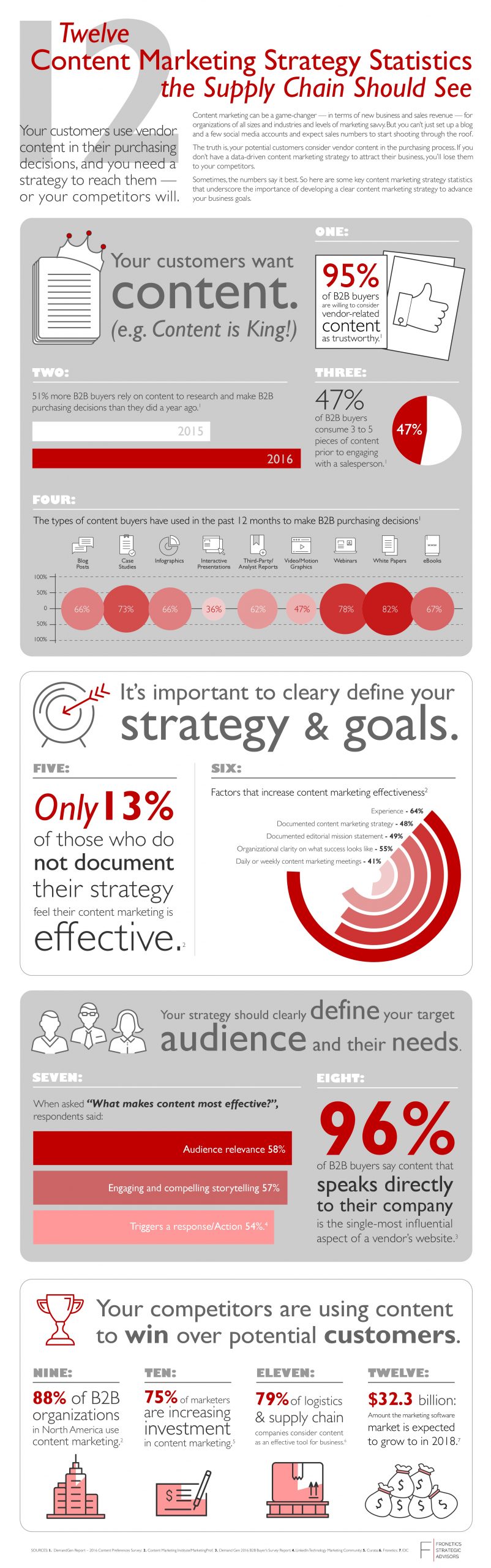
Companies in the logistics and supply chain industries should take a look at this content marketing infographic.
Content marketing is a form of inbound marketing in which vendors publish digital content to attract customers who are searching for products and services like theirs. If done right, it is highly effective in growing brand awareness, generating and converting leads, and driving sales and repeat business.
If your organization is exclusively using traditional outbound marketing techniques, like advertisements in print publications, you’re missing out on growth opportunities. We rounded up some of the most telling facts about the role of content marketing in today’s B2B purchasing environment for you to consider.
Here are 12 facts about content marketing that your business should keep in mind.

by Elizabeth Hines | Sep 26, 2016 | Blog, Strategy, Talent
What do people find when they google your name? Branding yourself can help sway their first impression.
Face it: Potential employers, customers, and other associates have likely searched your name on the internet before they meet you in person. What do they see?
Your LinkedIn and Facebook pages, Twitter and Instagram accounts, personal blog, and even your pins on Pinterest are all subject to public scrutiny. The sum of those findings is your brand image, what you put forth to the world to define who you are and what you are about.
The reality is that when you walk into a job interview, client meeting, or other engagement, you are likely being evaluated against the first impression the person made prior to your arrival through an internet search. Shouldn’t you think carefully about your brand and how you want people to perceive you?
To be successful, you need to take steps to build and enhance your brand. Here are four steps to branding yourself.
1) Define your brand
A brand is a story. What is your story? Take the time to sit down and look at where you have been and where you are. Where you want to be? What is your skill set? What experiences do you have? How are you unique? Take all of this information and knowledge and define your brand — tell your story. Be clear, be concise, and be direct. If you can’t define your brand in a sentence or two, you have lost an opportunity.
2. Take stock
What information is “out there?” Start by making a list of all the social media accounts you have, even if you no longer actively use them. Next, Google yourself. What do you find? As G.I. Joe says, “Knowing is half the battle.”
3. Define a strategy
At this point you have a brand and you know what information about your brand is publicly available. Is the information enhancing or hurting your brand? What steps can you take to strengthen your brand? For example, should you adjust your privacy settings on some of your accounts so that personal information and exploits are not available for all to see? Does your LinkedIn page need to be updated? If you don’t take the time to define your strategy, you will not be able to execute it effectively.
4. Take action
Frank Cavallaro wrote, “Strategy is about making choices. Execution is about getting down and dirty so that those choices can produce results.” Don’t stop at creating the strategy — execute. And remember, the internet is not static. What information about you gets added over time? Furthermore, it is important to periodically look at your brand. Is it still representative of where are and where you want to be? If not, take the time to re-brand yourself.
When you take the time to brand yourself, you have the opportunity to define that first impression.
Related posts: