by Jennifer Hart Yim | May 19, 2015 | Blog, Logistics, Strategy, Supply Chain
This article is part of a series of articles written by MBA students and graduates from the University of New Hampshire Peter T. Paul College of Business and Economics.
Nicole Brooks is an MBA candidate at the University of New Hampshire.
Amazon keeps on innovating.
Just when you think that Amazon offers it all, they keep surprising their customers with more unbelievable plans and ideas to better improve our lives. With a mission “to be Earth’s most customer-centric company, where customers can find and discover anything they might want to buy online, and endeavors to offer its customers the lowest possible prices,” Amazon continues to be innovative in an effort towards a bright future. For example, Amazon was an industry leader with the introduction of 1-day shipping, shifting consumers to expect this new luxury as the standard.
In the previous three year’s first quarter financial statements, the company has experienced a decrease in their growth rate: approximately 30% during the first quarter three years ago and down to 20% in the first quarter of last year. This has pushed Amazon to begin considering alternative paths of business if they want to continue experiencing growth. As such, they have started to diverge into the services industry and have developed a platform that is used to match buyers and sellers for essentially all types of goods.
Amazon’s latest innovations include but are not limited to:
Kiva Robots
For the 2014 holiday season, Amazon put their new Kiva robots to work. Over 15,000 were placed inside the US fulfillment centers to “make operations more efficient” during the expected high volume holiday rush. They essentially eliminated the need for people to walk through the aisles to collect the necessary items for a shipment. The Kiva robots are programmed to know the placement of items within the shelving system and bring forth the shelf with the next needed item for the packers. The company’s forward looking decisions are based on Amazon’s future vision for what the industry leader could do next to make itself stand out.
Drones
Despite being turned down by the U.S. Federal Aviation Administration (FAA) in the early months of 2015, Amazon still fully intends to be able to deliver packages to customers utilizing their developed and tested drone technology. The video that can be viewed through the Amazon Prime Air webpage provides customers with an idea of what the drone would look like and what the process would be from the order being received at the warehouse to the package being delivered to someone’s doorstep.
Amazon has named this drone delivery service “Prime Air”. Prime Air has the goal and potentially the capability to offer customers 30 minute delivery. Yes, within a 30 minute time span from receiving an order Amazon wants to process it and be able to deliver those items. Of course, there would be a high premium associated with this, but it would minimize the need for companies to have to make purchases ahead of time, which for small companies, could be very beneficial for their bottom line. Currently, drones are being tested and allowed commercially in Canada as well as a handful of European countries. In Canada, for example, drones are only subject to be used when it is light outside, the weather is good, and the controller can keep the drone in his/her sight.
Amazon Home Services
Amazon formally introduced the Home Services platform to their website last month. This platform essentially is set up in the same manner as their goods and products platform, however instead of being shipped a product at the end, the customer is booking a service, such as plumbers, electricians, TV installation services, etc. This platform allows customers to look at the various offerings and to more easily compare different businesses and contractors based on the value that they perceive the service would ultimately be providing. The different home services, similar to a typical Amazon offering, will also have comments and rankings to help distinguish the variety of offerings.
Amazon Business
In light of the increasing “do-it-yourselfer” trend, Amazon has opened a distribution channel for those seeking high-tech electronic components and parts. In the past, these components would be bought directly through suppliers, authorized distributors, or various parts catalogs. Amazon, which caters to those who prefer to do their shopping online, has expanded their offerings with the Amazon Business platform. Consumers have the ability to create business accounts with multiple user access, set-up and utilize an approval system, and can qualify for free two-day shipping, among other benefits. With this specific addition, Amazon is expanding their platform to further cater to information technology and electronic industries, creating more of a reason for businesses to consider Amazon a one-stop shopping destination.
Amazon Destinations
Also recently announced, Amazon will begin offering an Amazon Destination platform for customers to quickly and easily be able to compare local hotels for a getaway. This is not yet currently available to customers, but once it is, similar to the offering above, will give shoppers an all-encompassing inside look at what the various hotels in the area have to offer as far as rate and amenities upfront.
The Future
At this stage, Amazon is a mature company with a well-developed online shopping platform coupled with industry-leading delivery and logistics offerings. Now with the expansions into service offerings, Amazon has proved that there is no limit to what they can do. Their steps have been logical and it only makes sense that they now spread their platform to consist of more things everyday consumers are looking for. We can already get any item imaginable through their website, why not any service. As the service offerings expand, it would not be a far stretch to say that in the coming years we will be able to plan weddings, book vacations around the world, and even possibly compare medical procedures through Amazon.com.
It’s difficult to accurately predict what Amazon will be doing fifteen years from now, but whatever they are doing, will mostly likely continue to shape consumer expectations and impact the surrounding business and consumer markets in ways we had not thought of beforehand.

by Jennifer Hart Yim | May 18, 2015 | Blog, Logistics, Strategy, Supply Chain
This article is part of a series of articles written by MBA students and graduates from the University of New Hampshire Peter T. Paul College of Business and Economics.
Michael Hickey is a former fifth grade teacher turned business professional. His experience includes content marketing in the IT industry and operations management for United Parcel Service. He will complete his MBA from the University of New Hampshire in 2015. He enjoys long walks along the conveyor belt and Ben and Jerry’s ice cream. He lives with his wife, Betsy, in Dover, New Hampshire and they are expecting their first child in June.
4 questions to ask when determining if a 3PL is right for your company
Third-party logistics, or 3PL, is an industry on the rise thanks to the constant innovations in complementary industries like telecommunications, data analytics, and cloud technologies. To avoid confusion, let’s call 3PL what it is: outsourcing. But it’s not the kind of outsourcing that typically comes to mind when you hear the term. Rather, it’s a specific type of outsourcing related to the operations side of a company in areas like order fulfillment, inventory and warehouse management, or transportation of finished goods. As many companies, and perhaps your competitors, begin to employ some form of 3PL, you may be tempted to follow suit. But before you hand over the keys, consider whether or not 3PL is a good fit for your company by answering these four questions:
Question 1: What are your company’s core values?
Why do you exist as a company? What service or product do you provide that you believe is better than all others like it? And what are the core values that your company adheres to in good times and bad, for better or for worse? Core values make you who you are. They are the DNA of the company. Stonyfield Farm, for example, produces a variety of yogurts from their New Hampshire-based facility. One of their core values is that they use only organic ingredients, sourced from family-owned organic farms in their products. No ifs, ands, or buts. That’s a core value. It won’t change, during either boom or recession. And everything they do as a company must align with that. Your company’s strategic alignment stems from identification of its core values, and each decision you make as a company should work seamlessly with your strategic alignment.
Action step: Identify your core values. If 3PL conflicts with any core values, you should avoid forcing its implementation, even if there are cost savings to be gained.
Question 2: What are your company’s core competencies?
What are the things that your company does well? The Yankee Candle Company’s core competencies lie within their research and development and the chemists they employ. Their specialized skills and olfactory expertise drive the creation of precisely scented candles that make you say, “I know I smell a pumpkin pie, but I can’t find it anywhere!” Their competencies help them stand apart from the competition. You would be remiss to give over your core competency to someone else. If your expertise lies in local delivery and timely service, why outsource it to the guys with the brown trucks?
Action step: Identify your core competencies. If 3PL takes the place of any part of your core competencies, you could be weakening the overall value proposition of your company.
Question 3: Will using a 3PL provider allow you to enhance your core competencies to meet your company’s goals?
The purpose of debating whether or not to employ 3PL providers should not focus so much on reduced costs, which can be one of the foremost benefits, but rather whether or not it can enhance your core competencies and stimulate growth for your company. Is your goal to reach broader markets, but you lack the expertise to make it happen? Perhaps an e-commerce fulfillment provider could help you reach those markets. Do you have an outstanding product, but can only sell it to those within a small radius of your operations? Maybe this would be the appropriate time to call on the guys with the brown trucks.
Action step: Draw parallels between the service you wish to outsource and the goal it will meet.
Question 4: What is the cost to your company?
It’s the question that always needs to be considered. But don’t take this question at face value: we’re not just talking about how choosing a 3PL will affect the bottom line. Of course there will be monetary costs associated with hiring another company, and there is even a tipping point when using a 3PL may be cost ineffective. So after a careful cost/benefit analysis, consider the other costs associated with handing over part of your value chain to a third party:
Time costs: Does outsourcing add lead times or delivery times to orders? Decide whether possible time costs take away from your value proposition, or enable your company to meet larger goals.
Control costs: Are you willing to hand over direct control of part of your value chain to someone else? Keep in mind that it’s possible no one cares about your business quite as much as you do. Can you trust someone else to make the same kind of decisions you would make in respect to your company and its customers?
Reputation costs: What happens if a 3PL provider does not perform as anticipated? Will it put a blemish on your company’s image? If a farm outsources its delivery to a local trucking company, and the refrigeration in the trucks falters and causes food to spoil, will the customer assume that the trucking was bad, or do they just assume that the quality of the produce from the farm is questionable? It takes a long time to build up a reputation, and only a short time to dismantle it. Don’t risk it on a provider you can’t trust.
Action step: Vet your possible 3PL options to see whose values closely align with yours. It may prove to be a critical step in choosing the right provider as opposed to the cheapest one.
Third party logistics provides an avenue for companies to scale to capabilities they may never have had the ability to reach. Expanded consumer markets, faster delivery times, and more efficient inventory management are some of the benefits to be had. But before you get drawn towards the soft glow of higher revenues and wider margins through outsourcing, be careful to make sure that your choice to engage 3PL providers aligns with your company’s strategic plans. And if you do choose to outsource, take your time to find the right provider who can add the most value to your business, not just the least amount of digits on the balance sheet.

by Jennifer Hart Yim | May 14, 2015 | Blog, Strategy, Supply Chain
This article is part of a series of articles written by MBA students and graduates from the University of New Hampshire Peter T. Paul College of Business and Economics.
Sarah Hebert is currently a full-time MBA student at the University of New Hampshire, having previously completed her Bachelor’s of English Language and Literature at the same institution in 2014. Following the completion of her Master’s degree, she hopes to find a job in Marketing and Advertising.
When “Food with Integrity” meets the bottom-line.
As Chipotle’s nation-wide gastronomic success has propelled their brand into the fast-casual limelight, so followed the news of their carnitas crisis, as the chain announced in January 2015 that they were and would be experiencing a significant strain in their Responsibly Raised® Pork supply for the foreseeable future.
Chipotle®, a Mexican fast-casual restaurant chain that has built its brand on self-established food quality standards, such as organic, local vegetables and ethically raised animals, made waves with their voluntary decision to cut their pork supply due to a supplier violation of their animal welfare standards. As stated by the chain, pigs living within these pork farms must be:
- Raised with outdoor access or deeply bedded pens
- Free of breeding, gestation, and farrowing crates
- Never treated with antibiotics
Upon discovering that this particular supplier did not allow their animals to have outdoor access and did not supply the alternative pens that were required under those conditions, Chipotle immediately ceased their business with the farm in question. As a result, 1/3 of their chain-wide supply was eliminated, directly affecting the 7-8% of total sales that are accounted for by their pork-consuming customers.
Rather than keeping mum about this potentially destructive development, Chipotle defied expectations and proactively embraced this supply-chain debacle as a strategic PR opportunity, fully acknowledging their decision and citing their core values as their motive. On the front end of their business, Chipotle addressed this issue across all channels—attention grabbing signage on storefronts, disclaimers at the launch of their online ordering services, an FAQ page on their website solely dedicated to their carnitas shortage, and countless press releases provided to news sources across the country.
On the back end, the chain exercised several strategies to try to compensate for the consequences of their actions. In a short-term attempt to alleviate the additional, compensatory pressures faced by their remaining pork suppliers and to satisfy pork-consuming customers where possible, Chipotle chose to geographically rotate their carnitas supplies around the country every 6 weeks. Realizing that their characteristically high standards for food sourcing would continue to be tested as the chain continues to grow at an astronomical pace (currently operating approximately 1800 locations nation-wide), Chipotle wasted no time to begin addressing their long-term supply concerns, exploring solutions such as acquiring additional suppliers, integrating new cuts of pork into their carnitas option, and feasibly increasing the amount of meat secured from their current providers in order to best insulate themselves from future supply constraints.
Since their notorious announcement back in January, it is estimated the Chipotle’s decision to stand by their ethically-poised brand and diminish their supplies volume will cost them nearly a year of operating at full capacity, projecting that the chain’s shortage will not completely recover until the end of Q4. Translation? No carnitas until December 2015. At the conclusion of the first quarter of 2015, Chipotle fell 1.3% short of their projected 11.7% sales growth put forth by Wall Street, achieving a growth rate of only 10.4% total.
Despite Chipotle’s applaud-worthy success at capitalizing on this marketing opportunity by means of reinforcing their “Food with Integrity” adage and raising awareness for animal welfare, the question shifts from a concern regarding their recovery timeline to one of sustainability and future growth. As the chain continues to mature and prosper, are their sourcing practices and business model sustainable? At what point do you scale back your growth for the sake of maintaining your brand integrity, or to better meet your demand with an already constrained supply? While the admirable decision made by the chain played nicely into the hands of their marketing and public relations teams, one has to wonder about how these decisions may jeopardize the future of their consumer dependability–ultimately, at what cost is your pride more important than your profits?
To say that Chipotle turned the tides on their self-inflicted disaster would be an understatement—more than ever, the chain is being commended for their devotion to their ethical standards and continues to gain national attention for their damage control tactics. As the problem has yet to be completely rectified and the light is still being brightly shone on Chipotle’s radical supply-chain stance, the eyes of the consumers remain locked on the positive statement being made in the here and now. After the storm passes and carnitas are back in the hands of Chipotle customers, the reliability and sustainability of their sourcing practices will undoubtedly come into question. With growth of business comes increased demand, and as the company has yet to establish a long-term supply solution for its Responsibly Raised meats, it’s certainly not irrational to wonder if the fast-casual kingpin will be as lucky to weather the storm the next time around.

by Jennifer Hart Yim | May 13, 2015 | Blog, Leadership, Strategy, Supply Chain
This article is part of a series of articles written by MBA students and graduates from the University of New Hampshire Peter T. Paul College of Business and Economics.
Corey Ducharme is Green Belt Certified in Six Sigma. He has a BA in Business and is currently in the MBA program at the University of New Hampshire. He has consulted at major corporations including Johnson & Johnson, Universal Studios, Sony Pictures, Oklahoma Oil & Gas, and Suncor as a management consultant at D&A Management. He can be reached via e-mail.
We all use Six Sigma problem solving whether we know it or not
How do humans tend to solve problems? Consciously or unconsciously humans use a four-step method that is defined as:
Table 1: Traditional Problem Solving Process

In the above example, the root cause is identified – exercise and eating less equals losing weight – and verified. The conventional wisdom is proven true and there is little need to consider a more robust or analytical method. Most humans solve their day-to-day issues in this manner whether consciously or unconsciously. My root-cause analysis in this case (I exercise and eat less) is verified by the fact that I lost ten pounds and sustainable until my goal is achieved. (Losing 20 pounds).
Six Sigma Problem Solving 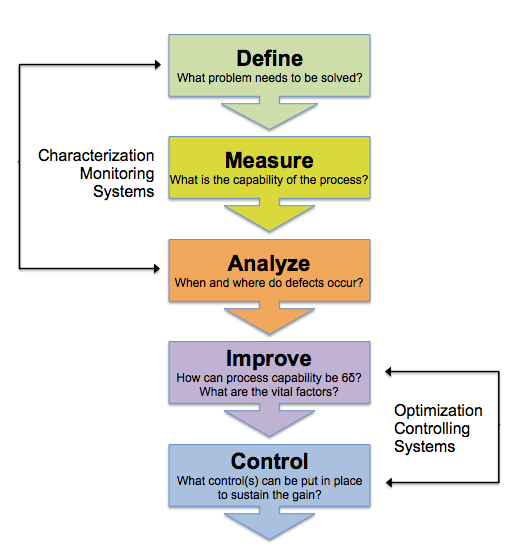
What if the root-cause lies outside of conventional wisdom or is difficult to determine?
These needle-in-a-haystack problems – due to limited business resources – cause businesses to lose revenue and lead to process failures, poor quality, and poor customer service. These types of problems are at the heart of Six Sigma Problem Solving and are a way to find the needle-in-the-haystack.
The Six Sigma methodology is based on the DMAIC process and using our weight loss example we begin to see the similarities between the two methods.
- Define Phase: What is the problem and set the end goal.
- Measure Phase: What is the current state?
- Analyze Phase: 1. Develop cause-and-effect analysis of problem. What are the real causes and prove cause and effect links.
- Improve Phase: Action
- Control Phase: 1. Verify improvement and 2. Sustainability
What differs between the phases of conventional and Six Sigma problem solving begins in the Analyze Phase. Six Sigma methodology demands the proof of cause be determined before a clear course of action is taken. The proof of cause must be data-driven as root-cause analysis is at the core of Six Sigma problem solving. It is also the reason that the Analyze phase is divided into the development of cause-effects and proof of cause-effect links.
The second difference is in the fifth phase. In the Traditional problem-solving methodology, verification comes in the form of losing weight. I can prove it by weighing myself. In Six Sigma problem solving, a two-step process is needed. Verification is essential (Did I improve?) and if so, a plan to sustain our gains is created. This is not necessary in a Traditional methodology because our cause-effect is proven (exercise/eat less = weight loss); however, in the Six Sigma methodology our cause-effect must be tested and verified.
The Linguistics of Six Sigma: Y=f(X)
To speak in the language of Six Sigma, we need to change ‘problem’ with ‘Y’ and ‘cause’ with ‘X’. The Y is the output and the X(s) are any inputs that are involved in producing the output. In other words, the Y = 100% customer satisfaction and X(s) are the variables that affect the level of customer satisfaction. For more, click the following link: Y=f(X).
Using Six Sigma linguistics and the DMAIC process, we can combine the Traditional problem solving steps in Table 1 and we see that our four-step process has become a more robust seven-step process. We can now use DMAIC to ask ourselves the most essential question:
If our root-cause analysis is discovered and proven true, then can the problem be solved or reduced by controlling or removing the cause(s)?
Table 2: DMAIC Problem Solving
Real World Example: Boeing
Boeing’s Six Sigma team in Everett, WA discovered that root cause analysis is often like finding a needle-in-a-haystack, especially for the maker of the world’s largest commercial twin-engine airplane with millions of components. (To read the entire story, click the following link: Problem-solving approach helps team pinpoint solution). Boeing discovered that recirculating air fans were being rejected during production, costing Boeing money in waste, removal, testing, and cost of replacing the component.
Boeing assembled a cross-functional ‘detective squad’ that included employees from Engineering, Quality, Manufacturing, Supply Management, Procurement, and their supplier Hamilton Sundstrand who began the problem-solving techniques of the DMAIC process by examining data from the fans and beginning root-cause analysis.
This analysis determined that Foreign Object Debris (FOD) damaged the fans and the test tools. Job done, right? Not according to Kent Kuiper, Six Sigma expert at Boeing, the team had to dig deeper. “For example,” he said, “when we found that FOD was a problem and determined the source for it, removing the FOD and replacing the fan wasn’t going to get us where we needed to go. We had to figure out a way to keep the FOD from happening again.”
Further inspection led the team to discover failures in ductwork caps and plastic sheeting – two items ironically intended to prevent FOD damage and two electrical issues. One failure of improperly modified test equipment and the second issue related to crimping procedures in manufacturing process that improved connections in the fans. The results? Although the FOD in the fans was the main X, the results were clear. “After 18 fan failures in two years, we went four and a half months without a rejection,” said Max Limb, a supplier field service representative. “We haven’t completely eliminated the rejections, but we’re close.”
“Our team has become well-versed in the concept of Six Sigma,” said Valerie Feiberti, Supply Management and Procurement Director of the Lean Promotion Team. “We feel very strongly that it provides a way to correct production-related problems and proactively design-in quality.”
Summary
The DMAIC methodology is essentially a series of common sense questions to determine root-cause analysis, identification of X(s), elimination of problems, and maintaining of gains. The DMAIC process asks the following questions:
- Define: What is the Y that is performing poorly?
- Measure: What is Y’s current performance?
- Analyze: What are the X(s)? Are they real?
- Improve: How can X(s) be controlled/eliminated?
- Control: How can X(s) be controlled to sustain gains in Y?
Six Sigma problem solving is the data-driven representation of the conscious or unconscious thinking we use to solve problems in our lives and can be used to solve may needle-in-a-haystack problems that vex businesses.

by Jennifer Hart Yim | May 12, 2015 | Big Data, Blog, Data/Analytics, Strategy
This article is part of a series of articles written by MBA students and graduates from the University of New Hampshire Peter T. Paul College of Business and Economics.
Josh Hutchins received his B.S. in Business Administration from the University of New Hampshire in 2005. He is currently pursuing his MBA at the Peter T. Paul School at the University of New Hampshire; on course to graduate in May 2016.
“Working with data is something I do every day as a financial analyst. I enjoy crunching the data and experimenting with various data analytic techniques. I’ve found that my love for playing with the data and thinking in unconventional ways has led me to be efficient and successful at work. The way data is being used is revolutionizing the way we do business. I’m glad I can be part of this wave of the future.”
The responsibility of big data
Data is coming into businesses at incredible speeds, in large quantities, and in all types of different formats. In a world full of big data it’s not just having the data – it’s what you do with it that matters. Big data analysis is becoming a very powerful tool used by companies of all sizes. Companies are analyzing and using the data in order to create sustainable business models and gain a competitive advantage over their competition. However, as one company would come to learn – with big data comes big responsibility.
Solid Gold Bomb T-Shirt Company
In 2011, Solid Gold Bomb, an Amazon Marketplace merchant based out of Australia, thought of an ingenious way to create fresh slogans for t-shirts. The main concept behind Solid Gold Bomb’s operation was that by utilizing a computer programming script, they could create clever t-shirt slogans that no one had thought of previously. The company created various t-shirt slogans that played off of the popular British WWII era phrase Keep Calm and Carry On. Under the systematic script method, Solid Gold Bombs was able to create literally millions of t-shirt offerings without the need to have them on hand in inventory. With the substantial increase in product offerings, the chances of customers stumbling upon a Solid Gold Bomb shirt increased dramatically. By utilizing this new on-demand approach to t-shirt printing, Solid Gold Bomb was able to reduce expenses, while simultaneously increasing potential revenue by offering exponential products at little additional marginal cost.
Use of ‘Big Data’
The computer script relied on the following to operate: a large pool of words, associated rule learning, and an algorithm.
Large Pool of Words – Solid Gold Bomb gathered a list of approximately 202,000 words that could be found in the dictionary. Of these words, they whittled it down to approximately 1,100 of the most popular words. Some of the words were too long to be included on a t-shirt, so the list was further culled. They settled on 700 different verbs and corresponding pronouns. These words would be used by the computer script to generate t-shirt slogans.
Associated rule learning – Associated rule learning is the degree to which two variables in a given list relate to each other. The first step in associated rule learning is to identify and isolate the most frequent variables. The second step is forming rules based on different constraints on the variables – assigning an “interestingness” factor. In the case of Solid Gold Bomb, the associated rule learning assigned an interestingness factor to verb-pronoun combinations.
Algorithm – The algorithm designed by Solid Gold Bomb was very simple. Each shirt would begin with “Keep calm and”. The algorithm script would then search through the word pool and pull back the most highly associated verb and pronoun combinations. The words would then be put into the typical format of the Keep Calm and Carry On. An image of each individual combination would be mocked up and posted to their Amazon merchant account. The process would continuously loop, creating millions of combinations.
The Big Data Blues
With one innocent mistake, Solid Gold Bomb fell apart in the blink of an eye. Amazon started getting complaints about offensive slogans on Solid Gold Bomb’s t-shirts. Images of t-shirts with phrases such as “Keep Calm and Rape Her” and “Keep Calm and Hit Her” were being sold on their Amazon merchant account. Their typical weekend orders for around 800 shirts were reduced to just 3 – few enough to count on one hand. Amazon ended up pulling their entire line of clothing, essentially putting Solid Gold Bomb out of business.
What went wrong?
While Solid Gold Bomb had a good handle on how to use data that they had gathered and how to use it to their advantage, they neglected to consider the potential hidden consequences of unintentional misuse of the data. When culling 202,000 words down to 700 useable words, words such as “rape” should have been eliminated from the useable word pool. From a high level perspective, the human mind is incapable of naming all the potential combinations of the 700 useable words without the assistance of a computer program. However, the end user needs to be aware that the computer program logic will create every potential combination based on the word pool.
Moral of the Story
Big data by itself is not beneficial to a company. The real value is in the analytics that are applied to the data. The results of the analytics can be utilized in numerous ways – to make more informed decisions, create new revenue streams, and create competitive advantages, to name a few. When a company makes the decision to utilize big data analytics, each process needs to be mapped out to have an intimate understanding of how the data will be used. In the case of Solid Gold Bomb, they failed to have this intimate understanding of how the data would be used throughout the process. As a result, they paid the ultimate price; they were not able to sustain themselves through this debacle. The morale of the story: With big data comes big responsibility. Know your data and know the potential uses of the data better. Don’t be afraid to think outside the box, but know the potential consequences.
For information about another big data faux pas, learn how Target predicted that a 16 year old girl was pregnant before her father knew.