by Elizabeth Hines | Jan 5, 2015 | Blog, Content Marketing, Internet of Things, Logistics, Marketing, Social Media, Strategy, Supply Chain, Talent

Here are the top supply chain and logistics blog posts of 2014
2014 is over and a new year has begun. We look back at the content we created and shared in 2014.
Looking at content focused on the supply chain and logistics industries, there are three topics which garnered the most interest:
- The use of social media and content marketing;
- Supply chain talent;
- Technology.
Here are the top ten supply chain and logistics blog posts of 2014 based on pageviews. #1 receiving the most pageviews.
The Internet of Things trend is quickly approaching and will impact the way we live and work through increased productivity and efficiency. Supply Chain Management will continue utilizing these advanced technologies to improve factory workflow, increase material tracking, and optimize distribution to maximize revenues. Read the full blog post.
Within the past five years companies within the logistics and supply chain industries have begun to see social media as a strategic tool and have begun to actively use and leverage social media. A survey conducted by Fronetics Strategic Advisors looks, broadly, at the use of social media within the logistics and supply chain industries. The report discusses use, motivations, preferences, benefits, and challenges. Read the full blog post.
Santa’s supply chain was the first to run “in the cloud.” Read the full blog post and check out the infographic.
Looking at the manufacturing, supply chain, logistics, transportation, distribution and freight industries there are a few companies that have emerged as leaders – companies that exemplify the business value of creating and executing digital, social media, and content marketing strategies. Cerasis, a freight logistics company, is one of these companies. Read the full blog post.
The supply chain industry has a talent crisis. The question is: how can we solve this crisis? To answer this question I turned to Rodney Apple, founder of the SCM Talent Group. Apple has worked as a supply chain recruiter for the majority of his 19+ year career within the staffing industry and he has filled more than 1,000 positions within the industry ranging from executive-level in Fortune 500 headquarters settings to leadership and staff-level roles across large networks of manufacturing and distribution facilities within North America. Apple’s role affords him the ability to witness the talent crisis from the perspective of the industry, the company, and the job seeker. Read the full blog post.
The purpose of this series of blog posts is to give others in our industry and especially those in the manufacturing industry, a guide to create an effective digital, social media, and content marketing strategy which will produce results for your company. If you have followed the Cerasis blog since its launch in March 2013, you have noticed that we work really hard at executing our strategy. The reason we work so hard is because we are passionate about educating the marketplace on information that matters to them. In that way, we want to be the de facto expert in the manufacturing and logistics industries. If we can help those who are our customers and potential customers (manufacturers and distributors) with best practices around logistics and freight, as well as manufacturing industry news, we are continuing our mission of driving long term value (even if we give the information away for free). The result (we hope and have seen) is that people view us as the expert and will want to engage us in a long term relationship as their logistics services provider. We hope this is helpful and you learn something from it! Read the full blog post.
3PL provider Coyote Logistics is one of the fastest growing companies in North America. The company’s incredible growth (five-year growth: 3,585 percent) and tenacious spirit has not gone unnoticed. Forbes included Coyote in its list of Most Promising American Companies; Supply & Demand Chain Executive listed Jeff Silver, Coyote CEO, as one of their “Pros to Know;” and the company was listed as one of the best places to work by the Chicago Tribune. There are undoubtedly many factors that have contributed to the success of the company. Coyote’s approach to social media is likely one of the company’s keys to success. Read the full blog post.
Here’s the thing – the supply chain industry is perceived by those outside the industry as having no “wow” factor whatsoever. If the supply chain industry is going to attract new and qualified talent, it needs a face lift. It is time for the supply chain industry to re-brand itself. Read the full blog post.
Without a comprehensive social media strategy, your message may be getting lost in the chatter. There are a number of tools that will help you monitor your online influence and, effectively, make the necessary adjustments to ensure your efforts are paying off. Here are 10 free tools to help you measure your social media ROI. The basic features of each of these tools are free. Read the full blog post.
Regularly tracking your relationship with your suppliers and their performance toward your expectations is critical to ensure the success of your business. One mechanism for tracking this is the supplier scorecard. A scorecard is in essence a report card for your supplier. Supplier scorecards when used effectively can help maintain a healthy supply chain and will benefit both parties. If not used effectively supplier scorecards can damage the supplier relationship and hurt both businesses. Read the full blog post.

by Elizabeth Hines | Dec 30, 2014 | Blog, Logistics, Manufacturing & Distribution, Marketing, Social Media, Strategy, Supply Chain
 I wrote a guest blog for freight logistics company Cerasis in October which discussed how companies within the manufacturing, supply chain, logistics, and industrial industries can increase their B2B visibility on LinkedIn.
The catalyst for writing the blog were results from a recent survey focused on the supply chain and logistics industry. 58% of respondents rated LinkedIn as “very impactful,” and 37% rated LinkedIn as “somewhat impactful.” At the same time, respondents reported challenges associated with strategy (33%) and a lack of understanding about the application of social media (24%).
Leveraging LinkedIn
There are over 3 million LinkedIn company pages. Being present on LinkedIn is critical, but is not enough. To maximize your LinkedIn presence you need to take steps to increase your B2B visibility. Here’s how:
-
Create a compelling company page
Your company page is an extension of your company. Make sure that the page is compelling, informative, and presents your company as a leader within the industry.
-
Be active
In addition to keeping your company page up-to-date, you need to be active on LinkedIn on a daily basis. LinkedIn groups are great. Actively participating in LinkedIn groups will allow your company to: 1) gain business and market intelligence; 2) introduce you to new, interesting, and relevant topics; 3) help you increase brand awareness; and 4) position your company as an industry leader.
-
Distribute content
If you want your content to be seen you need to get it out there; you need to distribute your content. Distribute your content and curated content via your company page and (when relevant) within the LinkedIn groups to which you belong.
-
Employee engagement
Your employees are your brand ambassadors. Empower your employees to be active within LinkedIn groups as representatives of your company. Encourage employees to share your content and industry content with their connections. Additionally, encourage employees to share open positions with their LinkedIn connections, and to identify great talent within their network.
-
Prospect for leads
LinkedIn is an effective prospecting tool. Use LinkedIn to prospect for leads and to build your sales pipeline.
-
Optimize your profile
Every employee is a reflection of the company. Encourage employees to optimize their personal LinkedIn profiles.
-
Don’t be annoying
You will fail if you take a “me, me, me attitude.” Constantly self-promoting is bad for business.
If your company is not using LinkedIn you are missing out on opportunities and revenue.
by Elizabeth Hines | Dec 18, 2014 | Blog, Marketing, Social Media, Strategy
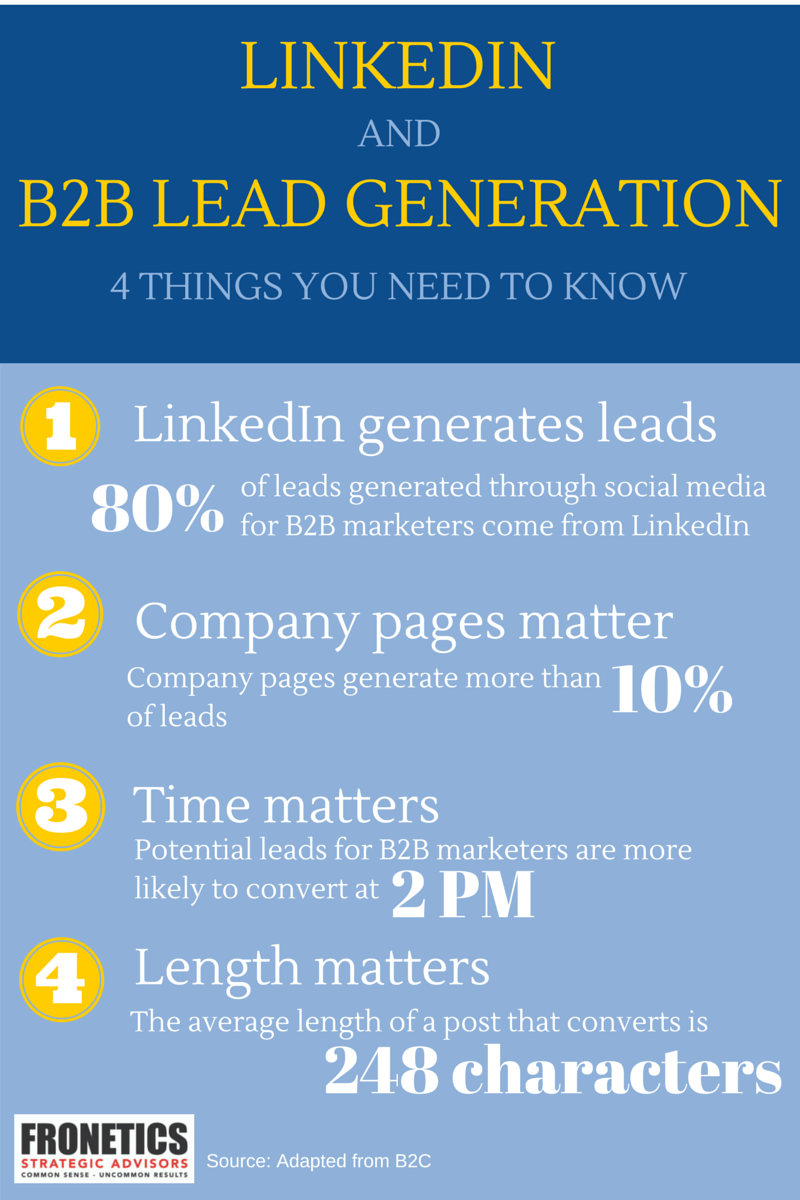
Oktopost, a social media marketing platform, analyzed over 100,000 posts on four different social networks (LinkedIn, Twitter, Facebook, and Google+) and found that LinkedIn is the most effective social network for B2B.
Oktopost found that more than 80% of B2B leads were generated through LinkedIn. Lead generation through other social networks paled in comparison:
- Twitter: 12.73%
- Facebook: 6.73%
- Google+: 0.21%
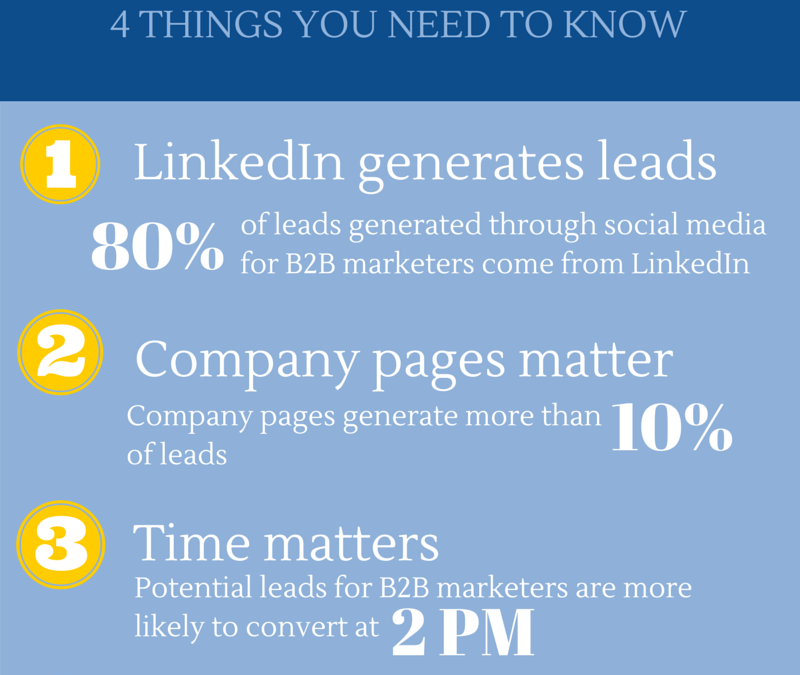
We’ve put together an infographic that outlines four things you need to know about LinkedIn and lead generation.

by Elizabeth Hines | Nov 25, 2014 | Blog, Internet of Things, Marketing, Social Media, Strategy, Supply Chain

The 2014 UPS B2B Buyers Insight Study found that companies need to have a strong online presence to grow their business.
Buyers are looking for information online
Buyers are conducting research on industrial suppliers online. Sixty-eight percent of buyers research supply purchases via supplier website, and 52 percent use search engines.
In their report, UPS and TNS discuss the importance of a strong online presence:
“Given buyers’ high satisfaction levels with supplier performance on key selection criteria, and considering that web-based research is most preferred, it’s reasonable to infer that many buyers consider online research essential to their supplier selection process. The use of search engines means that suppliers may be at greater risk of losing share to companies whose products are perhaps easier to find, in stock or competitively priced. On the other hand, suppliers whose products are easy to find online and meet buyers’ criteria may also stand to gain customers.”
Being able to buy online is more important to buyers than a sales rep
Being able to access information about products online and being able to make purchases online is more important to buyers than sales representatives and printed catalogs.
Respondents were asked to rate attributes with respect to deciding from which industrial supplies vendor to purchase. Seventy-eight percent of respondents rated product information on the supplier website as “extremely important” or “very important.” Seventy-four percent of respondents rated the ability to make purchases on the supplier’s website as “extremely important” or “very important.” In contrast, fifty-eight percent of respondents rated having a sales representative as “extremely important” or “very important.” Fifty-four percent of respondents rated having a hardcopy product catalog as “extremely important” or “very important.”
Buyers like to purchase through websites
Sixty-three percent of industrial supplies buyers reported that they purchase through websites (directly from suppliers or via a third-party provider).
Sixty-seven percent of buyers responded that the ability to order through a supplier’s website is considered “extremely important” or “very important”
If you think your current customers don’t care if you don’t offer the ability to purchase products online – think again. The survey found that 34 percent of buyers say that they have gone outside of their existing supply base to make an online purchase.
Meet your customers online
Having a strong online presence is an essential component to your business strategy. If you want to grow your business you need to be online. UPS and TNS sum this up nicely:
“Be in the right place when buyers are looking: Having a superior supplier website with stellar functionality means little if buyers can’t find the site or don’t know it’s available. Making sure products and supplier information can be found easily by search engines (SEO), and being visible when buyers search for products (SEM), are essential strategies for retaining and increasing customer base.”

by Elizabeth Hines | Nov 11, 2014 | Blog, Current Events, Marketing, Social Media, Strategy
Ello launched in beta on August 7th. By the last week in September the invite-only social network was receiving more than 50,000 invite requests per hour.
What sets Ello apart from other social networks? Ello is ad-free and doesn’t sell user data to third parties. On October 23rd Ello became a Public Benefit Corporation; therefore, making it virtually impossible for Ello to ever sell ads or user data.
The company’s manifesto points to the frustrations which were the impetus for founding Ello, and to the company’s strategic direction:
“Your social network is owned by advertisers.
Every post you share, every friend you make, and every link you follow is tracked, recorded, and converted into data. Advertisers buy your data so they can show you more ads. You are the product that’s bought and sold.
We believe there is a better way. We believe in audacity. We believe in beauty, simplicity, and transparency. We believe that the people who make things and the people who use them should be in partnership.
We believe a social network can be a tool for empowerment. Not a tool to deceive, coerce, and manipulate — but a place to connect, create, and celebrate life.
You are not a product.”
Ello’s mindset resonates. Not only are people clamoring to join the social network, investors are pounding on the door. CEO and Co-Founder Paul Budnitz told BusinessWeek:“I have every investor in the world in my inbox. Someone today offered to fly us out in a private jet to talk, and we said we’re just too busy.” Ello is only open to additional financing from backers with similar values.
What can businesses learn from Ello’s rapid rise to stardom? No one wants to be thought of as a product. If your company recognizes this and your social media strategy reflects this – you are more likely to be successful and rise to stardom (or at the very least increase your revenue).
Your company should use social media to:
- Build trust and relationships with prospects and customers;
- Engage with customers;
- Listen;
- Learn from your customers.
As Alexandra Samuel, Vice-President of Social Media at Vision Critical, recently wrote in an article for the HBR Blog Network: “Instead of relying on algorithms and ad targeting to get dollars out of their customers’ wallets, companies need to think about the value they can offer to their customers’ online lives.”