by Jennifer Hart Yim | Aug 7, 2014 | Blog, Marketing, Social Media, Supply Chain, Transportation & Trucking
This guest post is written by Keychain Logistics. Keychain Logistics is a leading transportation provider enabling businesses to directly engage carriers, track shipments, and monitor its logistics needs online.
It’s 2012. Platforms like Uber, Airbnb, and Homejoy are growing rapidly. New customers are signing up via search, paid referrals, and social media. Marketing teams at each are delicately balancing the supply and demand of their output with a spread of calculations that, if not projected carefully, may lead to service outages and upset customers.
Now what’s going on here, and what does this have to do with logistics?
The companies above, alongside many others eating the world today with software, are all marketplaces.
Speaking in online terms, a marketplace is where buyers and sellers of a particular product or service can collaborate in a streamlined process to achieve what they want from the other side.
In exchange for facilitating relationships, thus saving time and resources for the entities wanting to connect, marketplaces may charge subscription fees, transaction commissions, or depend simply on high traffic volume to sell other assets like media space or proprietary content.
But facilitating relationships is only a necessary component, and not a sufficient one, to the success of a marketplace. This is because some buyers and sellers feel that the benefit of a marketplace has been fully realized upon their connection, and thus don’t stick around for the platform to send a bill.
What marketplaces must do to maintain engaged users, then, is create experiences inside the application that remove the incentive to circumvent it. And this is a tough challenge to solve.
One great example of this is Odesk.com, a marketplace connecting freelancers with employers who have projects to outsource. In exchange for this service, Odesk charges a 10% fee to employers per transaction. While this may sound steep, Odesk meets this ask with a suite of free management tools such as random monitor screenshots that let employers track the productivity of an outsourced team member without worrying about being overbilled on hours.
For freelancers, Odesk requires employers to place valid credit cards on file pre-hire, protecting them from employers who might otherwise attempt to avoid a payment. Tools like this make the Odesk platform (and its fees) worth every penny, thus creating a winning marketplace that helps both sides get what they deserve.
That said, let’s get back to logistics and how Keychain Logistics fits into this marketplace, value-adding, supply and demand spectrum.
The transportation industry is one of the largest, oldest conglomerates on the planet, with millions of drivers and thousands of shippers and brokerages in the US alone. The industry is also a fragmented one, with the biggest brokerage only commanding ~3% market share.
If anything is clear about business, it is that markets become more efficient through consolidation. From Coca-Cola buying a new beverage brand to a toy manufacturer owning its own factories, market consolidation is a common practice and, if done right, typically results in positive benefits for end-customers such as lower prices, higher quality, and so forth.
But for a myriad of reasons we won’t go into today, this kind of consolidation has yet to happen in the transportation industry.
Introducing Keychain.
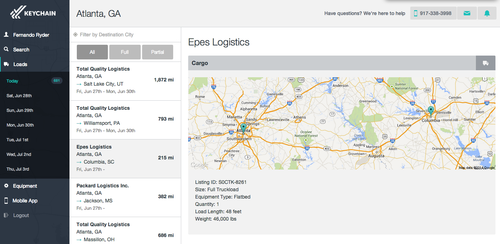
Keychain is a marketplace connecting drivers directly with shippers, and the benefits are three-fold:
1. Shippers (effectively, employers) can bypass expensive commissions by man-powered brokerages,
2. drivers can book loads while on the go, and
3. Keychain verifies user insurance policies and other legal compliance measures, prior to allowing entry to the platform.
To achieve the win-win harmony of a successful marketplace, not only does Keychain facilitate the relationships but it also addresses the circumvention component with tools for drivers and shippers such as mobile apps, online dashboards, easy payment gateways, and in-app communications between parties.
Keychain is the technological consolidation of a market that just won’t give up its antiquated methods. Together, we can bring much needed efficiency to the efficiency business: logistics.

by Elizabeth Hines | Aug 6, 2014 | Blog, Logistics, Marketing, Social Media, Strategy, Supply Chain, Transportation & Trucking

Keychain Logistics has made two bold promises. The company has promised truckers that they will never drive empty again and has promised shippers that Keychain will improve their bottom line.
Can the company deliver on these promises?
Who is Keychain Logistics?
Keychain is a leading transportation provider enabling businesses to directly engage carriers, track shipments, and monitor its logistics needs online.
According to Bryan Beshore, the company’s founder, Keychain grew out of the idea that a technology driven marketplace could operate with significantly lower overhead than a manual, human powered brokerage:
“My initial contact with the industry was in 2000. I have researched, analyzed, and thought about the industry ever since. Keychain is a product in understanding the fundamental efficiency problems the third party logistics industry has faced for a long time.”
Beshore goes on to point out that while building a technology company is tough, building Keychain was easier than anticipated:
“With Keychain it was a natural process and easier than I had imagined. I believe the reason for this is twofold: the challenges this industry faces are huge, and the solutions we are building to meet those problems are really fun to solve. Because our work directly affects the wallets of our users (increased pay for drivers, better rates for shippers), we are effectively helping people create better lifestyles for themselves and their families, and that’s really rewarding.”
The company was slated to be built in 2007; however, the timing was not right given the low proliferation of internet-connected mobile devices (500 million). Beshore waited. In 2012 he decided to move forward with the launch of the company (the number of internet connected devices reached 8.7 billion in 2012).
How does it work?
One can draw a parallel between Keychain and Uber – the company removes the broker and connects truckers directly with shippers therefore enabling truckers to focus on driving and shippers to focus on selling products.
Keychain is a marketplace for truckers to book commercial shipments directly with shippers. The company’s technology matches owner operator drivers (and small fleets) with shippers who rely on Keychain Logistics to find the ideal carrier for their freight.
The core of the company’s platform is their network of ten-of-thousands of carriers throughout the US who are connected 24/7/365 via Keychain’s iOS, Android, and Windows phone apps. Keychain can instantly communicate load opportunities to independent owner-operators, 97 percent of whom operate in fleets of 20 trucks or less, and small carrier fleets.
Too good to be true?
One of the biggest challenges the company has faced is that it is perceived as being “too good to be true.” Beshore:
“The transportation industry is traditional and technologically far behind. Because of this, the inherent challenge to sharing our offering is overcoming the “too good to be true” bias. While many of our potential customers have wanted a product like ours for a while, they either don’t know how to articulate it in a Google search or are skeptical that tech companies like Keychain are committed to solving their problems.”
Solving immediate need
Keychain has been working to overcome the perception of being too good to be true. It has been talking to current users, and has honed in on developing a solid marketing message. The message – we can solve your immediate need.
Not expressing the full-vision up front has been a challenge when Keychain reaches out to companies with whom they have little or no relationship; however, they have found that solving an immediate need is what gets companies excited.
What immediate need(s) can the company address? According to Beshore: “For shippers, this is getting them access to trucks, sometimes within just minutes of our first contact. For drivers, this means getting them a paying load when they’re stuck at a rest stop, are far from home, or simply need a line-haul out.”
Leveraging social media to grow the company
The company has found that one of the best ways to use social media is for listening. Rather than spend time and money putting together and distributing sales literature, the company searches for relevant industry hashtags (i.e.: #trucking) to see what people are talking about, and more importantly what they care about. By using social media this way, Keychain is an audience to users instead of the other way around. This has enabled the company to shape their offering with a solid understanding of what people want from a transportation provider.
“From phone calls to interviews, crowdfunded campaign partnerships, and beyond, social media has certainly helped us grow our business,” says Beshore.
Can they deliver?
Can Keychain deliver on their bold promises? Their customers believe so. Here is what three customers say about the company:
“With Keychain I no longer have to waste hours on logistics. Their platform makes it easy to quickly enter shipment details and receive the most competitive rates available.” Marc DeVidts, Double Robotics
“Keychain gives us instant access to thousands of reliable carriers nationwide. It’s the most efficient and cost effective tool we’ve found.” Nathan Brown, Reclaimed American Hardwood
“Within minutes I can enter my shipment details and Keychain handles the rest. Annoying phone calls and exorbitant broker fees are over.” Ad Sachan, Treeline Woodworks.

by Elizabeth Hines | Jul 30, 2014 | Blog, Marketing, Social Media, Strategy, Supply Chain, Talent
Source: www.social-hire.com
Great talent is out there. The question is – where? With more than 73 percent of online adults and 89 percent of job seekers using social networking sites the answer is clear – online.
Many companies employ a strategy of “post and pray.” That is, they post the job on their website and then they sit back and wait for the applications to pour in. If you want to attract top talent, you need to move away from post and pray and instead use an active talent acquisition strategy.
Here are the components of an active strategy– one that will enable your company to attract and land top talent.
Post
In addition to posting the job description on your company’s website, post it on industry job boards and on LinkedIn.
Share
LinkedIn, Twitter, and Facebook are great places to share that your company has an opening and is looking for great talent. When using social media to share the job posting remember that, for example, the lifespan of a Tweet is about 18 minutes. Given this, it is necessary to share the job opening more than once so that it doesn’t get lost in the chatter.
Explore
Go out and look for talent. Look to the LinkedIn groups to which you belong. Are there individuals who, given their contributions to the group, seem like they would be a good fit for the position? If so, reach out to them and let them know they caught your attention. Share the position with them, and go from there.
Similarly, look to Twitter and to blogs. When looking at blogs to identify a potential candidate, look not only at the author, but also at people mentioned within a blog post.
Network
Use your network and your employee’s networks to share the position and to identify potential candidates.
The next time you have a job opening, try an active strategy. You’ll be amazed – an active approach to talent acquisition will yield a stronger pool of candidates.

by Elizabeth Hines | Jul 22, 2014 | Blog, Supply Chain, Talent
Hiring the wrong person is a costly mistake not only financially, but also in terms of team morale and productivity. Making the right hire is crucial.
Research conducted by the PewResearch Internet Project found that in 2013 73 percent of online adults used a social networking site of some kind. The percentage is even higher for job seekers – 89 percent. Given the high prevalence of use, it is likely that your talent pool is on at least one social networking site. Hiring managers and HR professionals within the supply chain industry should use this reality to hire great supply chain talent.
Social media is increasingly being used by hiring managers and HR professionals in their hiring process. More than one third of employers use social media in their hiring practices, here’s why you should follow suit.
A study conducted by CareerBuilder.com found that 65 percent of employers who use social media to screen candidates do so to see how the candidate presents themselves professionally. Fifty-one percent of employers used social media to see if the candidate would be a good match for the company’s culture, and 45 percent reported that they used social media to further research the candidate’s qualifications.
Of those employers who use social media in their hiring process, 34 percent reported that they found content that resulted in them not hiring a candidate. Close to 50 percent of reported that they did not hire a candidate because of inappropriate material in their profile, and 45 reported they did not make the hire because of indications of drinking and/or drug abuse. Other negatives found by the employer were poor communication skills, criticizing former employers, and making prejudicial comments.
A candidate’s social media profile and use can also provide employers with information that can push a candidate to the top of the list. Approximately 29 percent of employers reported that they hired a candidate because their social media profile supported professional qualifications and/or contained a great reference about the candidate. Additionally, employers reported that they hired a candidate because their social media profile showed that the candidate was creative, well-rounded, or had great communication skills.
One thing to keep in mind – all information found online and via social media needs to be treated in the same manner as information found via traditional sources. All hiring practices must abide by state and federal laws relating to fair and equal hiring.
Social media is a great tool that can assist hiring managers and HR professionals hire great talent.
by Elizabeth Hines | Jul 16, 2014 | Blog, Manufacturing & Distribution, Marketing, Social Media, Strategy, Supply Chain, Talent, Warehousing & Materials Handling
According to the 2013 CareerBuilder Candidate Behavior Study, job seekers looking for a position with the manufacturing, transportation, and warehousing industries are using the internet and social media not only to look for jobs, but also to research companies within these industries.
Candidates use the internet and social media throughout their job search
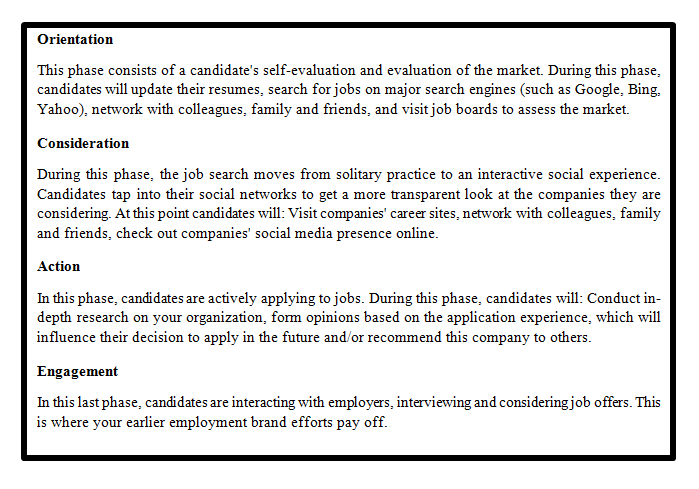
The CareerBuilder study looked at the behavior of candidates throughout the four phases of their job search (orientation, consideration, action, and engagement) and found that the internet and social media were used throughout each of the phases. (See Figure 1 for a definition of each of the four phases.)
Figure 1: The four phases of the the job search
Source: 2013 CareerBuilder Candidate Behavior Study
Job seekers in the orientation and consideration phases have not yet applied for a job at your company. Instead they are assessing the market, learning about an industry, and learning about companies within the industry. These stages are very much knowledge seeking phases for the candidate. Companies who are positioned right can attract great talent during these phases. However, companies who do not have a strong online presence and who do not participate in social media will not catch the eye of job seekers. Think of it as speed dating – you only have a short period of time to make an impression. According to the Neilson Norman Group you have 10 to 20 seconds to make that great impression. If you don’t make a great impression during those few seconds the user will navigate away from your website. Therefore you need to make sure that your website is visually engaging, easy to navigate, and contains quality and informative content.
When a candidate reaches the action stage they not only apply to jobs, they also conduct more in-depth research about a company, and form opinions based on the application experience. Candidates are not afraid to share their experience with the application process. Fifty percent of candidates share bad experiences with others and 64 percent share positive experiences.
In the engagement stage candidates interact with employers, interview for positions, and consider offers. Ninety-one percent of candidates believe employment brand plays a role in their decision whether or not to apply – therefore it is at this stage where your company’s online presence and participation in social media pays off.
How do candidates looking for a position within the manufacturing, transportation, and warehousing industries approach their job search? Let’s look.
Manufacturing industry
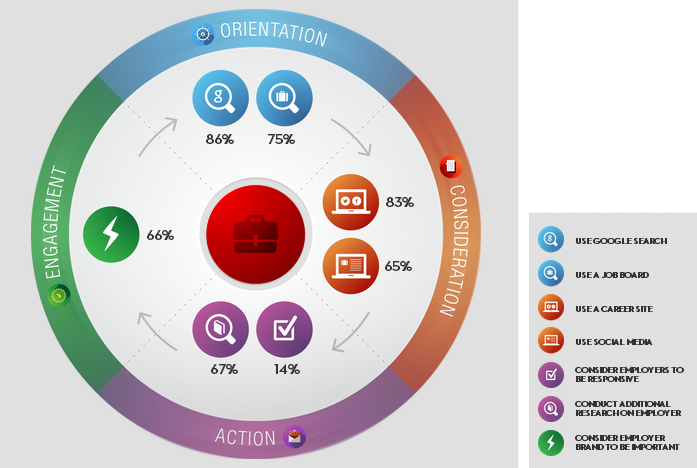
As shown in Figure 2, within the orientation stage, 85 percent of candidates looking for a job within the manufacturing industry turned to Google and 75 used a job board. In the consideration stage 83 percent used a company’s career site and 65 percent used social media to learn more about the company.
In the action stage 67 percent of candidates reported that they conducted additional research on an employer. In this stage only 14 percent of candidates reported employers in the manufacturing industry to be responsive.
Finally, looking at the final stage of the candidate’s journey, 67 percent reported that they felt the employer brand to be important.
Figure 2: The four phases of the job search; manufacturing industry
Source: 2013 CareerBuilder Candidate Behavior Study
Transportation and warehousing industries
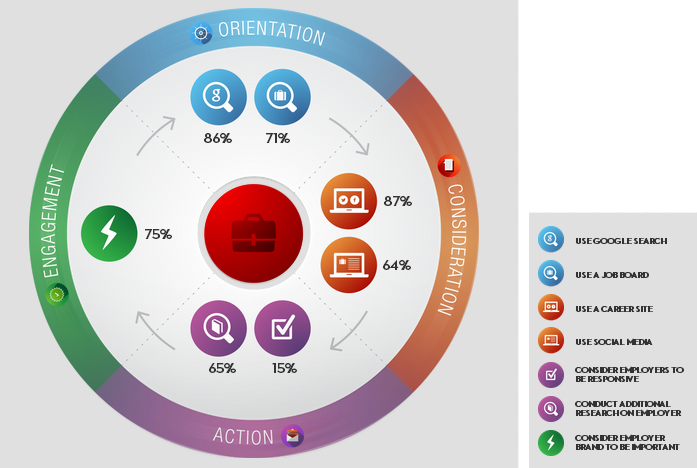
Figure 3 shows that within the orientation stage 86 percent of candidates looking for a job within the transportation and warehousing industries turned to Google and 71 percent used a job board. In the consideration stage 87 percent used a company’s career site and 64 percent used social media to learn more about the company.
In the action stage 65 percent of candidates reported that they conducted additional research on an employer. In this stage only 15 percent of candidates reported employers to be responsive.
In the engagement phase, 75 percent of candidates reported that they felt the employer brand to be important.
Figure 3: The four phases of the job search; manufacturing industry
Source: 2013 CareerBuilder Candidate Behavior Study
In the end
Candidates looking for jobs within the manufacturing, transportation, and warehousing industries are using the internet and social media. They are researching these industries and researching companies within these industries. They are forming opinions, acting on these opinions, and sharing their opinions with others.
If the manufacturing, transportation, and warehousing industries want to attract great talent and retain their interest throughout a candidate’s job search they need to invest in their online presence and become active in social media.