by Elizabeth Hines | Oct 30, 2014 | Blog, Marketing, Social Media, Strategy, Supply Chain
The use of third-party logistics providers are on the rise. As many as nine out of ten 3PLs surveyed by Inbound Logistics reported their client base grew by 5 percent this year, continuing the unabated expansion of recent years.
And there’s good reason for it.
In an interesting article on SupplyChain 24/7, Adam Robinson, the marketing guru at Cerasis, lists seven reasons companies should outsource non-core transportation management functions to 3PL providers. Surprisingly, perhaps, many of the same arguments can be applied to companies debating who should be in charge of their content creation.
As the number one reason to outsource, Robinson cites “Time and Money.”
He writes:
“3PL providers are able to reduce the amount of infrastructure investments in equipment, software, facilities and personnel… These 3PLs are like having non-paid employees on your staff and allow shippers to focus resources on areas where they are the expert (i.e. manufacturing, product sales).”
Time and money – or lack thereof – are similarly common issues among companies with respect to social media. In a new Fronetics report on social media use in the supply chain and logistics industries, nearly half of the respondents cited time and budgetary constraints as their top two challenges. Such companies may, as a result, participate only sporadically or not at all.
Since consistency is crucial to online lead generation, anything but a fulltime commitment to the company blog, content curation, and social media outreach is doomed to fail. An outside provider can, just like a 3PL, take these tasks off your hands, allowing you to focus on your core competencies.
Robinson also argues:
“As shippers rely on 3PL partners to provide more strategic oversight, and help catalyze business process change within the organization, the relationship is growing more fluid, and less analytical. Service providers are becoming an extension of the enterprise.”
In short, 3PL providers should not be perceived as outsiders but as partners who know their stuff. They contract with thousands of carriers and know the fastest and most reliable routes to move product from point A to point B.
A marketing company, especially one specialized in content creation for the logistics, transportation and supply chain industries, works the same way, drawing on a wealth of industry knowledge. In essence, you hire experts equipped with the right strategic tools to leverage their market expertise to your advantage.
Finally, Robinson writes visibility of loads gives 3PLs a leg up on the competition:
“Many 3PLs are able to integrate tracking into shipper IT systems, provide integration into ERP and WMS automated notices or even real-time delivery notifications by e-mail.”
Losing track of a shipment equals chaos. 3PL providers are there to ensure it never happens. In the same vein, companies need to track the metrics of their content strategy or risk wasting resources on something that yields no results. They need to know which social media outlets work for their business and what types of content draw traffic to their site. It takes time and resources – and as our survey revealed, both tend to be in short supply.
Your content marketing partner, on the other hand, knows metrics is as important as a shipment is to a 3PL provider.
Outsourcing content creation may be your strategic advantage over your competition.
by Elizabeth Hines | Oct 14, 2014 | Blog, Logistics, Manufacturing & Distribution, Marketing, Social Media, Strategy, Supply Chain
Social media is a strategic tool. The benefits companies can realize by using social media are immense. Which benefits are motivating companies within the logistics and supply chain to use social media? Even more broadly, why are companies using social media?
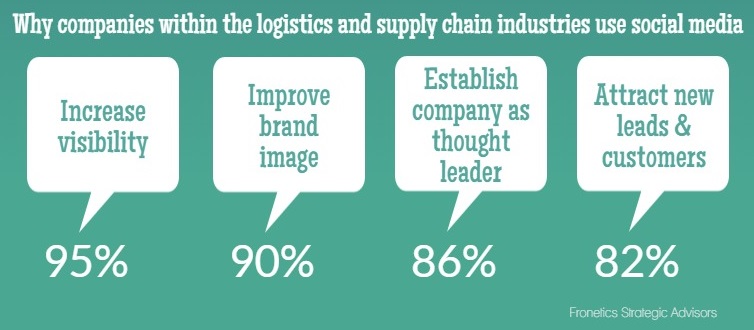
A recent survey conducted by Fronetics Strategic Advisors found that the predominant reasons companies within the logistics and supply chain industries use social media are to: increase the visibility of their company; to improve their brand image; establish their company as a thought leader; and to attract new leads and customers.
To learn more about the use, motivations, benefits, and challenges of social media and the logistics and supply chain industries, download our report: Social media and the logistics and supply chain industries.


by Elizabeth Hines | Sep 9, 2014 | Blog, Marketing, Social Media, Strategy, Supply Chain
Many companies within the supply chain industry do not participate in social media because “they can’t get past the word ‘social’ and the perception it creates.” Companies with this mindset are at a disadvantage.
The supply chain industry is, by nature, an industry that is built on relationships, partnerships, cooperation, networks, and on communication. Being social is vital to the success of companies with the supply chain industry. Social media is a platform that is well poised to meet the needs and demands of the supply chain industry – and to help companies within the industry grow their business.
Social media is a tool that can be used be the supply chain industry for: risk management, business intelligence, recruitment, lead generation, engaging with current and prospective customers, attracting new customers, improving productivity, problem solving, and establishing your company as an industry leader. Moreover, social media can be used as the foundation for a new business model.
Clara Shih, CEO and Founder of Hearsay Social, and Lisa Shalett, Managing Director and Head of Brand Marketing and Digital Strategy at Goldman Sachs, write:
Social media is perhaps best thought of as a set of new and innovative ways for businesses and customers to do what they have always done: build relationships, exchange information, read and write reviews, and leverage trusted networks of friends and experts.
Similarly, Tony Martins, President of Tony Martins & Associates, notes that:
Supply chain executives should look at the social model of collaboration that can be enabled through social media as the most significant strategic weapon in supply chain optimization today. It liberates them from the rigid framework of functional structures and client-supplier relationships. It is the best way I’ve seen to keep the supply chain moving quickly, in spite of the many problems that will always occur.
Still skeptical? Look at companies who have successfully leveraged social media. Or, as Shih and Shalett suggest: “As you contemplate the risks and rewards of social media, we would suggest that the key ingredient for evaluation is simply to experience it for yourself.”
Interested in learning more about social media and the supply chain industry? Download our white paper: “Social Media and the Logistics and Supply Chain Industries: Why Not Participating is a Risk You Can’t Afford to Take.”

by Elizabeth Hines | Aug 6, 2014 | Blog, Logistics, Marketing, Social Media, Strategy, Supply Chain, Transportation & Trucking

Keychain Logistics has made two bold promises. The company has promised truckers that they will never drive empty again and has promised shippers that Keychain will improve their bottom line.
Can the company deliver on these promises?
Who is Keychain Logistics?
Keychain is a leading transportation provider enabling businesses to directly engage carriers, track shipments, and monitor its logistics needs online.
According to Bryan Beshore, the company’s founder, Keychain grew out of the idea that a technology driven marketplace could operate with significantly lower overhead than a manual, human powered brokerage:
“My initial contact with the industry was in 2000. I have researched, analyzed, and thought about the industry ever since. Keychain is a product in understanding the fundamental efficiency problems the third party logistics industry has faced for a long time.”
Beshore goes on to point out that while building a technology company is tough, building Keychain was easier than anticipated:
“With Keychain it was a natural process and easier than I had imagined. I believe the reason for this is twofold: the challenges this industry faces are huge, and the solutions we are building to meet those problems are really fun to solve. Because our work directly affects the wallets of our users (increased pay for drivers, better rates for shippers), we are effectively helping people create better lifestyles for themselves and their families, and that’s really rewarding.”
The company was slated to be built in 2007; however, the timing was not right given the low proliferation of internet-connected mobile devices (500 million). Beshore waited. In 2012 he decided to move forward with the launch of the company (the number of internet connected devices reached 8.7 billion in 2012).
How does it work?
One can draw a parallel between Keychain and Uber – the company removes the broker and connects truckers directly with shippers therefore enabling truckers to focus on driving and shippers to focus on selling products.
Keychain is a marketplace for truckers to book commercial shipments directly with shippers. The company’s technology matches owner operator drivers (and small fleets) with shippers who rely on Keychain Logistics to find the ideal carrier for their freight.
The core of the company’s platform is their network of ten-of-thousands of carriers throughout the US who are connected 24/7/365 via Keychain’s iOS, Android, and Windows phone apps. Keychain can instantly communicate load opportunities to independent owner-operators, 97 percent of whom operate in fleets of 20 trucks or less, and small carrier fleets.
Too good to be true?
One of the biggest challenges the company has faced is that it is perceived as being “too good to be true.” Beshore:
“The transportation industry is traditional and technologically far behind. Because of this, the inherent challenge to sharing our offering is overcoming the “too good to be true” bias. While many of our potential customers have wanted a product like ours for a while, they either don’t know how to articulate it in a Google search or are skeptical that tech companies like Keychain are committed to solving their problems.”
Solving immediate need
Keychain has been working to overcome the perception of being too good to be true. It has been talking to current users, and has honed in on developing a solid marketing message. The message – we can solve your immediate need.
Not expressing the full-vision up front has been a challenge when Keychain reaches out to companies with whom they have little or no relationship; however, they have found that solving an immediate need is what gets companies excited.
What immediate need(s) can the company address? According to Beshore: “For shippers, this is getting them access to trucks, sometimes within just minutes of our first contact. For drivers, this means getting them a paying load when they’re stuck at a rest stop, are far from home, or simply need a line-haul out.”
Leveraging social media to grow the company
The company has found that one of the best ways to use social media is for listening. Rather than spend time and money putting together and distributing sales literature, the company searches for relevant industry hashtags (i.e.: #trucking) to see what people are talking about, and more importantly what they care about. By using social media this way, Keychain is an audience to users instead of the other way around. This has enabled the company to shape their offering with a solid understanding of what people want from a transportation provider.
“From phone calls to interviews, crowdfunded campaign partnerships, and beyond, social media has certainly helped us grow our business,” says Beshore.
Can they deliver?
Can Keychain deliver on their bold promises? Their customers believe so. Here is what three customers say about the company:
“With Keychain I no longer have to waste hours on logistics. Their platform makes it easy to quickly enter shipment details and receive the most competitive rates available.” Marc DeVidts, Double Robotics
“Keychain gives us instant access to thousands of reliable carriers nationwide. It’s the most efficient and cost effective tool we’ve found.” Nathan Brown, Reclaimed American Hardwood
“Within minutes I can enter my shipment details and Keychain handles the rest. Annoying phone calls and exorbitant broker fees are over.” Ad Sachan, Treeline Woodworks.

by Elizabeth Hines | Jul 30, 2014 | Blog, Marketing, Social Media, Strategy, Supply Chain, Talent
Source: www.social-hire.com
Great talent is out there. The question is – where? With more than 73 percent of online adults and 89 percent of job seekers using social networking sites the answer is clear – online.
Many companies employ a strategy of “post and pray.” That is, they post the job on their website and then they sit back and wait for the applications to pour in. If you want to attract top talent, you need to move away from post and pray and instead use an active talent acquisition strategy.
Here are the components of an active strategy– one that will enable your company to attract and land top talent.
Post
In addition to posting the job description on your company’s website, post it on industry job boards and on LinkedIn.
Share
LinkedIn, Twitter, and Facebook are great places to share that your company has an opening and is looking for great talent. When using social media to share the job posting remember that, for example, the lifespan of a Tweet is about 18 minutes. Given this, it is necessary to share the job opening more than once so that it doesn’t get lost in the chatter.
Explore
Go out and look for talent. Look to the LinkedIn groups to which you belong. Are there individuals who, given their contributions to the group, seem like they would be a good fit for the position? If so, reach out to them and let them know they caught your attention. Share the position with them, and go from there.
Similarly, look to Twitter and to blogs. When looking at blogs to identify a potential candidate, look not only at the author, but also at people mentioned within a blog post.
Network
Use your network and your employee’s networks to share the position and to identify potential candidates.
The next time you have a job opening, try an active strategy. You’ll be amazed – an active approach to talent acquisition will yield a stronger pool of candidates.