by Elizabeth Hines | Sep 10, 2014 | Blog, Data/Analytics, Marketing, Strategy
Metrics matter. Metrics allow you to measure success, drive strategy, and demonstrate the ROI of your marketing efforts. Conversions are one of the most important metrics to monitor.
Why conversion rates matter
What is a conversion? A conversion means action. It means that someone took some action that entered them into your funnel or moved them further down your funnel. Examples of conversions are: downloading a white paper, filling out a form, requesting information, opening an email, and becoming a customer.
By monitoring and tracking conversions you can determine what marketing efforts are paying off. Additionally, by monitoring and tracking conversions you can identify which efforts need to be re-evaluated or even discontinued. In short, conversion rates can help you measure your ROI.
Why conversion rates don’t matter
Conversion rates are not the Holy Grail of metrics. Your website should be a magnet. It should attract and engage prospective customers and current customers. Your website should serve to educate and to establish your business as an industry leader. Eighty to 90 percent of prospects are not ready to make a purchase when they first engage with your company. Conversion rates don’t capture the amount of time people spend on your website, learning, exploring, and getting to know your business. Conversion rates also do not capture the amount of time current customers spend on your website – valuing your company as a resource.
While conversion rates are an important metric to measure, remember that they are not the end all be all.
Tracking conversion rates
We created a template that you can download and use to track conversion rates and other critical metrics. While the template captures visitor-to-lead and lead-to-customer conversion rates, you can easily modify the template to include additional conversion rates that are useful to your business.


by Elizabeth Hines | Sep 2, 2014 | Blog, Content Marketing, Data/Analytics, Marketing, Supply Chain

To grow your B2B business you need to take a comprehensive data driven approach to marketing. Metrics enable you to measure success, drive strategy, and demonstrate the ROI of your marketing efforts.
What metrics should you track?
Given that your objective is to attract, acquire, and retain customers, the most effective metrics to track are those where the unit of focus is the prospect, lead, or customer. These include the following:
Visits
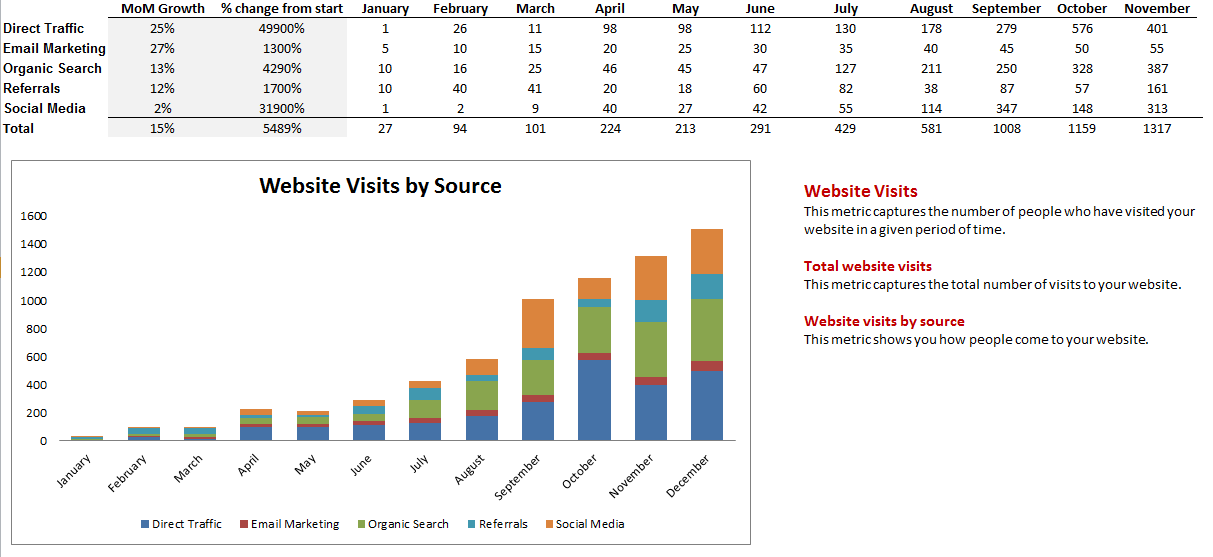
Visits capture the number of visitors to your company’s website in a given period of time. In addition to tracking the total number of visits, it is also important to track visits by source. That is, how visitors come to your website. Sources typically include direct traffic, organic search, referrals, social media, and email marketing.
Reach
Reach is the number of people who can be reached through your marketing channels (e.g. LinkedIn, Twitter, and Facebook). This metric is a good indicator of how well the content you are publishing attracts new people to your network, and how well the content engages people within your network. In addition to tracking your company’s total reach (the total number of people you can reach across all channels), you should also track reach by channel.
Leads
Leads are one of the strongest indicators of ROI. By tracking leads by source, you can identify where your marketing efforts are most effective, areas where you can improve, and areas you could eliminate from your strategy.
Customers
Customers are also a strong indicator of ROI. Like leads, customers should be tracked by source.
Conversion rates
Conversion rates measure the percentage of people who are moving from one marketing stage to the next. An increase in your conversion rates implies an improvement in the quality of your content and/or traffic. You should track the visit-to-lead conversion rate (How many of your website visitors are becoming new leads?) as well as the lead-to-customer conversion rate (Are you generating sales-ready leads?).
Ranking
Ranking matters. The top listing in Google’s organic search results receives 33 percent of the traffic compared to 18 percent in the second position. Two metrics you can track are your domain authority and your marketing grade.
Domain authority is a score ranging from 1 to 100 that represents how well a website will perform in a search engine ranking. The lower the score – the less likely it will be found. Marketing grade is a holistic measure of a site’s online presence as measured by HubSpot’s Marketing Grader on a scale of 0-100. A higher score is better.
How to track metrics for success
Having an established database to capture your marketing metrics is critical to success. We created a template that you can download and use to track your metrics, measure success, and drive strategy. One of the great features about this template is that it generates graphs that can be used in your reports and presentations.