by Elizabeth Hines | Jun 4, 2015 | Blog, Marketing, Social Media, Strategy
When thinking about where to focus your company’s social media presence, look at the numbers. LinkedIn generates 80% of B2B social media leads, more than Facebook, Twitter, and Google+ combined. A 2013 study conducted by Demo and CEO.com shared that “LinkedIn remains the one social media platform that is actually more popular with CEOs than the general public.” Why are company higher-ups turning to LinkedIn, the top professional social media platform?
LinkedIn currently has more than 350 million users, from over 200 countries and territories, and sees 2 new members added each second. A good amount of people, 40%, check LinkedIn daily. With these impressive numbers and LinkedIn’s goal of reaching 3 billion users, a company profile is bound to get traffic, especially if the company is utilizing the publishing format to share ideas and situate itself as a leading voice in the industry.
Your own employees, current and former, most likely have their own LinkedIn profile. They list their education, and of course, their work history. If your company does not have a LinkedIn page, there will be no logo to click on, no link, no exposure for you, and perhaps a loss of credibility. In today’s tech-savvy world, being engaged in social media platforms has come to be the norm for individuals and companies. People spend 1.72 hours on social media a day; let them find you easily during that time.
Leads:
With LinkedIn being the top social media site to generate leads, why not highlight your company there? Unlike Facebook, you have the ability to see who is looking at your company’s profile, and now, with LinkedIn’s newest analytics service, users can see who has been viewing their posts. Users can also see how many people liked and shared a post, and see more detail into demographics such as viewers’ industry, location, and job titles. By understanding who is looking at your company’s page or posts, you can see which demographic you’re reaching, and which you’re missing. You can reach out to those who show repeated interest and try to find ways to tailor future content to attract the people you’re not reaching.
Credibility:
Let your former and current clients and partners advertise your expertise for you. With the “recommendations” and “endorsements” features others can help build your level of trust with potential leads.
Coaches, consultants and recruiters also comb through LinkedIn looking for company matches for their clients. According to Executive Coach and Consultant, Stephenie Girard, “I rely on companies to use LinkedIn to increase their credibility, attract quality talent and expose their product or professional services. When organizations utilize LinkedIn in full capacity we gain access to the company’s values, culture, people and products – all of which are crucial pieces to the puzzle when matching a potential employee to employer.”
Connections:
Finding leads directly might be on your mind, but finding other business people and businesses that you can follow, monitor, learn from, and partner with, can also be incredibly valuable and may, in the end, bring you some leads and great business allies.
Once you have the connections made on LinkedIn, stay in touch with your old and new connections, clients, and customers. Many companies use LinkedIn as another platform to share press releases, white papers, videos, and product announcements.
According to Business Insider article LinkedIn May Not Be the Coolest Social Network, but It’s Only Becoming More Valuable to Businesses, “LinkedIn has the advantage of being the place for white-collar professionals to network, meaning its population is highly desirable since it is a high-income and highly educated user base.” Is LinkedIn right for you? If you’re looking for intelligent professionals, perhaps it is.

by Elizabeth Hines | Mar 16, 2015 | Blog, Marketing, Social Media, Strategy
How your business can use social media to generate leads.
Leads are essential to the growth of your business, and your marketing strategy is built around finding and connecting with leads. So when 92% of all marketers indicate that their social media efforts have generated more exposure for their businesses, you should take note and make social media part of your prospecting strategy.
Building a network of online connections is an effective way to find new leads. And with social media, you can find new leads by doing something called social prospecting. Social prospecting is the art of searching the social web, identifying potential prospects for your business, and engaging them in a manner that draws them to your company’s website and through your funnel. At the core, social prospecting is about listening. It’s about listening to social media conversations in order to generate leads for your business. It goes beyond monitoring keywords to engaging people that may or may not know what your business can do for them.
As you build your social prospecting strategy and develop new approaches to connect with leads, keep these 25 handy tips close by to guide your efforts.
Twitter
- Post content that draws prospects back to your website.
- Aim to share useful content on Twitter two to three times per week.
- Make customers feel appreciated by prioritizing their questions.
- Keep prospects engaged by retweeting some of their organic content.
- Favorite tweets with content that leads share.
- Respond to and offer help to industry peers’ questions.
- Delight customers by replying or favoriting tweets when they mention your company.
- Engage with potential prospects by offering help using relevant content.
LinkedIn
- Post at least twice a week to your company’s LinkedIn page.
- Join five LinkedIn Groups that could connect you with potential prospects.
- Join conversations in the group where you can add value with your content.
- “Like” content that others are sharing in the group.
- Share your own content to the group.
- Use LinkedIn Answers to respond to questions posted by others in your industry.
- Make a habit of routinely reviewing the content posted within your groups.
- Comment and add value to posts from others in the group.
- Ask for an offline meeting with your most engaged prospects.
Facebook
- Link to your blog from Facebook.
- Add calls to action to posts.
- Promote a special product or service offer solely for Facebook fans.
- Create and post visual content, like infographics and videos.
- Share a quote or industry statistic with your fans.
- To draw more comments from fans, pose a question.
- Create a Facebook event to promote trade show appearances or webinars.
- Update your company’s profile and cover photos routinely.
Ready to build a more full-bodied social prospecting strategy? We’ve laid out the quickest ways for you to find more leads and prospects on Twitter, Facebook, LinkedIn, Pinterest, and Google+ in our social prospecting workbook. In a dedicated worksheet to each of those social media platforms, you’ll find every worksheet includes: a short preparatory work to make the actual prospecting easy; visual instructions on how and where to find prospects; pro tips that will help you get the best results; prescriptions (Marketing Rx) for success; and take-home exercises for follow-up prospecting. To get started growing your prospecting opportunities and building alternative lead generation and nurturing strategies, download our free workbook.
Curious about what we’re up to on social media? Find out.

by Elizabeth Hines | Feb 10, 2015 | Blog, Content Marketing, Marketing, Strategy
You’ve likely heard it before – your business should be blogging. It’s understandable if it isn’t. Given the finite nature of a single workday, we all face daily pressure to prioritize projects and streamline strategies. But isn’t it true that our priorities should align with activities that have the most significant impact on performance? When data becomes the guide to choosing where to focus marketing efforts, it becomes clear that blogging is the powerhouse of digital marketing activity.
Blogging positively impacts a number of typical objectives for businesses. It makes it more likely for companies to be found in search engine results, produces higher quality leads, establishes industry expertise, and shortens sales cycles. To understand exactly to what degree blogging is affecting these outcomes, let’s take a look at the data.
Blogging generates high-quality leads and increases sales.
Practically all marketing activities ultimately seek to drive one objective – to increase sales. Many businesses are tying big sales wins to their blogging efforts. In a 2013 publication of Marketing Benchmarks, HubSpot reported companies that blog once or twice per month generate 70 percent more leads than those who don’t blog at all. Further, companies nearly double their sales leads by increasing blogging frequency from 3-5 times per month to 6-8 times per month.
Blogging drives increased website traffic.
Increased website traffic can almost always be linked to an increase in leads and sales. Companies with 51-100 pages on their website generate 48 percent more traffic than those with 1-50 pages according to the same HubSpot report. Consistent blogging activity builds the number of website pages and consequently the number of opportunities for your company to connect with customers, leads, and industry peers. Publishing frequency matters, too. Companies that blog at least 15 times per month get five times more traffic than those that don’t blog. Small businesses with 1-10 employees see the largest gains by posting more often.
Blogging links businesses and customers.
Business websites with blogs have 434 percent more indexed pages and 97 percent more indexed links based on the findings of a 2013 Social Media Today report. If search engines can easily find your business, prospective customers will find you easier, too. Building links ensures existing and potential customers can connect and engage meaningfully with your company.
Blogging seeks to educate and establish expertise.
Crafting and publishing quality blog content builds credibility and trust. Social Media Today reports a full 70 percent of consumers learn about companies through articles rather than ads and that 61 percent of consumers have made a purchase based on a blog post.
Data makes it clear that relevant and engaging blog content is a valuable marketing asset and sales driver for many businesses. In fact, marketers who have prioritized blogging are 13 times more likely to enjoy positive ROI. Is your company taking full advantage of this powerhouse marketing activity or is it missing opportunities to attract leads and delight customers?
by Elizabeth Hines | Dec 18, 2014 | Blog, Marketing, Social Media, Strategy
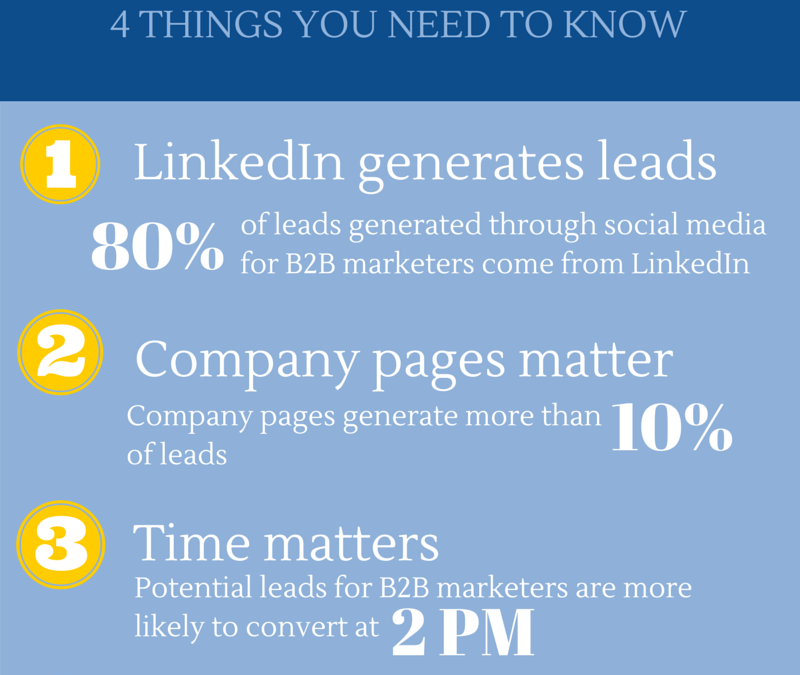
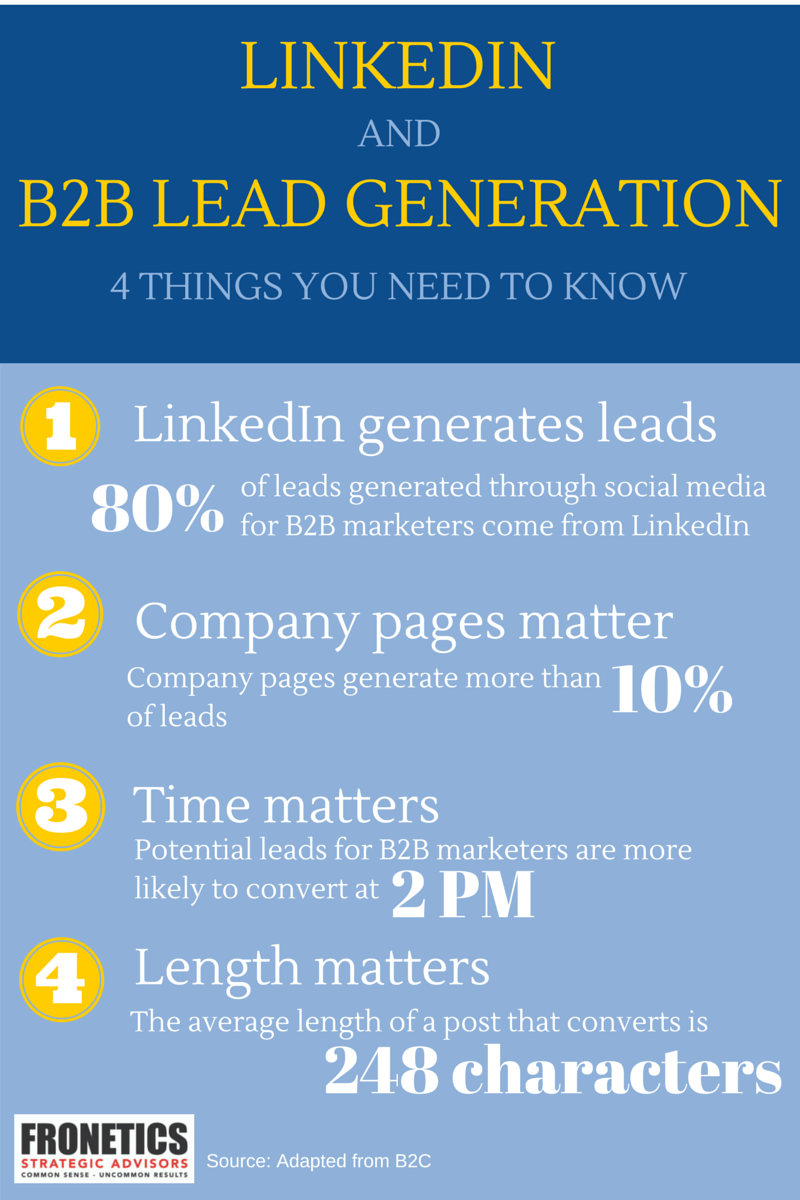
Oktopost, a social media marketing platform, analyzed over 100,000 posts on four different social networks (LinkedIn, Twitter, Facebook, and Google+) and found that LinkedIn is the most effective social network for B2B.
Oktopost found that more than 80% of B2B leads were generated through LinkedIn. Lead generation through other social networks paled in comparison:
- Twitter: 12.73%
- Facebook: 6.73%
- Google+: 0.21%
We’ve put together an infographic that outlines four things you need to know about LinkedIn and lead generation.

by Elizabeth Hines | Sep 30, 2014 | Blog, Strategy, Talent
Are your sales reps as sold on your leads as you are?
In theory, it seems straight forward: You write engaging blog posts; you spread your unique as well as curated content via appropriate social media channels; you include calls to action; you watch your prospects take the bait; and, finally, you hand off a neat list of qualified leads to sales.
Sales, in turn, swiftly goes to work and the sale is a fact.
The reality is, as most of us know, far more muddled. You may be in the habit of dumping any lead, qualified or not, on sales. Sales, on the other hand, may be busy doing anything but tending to your leads. Hours go by. Hours turn into days. When sales finally do follow up, the lead has moved on.
Here is the bad news: Time kills even the most eager leads.
The 2014 Lead Response Report by InsideSales.com shows an undeniable connection between the time it takes to make contact with a prospect and the likelihood of converting that prospect into a customer. Since most companies will send out an automatic e-mail confirmation to anyone who has filled out an online form, the study looked specifically at the phone response rate, which it argues is a much more effective sales tool.
Consider a few of the findings:
- Fifty percent of buyers choose the vendor that responds first.
- The median first call response time was 3 hours and 18 minutes.
- Only a fraction of companies reply within five minutes.
That last number is important because another InsideSales study on lead response management found the following:
“Making a successful contact with a lead are 100 times greater when a contact attempt occurs within 5 minutes, compared to 30 minutes after the lead was submitted. Similarly, the odds of the lead entering the sales process, or becoming qualified, are 21 times greater when contacted within 5 minutes versus 30 minutes after the lead was submitted.”
If you need further proof that response rate matters, an article in Forbes on inbound marketing sums it up perfectly: “If your goal is to ‘pull your customer toward you’ in order to sell them something, then time is definitely of the essence.”
With these statistics in mind, it is more important than ever to ensure marketing and sales are aligned. Too often poor lead-to-customer conversion can be blamed on a disconnection between the two departments.
Work in partnership to establish a common sales funnel. Spell out who is in charge of each step of the sales process. It doesn’t matter who makes that first call to your qualified lead, but it is important that you know someone will actually pick up the phone with a sense of urgency.
Bear in mind: All your leads need to grow cold is time.