
by Elizabeth Hines | Oct 1, 2013 | Blog, Leadership, Strategy
Vacations are going the way of the dinosaur. I say – bring the vacation back.
The Center for Economic and Policy and research released a report in May on vacations – or lack thereof. It turns out that the United States is the only advanced economy in the world that does not guarantee its employees paid time off. That is right; the US is the only advanced economy that does not legally require employers to give employees either paid vacation time or paid holidays. Given there are no legal requirements, what percentage of private sector employees receive paid time off? Seventy-seven percent of employees receive paid vacation time, and seventy-seven percent of employees receive paid holidays. Not surprisingly the higher the wage the employee receives, the more likely they are to receive time off. Specifically, half of low-wage workers typically receive paid time off whereas more than 90 percent of high-wage workers receive paid time off.
Harris Interactive reports that people like the idea of more time off. Specifically, 50 percent of workers who receive paid vacation time in the top 10 cities in the US say they would be willing to sacrifice a workplace benefit for more paid time off. Ironically, although employees say they want more time off, 57 percent don’t take off the time they already receive. In fact, each year there are 175 million vacation days which American workers are entitled to which are not taken.
So what about that vacation?
Those who do actually use their time off don’t spend the time unplugged. A recent survey by Pertino found that 59 percent of Americans regularly work, check email, take a phone call, and do other work related tasks while on vacation. Surprisingly, 47 percent of those surveyed reported that they are less stressed on vacation if they can stay connected to the office.
Are you one of the 36 percent who are conducting business from the beach?
The reality is that taking a true vacation is important to both physical and mental health. Taking time off is better for work performance and productivity. For example, a 2011 Harvard Medical School study found that sleep deprivation costs American companies $63.2 billion a year in lost productivity. Ernst & Young offers another example. In 2006 the company conducted an internal study of its employees and found that for each additional 10 hours of vacation employees took, their year-end performance ratings from supervisors (on a scale of one to five) improved by 8 percent. What’s more – retention rates were significantly higher among vacationers.
Security is another reason why employers encourage employees to unplug while on vacation. The Pertino survey found that 77 percent of those who work on their vacation do not have access to their office network. Because of this employees use unsanctioned or unsecured cloud services (32 percent) and/or bring their work computers and files with them on vacation (35 percent). Public Wi-Fi hotspots are commonly used by vacationers, creating an opportunity for data, credentials, etc. to be stolen.
Vacations, true vacations, are endangered. Let’s work to bring them back.

by Elizabeth Hines | Sep 24, 2013 | Blog, Leadership, Marketing, Strategy
Breaking Bad, AMC’s award-winning drama, is dark, violent, gritty – and it offers 9 essential business lessons.
1. Don’t cut corners; quality is paramount
Look, I like making cherry product, but let’s keep it real, alright? We make poison for people who don’t care. We probably have the most unpicky customers in the world.
You can make a million excuses as to why cutting corners is ok, but the reality is that cutting corners is not okay. Quality has a direct impact on your company’s productivity, profitability, costs, image, and customer satisfaction. Strive not to meet your customers’ expectations, but to exceed them.
2. Know your competition
While it is unlikely that knowing your competition is a matter of life and death as it is for anti-hero Walter White, it is necessary that you know who your competition is, what they are up to, and gain a competitive advantage. The company that is consistently first to the marketplace and is the best in the marketplace is the one that is noticed by customers.
3. Create strategic partnerships
You asked me if I was in the meth business or the money business. Neither. I am in the empire business.
Throughout the series, we watch Walt determine which partnership(s) will best serve to further his empire and then he does whatever necessary to establish those partnerships. Walt takes things to extreme, but he does offer a lesson – strategic partnerships are an essential component to a successful business.
If you are interested in learning how to choose a potential partner – you can check out a previous post I wrote on Find[ing] Your Perfect Outsource Mate.
4. Stick to what you know
Look. Let’s start with some tough love. You two suck at peddling meth. Period.
It is important to know and respect your core competencies. As I wrote previously, you need to determine your company’s core competencies and how you can deliver the best value to your customers. Are there services at which your company does not excel, or non-critical services which could be carried out more efficiently/effectively if the service were outsourced? If so, you may want to think about outsourcing.
5. Right person, right position
You may know a lot about chemistry man, but you don’t know jack about slangin’ dope.
Want to be the best? Make sure you hire the best and that you have the right person in the right position. This means instilling a rigorous performance plan and communicating with employees. This also means thinking outside the box – moving people within the company, hiring from outside the industry, and even firing people.
6. Establish a culture of innovation
Innovation is essential to Walt’s quest to establish an empire. While I don’t condone Walt’s murderous and vindictive actions, the guy does think out of the box and does recognize an innovative idea when he sees one.
A culture of innovation is essential to a successful business. Establish a culture that encourages employees to aspire to innovation and rewards innovation.
7. Have a contingency plan
Did you not plan for this contingency?
It is important that you not just have a risk management strategy for the big events, but that you also have a plan in place to deal with the everyday events that are more likely to occur.
8. Learn from your mistakes
Never make the same mistake twice.
Mistakes happen and, as James Joyce points out -“Mistakes are the portal of discovery.” That being said, learn from mistakes, do not repeat them.
9. Motivate your employees
I don’t believe fear to be an effective motivator.
An Inc. article astutely points out: “When you think about it, the success of any facet of your business can almost always be traced back to motivated employees. From productivity and profitability to recruiting and retention, hardworking and happy employees lead to triumph.”
by Elizabeth Hines | Sep 4, 2013 | Blog, Leadership, Strategy, Talent
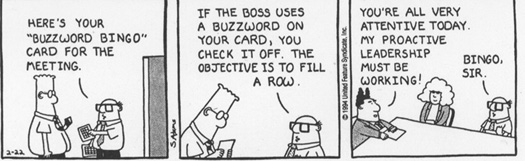
Let’s face it, meetings can suck. A poorly planned and executed meeting is a waste of time and money, and it can be demoralizing. Meetings shouldn’t be like this. Here are nine tips on how to plan and how to run an effective meeting.
1. Purpose
Every meeting should have a purpose. Meetings are often set up to happen on a reoccurring basis. The reality is that many times these meetings take place solely because they are in our calendars. If there is no reason to hold the weekly meeting this Wednesday, cancel it.
2. Focus
Have a clearly defined singular focus. Having a clearly defined singular focus keeps the meeting on track. If a meeting has more than one focus it is likely that one issue will be covered in far greater detail than the other, that the meeting will get off track, and/or none of the issues will be adequately addressed.
3. Prepare
Do your homework. Prior to every meeting make sure you have read anything you should have read and that you have completed any tasks that you should have completed. Additionally, know the lay of the land. For example, if the meeting is about the company budget and your employees are anxious over budget cuts – know this and be prepared to address your employees’ anxieties.
4. Invite
Invite those who should attend and do not invite people who should not be there. For example, if the focus of the meeting is sales, make sure you invite the sales team. Another example, if the focus of the meeting is the performance of your HR team, don’t invite your research and development team.
5. Leverage technology
Technology abounds and it should be utilized. Getting everyone in the same room is no longer necessary. Take advantage of technology such as Speek, Skype, and GoToMeeting.
6. Communicate
An effective meeting is not a place for you to download or transfer information. If you present information a manner that speaks to attendees you will motivate your employees and create buy-in. (The Heart of Change by Jon Kotter and Dan Cohen is a great resource on effective communication.)
7. Time management
Create an agenda and stick to it. Start the meeting on time and end the meeting on time. A meeting that is scheduled for 10:00-11:00 should not run from 10:15 to 11:15. Furthermore, if a meeting is scheduled for 1 hour, the meeting should last one hour or less (no need to try and fill the last 15 minutes if the agenda has been covered).
8. Facilitate
A meeting needs a leader. If it is your meeting – lead. Leading does not mean speaking at people for an hour; instead it means facilitating the agenda. For example, if an important but off-topic issue is raised during the meeting – don’t allow the meeting to go off on a tangent. Instead, acknowledge the importance of the issue and establish a time to address the particular issue. Handled correctly, your employees will not view this as blowing off their input, but rather they will value the fact that you will allot the necessary time to the issue.
Facilitating the meeting also means not allowing one person to monopolize the meeting. Give everyone the opportunity to provide input, and speak up if the agenda is being hijacked.
9. Action
At the end of the meeting review the action items. Make sure the right people are put in charge of each item, that they know what they need to do, and that they know when the task needs to be completed.
by Elizabeth Hines | Aug 28, 2013 | Blog
Last week I wrote a post for EBN about how to increase profits by looking at financial metrics on a granular level rather than in aggregate. Understanding your financial metrics at a granular level is important in that it allows for a true understanding of what is happening, and what is not. It enables you to drill down and appreciate, for example, similarities, differences, and outliers. Being informed at a granular level enables better decision-making when it comes to determining how to increase profits. The post was met with a couple questions. Specifically, how often does one need to look at these metrics and how does one evaluate and react to numbers?
The frequency with which to look metrics depends upon the area of business. For example, inventory flows and manufacturing output should be looked at on a daily basis. Your sales pipeline, on the other hand, should be looked at on a weekly basis, and your financials should be looked at monthly.
Once a schedule has been established, the question is what to do with the data – how should the data be evaluated and when is it time to act? The reality is that there is no hard and fast answer to this question. When to act is dependent upon the type of business, its typical cycle, and the company itself. It is therefore important to develop a database that captures your metrics. This database should be updated with the same frequency that the data is collected (see above for suggested frequency). A historical database will enable you to quickly identify a data point that is deviating, positive or negative, from the historical. When this happens, it is time to act.
by Elizabeth Hines | Aug 13, 2013 | Blog
Done right, an internship program can be a positive experience for the student and for your company.
An internship, done right, will serve to prepare the student for their first job. It will teach them about responsibility, accountability, and about the industry. Done right, an internship program should bring value to your company as well. Done right, the program will foster new talent, bring in new ideas, and serve as a channel for bringing well-prepared talent to you team.
Here’s how to do it right:
Sit down with the intern on the first day and establish a game plan. Ask the student what they hope to gain from the experience. Ask them what their career aspirations are. As the conversation continues and you lay out the tasks and responsibilities for which the intern will be responsible, point to how these tasks and responsibilities will serve to help them on their stated career path.
I mentioned, giving the intern tasks and responsibilities. These should be real tasks and responsibilities. The internship is an opportunity for the student to gain skills, and to learn how a company works, and how to navigate the workplace. Asking the intern to make coffee, copy papers, or pick up your dry cleaning will not benefit the student or the company (if you choose to hire them after the internship) in the long run.
To this end, it is important that you hold the intern accountable. They should show up on time, meet deadlines, and they should dress in an appropriate manner for your office. If this is not happening, a conversation is necessary. Overlooking these issues is at cross purposes with a valuable internship.
Also essential – providing the intern with the tools they need to succeed and acting as a mentor throughout the internship program. Answer questions. Set up regular check-ins. Introduce the intern to others in the office.
One more thing to consider when doing an internship right – the laws which govern internships.
In June a federal district judge in Manhattan ruled that Fox Searchlight Studios had broken New York and federal minimum wage laws by failing to pay two interns who had worked on the set of the film “Black Swan.” Given that there are more than one million unpaid internships in the US each year, this ruling has opened doors for additional lawsuits and has companies taking a close look at their internship programs to determine if they are in fact legal. For clarification, companies are turning to the Department of Labor. The Department of Labor lists six criteria which an internship must meet in order for the internship to be an unpaid internship. In a 2010 New York Times article, Nancy J. Leppink, then acting director of the Department of Labor’s Wage and Hour Division, is quoted: “If you’re a for-profit employer or you want to pursue an internship with a for-profit employer, there aren’t going to be many circumstances where you can have an internship and not be paid and still be in compliance with the law.”
Interestingly, Intern Bridge’s 2012 Internship Salary Survey found that 51.3% of students surveyed had internships that were unpaid and that the number of paid internships declined by 3.6% from the previous year.
Another interesting piece of information – a 2013 survey conducted by the National Association of Colleges and Employers (NACE) found that paid interns were more likely to get at least one job offer and obtain a higher starting salary than students who had had an unpaid internship or no internship. Specifically, 63.1% of paid interns reported that they had received at least one job offer compared with 37% of students who had participated in an unpaid internship and 35.2% of students who hadn’t participated in an internship. With respect to salary, students who had participated in a paid internship reported a median starting salary of $51,930 as compared to $35,721 for unpaid interns and $37,087 for students who did not participate in an internship.