by Elizabeth Hines | Apr 14, 2015 | Blog, Leadership, Marketing, Talent
As much as 80 percent of employee turnover is due to bad hiring decisions, which doesn’t fare well for a company since a poor hiring choice can cost from 1.5x to 3.5x of that person’s annual salary. Consider an employee who earns $50,000 a year. If that person is a bad hire it could cost a company up to $175,000. The higher the position, the higher the salary, the higher the cost is to lose or fire that person.
More than ever companies are hiring project-based professionals who provide a specific skill-set. These placements might be short-term or long-term, depending on the company’s needs. According to the Wall Street Journal, in March 2014, more than 2.8 million workers, or 2.5% of the workforce, held temporary jobs, up from 1.7 million in 2009. One reason for the spike in numbers is due to companies having to reassess their processes and spending after the recession. Some of these employees, many of whom hold multiple part-time jobs as temps or contractors, are the new semi-permanent, temporary, or “perma-temp” work force. They are in charge of their own brand, skill-set, and advancement.
Why do companies continue to lean in this direction, even while the economy is recovering?
Let’s have a look at the benefits for employers:
- Hiring a temp or contractor allows a company to meet work demand and deadlines without having to make rushed decisions about long-term, expensive, permanent staffing.
- By hiring a contractor or temp employee companies cut expensive benefit, administrative, and payroll costs, not to mention unemployment insurance.
- Bringing in temps or contractors can boost morale amongst other employees who may feel overtaxed. A temp or consultant can take some of the work overflow from other employees.
- Temporary and contracted employees are often eager to work hard to prove themselves and gain experience. Some may be coming off of a period of unemployment and anxious to get back to work. Temporary and contract workers may work creatively and tirelessly to meet their own financial obligations. They might not have the same loyalty as full-time, permanent employees, but since they have to fend for themselves, they are not complacent. According to University of Illinois professor Joe Broschak, “On average, these temporary workers displayed better performance relative to goals compared to their full-time counterparts.” When those temps were hired on as full-time employees “they continued to become better workers after becoming permanent.”
- Temp and contract workers can offer an area of specialization that a company might be lacking in current staffing. It might be less expensive to hire a new contracted employee with years of experience in a specific skill-set than to train a current employee.
Semi-permanent work is not ideal for everyone. Some employees, especially those seeking security, certainty, and the full gamut of benefits will not be satisfied with this work. One concern is how temporary or semi-permanent employees are paid and treated. If paid fairly and treated well, this paradigm will work smoothly for some people.
What are the benefits for employees?
- Many contracting and temporary positions allow for flexibility. The jobs might be part-time and allow for adjusted hours that could accommodate an employee’s home life, another part-time job, or other interests. Because these workers have a different status than permanent, full-time employees, the same “in-office face-time” expectations may not apply to a consultant or temporary worker.
- If a temporary worker or consultant is hired for a specific skill set, they are able to focus on work they’re good at and interested in. If they’ve been out of work they can use this as an opportunity to sharpen their skillset or, perhaps, learn a new one.
- Working on a short-term project might be freeing and invigorating. Having more of a sense of control over one’s own branding, hours, and projects is exciting for many people.
- This can be a wonderful opportunity for people to network, build their personal “press kit”, and garner new, current references.
- Temporary positions often turn into long-term, semi-permanent project based consulting positions. Some people find the combination of interesting work and flexibility perfect for their lives.
It is important to remember that every dollar paid to employees –temporary, semi-temporary, “perma-temp”, full-time, or part-time—is not a dollar taken away from the bottom line, but an investment in the company. Finding the right fit that benefits employers and employees is critical.

by Elizabeth Hines | Apr 7, 2015 | Blog, Leadership, Strategy
There are times when change is good. There are also times when change is bad for business.
The phrase “If it ain’t broke, don’t fix it” is often attributed to Thomas Bertram Lance, businessman and Director of the Office of Management and Budget under President Jimmy Carter. He was quoted in the May 1977 issue of the magazine Nation’s Business, though the sentiment feels as old as human existence. If something is working, and has always worked, then why change it? There are many adages along the same lines: leave well enough alone, never change a running system, don’t change a winning team.
True, humans are always evolving, but we also like consistency and stability. In his book Handbook of Contemporary Economics, Morris Altman wrote, “Without some stability over at least the short term, it is hard to conceive of humans engaging in sustained goal-oriented activity.” Change, adaptability, and flexibility, especially in business culture and lore, have turned from buzzwords to commandments. There are some things, though, that don’t require change. Assess whether change is necessary, rather than assuming it is because it’s socially and commercially popular. Ask:
- Are there assessment tools in place to monitor the business’s success?
- Are customers reporting satisfaction?
- Do your goods match customer needs?
- Do you understand the current market and your place amongst competitors?
- Are profits growing?
- Are overall finances sound?
- Are things running efficiently?
- Are current practices meeting regulations?
- Do you have the right people to meet your objectives?
- Are employees engaged, trained, and developing?
If the answer to these questions is yes, then why change? According to Harvard Business Review change could alienate your base, confuse people, damage your brand, and lose you money. Cadbury and its parent company, Kraft, are experiencing intense backlash due to a change in the Cadbury Creme Egg recipe. People are protesting, writing letters, posting negative comments online, and accusing the company of “ruining Easter.” We’ve seen this before. According to TIME’s article on the top 10 bad beverage ideas, “April 23, 1985, stands as one of the most significant dates in business history — the date the 99-year-old Coca-Cola company announced it was scrapping its original soda formula for a newer, sweeter version.” This change brought with it over 40,000 letters of protest, not to mention the bad press. Within three months the original soda formula, Coca-Cola “classic”, was back and met with an incredibly positive reception.
Some companies opt for a subtler approach to change by expanding its traditional offering. Instead of changing the successful product line for women, Dove expanded into the male market, creating Dove Men+Care, while still adhering to their public image and mission of creating personal care products that support natural health and realistic beauty.
The Harvard Business Review lists Brooks Brothers as a company that successfully found new opportunities without changing its values, “Instead of simply sticking to selling classic clothing, and waiting for outside catalysts (such as the popularity of the fashion in the television show Mad Men) to increase its popularity, the chain innovated around the edges by offering more fashionable accessories — shoes, belts, bags and the like — while leaving its core basically unchanged.” Capitalizing on this opportunity did not drive customers away because Brooks Brothers’ base products remained.
Remember that change has a cost. Are your consumers willing to pay the cost, especially if they didn’t require the change in the first place? Will your partners in the supply chain be willing to do business with you if the change you implement doesn’t suit them or benefit them? Think about some of the elements, for example, of a brand change:
- Content
- Communication
- Collateral
- Contacts
Things such as graphic design, business cards, letterhead, social media, advertising, re-launch, etc. all require real time and money. You must assess if your change will reap real, solid benefits. You don’t want to expend the effort, time, and money to change if you don’t have to, especially if it requires reversing the change or worse, killing your business.

by Elizabeth Hines | Mar 2, 2015 | Blog, Leadership, Strategy
Frank Underwood and his house of cards offers up valuable business lessons.
Netflix’s Emmy-winning drama House of Card’s is one of the most binge-watched shows. Two percent of U.S. Netflix subscribers watched the entire 649 minutes of the second season in just over 72 hours. Around 6 to 10 percent of US subscribers watched at least one episode of the season the weekend it was released.
At the heart of House of Cards is Frank Underwood (F.U.), a man you hate to love. Notwithstanding Frank’s blatant disregard for morals and ethics, Frank and his house of cards offers up business lessons.
1. Relationships matter
Frank focuses much of his time on forging and nurturing relationships. He understands that relationships matter.
Relationships between individuals and relationships between organizations are what drive success. Develop and nurture relationships.
2. A strong team is essential
Frank’s team is critical to his success. This is not happenstance. Frank has assembled a team comprised of individuals with the right skillset to achieve his goals. He understands that success cannot be achieved without these individuals.
Assembling the right team is critical whether it be at the project or organizational level. A strong team is essential for success.
3. Be proactive
Frank once said: “If you don’t like how the table is set, turn over the table.” Frank does not wait for things to happen, he makes things happen.
If you don’t like how it is going (or not going), do something about it.
4. Stay true to your word
In business as in life it is important to stay true to your word. In Frank’s words: “The nature of promises, Linda, is that they remain immune to changing circumstances.”
5. Knowledge is powerful
“I don’t want to assume, I want to know”
Knowledge is critical to Frank’s success. Frank doesn’t make assumptions, rather he takes the time to learn the facts and to learn how the information he has gathered can best be used.
Do the same. Take the time to learn about what matters to those around you, to your customers, and your industry. Use this knowledge constructively.
6. Emotions matter
Not all decisions are made based on logic. Although often ignored, emotion plays a significant role in business. Understanding and speaking to the emotions of a customer or potential business partner, for example, can be the key to success. Or as Frank puts it: “I should have thought of this before. Appeal to the heart, not the brain.”
7. Change often
Remy Danton, Frank’s former Chief of Staff, gives Frank a watch inscribed with a quote from Winston Churchill: “To improve is to change. To perfect is to change often.”
Change is critical. Without change it is not possible to meet the dynamic needs of customers and of your business. Without change growth opportunities will diminish.
8. Don’t let your weaknesses be your downfall
Don’t let your weaknesses be your downfall. Work at strengthening your weaknesses so that you are not an easy target. As Frank points out: “Even Achilles was only as strong as his heel.”
9. Don’t lose sight of the details
The details often get lost in the big picture. However, it is often the details that are critical to success. As Frank puts it: “Pay attention to the fine print. It’s far more important than the selling price.”
by Elizabeth Hines | Feb 19, 2015 | Blog, Strategy, Supply Chain, Warehousing & Materials Handling
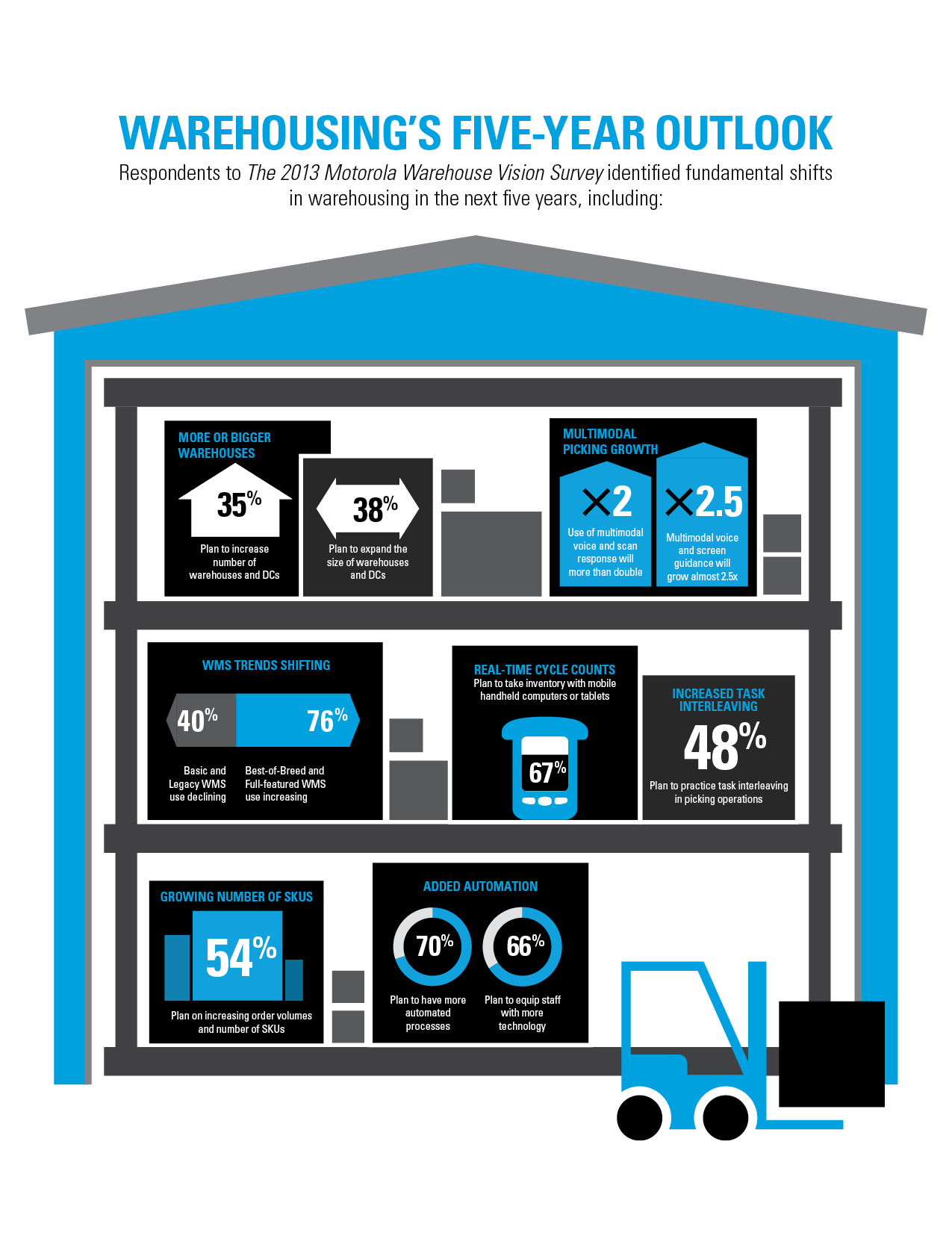
Source: Motorola
Growing in concert with consumer demand, distribution centers are getting bigger. In fact, a 2013 Motorola Warehouse Vision Survey reported that a full thirty-eight percent of respondents would be increasing the size of their warehouses and distribution centers over the next five years. And while there are certainly potential benefits, there are also plenty of potential problems. With good planning, though, organizations can successfully navigate around the pitfalls of distribution center growth.
Here’s how to achieve success when growing the size of your distribution center.
Streamline operations and processes
Increasing the square footage of your distribution center requires extensive strategy pre-planning. This means taking stock of your entire logistics and distribution process and strategically thinking about how these processes can be made more efficient. Areas where many companies can increase efficiencies include: decreasing reliance on paper, cross-docking, incorporating multi-modal wireless solutions, and revamping the pick strategy.
Optimize communication across departments
Communication is essential when growing your distribution center. Communicating across departments will enable your company to be able to effectively plan for both current capacity requirements as well as capacity requirements that are forecasted in the near-, mid-, and long-term. Building a larger distribution center only to outgrow it five years later is a costly mistake. Furthermore, communication across departments will allow for the right-sizing of both equipment and labor.
Be flexible
Allowing for flexibility is a key factor of successful growth. A large distribution center that can process a limited number of SKUs is, well, limited. A distribution center that is designed to be able to process a wide variety of goods and SKUs can reduce operating costs and enable your company to be more nimble. When designing your distribution center, keep flexibility at the forefront.
Invest and utilize technology
A larger distribution center requires more automation and more technology than a smaller distribution center. Similarly, a larger distribution benefits from mobile solutions. As more specific and sophisticated technology emerges, implementing smart technologies can aid in your efforts to achieve optimization of communications and streamline your operations more efficiently.
When the square footage of your distribution center grows, it is important to remember that you are dealing with a different beast. It’s one that requires extra careful thought. Taking the time to consider potential problems and preparing a solid plan of implementation before you begin will increase your odds of successful growth.
![Supply Chain: 4 Essential Year End Questions to Ask Yourself [Infographic]](https://fronetics.com/wp-content/uploads/2024/10/SupplychainSMARTgoals-1080x675.jpg)
by Elizabeth Hines | Jan 14, 2015 | Blog, Leadership, Strategy, Supply Chain

Don’t start the year without asking these 4 essential questions.
Well, another year has come and gone. Out with the old, in with the new, right? Wait, not so fast. Don’t overlook the valuable information you can glean from conducting a year end review. Use these four questions as a guide to thoughtfully assess the past year. Then, read on to see how a few simple tasks can help shape your best year ever.
1. What were my biggest accomplishments this year?
Twelve months can seem like a long time when you consider everything that happened over the course of the last 365 days. Setting aside some time to review successful projects, notes of thanks from clients, or a particularly positive performance review reminds us what we’re capable of achieving and gives us a renewed sense of accomplishment.
Try this: This year, designate a file folder near your workspace to collect any materials or notes related to your successes as they occur. Doing so will make it easier for you to recall your accomplishments and provide quick access to a list of your achievements – helpful for a healthy dose of motivation or last-minute performance reviews.
2. How satisfied are you with the past year?
Were you successful in meeting the majority of your goals? Do you feel that you worked to your highest potential? Would you have done something differently? What about missed opportunities? Examining what went right and identifying areas for growth and opportunity are powerful exercises that both prevent the recurrence of negative behaviors and reinforce our commitment to our priorities.
Try this: Adding some context to your experiences presents a more accurate picture of your year by tempering unusual highs and lows. Thinking about your experiences of the past year in sum, try to assign a value to your entire year. How would you rate your year on a scale from 1 to 10? 1 to 100? Why?
3. Is my current daily routine structured to optimize time for my priorities?
It’s easy to fall victim to time suckers, especially when they become ingrained into your routine. Has your daily 15 minute coffee break gradually morphed into 25 minutes? Are your 10 minute “headline scans” now closer to 30 minutes? These small, seemingly innocent extensions can snowball into major time loss, causing unnecessary panic as you scramble to meet deadlines.
Try this: The start of a new year is a great time to reset (or rethink) our daily routines. Build activities into your day. If you’d like to continue your now-daily 25 minute coffee break, think about extending your work day by 25 minutes. Feeling like you can’t absorb everything news-worthy in less than 30 minutes? Set your morning alarm 30 minutes earlier so you can arrive to work having already completed your scan of daily headlines. By taking a hard look at where your time is actually going and then spending a few minutes realigning your daily routine with your priorities, you’re intentionally and consciously assigning time to the things you find the most important.
4. What is it that I want to achieve next year?
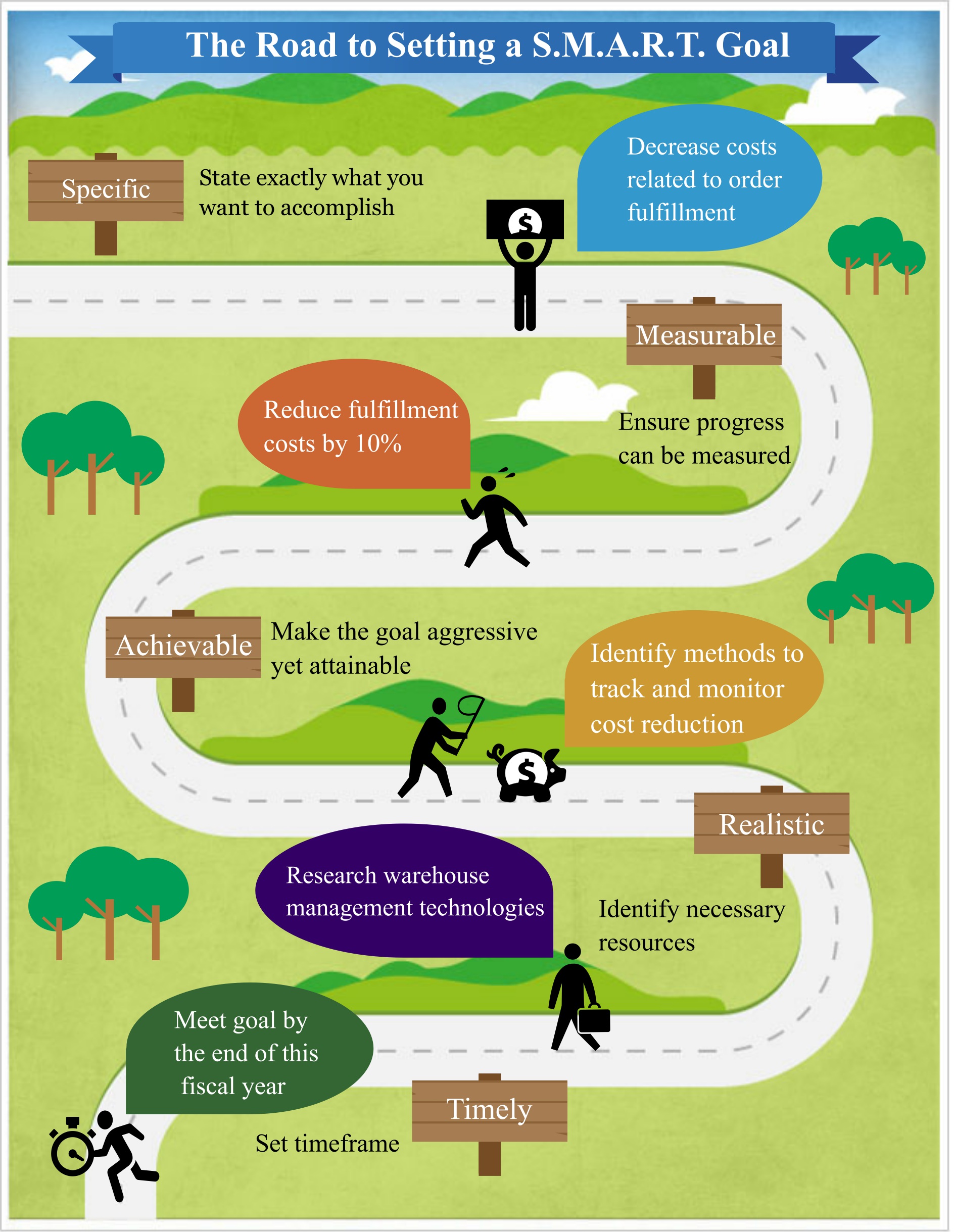
Each new year brings with it a renewed energy to being our best selves. In order to get started, we need to define our priorities and what our success will look like. Setting SMART goals, or goals that are specific, measurable, achievable, realistic, and timely, keeps us moving forward by providing detail and assigning accountability.
Try this: After reviewing your past year, set aside some time to consider what you’ll set out to achieve this year. Create a detailed roadmap to successful completion of your goals.
Use this infographic to help you set, and achieve your SMART goals.
How was your year in review? What were your biggest accomplishments? Are there any goals that you’ll carry over into the new year? Do you regularly set aside time at the close of a year to reflect? We’d love to hear what you do to reset for a new year.