by Jennifer Hart Yim | Aug 7, 2014 | Blog, Marketing, Social Media, Supply Chain, Transportation & Trucking
This guest post is written by Keychain Logistics. Keychain Logistics is a leading transportation provider enabling businesses to directly engage carriers, track shipments, and monitor its logistics needs online.
It’s 2012. Platforms like Uber, Airbnb, and Homejoy are growing rapidly. New customers are signing up via search, paid referrals, and social media. Marketing teams at each are delicately balancing the supply and demand of their output with a spread of calculations that, if not projected carefully, may lead to service outages and upset customers.
Now what’s going on here, and what does this have to do with logistics?
The companies above, alongside many others eating the world today with software, are all marketplaces.
Speaking in online terms, a marketplace is where buyers and sellers of a particular product or service can collaborate in a streamlined process to achieve what they want from the other side.
In exchange for facilitating relationships, thus saving time and resources for the entities wanting to connect, marketplaces may charge subscription fees, transaction commissions, or depend simply on high traffic volume to sell other assets like media space or proprietary content.
But facilitating relationships is only a necessary component, and not a sufficient one, to the success of a marketplace. This is because some buyers and sellers feel that the benefit of a marketplace has been fully realized upon their connection, and thus don’t stick around for the platform to send a bill.
What marketplaces must do to maintain engaged users, then, is create experiences inside the application that remove the incentive to circumvent it. And this is a tough challenge to solve.
One great example of this is Odesk.com, a marketplace connecting freelancers with employers who have projects to outsource. In exchange for this service, Odesk charges a 10% fee to employers per transaction. While this may sound steep, Odesk meets this ask with a suite of free management tools such as random monitor screenshots that let employers track the productivity of an outsourced team member without worrying about being overbilled on hours.
For freelancers, Odesk requires employers to place valid credit cards on file pre-hire, protecting them from employers who might otherwise attempt to avoid a payment. Tools like this make the Odesk platform (and its fees) worth every penny, thus creating a winning marketplace that helps both sides get what they deserve.
That said, let’s get back to logistics and how Keychain Logistics fits into this marketplace, value-adding, supply and demand spectrum.
The transportation industry is one of the largest, oldest conglomerates on the planet, with millions of drivers and thousands of shippers and brokerages in the US alone. The industry is also a fragmented one, with the biggest brokerage only commanding ~3% market share.
If anything is clear about business, it is that markets become more efficient through consolidation. From Coca-Cola buying a new beverage brand to a toy manufacturer owning its own factories, market consolidation is a common practice and, if done right, typically results in positive benefits for end-customers such as lower prices, higher quality, and so forth.
But for a myriad of reasons we won’t go into today, this kind of consolidation has yet to happen in the transportation industry.
Introducing Keychain.
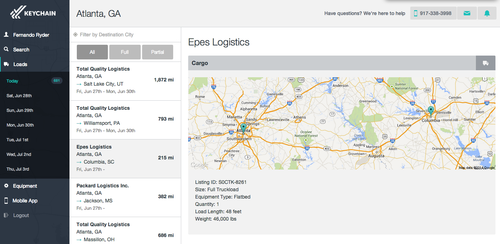
Keychain is a marketplace connecting drivers directly with shippers, and the benefits are three-fold:
1. Shippers (effectively, employers) can bypass expensive commissions by man-powered brokerages,
2. drivers can book loads while on the go, and
3. Keychain verifies user insurance policies and other legal compliance measures, prior to allowing entry to the platform.
To achieve the win-win harmony of a successful marketplace, not only does Keychain facilitate the relationships but it also addresses the circumvention component with tools for drivers and shippers such as mobile apps, online dashboards, easy payment gateways, and in-app communications between parties.
Keychain is the technological consolidation of a market that just won’t give up its antiquated methods. Together, we can bring much needed efficiency to the efficiency business: logistics.

by Elizabeth Hines | Aug 6, 2014 | Blog, Logistics, Marketing, Social Media, Strategy, Supply Chain, Transportation & Trucking

Keychain Logistics has made two bold promises. The company has promised truckers that they will never drive empty again and has promised shippers that Keychain will improve their bottom line.
Can the company deliver on these promises?
Who is Keychain Logistics?
Keychain is a leading transportation provider enabling businesses to directly engage carriers, track shipments, and monitor its logistics needs online.
According to Bryan Beshore, the company’s founder, Keychain grew out of the idea that a technology driven marketplace could operate with significantly lower overhead than a manual, human powered brokerage:
“My initial contact with the industry was in 2000. I have researched, analyzed, and thought about the industry ever since. Keychain is a product in understanding the fundamental efficiency problems the third party logistics industry has faced for a long time.”
Beshore goes on to point out that while building a technology company is tough, building Keychain was easier than anticipated:
“With Keychain it was a natural process and easier than I had imagined. I believe the reason for this is twofold: the challenges this industry faces are huge, and the solutions we are building to meet those problems are really fun to solve. Because our work directly affects the wallets of our users (increased pay for drivers, better rates for shippers), we are effectively helping people create better lifestyles for themselves and their families, and that’s really rewarding.”
The company was slated to be built in 2007; however, the timing was not right given the low proliferation of internet-connected mobile devices (500 million). Beshore waited. In 2012 he decided to move forward with the launch of the company (the number of internet connected devices reached 8.7 billion in 2012).
How does it work?
One can draw a parallel between Keychain and Uber – the company removes the broker and connects truckers directly with shippers therefore enabling truckers to focus on driving and shippers to focus on selling products.
Keychain is a marketplace for truckers to book commercial shipments directly with shippers. The company’s technology matches owner operator drivers (and small fleets) with shippers who rely on Keychain Logistics to find the ideal carrier for their freight.
The core of the company’s platform is their network of ten-of-thousands of carriers throughout the US who are connected 24/7/365 via Keychain’s iOS, Android, and Windows phone apps. Keychain can instantly communicate load opportunities to independent owner-operators, 97 percent of whom operate in fleets of 20 trucks or less, and small carrier fleets.
Too good to be true?
One of the biggest challenges the company has faced is that it is perceived as being “too good to be true.” Beshore:
“The transportation industry is traditional and technologically far behind. Because of this, the inherent challenge to sharing our offering is overcoming the “too good to be true” bias. While many of our potential customers have wanted a product like ours for a while, they either don’t know how to articulate it in a Google search or are skeptical that tech companies like Keychain are committed to solving their problems.”
Solving immediate need
Keychain has been working to overcome the perception of being too good to be true. It has been talking to current users, and has honed in on developing a solid marketing message. The message – we can solve your immediate need.
Not expressing the full-vision up front has been a challenge when Keychain reaches out to companies with whom they have little or no relationship; however, they have found that solving an immediate need is what gets companies excited.
What immediate need(s) can the company address? According to Beshore: “For shippers, this is getting them access to trucks, sometimes within just minutes of our first contact. For drivers, this means getting them a paying load when they’re stuck at a rest stop, are far from home, or simply need a line-haul out.”
Leveraging social media to grow the company
The company has found that one of the best ways to use social media is for listening. Rather than spend time and money putting together and distributing sales literature, the company searches for relevant industry hashtags (i.e.: #trucking) to see what people are talking about, and more importantly what they care about. By using social media this way, Keychain is an audience to users instead of the other way around. This has enabled the company to shape their offering with a solid understanding of what people want from a transportation provider.
“From phone calls to interviews, crowdfunded campaign partnerships, and beyond, social media has certainly helped us grow our business,” says Beshore.
Can they deliver?
Can Keychain deliver on their bold promises? Their customers believe so. Here is what three customers say about the company:
“With Keychain I no longer have to waste hours on logistics. Their platform makes it easy to quickly enter shipment details and receive the most competitive rates available.” Marc DeVidts, Double Robotics
“Keychain gives us instant access to thousands of reliable carriers nationwide. It’s the most efficient and cost effective tool we’ve found.” Nathan Brown, Reclaimed American Hardwood
“Within minutes I can enter my shipment details and Keychain handles the rest. Annoying phone calls and exorbitant broker fees are over.” Ad Sachan, Treeline Woodworks.
by Elizabeth Hines | Jun 24, 2014 | Blog, Logistics, Marketing, Social Media, Strategy
Many companies within the logistics and supply chain industries are stuck on the social media starting line. The reason – “they can’t get past the word ‘social’ and the perception it creates.” The reality is that social media is a tool that can be utilized to create value and grow your business.
This is the fifth in a series of articles that provides examples of companies within the logistics and supply chain industries who have moved beyond the social media starting line and have realized the business value of participating in social media.
Logistics industry start-ups leverage social media
Social media allows for instant connections and communication. Two start-ups, Trucker Path and Keychain Logistics, have created solutions for the logistics industry which leverage these characteristics of social media.
Trucker Path
Launched in February 2013, Trucker Path is a mobile platform for the trucking industry which connects shippers and carriers, and provides crowdsourced logistical assistance.
Specifically, the Trucker Path app (available via iOS, Andriod, and Web) enables carriers to find truckloads, shippers to move their cargo, and for truckers to get crowdsourced logistical information such as the locations of truck stops, rest areas, and information on weigh stations.
Keychain Logistics
Keychain Logistics uses technology to automate the marketplace and match shippers with carriers.
The Keychain Logistics app (available via iOS, Andriod, and Web) provides instant communication between shippers and carriers – eliminating the need for human powered brokerage.
Both Trucker Path and Keychain Logistics have recognized that there is more to social media than socializing – they have recognized that social media is a business tool.
by Elizabeth Hines | Jun 23, 2014 | Blog, Logistics, Marketing, Social Media, Strategy, Supply Chain
Many companies within the logistics and supply chain industries are stuck on the social media starting line. The reason – “they can’t get past the word ‘social’ and the perception it creates.” The reality is that social media is a tool that can be utilized to create value and grow your business.
This is the fourth in a series of articles that provides examples of companies within the logistics and supply chain industries who have moved beyond the social media starting line and have realized the business value of participating in social media.
Cerasis is a top freight logistics company and truckload freight broker. During the company’s first 15 years it focused on traditional sales and marketing strategies and relied heavily on referrals. This strategy worked. Cerasis acquired new customers, retained current customers, and realized positive growth. However, Cerasis was not viewed as an industry leader, and brand awareness was low.
In 2012 Cerasis decided to participate in social media and launch a content marketing strategy.
Cerasis began actively blogging, and began using Twitter, LinkedIn, Facebook, Pinterest, and Google+. The company quickly became seen as a leader within the industry, and brand awareness increased dramatically.
Within 15 months the company received 71 leads from search engines, 65 leads from social media, and 52 leads from webinars. Even more impressive, within 15 months the company gained 35 customers (one customer within the freight logistics industry can mean a lot of revenue).
The results show that Cerasis is no longer on the social media starting line – rather, Cerasis is now a leader, not only in the freight logistics industry, but also in using social media as a business tool.

by Elizabeth Hines | Jun 9, 2014 | Blog, Marketing, Social Media, Strategy, Supply Chain, Transportation & Trucking
Many companies within the logistics and supply chain industries are stuck on the social media starting line. The reason – “they can’t get past the word ‘social’ and the perception it creates.” The reality is that social media is a tool that can be utilized to create value and grow your business.
This is the second in a series of articles that provides examples of companies within the logistics and supply chain industries who have moved beyond the social media starting line and have realized the business value of participating in social media.
Long-haul truck drivers are more likely to be overweight or obese than the general public (86% v. 65%). Additionally, truck drivers are more likely to smoke, have high blood pressure, and suffer from sleep apnea than the general public. The poor health of long-haul truckers is largely due to their lifestyle. Long-haul trucking is a sedentary lifestyle. It is also a lifestyle which makes it challenging to access gyms and healthy foods.
The cost of poor health is enormous – for truckers and for their employers. The estimated annual health care costs of obesity-related illness are $190.2 billion, or nearly 21 percent of annual medical spending in the United States. Looking specifically at the trucking industry – a study published in the Journal of Occupational and Environmental Medicine found that obese truckers had an annual average total health care cost of $1,944, compared with $1,755 for overweight truckers and $1,131 for normal-weight drivers. A sleep apnea screening and treatment program conducted by Schneider National identified 350 drivers who required treatment. Treating these drivers not only improved their health, but it also improved the company’s bottom line – over a one year period, Schneider National saved $530 per month per driver in insurance costs and saw a 71 percent reduction in accidents involving those drivers during the same period.
An article in Today’s Trucking shares the story of Jason Janneta a 42 year old trucker who had been driving for 20 years and was a poster boy for the statistics – overweight and unhealthy. Fed up, he decided to make a lifestyle change. Within six months of embracing a healthier lifestyle he had lost 80 pounds. During this period he had also taken to Twitter to share his experience and to motivate other truckers to adopt a healthier lifestyle, lose weight, and improve their health.
Tweeting as @urbanhauler with #fittrucker, Jannetta captured the attention of other truckers (he quickly grew his followers to more than 1,500) and the attention of Jared Martin, the President of Speedy Transport.
Martin recognized the value of Jannetta’s efforts and of #fittrucker – healthier individuals, a healthier bottom line, and opportunity to attract new drivers.
According to Martin:
“I really enjoyed a lot of his posts and what he was trying to do for the industry, so we brought him in for a meeting.”
The two discussed the role of health and fitness on the future of the transportation industry. The next day, Martin offered Jannetta a job at Speedy Transport – Driver Trainer and Wellness Advisor. Martin accepted the position and now tweets for @speedywellness where he brings “#trucking and #fitness/#wellness together.”
Speedy Transport is one company which has recognized social media as a business tool and has moved far beyond the social media starting line. The Twitter profile of @speedywellness rightly points out “we #ChangeTheGame of #Trucking.”