by Fronetics | Oct 10, 2019 | Blog, Content Marketing, Logistics, Marketing, Robotics & Automation, Supply Chain
Supply chain companies are beginning to use robotics to boost warehouse efficiency and drive profits thanks to new automated technologies.
Highlights:
- High-res cameras, pressure sensors, navigation lasers, and acoustic warning indicators allow automated devices to navigate warehouses efficiently and autonomously.
- Robotics offers enhanced efficiency for both warehouse capability and predictive supply chain management.
- After major investments in automated fulfillment centers, Amazon has seen a 50% increase in capacity when compared to facilities that don’t use robotics.
A recent Information Services Group (ISG) study suggests that something big is happening: 72% of information services (IS) enterprises plan to increase their investment in robotics by the end of the 2019. Why? Because automation and IS are a natural fit.
Leading companies worldwide are beginning to use robotics to boost their warehouse efficiency and forecasting capabilities. And an improving price-to-performance ratio associated with robotics technology means that usage is sure to continue expanding.
The advantages of automation
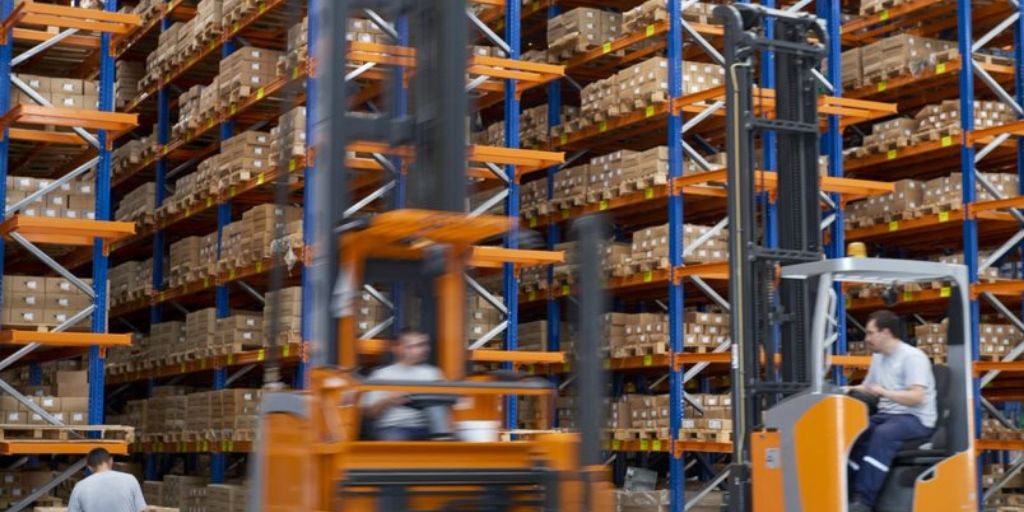
New automated technologies are a game-changer. Until recently, available robotic devices were stationary and couldn’t interact visually with their surroundings or respond to unexpected inputs. Today, robots are mobile and collaborative. High-res cameras, pressure sensors, navigation lasers, and acoustic warning indicators allow automated devices to navigate warehouses efficiently and autonomously.
Recent technology upgrades include software that causes a robot to cease activity temporarily if it encounters an unexpected object or input, meaning that these devices can safely work alongside humans. Whereas earlier robots were used mainly to transfer objects from one place to another, more recent technology can enhance tasks ranging from managing inventory to retrieving, assembling, and packing orders.
Industry leaders have invested in automated warehouse management systems (WMS) with undeniable results. After major investments in automated fulfillment centers, Amazon has seen a 50% increase in capacity when compared to facilities that don’t use robotics. Amazon has even acquired the company that creates its robots, indicating Amazon’s confidence that the continued production and development of automated technology will play a big part in their future.
JD.com, China’s largest online retailer, has gone even further. Boasting the world’s first fully automated e-commerce warehouse, JD has equipped the 43,000-square-foot facility with 20 industrial robots that allow the company to provide same- and next-day delivery to more than 1 billion customers. Whereas a standard warehouse of that size would require nearly 500 workers, JD employs just 5.
Streamlining operational staff offers a big pay-off. On average, a warehouse employee wastes almost 7 weeks per year in unnecessary motion, which adds up overall to $4.3 billion in labor expenses. For employees, simply walking around in the warehouse accounts for 50% of the time involved in retrieving orders and checking inventories. Coupled with the potential for human error, the superior efficiency of robots makes it a question of “when?” rather than “if?” automation will become the new norm in parcel-sorting hubs and distribution centers.
Automated guided vehicles
The robotics revolution is already underway. One of the most widespread and effective uses of robots in warehouses is the automated guided vehicle (AGV). These self-driving vehicles are rendering expensive and single-use equipment like conveyor belts and large loading vehicles obsolete. Battery-monitoring systems send AGVs back to their charging ports when necessary, maximizing the efficiency of their operation. AGVs can be directed by voice or programmed to retrieve orders, guided by physical markers, magnets, and vision systems. In addition to navigating a warehouse floor more quickly and efficiently than human employees, AGVs are also capable of lifting and transporting much heavier weights, allowing for a larger number of orders to be retrieved in the same amount of time.
The advantages of AGVs run deeper than warehouse efficiency, however, and extend to logistics operations as well. AGVs track and update inventory records in real time as they retrieve orders. Ordinarily, the immense amount of data involved in running supply chains creates inefficiency and requires additional personnel to monitor inventory levels and place orders. The AGV integrates these tasks into a streamlined operation, as it can retrieve items as soon as order data is received and updates inventory levels instantaneously, even placing automatic purchases. This allows for improved forecasting and faster inventory refill.
Effi-BOT & Sawyer
That’s all very well in theory. But how does it work in practice?
DHL has led the pack in using robots to assist employees with repetitive and physically demanding tasks. Effi-BOT, an AGV that follows employees through DHL warehouses, takes over the physical work involved in picking orders. The use of Effi-BOT has allowed DHL to move from single-order picking to a multi-order model, and helps track complex inventory dynamics.
Another robot, Sawyer, has illustrated how automation can be used in flexible ways to accommodate ever-changing purchasing and order patterns involved in e-commerce. Sawyer’s collaborative capabilities allow it to handle repetitive aspects of the co-packing process. By adding Sawyer to its existing workforce, DHL has been able to use the robot to flexibly adjust to unpredictable order data.
Managing robotics
Typically, the inventory and performance data generated by devices such as Sawyer and Effi-BOT is aggregated in a dashboard that supply chain managers can use to check inventory levels and review automated requests sent from robotic devices to purchasing departments. By integrating data recorded in real time by automated devices, dashboards make larger and larger segments of the supply chain visible, allowing managers to pinpoint the source of problems, such as a delayed order from a supplier’s factory.
Robotics thus offers enhanced efficiency for both warehouse capability and predictive supply chain management. While the regulatory policies surrounding the use of robotics in the workplace are as yet uncertain, there can be no doubt that automation is already re-shaping the supply chain. Successful companies of the future will be the ones that find ways of taking advantage of new robotics technology today.
This post originally appeared on EBN Online.
Related posts:


by Fronetics | Sep 26, 2019 | Blog, Current Events, Marketing, Social Media
Having the right social media image sizes for each platform is a key part of creating visually appealing posts.
Highlights:
- Each social media platform has its own set of image guidelines.
- Choosing the right social media image sizes ensures that your content is as visually appealing as possible.
- We like Canva Pro for quick resizing of images and graphics.
Social media is all about the visual. Whether it’s Instagram, Facebook, Twitter, or LinkedIn, having the right image can make or break the effectiveness of a post. Social media image size might seem like a relatively unimportant facet of choosing an effective image for a post. But you might be surprised to discover how important it can be.
An incorrect social media image size can make your post less visually appealing than it could be, and it can even erode how the number of impressions a post receives. Because each platform has its guidelines for sizes — and because each image type (profile picture, cover photo, etc.) has different size restrictions — determining correct social media image size is no easy task.
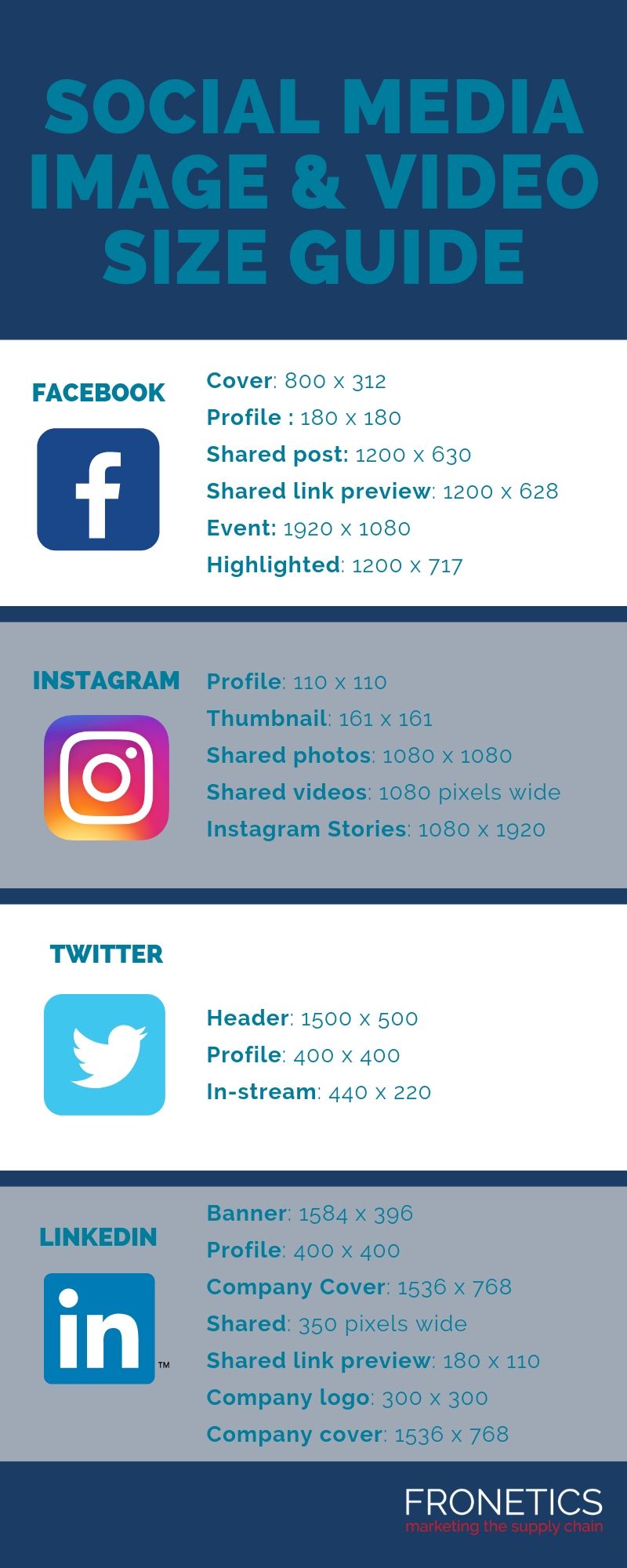
The infographic below gives you a complete guide to the various image size requirements on Facebook, Instagram, Twitter, and LinkedIn. Once you know the correct social media image sizes, you can set your photo editing software to the correct dimensions.
Social media image sizes: by the network
(Made with Canva)
Facebook
Facebook is perhaps the crown jewel of social media platforms, boasting 1.5 billion daily active users. While the platform is text-friendly, images are key to creating engaging content on the platform. An important thing to remember when it comes to images on Facebook is that they will display differently on your page’s timeline as compared to a user’s newsfeed. This means that your choice of image dimensions should be based on where you want your viewers to see your image.
Image dimensions:
- Cover image: 800 x 312
- Profile image: 180 x 180 (though it will display as 170 x 170 on desktop, and 32 x 32 as a thumbnail)
- Shared post image: 1200 x 630
- Shared link preview image: 1200 x 628
- Event image: 1920 x 1080
- Highlighted image: 1200 x 717
Instagram
Instagram is all about the visual – which means that it’s crucial that your brand’s presence on the platform is driven by high-quality images. As a rule, the platform scales down photos to 612 x 612, but it’s still recommended that shared images be set to 1080 x 1080 to optimize quality.
Image dimensions:
- Profile image: 110 x 110
- Image thumbnail: 161 x 161
- Shared photos: 1080 x 1080
- Shared videos: 1080 pixels wide
- Instagram Stories: 1080 x 1920 (minimum 600 x 1067); maximum 4 GB
Twitter
Twitter has 313 billion monthly active users and has recently updated its image guidelines.
Image dimensions:
- Header image: 1500 x 500; maximum 5 MB
- Profile image: 400 x 400; maximum 2 MB
- In-stream image: 440 x 220
LinkedIn
While the network may not be thought of as a highly visual platform, images on LinkedIn make a big difference in terms of post engagement. With 467 million registered users, it’s the world’s largest professional network. Having polished, well-sized images on the platform can go a long way toward maximizing its potential for professional networking and industry visibility.
Image dimensions:
- Banner image: 1584 x 396; maximum 4 MB
- Profile image: 400 x 400 (minimum 200 x 200); maximum 10 MB
- Company Cover image: 1536 x 768
- Shared image: 350 pixels wide
- Shared link preview: 180 x 110
- Company logo image: 300 x 300; maximum 4 MB
- Company cover image: 1536 x 768 (minimum 1192 x 220); maximum 4 MB
- Company page banner image: 646 x 220; maximum 2 MB
- Square logo (appears in company searches): 60 x 60; maximum 2 MB
An insider trick for quick and easy resizing
As you can see, there is quite a bit of variability in social media image sizes. You could spend hours resizing graphics or images for the same post across multiple platforms… Or, you could do what we do, and try a design platform like Canva. Not only does it already have all the proper dimensions available as templates, Canva Pro lets you change the size of graphics you created in a single click. It definitely makes life a lot easier.
Related posts:

by Fronetics | Jul 11, 2019 | Blog, Content Marketing, Current Events, Logistics, Marketing, Social Media, Supply Chain
Here are our most-viewed supply chain and logistics blog posts from this year as of July 1, 2019.
Throughout the year, we regularly write blog posts to help our readers stay on top of the latest news and trends happening in the supply chain and logistics industries, particularly in regards to digital marketing. We hope these posts provide insight, tips, and insider information on how to stay ahead of your competitors with the consistent publication of quality content.
We’ve covered some great stuff this year, from new trends in automation to the best places to distribute your videos. Here’s a look at our most popular posts so far this year.
Top supply chain and logistics blog posts from 2019 (so far)
1. Top 3 Logistics and Supply Chain Blogs of 2019
You voted, and the results are in! Cerasis is your number one blog of the year, with Women in Trucking and Hollingsworth coming in second and third. Read more
2. Digital Marketing for the Supply Chain and Logistics Industries
Today’s B2B buyers are researching, evaluating, and coming to conclusions about companies without a single contact with a team member or salesperson. This kind of B2B buying landscape requires cutting-edge marketing strategies to showcase nut-and-bolt industries that have survived without them for many years. Read more
3. Send in the Drones: How PINC & Amazon Have Optimized Inventory Management
It’s been five years since Charlie Rose interviewed Amazon CEO Jeff Bezos on 60 Minutes about new innovations that Amazon was working on. Bezos revealed that Amazon was on the brink of a supply chain revolution involving octocoptor drones transporting parcels: Amazon Prime Air. Read more
4. 4 Examples of AI for the Supply Chain
Artificial intelligence is not simply affecting supply chain management; it is revolutionizing it. With the power to drastically increase efficiency in all areas of the supply chain, McKinsey estimates that firms could gain $1.3 trillion to $2 trillion a year from using AI in supply chain and manufacturing. Read more
5. Infographic: 10 Companies that Are Getting Instagram for B2B Marketing Right
Instagram now boasts over 1 billion monthly active users, making it one of the most popular social media platforms out there. It’s a tremendous opportunity for businesses. In fact, recent research has shown that 66% of brands now use Instagram. But many B2B marketers are still struggling to find their footing on this highly visual platform. Read more
6. B2B Digital Marketing Trends, Budgets, and Benchmarks: Highlights for 2019
The Content Marketing Institute has published its ninth annual survey, giving insight into the most significant digital marketing trends and priorities for 2019. We’ll get into some key takeaways in detail, but perhaps the most striking finding was one that we’ve been talking about for years. Read more
7. Video: 4 Best Channels for Video Distribution
Knowing the right video distribution channels can go a long way toward driving traffic and getting your content to your target audience. Bottom line is using the right distribution channels helps you get the most out of your video marketing efforts. Here are the 4 best channels for distributing your videos. Read more
8. Video: 6 Digital Marketing Trends for the Supply Chain 2019
Digital marketing has become essential for creating brand awareness, educating audiences and building trust and credibility with your customers. Supply chain and logistics companies increasingly see the value in digital marketing. They’re increasing their budgets, and it’s important to understand what the trends are for the upcoming year. Read more
9. How Rogue Ales is Leveraging IoT to Revolutionize the Beer Brewing Industry
Rogue Ales believes that its “Ground to Glass, Grow your Own Revolution” is a key tenet to its success. The company leverages the Internet of Things (IoT) to ensure that the supply chain is able to deliver the highest-quality ingredients to its breweries just in time. Read more
10. 6 Content Marketing Trends for the Supply Chain in 2019
Content marketing is no longer optional. It’s essential in creating brand awareness, educating audiences, and building credibility. Here’s a look at the biggest digital marketing trends for 2019. Read more
Related posts:

by Fronetics | Jul 10, 2019 | Blog, Content Marketing, Current Events, Marketing, Social Media
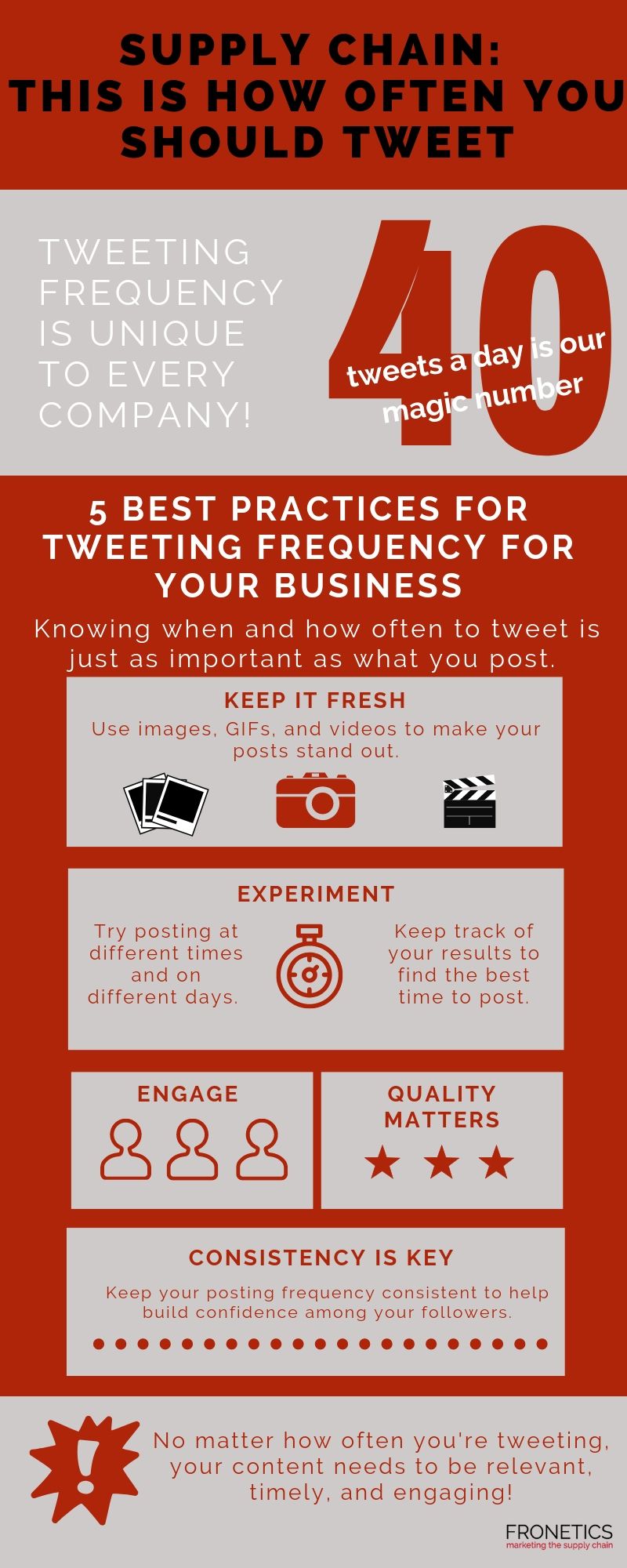
Knowing when and how often to tweet is just as important what you post. Here’s how often your business should be tweeting.
Highlights:
- Be consistent with your tweeting frequency, while keeping content fresh.
- To determine how often to tweet for your business, experiment with different posting frequencies, and use analytics tools to track your results.
- As with any digital marketing endeavor, quality is more important than quantity.
It’s a perennial question we get from our clients: how often should business be posting on social media? The answer varies widely from platform to platform, and the answer for how often to tweet has proved a controversial one.
Back in 2016, in response to a Socialbakers study that suggested that posting to Twitter three times a day is an ideal frequency for brands, Fronetics conducted a study of our own. We determined that for our business, tweeting around 40 times a day is optimal.
What these radically divergent results demonstrate is that the answer to how often to tweet is not a simple one. While the bottom line is that optimal tweeting frequency is unique to every brand, there are 5 best practices your business should be aware of.
5 best practices concerning how often to tweet for your business
(Made with Canva)
1) Consistency is key
Whether you’re tweeting once a day, or a hundred, being consistent about posting frequency will serve you best. Keeping your posting frequency relatively consistent lets your followers gain confidence that you will set and expectation and meet it. As social media algorithms become less friendly to businesses, it’s all the more important that you bring your followers to you.
2) Keep it fresh
It’s important to point out that consistency is key only when it comes to how often to tweet – not the content you’re publishing. Particularly on Twitter, varying your content is the best way to keep your audience engaged. Use images, GIFs, and videos to make your posts stand out, or ask questions to promote conversation and engage your followers.
3) Experiment
When it comes to how often to tweet for your business, you’ll find all kinds of divergent ready-made answers. But the truth is, there’s no magic number. Your business or your marketing partner needs to determine what works for your unique brand and audience. The best way to do this is to experiment with posting at different times and keep track of your results. In addition to Twitter’s internal analytics, these five tools can help you track and evaluate the results of your experiment.
4) Engage
As with any social media platform, publishing content shouldn’t be your only focus. Engaging with your followers, from comments to retweets, is crucial for generating an active and loyal audience.
In addition, using social media to interact with your audience can help inform your decisions about how often to tweet. When are your followers most active? What kind of content do they want to see from you? Having a conversation with your followers is one of the best ways you can answer this question.
5) Quality matters
There’s no amount of posting frequency that makes up for posting poor quality content. If your content is bad, you’d likely be better off not posting at all. Publishing content that doesn’t interest your audience will lose you followers and leads. No matter how often you’re tweeting, your content needs to be relevant, timely, and engaging.
Related posts:

by Fronetics | Jun 11, 2019 | Blog, Content Marketing, Logistics, Marketing, Social Media, Supply Chain
An effective social media strategy requires data. Here are our 10 favorite social media analytics tools to empower you with insights that will boost your social media game.
Highlights:
- Hootsuite and Sprout Social are all-around social media management tools that offer analytics.
- Google Analytics is an overall powerhouse tool to track the performance of all your digital assets.
- Newcomers to the list include Awario, Squarelovin, Keyhole, and image analytics tool PixL.
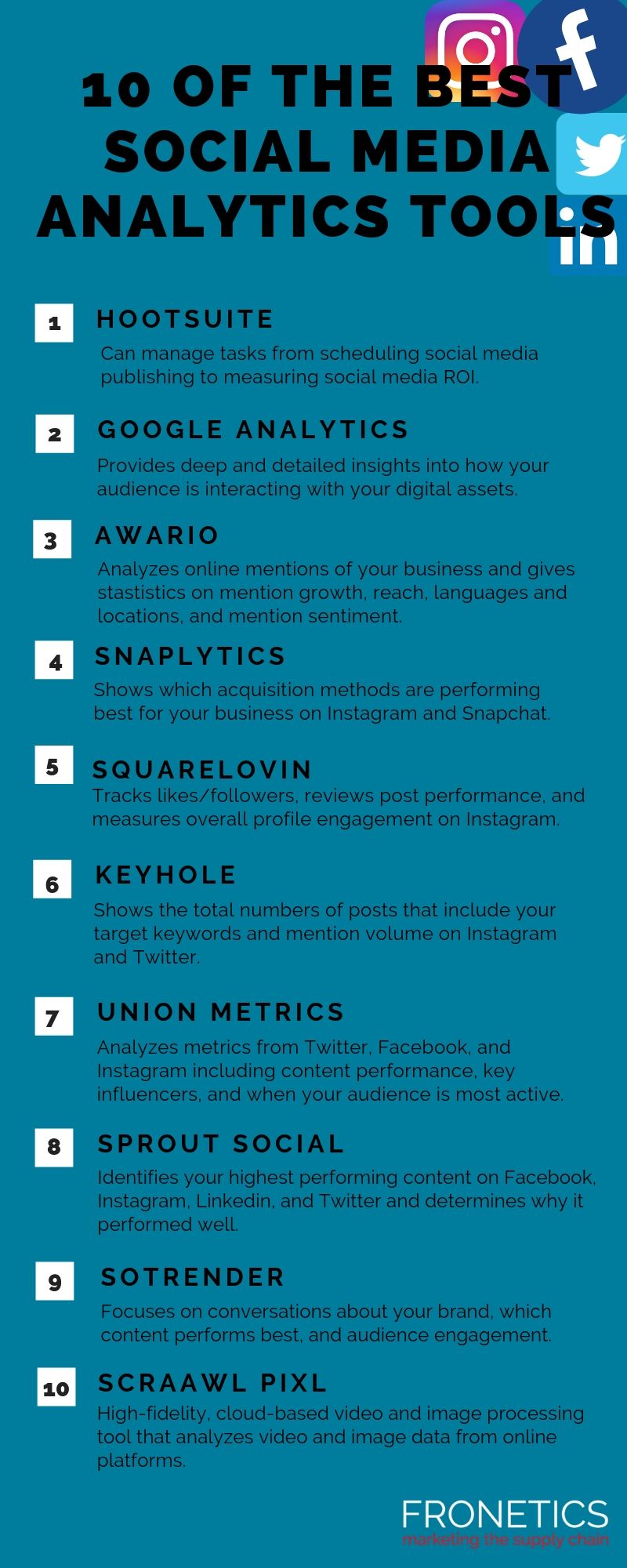
At Fronetics, we believe in a data-driven approach to digital marketing. A solid analytical framework has the potential to offer insights that will shape and refine your strategies, increasing your ability to generate, nurture, and convert leads. We’ve pulled together 10 of the best social media analytics tools to help you determine what’s working and what’s not — and to empower you to develop a data-driven strategy.
Our 10 favorite social media analytics tools
(Made with Canva)
1) Hootsuite
There are so many tools out there, and our internal list of the best social media analytics tools often shifts. But there are a few platforms that always make the list, and Hootsuite is one of them. It’s one of the most popular social media management tools for a reason – it’s a powerhouse that can manage tasks from scheduling social media publishing to measuring social media ROI.
Hootsuite gives you key metrics from Twitter, Facebook, and Instagram with audience and post insights, as well as performance data. It packages all the data in approachable charts and graphs. One of our favorite features is the AutoSchedule tool, which lets Hootsuite determine the optimal time to post or tweet based on when similar content performed well in the past.
2) Google Analytics
Another of our perennial favorites, Google Analytics is a robust platform that can provide deep and detailed insights into how your audience is interacting with your digital assets, including social media. This is one of the best social media analytics tools out there, and we’ve written extensively about how to get the most out of it.
For social media analytics, we particularly recommend three custom reports: Best Days to Post on Social Media, Best Time to Post on Social Media, and the Social Media Traffic by Date and Hour. These three reports offer real-time data, along with the in-depth insight you need to help your business optimize its social media strategy.
3) Awario
Awario analyzes online mentions of your business and gives you statistics on mention growth, reach, mentions’ languages and locations, mention sentiment, and where on the web mentions are occurring. We particularly appreciate that the tool also identifies social media users who have used your keywords and provides you with a list of social media influencers in your specific area.
Benchmarking your social media marketing strategy against your competitors is key to understanding how you’re doing. Awario lets you create alerts for your main competitors and offers you a step-by-step comparison of your social media performance against theirs.
4) Snaplytics
While all-inclusive tools like Hootsuite and Google Analytics are excellent for evaluating your overall social media strategy, we also recommend a few tools that focus on specific platforms. Snaplytics hones in on Instagram and Snapchat, including offering insights on Instagram Stories.
For both networks, Snaplytics shows you which acquisition methods are performing best for your business, as well as what precipitates rises and falls in engagement levels. Snapchat can be a tricky platform for brands, and Snaplytics provides the kinds of insights you need to make inroads on this millennial-dominated network.
5) Squarelovin
We’ve written extensively about how supply chain companies can make the most of Instagram and Instagram Stories. Squarelovin is an analytics tool specifically for Instagram that provides you with the data you need to optimize your strategy. It tracks likes and followers, reviews post performance, and measures overall profile engagement.
One of the best social media analytics tools for Instagram out there, Squarelovin highlights the best times to post, ideal filters to use, and most popular hashtags. It also gives you a history of engagement with your posts, broken down by hour.
6) Keyhole
This social media monitoring tool offers up deep analytics for Twitter and Instagram. Keyhole will show you the total number of posts that include your target keywords, as well as how mention volume has changed over time. It displays engagement data, hashtag usage trends, sentiment metrics, and reach statistics.
Influencers are key on Instagram and Twitter, and influencer marketing should be part of your social media strategy. Keyhole provides insights into influencers and trends in your specific niche, along with audience demographics and locations.
7) Union Metrics
Union Metrics analyzes a range of metrics from Twitter, Facebook, and Instagram. Like Hootsuite, it lets you know which content is performing best across each platform, the times when your audience is most active throughout the day, and who your key influencers are.
What really sets Union Metrics apart is in its potential for optimizing content creation. The tool goes above and beyond by tracking relevant trends to help you generate ideas for new content, based on hard performance data.
8) Sprout Social
Sprout Social is probably Hootsuite’s biggest competitor, and it’s another of our frequent favorites. Like Hootsuite, it’s an all-around social media management tool that provides key analytics as well. It measures performance and engagement across Facebook, Instagram, LinkedIn, and Twitter and benchmarks your data against competitors.
Sprout Social also helps you identify your highest performing content and determine why it has performed well. It can also show you how your paid ads are performing through a comparison of paid versus organic impressions and followers gained.
9) Sotrender
This formidable social media analytics tool shows you where conversations about your brand are happening, which of your content performs best, and how your audience engages with your social media content. Sotrender analyzes Twitter, YouTube, Facebook, and Instagram and makes it easy for you to benchmark your efforts against your competitors.
We like any tool that not only offers data but gives you advice for improving your strategy. Sotrender offers customized tips on where your marketing strategy needs improvement, based on the analysis it performs.
10) Scraawl PixL
As the internet, and social media in particular, becomes more visual, experts have pointed to a dearth of analytics tools with the capability to perform rich analysis on images. Scraawl PixL is a relatively new kid on the block, and it’s attempting to fill the void when it comes to image-based analytics.
This high-fidelity, cloud-based video and image processing exploitation tool offers an easy-to-use interface, as well as workflows for analyzing video and image data from online digital platforms. It relies on machine learning-based algorithms that enable face detection and recognition as well as object detection, tracking, and classification.
What are your favorite social media analytics tools?
Related Posts: