
Infographic: 3 Questions Manufacturers Ask about Social Media (and Our Answers)
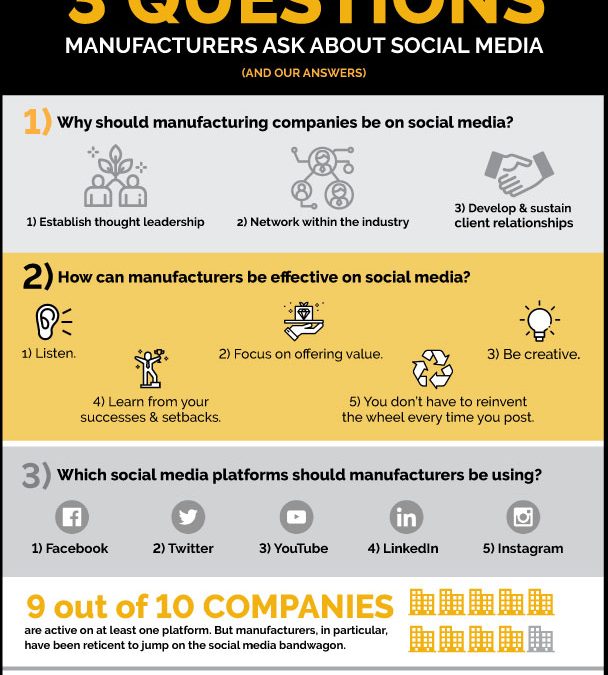
We get many queries from manufacturers about social marketing — mostly, why and how should I use it — so here are our answers to the most-popular questions manufacturers ask about social media.
Highlights:
- Facilitate networking opportunities, thought leadership, and prospect/client relationships.
- Consider using popular platforms like YouTube and Instagram to engage users and drive website traffic.
- Don’t use social media to push your products.
B2B operations have increasingly embraced social media as a strategic marketing tool. In fact, 9 out of 10 companies are active on at least one platform. But manufacturers, in particular, have been reticent to jump on the social media bandwagon.
If your manufacturing operation isn’t making use of social media as a tool to engage with your audience, you’re missing out on big lead generation potential. Manufacturers like the Dow Chemical Company, ArcelorMittal, and CAT Products are among those that have figured out how to harness the power of social media.
To help you launch or refine your efforts, we’ve put together the following answers to the most-popular questions manufacturers ask about social media.
Why should manufacturing companies be on social media?
There are three major reasons that manufacturing brands should be all over social media:
- Establish thought leadership
- Network within the industry
- Develop and sustain client relationships
Notice that none of these involve selling products. As with content marketing in general, good social media marketing isn’t about pushing your products.
To make the most of social media as a marketing tool, abandon the idea that it’s about blatant sales pitches. Instead, approach it from the perspective that it’s an inherently social tool – that is, its value for manufacturers is in its potential to establish and expand thought leadership and to cultivate meaningful and fruitful relationships within your industry and among prospects and clients.
Which social media platforms should manufacturers be using?
Not all social media platforms are created equal. Each requires its own strategy, content format, and media. We recommend that manufacturers consider these five platforms:
1) Facebook
Facebook is an excellent place to share content with a wide segment of your audience, to promote engagement (through likes, comments, and shares), and to engage with peers and prospects. Not only that, the savviest marketers are using Facebook to understand their industry better – everything from strategies of peer brands to a fuller picture of your target buyer persona to the informational or product needs of your prospects.
2) Twitter
Twitter’s format is about brief, pithy content, used to engage with and inform your audience. This is an ideal place to let customers know what you’re planning next, to establish your corporate personality, and to let your audience in on a slice of your day-to-day operations and values.
3) YouTube
Video marketing for manufacturers is skyrocketing. With video being the most popular form of content online today, YouTube is an obvious choice for marketers. Whether it’s “how to” videos, footage of your operations, or interviews with subject-matter experts, your brand should be using YouTube to drive search traffic and educate prospects.
4) LinkedIn
B2B marketers unequivocally rank LinkedIn as the most effective network for lead generation, follower engagement, and traffic to their websites. An ideal place to engage with industry leaders, LinkedIn is also great for distributing content to a focused audience.
5) Instagram
The popularity of this highly visual platform has continued to skyrocket – it’s currently the second-most-used social media platform (up from fourth just two years ago). And believe it or not, this picture-based network is a powerhouse for B2B brands. We’ve written extensively about how brands can leverage Instagram and Instagram Stories. Suffice it to say, this is a perfect place to post your most engaging visual content and actively engage with followers.
How can manufacturers be effective on social media?
As with any content marketing effort, a well-thought-out social media strategy is a big part of success. As you create and begin to implement your strategy, start with these five tips.
1) Listen.
Before you post even a single piece of content, start by listening to your audience. In the days before social media, marketers had it much harder when it came to determining audience needs and preferences. Use these platforms to research your target prospects, as well as how competitors are engaging followers. Make note of the questions your target audience has, frustrations or challenges they express, and what types of content they engage with.
2) Focus on offering value.
You’d be surprised how many manufacturers neglect to place a premium on simply being useful with their social media content. It’s not complicated: If you post relevant, valuable content for your target audience, you’ll boost engagement, grow brand awareness, and generate and convert more leads.
3) You don’t have to reinvent the wheel every time you post.
One of the great things about social media is that it rewards not only content creation, but content curation. While you do want to be posting original content most of the time (experts recommend about 60%), a good chunk of your posting activity should include curating relevant content from third parties to share with your followers.
4) Be creative.
Separating yourself from your competitors can be a challenge, but it’s one worth striving toward. Start by asking yourself what makes your operation unique, what’s special about your process, what industry-leading expertise does your executive team have, what unusual perspective can you offer? Next, start breaking these four rules.
5) Learn from your successes and setbacks.
There are many tools out there to help you track the results of your social media efforts. Determine the right KPIs for your business and keep track of your results relentlessly. These metrics will allow you to study your impact and frequently tailor your strategy accordingly.
It’s time for manufacturers to fully embrace the marketing potential of social media. Whether you create and implement your own strategy, or decide to outsource your social media efforts, social media is a powerful set of tools that manufacturers should be harnessing.
Are there other questions manufactures ask about social media that we missed? Let me know in the comments.
Related posts:
- Top 3 Priorities for Manufacturing Companies in 2018
- The One Thing Manufacturing Marketers Must Do Now: Video Short
- Infographic: 4 Strategies for Supply Chain Marketers to Build a YouTube Audience

Twitter’s New Video Analytics Tool, Facebook Showcase, and More Social Media News March 2019
Also, this month in social media news: Twitter launches new camera tools to increase visual focus; and Pinterest introduces Catalogs and expands shopping ads.
This month on social media news, we’re seeing a few trends continuing. Platforms are increasingly offering robust analytics tools to content creators in an effort to boost engagement. This time, it’s Twitter rolling out a new tool that gives video publishers insights on optimal post timings. Twitter is also jumping on the “Stories” bandwagon, with its own answer to the trend: a camera feature that allows users to create images similar to Instagram and Facebook Stories.
Also this month, we’re seeing good news for brands when it comes to advertising on social media. Facebook is introducing a feature for premium video advertising, while Pinterest is rolling out multiple tools to help brands sell directly from the platform. Read on for a round-up of social media news.
Social media news for March 2019
Twitter Debuts a New Analytics Tool for Video Publishers
In an effort to provide video publishers with increased data to aid in performance improvement on Twitter, the platform has released the first in a new series of publisher insights tools: Timing is Everything. According to Twitter, the tool “displays historical data showing when audiences are on Twitter watching and engaging with video. This data highlights the best time(s) to Tweet video content with an aim to maximize engagement, conversation, and viewership.”
This is big news for video publishers, including content marketers. Twitter is offering key insights on one of the most important factors in determining social media marketing success: timing. Of course, increased engagement is in the platform’s best interest — and it’s in yours as well. Stay tuned for the release of more insight tools from Twitter in the coming weeks and months.
Facebook Announces Facebook Showcase for Premium Video Advertising
Facebook has debuted Facebook Showcase, a new premium video ad program that gives online video and TV ad buyers participating in the upfront selling cycle new opportunities to reach their target audiences on the platform. Showcase is currently available for campaigns targeting U.S. audiences and includes In-Stream Reserve, In-Stream Reserve Categories, and Sponsorships.
Facebook’s announcement is another big one for advertisers. Showcase will help advertisers connect with people through premium content and unique video experiences and can help reach younger-skewing audiences that are increasingly difficult to reach on TV.
Twitter Launches New Camera Tools to Increase Visual Focus
While platforms like Facebook and Instagram are increasingly ushering users towards their respective Stories features, Twitter is introducing a camera tool which will let users capture Stories-like images, including overlays and a searchable element. In addition to bringing the platform on board with the Stories trend, it ushers in more visual content options.
[bctt tweet=”Twitter is introducing a camera tool which will let users capture Stories-like images, including overlays and a searchable element.” username=”Fronetics”]
Swiping left on your Twitter timeline from your mobile device will take you to the new camera. There you can capture an image or video, or even go Live straight from Twitter, rather than having to be routed through Periscope. Next, users have the option to add details to the image, including hashtags suggested based on location. Stickers and filters aren’t here yet, but no doubt they’ll be coming soon.
Pinterest Introduces Catalogs and Expands Shopping Ads
Pinterest has rolled out a series of new tools and products to help brands sell their products directly on the platform. The company has debuted Catalogs, which allows brands to upload their full product portfolios to Pinterest and easily turn each item into dynamic, shoppable product pins. In addition, Pinterest has introduced personalized shopping recommendations for style, home, beauty, and DIY boards.
The platform’s rollouts are good news for brands and speaks to the company’s pro-business corporate mindset: “People come to Pinterest in a shopping mindset open to discovering products, which creates a great connection between Pinners and businesses. Pinners are looking for inspiration, and brands help make that inspiration a reality.”
What other social media news has your attention this month?
Related posts:
- Facebook Adds CTA Stickers for Page Stories, Twitter Plans New Conversational Features, and More Social Media News
- Facebook Integrating Messaging Platforms, LinkedIn Updates Recruiter Platforms, and More Social Media News February 2019
- Facebook Announces 3Q Earnings, LinkedIn Offers New Integration Tools, and More Social Media News

5 Secrets to Creating Infographics that Will Wow Supply Chain Buyers
Infographics are a content powerhouse, but creating them isn’t always easy. These five tips will help you make the most of this format.
Infographics can be one of the most effective content mediums. We know that digital natives, who make up the majority of B2B buyers today, prefer short-form, highly visual content. So infographics make a lot of sense when it comes to speaking their language.
[bctt tweet=”Infographics can be one of the most effective content mediums. We know that digital natives, who make up the majority of B2B buyers today, prefer short-form, highly visual content. ” username=”Fronetics”]
Infographics are also prime candidates for reposts on social media. But, if you’ve ever tried to create one yourself, you know making an effective infographic is a lot harder than it sounds.
It might seem daunting at first, but these five tips will go a long way to help you in creating infographics that are effective in engaging supply chain buyers.
5 tips for creating infographics that engage supply chain buyers
1. It’s all about the title
Well, maybe not all, but your title does matter a lot. When it comes to infographics, your audience will definitely be judging a book by its cover. This means that your title should be accurate, short (70 characters or less), descriptive, and engaging. This is how your audience will decide whether they’ll click and read.
2. Colors matter
You’d be surprised by how much people are influenced by color in their content choices. The color scheme you choose should make your readers feel comfortable and should be visually appealing. This generally means sticking to two main colors and using no more than four colors. Use clear, bold colors for your main colors, and subtle, warm tones for complimentary colors.
3. Bump up your SEO
There aren’t a lot of downsides to infographics, but, unfortunately, there is one: publishing them on your blog doesn’t do much for your SEO, since text in infographics is contained in the image and isn’t recognized by search bots. But there’s an easy way around this: Include a transcript of your text with your graphic. I recommend writing at least 350 words, in addition to the graphic, to boost SEO.
4. Keep it simple
There’s a reason that simplicity is king when it comes to graphic design online. Increasingly, designers and businesses are favoring clean, minimalistic layouts. This means few unnecessary elements and plenty of white space so as not to overwhelm readers and to convey information without unnecessary distractions.
5. Get interactive!
If you’ve mastered creating infographics and are feeling ambitious, try taking on the next big thing: interactive designs. This means your readers can engage with your content, whether by hovering over it, clicking on it, or even answering questions or taking a quiz.
There are a number of infographic-creation tools available on the internet these days. At Fronetics, we really like using Canva, which has plenty of templates that are easy to use and do a lot of the design work for you.
What are your tips for creating infographics?
Related posts:
- Infographic: 8 Quick Tips to Improve SEO For Your Blog
- 6 Blogging Tips from Top Business Blogs
- 3 Quick SEO Tips to Improve Your Blog Right Now

Facebook Boosts Local News, Twitter Launches Sponsored Moments, and More Social Media News
Also in social media news February 2018: Facebook is developing more sophisticated chatbots, Twitter’s increased character count leads to more tweets, and Instagram introduces a new content publishing beta for businesses.
The Olympics aren’t the only thing to keep an eye on this month. The results from the fourth quarter of 2017 show that social media sites are going for the gold when it comes to customer engagement.
Updates to the most popular sites have included longer character counts, more advanced conversational skills with chatbots, and new tools for easier sharing. All of these changes are working to improve user experience and help keep users active on the biggest sites.
Here’s your social media news for February 2018.
Instagram launches content publishing beta for businesses
Instagram’s latest update allows businesses to schedule photo posts, view posts they’ve been tagged in, and view other business profiles. Prior to this update, users would have to use a third-party tool to publish posts to the site. “This change helps businesses manage their organic presence more effectively,” writes Instagram on its business blog. This new feature is also open to Facebook Marketing Partners.
Facebook boosts local news posts
In a continued effort to increase customer engagement, Mark Zuckerberg shared the latest changes to Facebook’s News Feed. The site will now boost local events and news stories from high-quality sources. “We’re making a series of updates to show more high-quality, trusted news. Last week we made an update to show more news from sources that are broadly trusted across our community. Today our next update is to promote news from local sources,” writes Zuckerberg. The updates to News Feed are rolling out in the U.S., with plans to expand to other countries later this year.
Twitter launches Sponsored Moments
Twitter introduced a new sponsorship opportunity, Sponsored Moments, in which advertisers can run tweets designed around a specific event or theme. Similar to other in-stream sponsorships, advertisers can promote the moment to their specific target audience and expand their reach beyond the content partner’s existing followers. Twitter is hoping these changes will help advertisers be relevant “in the moment” and create opportunities for a more organic marketing reach.
Facebook developing new chatbots with better conversational skills
The Verge reports that Facebook is working on more sophisticated chatbots with a “consistent personality” and the ability to carry on better conversations. Feedback from Facebook’s FAIR lab showed that customers were unhappy with chatbots’ ability to provide context-based responses and their programmed responses, like “I don’t know,” when faced with questions they can’t answer. Facebook’s new research is looking for patterns in large datasets that will allow chatbots to converse in a more natural human dialogue.
Snapchat hits 187 million daily active users
Snap’s Q4 2017 Earnings Report showed that Snapchat gained 8.9 million daily active users during the last quarter, bringing its total to 187 million daily active users. While still not reaching Instagram and Facebook’s user numbers, this growth shows the largest increase in users since 2016. This increase included 3 million new users from outside of the U.S., a market Snapchat has just recently focused on expanding into.
Twitter’s increased tweet character count leads to more tweets
Back in November, Twitter increased its tweet size to 280 characters. Though most tweets aren’t using the additional characters, the platform has seen an increase in tweets. CEO Jack Dorsey stated that the recent expansion hasn’t actually changed the length of messages people are sending out — but it has led to more engagement.” The increased engagement has come from more retweets and mentions, higher follower rates, and less abandonment of tweets.
Facebook updates branded content policies
Facebook will no longer allow publishers to take money for posting media they didn’t create or weren’t involved in creating. These updates to the platform’s branded content policies also prohibits publishers from placing ads in video, audio or visual content and states that all branded content may only be posted using the branded content tool and has to feature the proper disclosures.
Related posts:
- Facebook Updates News Feed, Instagram Allows User to Send Live Videos, and More Social Media News
- Facebook Introduces Explore Feed, Twitter Adds Self-Serving Advertising, and More Social Media News
- YouTube is Helping with Branding, LinkedIn is Creating Geofilters for Your Corporate Events, Facebook is Giving Out Background Details, and More Social Media News