by Fronetics | Mar 14, 2019 | Blog, Content Marketing, Marketing, Social Media
Instagram for business is a rising trend. Here are some top tips to get your business using Instagram as a part of your digital marketing strategy.
Highlights:
- Instagram is all about authenticity and personality. Let your audience get an up close and personal glimpse into your company’s culture.
- Audiences love real-time content and it lets them feel a genuine, human connection.
- Posts should do more than promote your brand and Instagram Stories are an ideal way to engage your audience!
Video transcript:
I’m Katie Russell, and I’m a marketing strategist here at Fronetics. Today I’m going to talk to you about Instagram for business. Instagram has been growing in popularity, and if you’ve been thinking about using Instagram for your business, here are some tips to get you started.
Be authentic
Instagram is all about authenticity and personality. Give your viewers an inside glimpse into your company’s culture. An easy example would be to create little videos answering your audiences questions. It shows that your viewers are being heard and as well as an opportunity to engage with new audiences.
Keep up the pace
Instagram is one of the easiest platforms to post to, so don’t be afraid to take pictures at meetings, conferences, or events, anywhere that you are. The pictures don’t have to be perfect, just remember that the more you post the greater opportunity you have to reach new audiences.
Go live
Live video is the “it” trend in social media marketing right now. Audiences love real-time content, and it gives them feel a genuine, human connection that can sometimes be a struggle for B2B marketers.
Be a storyteller
Instagram is all about visual storytelling, so your newsfeed should be more than just promoting your brand. It should give viewers and audiences a look at what makes your brand different. Don’t be afraid to be quirky or think outside the box to show audiences what makes your brand unique.
Out of ideas? Just ask!
Creating content and coming up with new ideas can be a huge challenge for marketers. Don’t be afraid to survey your audiences and ask them what they’d be interested in seeing. You might just get some great ideas you never would have considered.
For more tips on how to get started for Instagram for your business, visit us at Fronetics.com.
Related posts:

by Fronetics | Feb 19, 2019 | Marketing, Social Media
Need some Instagram for B2B marketing inspiration? These 10 brands are getting it right.
Highlights
- Instagram is a great opportunity for B2B businesses.
- Avoiding blatant sales or advertising pushes is key.
- Successful accounts engage users with interesting visuals and/or provide them with value through informative content.
Instagramnow boasts over 1 billion monthly active users, making it one of the most popular social media platforms out there. It’s a tremendous opportunity for businesses. In fact, recent research has shownthat 66% of brands now use Instagram.
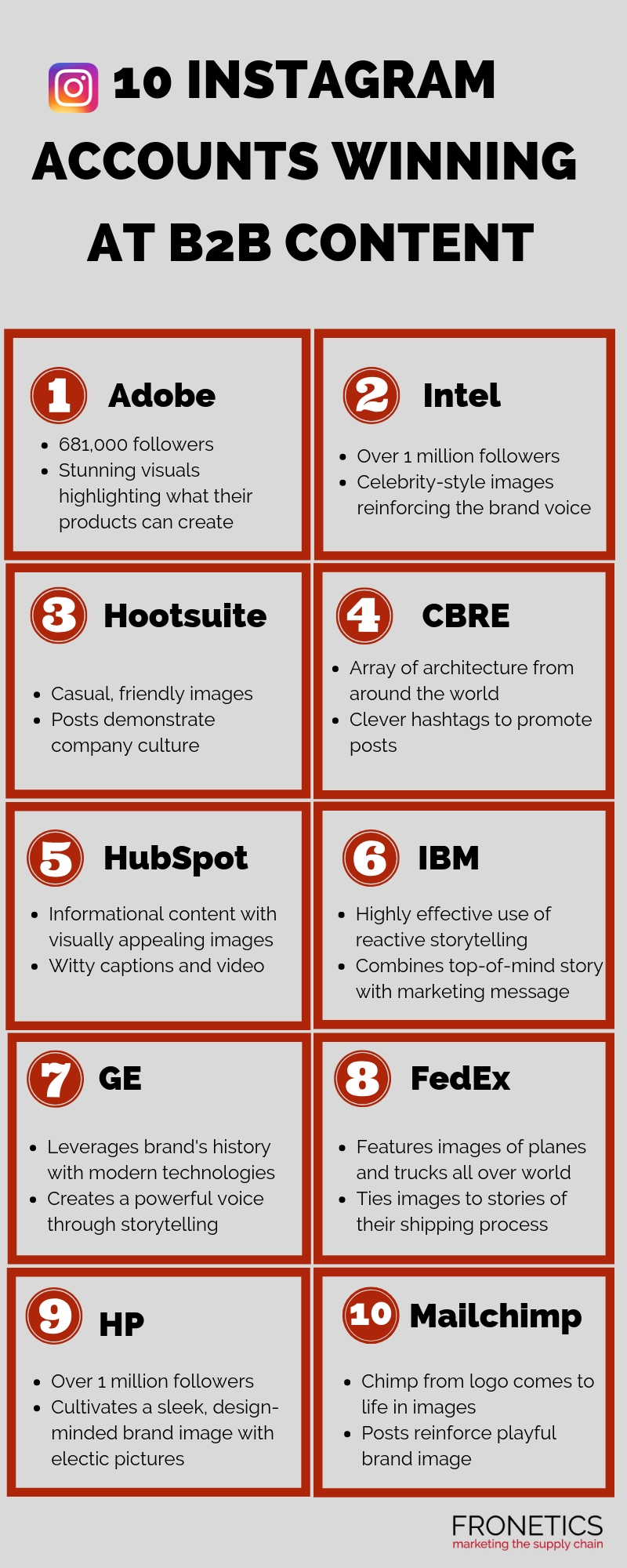
But many B2B marketers are still struggling to find their footing on this highly visual platform. Since we could all use a little inspiration now and then, here are 10 brands that are crushing Instagram for B2B marketing — and what we like about their presence.
10 brands that are nailing Instagram for B2B marketing
(Made with Canva)
1) Adobe
With 681k followers, Adobe (@adobe) is a fortunate brand when it comes to Instagram in that its product naturally lends itself to the visual medium. Its account boasts some truly stunning visuals, highlighting what Adobe products can create.
2) Intel
The tech giant Intel (@intel) cultivates a celebrity-style image, giving its over-a-million followers an inside glimpse into big events the brand plays a role in, like the X Games, Grammys, and glitzy tech conferences. Each of the carefully curated images reinforces the brand’s voice, and captions do a great job of detailing exactly what the brand does in the tech space.
3) Hootsuite
Social media management dashboard Hootsuite (@hootsuite) does a fantastic job of showing brands their social media know-how, right in its Instagram profile. The company cultivates a casual, friendly image and posts content that demonstrates company culture. From team building photos to office dogs, Hootsuite makes followers feel like they’re getting to know the brand.
4) CBRE
Global commercial real estate firm CBRE (@cbre) is a phenomenal example of finding beauty within the context of its operations. The brand’s Instagram feed features a stunning array of architecture from around the world, with clever use of hashtags.
5) HubSpot
Here’s a company getting content Instagram for B2B marketing right. HubSpot (@hubspot) consistently provides value to followers, posting informational content. Rather than letting it get boring, the brand keeps content visually appealing and makes clever use of captioning and video.
6) IBM
Tech juggernaut IBM (@ibm) has made highly effective use of reactive storytelling on Instagram. This method of storytelling combines a top-of-mind story or idea with a compelling marketing message. IBM uses it during popular or inspiring events, demonstrating how it’s making use of the brand’s technology.
7) General Electric
It’s a household name brand, and it’s over a century old. General Electric’s (@generalelectric) Instagram presences does a great job of leveraging the brand’s history, highlighting its involvement with important developments in defense, aviation, and technology. It’s a great example of creating a powerful voice from a brand through storytelling and tapping into the audience’s nostalgia.
8) FedEx
FedEx (@fedex) is a prime example of a B2B brand that makes the absolute most of what it does to create a compelling story for its Instagram content. The account features photos of airplanes and trucks all over the world, telling the story of how the carrier cares for and ships products in its care.
9) HP
With over a million followers HP (@hp) cultivates a sleek, design-minded brand image on Instagram. It capitalizes on subtlety and style, with eclectic images that never feel overtly promotional but that highlight the brand’s innovation.
10) Mailchimp
Email marketing company Mailchimp (@mailchip) truly gets the most out of its whimsical logo. Its Instagram content has given the playful chimp logo life and transformed him into a personality and voice for the brand. The image is quirky and fun, and Mailchimp’s Instagram presence reinforces and capitalizes on that.
What companies do you think are doing Instagram for B2B marketing right?
Related posts:
by Fronetics | Feb 13, 2019 | Blog, Content Marketing, Marketing, SEO
Search engines are constantly changing, but these 5 tips will ensure that supply chain marketers can boost SEO in 2019.
Highlights
- People are changing how they search, and search engines are adapting accordingly.
- Simple changes to the structure of your site can have a big impact on your search engine rankings.
- Sites rich in quality content, like blogs and video, are poised to rank high for relevant search queries.
If there’s one constant when it comes to writing to boost Search Engine Optimization (SEO), it’s change. As users change the way they search online, search engines are continually adapting their algorithms to meet their needs. While it’s easy to get overwhelmed, it’s important for supply chain marketers to stay up-to-date and adapt their content strategy to boost SEO.
The year is just getting into full swing, and it’s a great time for savvy marketers to look ahead and make strategic decisions for SEO in 2019. These five tips will help you get ahead of the curve.
5 ways to boost SEO in 2019
1) Cluster content
Gone are the days of keyword rankings. Rather than prioritizing keyword focus, search engines have shifted to rewarding sites that produce strong content and arrange it in focused, niche topics.
Cluster content, a method of on-site SEO, might sound daunting. But it doesn’t require reinventing the wheel, just changing the structure of your site. For a detailed look at topic clusters and pillar content, check out part three of our four part series on writing for SEO.
We’ll give you the short version here: Select several core topics that most closely align with your brand, and reflect the knowledge you have to share. Evaluate your existing content, and categorize it based on which core topic or topics it falls under. Going forward, keep these core topics top of mind when planning and creating content. Next, arrange your site to reflect core topics with content clustered and linked from pillar pages.
2) Use header tags
As they become more and more sophisticated, search engines increasingly mirror human preferences. It doesn’t take an expert to tell you that text is more accessible to the eye when broken up by relevant subheadings — and search engines are no different. Headings make your text easier to skim and allow search engines to pick out content relevant to search queries.
Subheadings make your site more visually appealing, orienting readers and providing structure within your content. Remember that you’re creating headings for the dual purpose of guiding readers and optimizing for search engines. For this reason, stick to headings that are short and informative, reflecting the content below them, rather than teasing your readers with click-baity phrases.
[bctt tweet=” Stick to headings that are short and informative, reflecting the content below them, rather than teasing your readers with click-baity phrases.” username=”Fronetics”]
3) Blog
This one is evergreen. We’ve been writing for years about how blogging is crucial for supply chain companies, for all kinds of reasons — not the least of which is SEO. If increased lead generation and site engagement isn’t reason enough, you should know that blogging is one of the best ways to boost SEO.
A blog is your space for high-quality content that’s fresh, well-researched, and relevant. If you’re choosing your topics based on the needs and preferences of your target audience, chances are, you’re creating content that is perfectly aligned to search engine queries.
4) Make sure your page speed is high
Page speed is crucial for boosting SEO. If your page is loading slowly, Google logs it, and your ranking suffers. Not only that, visitors who do click on your site will be frustrated and turn away.
In fact, research shows that 40% of visitors will abandon sites where the page takes longer than three seconds to load.
One of the best ways to improve page speed is to switch to HTTP/2. If you haven’t already, switching your site from HTTP/1.1 (which has been the norm since 1999) is crucial. HTTP/2 was first published in 2015, with the goal establishing a faster, more secure internet. Search Engine Journal has published this great guide to HTTP/2, where you can learn more about the benefits, and how to switch.
5) Video
We’ve been talking about the benefits of video for a while now. Having video on your landing page will robustly improve your SEO. Video increases conversion rates, improves bounce rates, and boosts overall time on sites.
Search engines use bounce rate to rank pages — a low bounce rate and high user retention rate are indicators of strong content and high relevance to your target audience. Consequently, Google is strongly emphasizing these metrics in its ranking algorithm. Video keeps users on your site better than just about anything else and is therefore one of the most effective ways to boost SEO.
Related posts:


by Fronetics | Jan 17, 2019 | Blog, Content Marketing, Logistics, Marketing, Supply Chain
Blogging should be a central part of your content marketing strategy. Here are our top tips for creating and sustaining a successful supply chain blog in 2019.
Highlights:
- Blogging needs to be a central part of your content marketing strategy.
- Focus on quality over quantity.
- Make all posts mobile-friendly.
It’s the start of a new year and the perfect time to start setting goals and strategizing how to achieve them. Hopefully, blogging is a big part of your strategy for 2019 — after all, supply chain companies should make blogging a central part of their content marketing strategy for all kinds of reasons.
[bctt tweet=”At last count, users share 27 million pieces of new content on social media every single day. Twenty-seven million!” username=”Fronetics”]
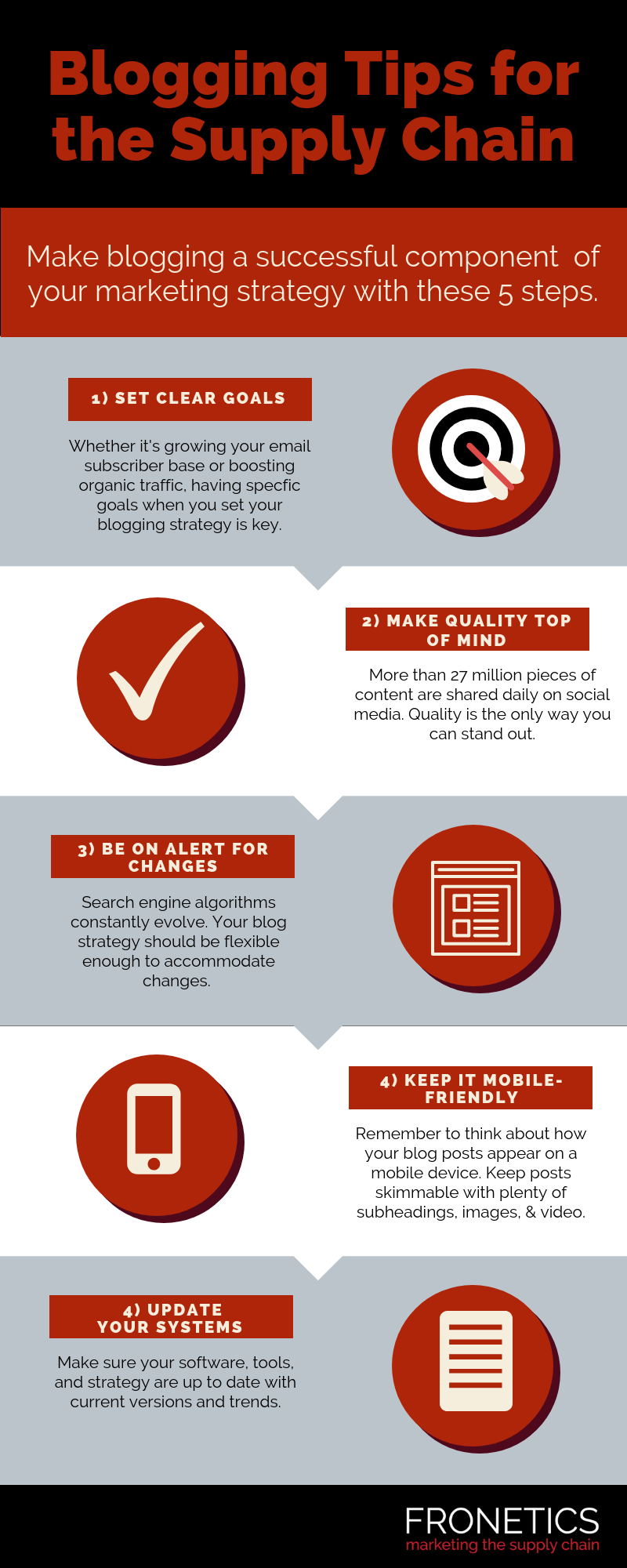
Making your supply chain blog stand out from the pack isn’t always easy. That’s why we created the infographic below. Read on for our top 5 supply chain blogging tips for 2019.
5 tips for your supply chain blog
(Made with Canva)
1. Set clear goals
We know, this one sounds obvious. But you’d be surprised how often marketers overlook this seemingly simple step or settle for general, vague goals. It’s true that blogging can have all kinds of positive impacts for the supply chain, but that doesn’t mean that you should just be blogging without a clear, documented set of goals specific to your business.
Whether it’s growing your email subscriber base, boosting organic traffic, or generating more qualified leads, having specific goals in mind when you set your blogging strategy is key. For one thing, it lets you target your efforts and generate content that is focused on achieving a specific result or set of results. Furthermore, having objectives allows you to be far more effective in evaluating your results, including measuring blogging ROI, and tweak your strategy accordingly.
What are your top three goals for your supply chain blog in 2019? Let us know in the comments!
2. Make quality top of mind
Ponder this for a minute: At last count, users share 27 million pieces of new content on social media every single day. Twenty-seven million. In a world of skyrocketing quantity, quality is ever-more important. There’s a huge amount of pressure on supply chain marketers to produce a constant stream of content, but the sad truth is, if you’re not producing high-quality, substantive content, you’re wasting time and energy.
For supply chain companies in particular, it’s crucial that every piece of your content be well-researched, clearly written, focused, and trustworthy. We know that producing consistently high-quality content isn’t easy, but, trust us: if you invest the time and energy to make your content stand out, you will see the results. To get you started or keep you focused, check out our guide to creating good content for logistics and supply chain marketers.
3. Be on the alert for changes
Particularly when it comes to search engine optimization (SEO), changes happen fast these days. In August of 2017, Google updated its algorithm, continuing a set of changes we’ve been watching for a while now. Voice searches are becoming increasingly prevalent, and researchers estimate that by 2020, 50% of all searches will be voice queries.
As these changes continue to happen, it’s crucial that your strategy is lithe and flexible, ready to adapt to a quickly shifting climate. This means keeping abreast of conversations going on in the industry, following blogs you trust and respect, as well as tracking your own results, and being alert to changing trends.
4. Keep it mobile-friendly
You don’t need researchers to tell you: people are increasingly receiving and reading content on their phones. Whether it’s social media, emails, or blogs, mobile usage continues to skyrocket as devices become more and more ubiquitous and user-friendly.
What does this mean for supply chain blogs? Of course, your website needs to have a visually attractive and accessible mobile version, but it’s also helpful to think about your blog posts in terms of how they appear on a phone. Keep your posts skimmable, with plenty of subheadings to orient the reader, and absolutely include video whenever possible.
5. Make sure your systems are up to date
We keep coming back to the reality of the rate of change these days. It can be exhausting and overwhelming for marketers to keep pace. Take the opportunity of the new year to make sure all your blogging-related tools are updated and running the current software.
As you’re keeping your tools fresh, it’s also a good time to make sure your procedures are running smoothly and are at a pace with the current marketing climate. This means evaluating responsibilities and results within your team, ensuring that your editorial calendar is serving you well, and taking a look at your data collection and reporting methods.
Bonus: What not to do in 2019
These might seem obvious, but again, you’d be surprised how may marketers fall victim to these blogging “don’ts.” We figured it bore repeating.
- Don’t: attempt to post content that doesn’t reflect your business’ “comfort zone.” Stick to what you know, and do it well.
- Don’t: copy and paste text or images from other blogs. Using other content for ideas is great. Copying it verbatim is verboten.
- Don’t: post at irregular intervals. Creating a content schedule and sticking it is key to establishing a loyal following and boosting your credibility.
What goals do you have for your supply chain blog this year?
Related posts:

by Jennifer Hart Yim | Jan 15, 2019 | Blog, Consumer Electronics, Content Marketing, Logistics, Manufacturing & Distribution, Marketing, Supply Chain
It’s time for consumers to stand up to tech giants and force them to procure raw materials, used in an ethical and sustainable manner, for smart devices.
Highlights:
- Smart devices have created a dependency on batteries.
- Blockchain is being considered to track cobalt from its source in the production of lithium ion batteries.
- The number one way to decrease reliance on batteries is to reduce overall consumption of energy from batteries.
Battery technology is hot these days, no pun intended. Consumers are demanding high performance and safety from batteries as energy storage devices. Smart device manufacturers are responding by producing batteries that are smaller, safer, and store more energy; this performance comes at a cost. Increasingly rare and advanced materials are required to produce a safer and more high-performance battery for your smart device.
Cobalt is one of the key raw materials required to support the green revolution. Too bad over half of the world’s cobalt supply comes from the war-torn Democratic Republic of the Congo, where they are known to use child and slave labor in the mining of cobalt.
No one cares, however. Device manufacturers are delivering a price point and value that the consumers are willing to pay for. Supply chain reform could briefly interrupt this harmony, and peoples’ relationships with their smart devices could be jeopardized. The sad truth is that device manufacturers have pulled the wool over our eyes for too long and we have now become dependent on these batteries.
There is a solution, however.
Consumers have to stand up to tech giants such as Apple and Samsung and force them to procure raw materials used in an ethical and sustainable manner. This is happening in the “Responsible Cobalt Initiative” where blockchain is being considered to track cobalt from its source in the production of lithium ion batteries.
The blockchain method relies on adequate and honest oversight at the very site where the cobalt is being mined from the Earth in locations such as the DRC. How will honest oversight be implemented in what is known to be one of the most war-torn and corrupt regions of the world? Why wouldn’t Congolese mine owners simply lie about labor practices? In this case, the supply chain reform also requires political and cultural reform. I can’t help but think about that time when the U.S. tried to cause political and cultural reform in Iraq…
The bigger and more disturbing picture is that society is on track for over-reliance on lithium-ion batteries as energy storage devices. The number of smart devices is skyrocketing. And if electric vehicles achieve widespread adoption someday, the amount of lithium-ion batteries and cobalt required to fuel that growth will be staggering.
This is just one reason why the energy future of our planet is so uncertain. Surely the population will continue to grow. Smart device numbers will keep rising exponentially. The planet is going to need more energy and more energy storage. Hopefully, an increasing amount of energy will come from renewable and carbon-neutral sources. In order to maximize the potential of renewable energy installations, we need vast amounts of energy storage. Putting all our eggs in the lithium-ion battery basket is a very bad idea by-in-large due to the shortcomings of the cobalt supply chain.
[bctt tweet=”In order to maximize the potential of renewable energy installations, we need vast amounts of energy storage. Putting all our eggs in the lithium-ion battery basket is a bad idea due to the shortcomings of the cobalt supply chain.” username=”Fronetics”]
It is important to note that the number one, most surefire way to decrease our reliance on batteries is to reduce overall consumption of energy from batteries. Simply put, if everyone were to spend half as much time on their cell phones, we would need half as many cell phone batteries. The phone would have to be charged half as often, and the battery would last twice as long, thus requiring half as many batteries over time. Maybe we would even start talking to each other once again.
In addition to reducing consumption, humankind must pursue radical technological advances in the field of energy storage. Power-to-gas and room-temperature-superconductors are two cutting-edge technologies that have the potential to revolutionize the way we store energy. Distributed generation, smart grids, and passive heating and cooling are some more conventional ways to reduce the energy storage burden placed on large-scale renewable generating facilities.
To make a long story short, the force of corporate greed and government corruption has overpowered the force of the consumers’ desires up until now. I am sure that the vast majority of smart device users, if asked, would be opposed to the use of child and slave labor in the mining of raw materials for their smart devices. I, for example, would be willing to pay more for a device that guarantees fair and ethical trade up and down the entire supply chain. We must never forget that we the consumers have the ultimate power. If we want Apple or Samsung to change their ways, we can easily do that. Get out and vote. Make your voice heard. Stand up to corporate greed and government corruption. Take a break from your cell phone and talk to the person next to you. I promise the world will be a better place.
This article was written by Peter Chivers, an MBA student at the Peter T. Paul College of Business and Economics at the University of New Hampshire. Pete is an engineer and MBA student with a passion for innovation and the outdoors. He spends his free time with his family hiking mountains, gardening, and building ice fishing contraptions.
Related posts: