by Fronetics | Oct 1, 2019 | Blog, Content Marketing, Logistics, Marketing, Supply Chain
Consumers are more likely to trust content generated by their peers, which means higher conversion rates at a lower cost for your brand. Is your brand benefitting from user generated content?
Highlights:
- User generated content is content created by users of a specific brand or on a specific platform.
- Images and video of real people using your products or talking about your services will create trust and loyalty for your brand.
- Don’t be afraid to engage with your audiences over social media, respond to comments, and answer questions.
Video transcript:
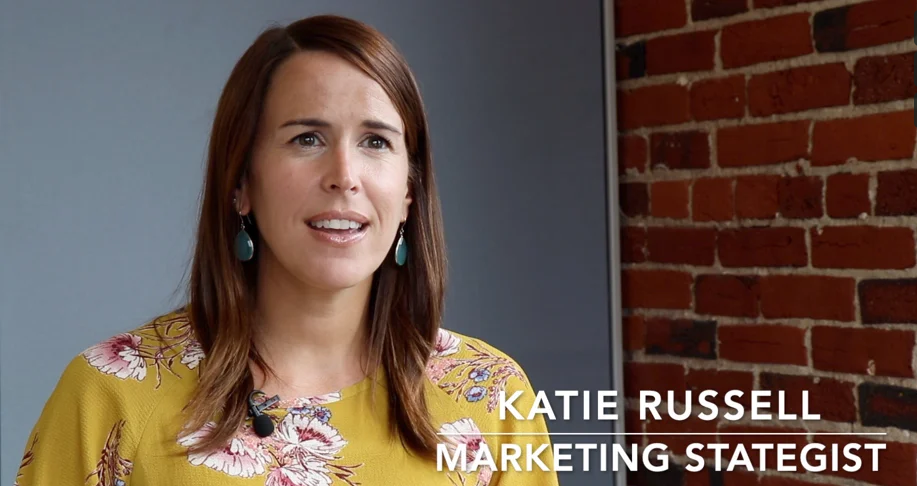
I’m Katie Russell, a marketing strategist here at Fronetics, and today I wanted to talk to you about user generated content. Also known as UGC, user generated content is one of the hottest topics in digital marketing right now, but there are many businesses that don’t know how to use this tool to their advantage.
Let’s start with the basics.
What is UGC?
User generated content is content created by users of a specific brand or on a specific platform. It’s highly effective and comes at little or no cost to your business.
With that said, a lot can qualify as UGC including: comments on your blog, testimonials on your website, social media posts, blog articles, videos, Instagram stories, The list goes on and on. What it comes down to is that UGC is really any form of content that comes from a customer or a user.
So, what are the benefits of UGC?
Authenticity
We know that consumers are more likely to trust content generated by their peers, which means higher conversion rates at a lower cost for your brand. This also means the content is authentic and genuine reviews from buyers. Does it get any better than that?
Inexpensive
Since your brand is not generating the content, you don’t have to invest in the time and resources to create it.
What’s hot in UGC right now?
Visual content
Visual content is by far the most popular among audiences, so visual UGC is a no brainer. Images and video of real people using your products or talking about your services will create trust and loyalty for your brand.
Snackable content
We all know that the attention span for content is extremely short these days. When reposting UGC, focus on short, funny and positive content. Content that leaves users feeling informed and entertained will perform best for your brand.
Enlisting influencers
Whether it’s a famous celebrity or a micro-influencer that’s respected within your industry, brands involving influential people in their marketing campaigns can expect higher ROI from UGC.
Don’t forget to follow-up
Once you’ve grabbed the attention of your community with a successful UGC campaign, it’s up to you to capitalize on the momentum. Don’t be afraid to engage with your audiences over social media, respond to comments, answer questions. Have questions about starting a UGC campaign as a part of your digital marketing strategy? Visit us at fronetics.com.
Related posts:

by Fronetics | Jul 31, 2019 | Blog, Current Events, Marketing, Social Media
Also this month in social media news: Facebook strives to attract content creators, and Pinterest debuts new video tools for brands.
Highlights:
- Less than a month after Facebook released details of its new cryptocurrency, the project has met a stumbling block from Fed Chairman Jerome Powell.
- Newly released statistics highlight key growth metrics and lay out expectations for digital marketing in the second half of 2019.
- Pinterest’s new video tools as well as updates from Facebook are geared to content creators and brands.
It’s hard to believe it’s already July and 2019 is at its halfway point. It’s a time when organizations are evaluating their performance thus far, and setting goals for the second half of the calendar year. To that end, both Mobile Marketer and Marketing Dive published key digital marketing growth statistics, and we’ve got the highlights for you below.
Last month, Facebook made news by releasing details of its new cryptocurrency, Libra. Now the social media giant has hit a roadblock, in the form of Fed Chairman Jerome Powell calling for a halt until serious concerns are addressed. Facebook is also making news this month by taking a page out if its competitors’ books in its attempt to attract more online content creators. Read on for details on these social media news items from July 2019.
Fed Chief Calls for Facebook to Halt Libra Project Until Concerns Are Addressed
Following closely on the heels of Facebook’s releasing details of its planned Libra cryptocurrency, U.S. Federal Reserve Chairman Jerome Powell said that the project “cannot go forward” until serious concerns are addressed. “Libra raises many serious concerns regarding privacy, money laundering, consumer protection, and financial stability,” Powell said before the U.S. House of Representatives Financial Services Committee.
The Fed chief’s tough comments not only underscore the regulatory hurdles facing Libra, but put pressure on the project, and dented the price of Libra’s forebear, bitcoin. The price of bitcoin fell by around 7% during his 3-hour testimony. Powell also called for regulatory review of the project to be “patient and careful,” while pointing to the fact that existing rules don’t adequately fit digital currencies.
“It’s something that doesn’t fit neatly or easily within our regulatory scheme, but it does have potentially systemic scale,” said Powell. “It needs a careful look, so I strongly believe we all need to be taking our time with this.”
Facebook spokeswoman Elka Looks responded to the testimony in an email to Reuters: “We are very much aligned with the Chairman around the need for public discourse on this,” wrote Looks. “This is why we along with the 27 other Founding Members of the Libra Association made this announcement so far in advance, so that we could engage in constructive discourse on this and get feedback.”
2019 Key Digital Marketing Growth Statistics Released
The midyear release of statistics from Marketing Dive and Mobile Marketer are important for brands and marketers to pay attention to. In the ever-shifting world of digital marketing, these statistics and trends offer valuable insight into where resources and time are best devoted.
Highlights from the reports include:
- Global online advertising spend is on track to grow 7% this year. That’s up from the 4% forecast in December 2018.
- Location-based marketing will likely grow 14%, reaching $24.4 billion in advertising spending by the end of 2019.
- 43% of all advertisers plan to increase spending on influencer marketing by April of 2020.
- Social referral traffic to retail ecommerce sites has grown by 110% in two years.
Facebook Strives to Attract More Content Creators
In an effort to attract more content creators to its platform, Facebook is giving videos more ways to make money. Observers have noted that the reigning social media giant is “pulling inspiration from other platforms to let you throw cash at your favorite video creators in the form of subscriptions or tokenized ‘stars’ that pay them a penny.”
Facebook’s announcement of its new video developments comes just ahead of VidCon, the world’s biggest conference for online video creators. It follows on the heels of three years of investments in the network’s video services and is in line with consumer trends toward video consumption.
Pinterest Debuts New Video Tools for Brands
Image-curating platform Pinterest is ramping up its video capabilities, in line with a larger consumer shift in viewing habits and a boost from advertisers in spending on social video. New video features include an improved uploader, video tab, lifetime analytics, and Pin scheduling.
The updated video uploader “enables businesses and creators to seamlessly upload video directly to Pinterest to engage with new and existing audiences, and access latest metrics,” according to the announcement.
Pinterest’s announcement points out that unlike on other platforms, videos don’t disappear (as they do on Instagram and Facebook Stories after 24 hours). To that end, their video analytics tool will allow businesses to gain insight into a video’s performance over its lifetime.
Related posts:

by Fronetics | Apr 23, 2019 | Blog, Content Marketing, Marketing
As the purchasing landscape increasingly skews younger, you need to think about how to improve your visual content to satisfy buyers’ preferences.
Highlights:
- Audiences increasingly prefer visual content.
- Optimize visual content for search engines by including text.
- Use graphics to make data pop.
Digital natives, who make up the majority of today’s B2B purchasing landscape, are highly steeped in online content. And, it may come as no surprise, they overwhelmingly prefer visual presentation, whether in video, infographic, animation, or gif format. What does this mean? Supply chain marketers need to adapt or be left behind.
While this doesn’t mean that text-based marketing is a thing of the past, it does mean that all your branded content — from blog posts to infographics to case studies to video — needs to be design-minded and visually appealing. These five suggestions will help improve your visual content game.
5 ways to improve your visual content
1) Optimize for search engines.
The biggest downside to visual content such as videos and infographics is that they aren’t searchable in the way that text-based content is. But this doesn’t mean that you need to lose out on the SEO benefits when publishing this type of content.
First off, it pays to post a text transcript with video or accompanying explanatory text with infographics and images. It’s also important for you to categorize and organize your visual content, which means labeling visual assets like logos and images with relevant keywords. When publishing them, be sure to tag images with keywords.
2) Make data interesting.
Common sense tells us that reading a bunch of numbers is far less compelling than seeing numerical data presented graphically. B2B marketers are in a prime position to make use of attractive data presentation, such as charts, graphs, animated images, or other formats to display your numerical data.
3) Create reusable graphics.
If you’re investing in visual content creation, it pays to consider how it can be reused. For example, when creating an infographic, consider how you can break it up into multiple graphics, each containing a set of statistics or other information. This way, you can add these smaller graphics to other pieces of text content, boosting engagement and adding visual appeal.
Additionally, keep in mind that visual snippets are ideal for posting on social media, as teasers, or even self-contained Instagram or Facebook Stories.
4) Keep your branding consistent.
A key point with visual content creation is consistent branding. Your brand’s visual presentation includes fonts, colors, font sizes, image styles, and anything else that is a visual indicator of your identity.
The first step to consistent branding is to document visual guidelines clearly and to distribute them to all content creators, along with samples for their use. Each time you publish visual content, make checking against the guidelines part of your editorial process.
5) Use visual content to tell a story.
Good content marketing is all about presenting information in a story format. Great content marketing also packs emotional resonance. When creating visual content, start with the idea of telling a story. Ideally, you’re presenting data in a way that communicates a feeling and elicits an emotional response from the viewer. If your data is impactful, your viewers will forge an emotional connection with your brand.
How are you trying to improve your visual content?
Related posts:

by Fronetics | Mar 28, 2019 | Blog, Content Marketing, Current Events, Logistics, Marketing, Social Media, Supply Chain
Also, this month in social media news: Twitter launches new camera tools to increase visual focus; and Pinterest introduces Catalogs and expands shopping ads.
This month on social media news, we’re seeing a few trends continuing. Platforms are increasingly offering robust analytics tools to content creators in an effort to boost engagement. This time, it’s Twitter rolling out a new tool that gives video publishers insights on optimal post timings. Twitter is also jumping on the “Stories” bandwagon, with its own answer to the trend: a camera feature that allows users to create images similar to Instagram and Facebook Stories.
Also this month, we’re seeing good news for brands when it comes to advertising on social media. Facebook is introducing a feature for premium video advertising, while Pinterest is rolling out multiple tools to help brands sell directly from the platform. Read on for a round-up of social media news.
Social media news for March 2019
Twitter Debuts a New Analytics Tool for Video Publishers
In an effort to provide video publishers with increased data to aid in performance improvement on Twitter, the platform has released the first in a new series of publisher insights tools: Timing is Everything. According to Twitter, the tool “displays historical data showing when audiences are on Twitter watching and engaging with video. This data highlights the best time(s) to Tweet video content with an aim to maximize engagement, conversation, and viewership.”
This is big news for video publishers, including content marketers. Twitter is offering key insights on one of the most important factors in determining social media marketing success: timing. Of course, increased engagement is in the platform’s best interest — and it’s in yours as well. Stay tuned for the release of more insight tools from Twitter in the coming weeks and months.
Facebook Announces Facebook Showcase for Premium Video Advertising
Facebook has debuted Facebook Showcase, a new premium video ad program that gives online video and TV ad buyers participating in the upfront selling cycle new opportunities to reach their target audiences on the platform. Showcase is currently available for campaigns targeting U.S. audiences and includes In-Stream Reserve, In-Stream Reserve Categories, and Sponsorships.
Facebook’s announcement is another big one for advertisers. Showcase will help advertisers connect with people through premium content and unique video experiences and can help reach younger-skewing audiences that are increasingly difficult to reach on TV.
Twitter Launches New Camera Tools to Increase Visual Focus
While platforms like Facebook and Instagram are increasingly ushering users towards their respective Stories features, Twitter is introducing a camera tool which will let users capture Stories-like images, including overlays and a searchable element. In addition to bringing the platform on board with the Stories trend, it ushers in more visual content options.
[bctt tweet=”Twitter is introducing a camera tool which will let users capture Stories-like images, including overlays and a searchable element.” username=”Fronetics”]
Swiping left on your Twitter timeline from your mobile device will take you to the new camera. There you can capture an image or video, or even go Live straight from Twitter, rather than having to be routed through Periscope. Next, users have the option to add details to the image, including hashtags suggested based on location. Stickers and filters aren’t here yet, but no doubt they’ll be coming soon.
Pinterest Introduces Catalogs and Expands Shopping Ads
Pinterest has rolled out a series of new tools and products to help brands sell their products directly on the platform. The company has debuted Catalogs, which allows brands to upload their full product portfolios to Pinterest and easily turn each item into dynamic, shoppable product pins. In addition, Pinterest has introduced personalized shopping recommendations for style, home, beauty, and DIY boards.
The platform’s rollouts are good news for brands and speaks to the company’s pro-business corporate mindset: “People come to Pinterest in a shopping mindset open to discovering products, which creates a great connection between Pinners and businesses. Pinners are looking for inspiration, and brands help make that inspiration a reality.”
What other social media news has your attention this month?
Related posts:

by Fronetics | Mar 8, 2019 | Blog, Marketing, Social Media
Take note: Brands in the supply chain are not immune to these social media mistakes.
Highlights:
- There will be over 3 billion social media users by 2021.
- Not knowing your audience can cripple your efforts.
- Social media is about connecting – not promoting.
Approximately 81% of small and medium businesses use a social platform. And we all understand why. By 2021, it is estimated that there will be around 3.02 billion social media users around the globe. That’s a lot of potential customers.
It’s easy to see why companies are jumping on the social media bandwagon. And there’s no disputing that social mediais an effective way to increase brand awareness and generate leads. But it can be virtually useless if your company isn’t doing it right.
Are you making any social media mistakes? Check out our list of the biggest blunders we see companies making to find out.
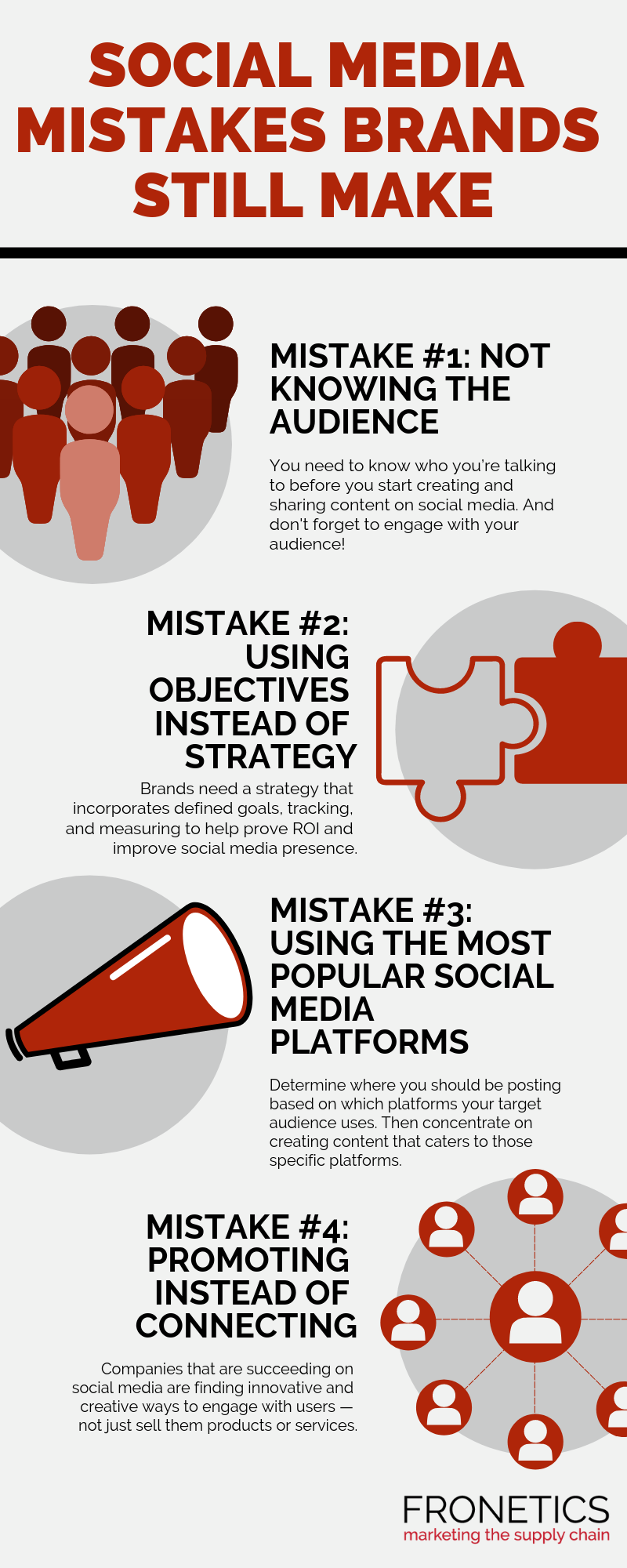
4 social media mistakes supply chain brands are still making
(Made with Canva)
Mistake #1: Not knowing the audience
You’d be surprised how often we find that brands don’t have a clear idea of their audience on social media. This covers everything from knowing when followers are active to what content hits home with them to other interests followers might have. You need to know who you’re talking to before you start creating and sharing content on social media.
So how do you figure out your audience? First, it’s important to create a detailed description of your target buyer persona – including location, education level, role in the industry, needs and concerns, and anything else that’s relevant. Next — and we can’t say it enough — engage with your audience! Participate in discussions, encourage comments, and pay attention to what your followers are telling you.
Mistake #2: Using objectives instead of strategy
Social media platforms are continually making changes and updates to improve the user experience. In order to weather these changes and keep your audience engaged, it’s imperative to have a clear strategy that includes types of content, frequency, and pillar topics. Posts should reflect your brand, so make sure posts follow style guidelines and reflect your specific tone.
A strategy will also help achieve ROI. Social Media Examiner’s 2018 Social Media Marketing Industry Report found that only 44% of marketers agree that they know how to measure social media ROI. That means two-thirds of marketers don’t know whether or how much their marketing efforts are paying off when it comes to the use of social media. A strategy that incorporates defined goals, tracking, and measuring will help prove ROI and improve your social media presence.
Mistake #3: Using the most popular social media platforms
Not all social media platforms are created equal. In fact, all social media channels have a differentiating quality that makes them appealing to specific audiences.
Start by identifying where your target audience is spending their time. For example, 81% of millennials view their Twitter account on a daily basis. If your company is looking to capture millennials as leads, your social media efforts should certainly include Twitter.
Once you’ve determined where you should be posting, concentrate on creating content that caters to those specific platforms. Lots of companies post the same content across all of the apps they use. We understand how easy that is for marketers, especially with automation tools. But the foundation of social engagement is authenticity, something that is hard to achieve when posts are the same across all channels. Work to create content — including video and images — that caters to specific platforms to build brand awareness and loyalty.
Mistake #4: Promoting instead of connecting
This one may be the cardinal sin of social media. These platforms are all about engagement. Users don’t want to engage with brands that are pushing their products and services. Users want informative, interesting, and, yes, even fun content. Companies need to focus on creating content that leaves their users wanting more.
[bctt tweet=”Users don’t want to engage with brands that are pushing their products and services. Users want informative, interesting, and, yes, even fun content. ” username=”Fronetics”]
Companies that are succeeding on social media are finding innovative and creative ways to relate to users. When you engage and get users involved in your story, you create long-lasting customer relationships. Storytelling creates an emotional bond with your company and drives brand loyalty.
Greg Hadden, executive creative director of Motive Made Studios, sums up the power of connecting with users: “What often gets lost is the fact that good storytelling is potent stuff. It has the power to make people want to believe and to belong, which is the goal of all storytellers. We’re all selling something, be it an idea, an exploration of the human condition, or say, a vacuum cleaner. It’s no mistake perhaps that good stories often create products.”
What social media mistakes do you try and avoid?
Related posts: