by Fronetics | Jan 24, 2017 | Blog, Content Marketing, Marketing
Long-form content generates more traffic, leads, and social shares than shorter content.
We’ve all heard the aphorism, “quantity over quality.” But when it comes to content marketing, part of quality may well be quantity.
While it can seem intimidating, the value of high-quality long-form content cannot be overstated. According to a 2012 study, long-form content converted 30% higher than shorter-form, and the same holds true today. Additionally, long-form posts generate more social media shares and have a higher average Google rank.
Here are some ideas for generating longer-form content that engages and informs your readers, and promotes your business in a meaningful way.
3 tips for creating longer-form content
1. Know your audience.
You first and foremost consideration should be your target audience. Take the temperature of your readers by frequently checking your comments sections, social metrics, and Google Analytics. It can also be useful to conduct a survey, which serves the dual purpose of directly engaging and communicating with your readers and giving you valuable information.
2. Chose relevant ideas.
Read all the articles that are on the first Google search page for your topic, and make sure your post contains relevant information you find. You should be answering as many of the questions that appear in Google Suggest at the top and bottom of the search page.
3. Write good content.
It seems painfully obvious, but it’s worth keeping quality at the top of your priority list. The idea of longer-form posts is to keep readers engaged and encourage them to peruse as much of your site as possible.
Neil Patel suggests that if you “strive to provide enormous value with every word you write,” your writing becomes more targeted. Keep posts visually accessible and easily digestible with short paragraphs, subheadings, and relevant images. Another key element of good content is research. Posts that include actual examples and case studies perform better than data-free posts.
Creating longer-form content may mean that your business needs to devote more resources to its content marketing efforts. But the benefits are well-documented and far outweigh the cost.
Related posts:

by Fronetics | Jan 3, 2017 | Blog, Content Marketing, Marketing, Social Media
The most popular content from LinkedIn in 2016 offers some headline inspiration for businesses hoping to improve reach and impact in 2017.
Buzzsumo’s Steve Rayson wrote an article the other day that really struck a chord with what we do here at Fronetics: He used data to analyze patterns in successful content. More specifically, Rayson examined the most popular content posted on LinkedIn in 2016 and identified headlines and topics that were most successful last year.
The results are really interesting and say a lot about what content resonates with the general LinkedIn community. I’ve summarized his findings below.
Most popular headline phrases
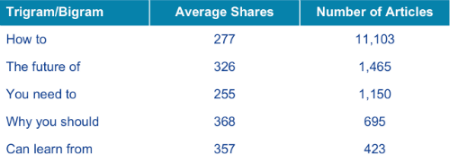
Rayson examined the 10,000 most-shared posts on LinkedIn in 2016 and identified the most common two- and three-word phrases from their headlines. Some of the most frequent included:
- How to
- You need to
- Why you should
- Can learn from
- The future of
Rayson then pulled all the headlines from 300,000 posts using these phrases. He found that not only did more headlines include these phrases, but also that posts with headlines using these phrases received more shares than average.
For context, the average number of shares for all LinkedIn posts in November 2016 was 230. Here are Rayon’s findings.
Most impactful headline words and topics
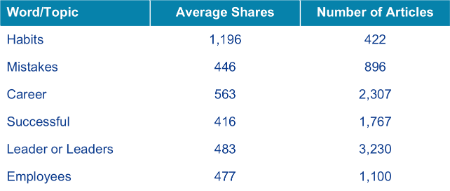
Rayson conducted the same exercise for single words or topics in headlines. His table below shows some of the best-performing words and their social reach.
How can I write better headlines?
Rayson concludes from his analysis that LinkedIn’s top-performing content — in terms of shares — usually involves instruction on how to be successful in one way or another. This is probably no surprise, given the network’s career-oriented nature. But it can be useful to marketers who are looking to create and distribute content through this platform in the coming year.
Rayson’s takeaways offer some useful suggestions for framing LinkedIn content to improve reach and impact.
- Write about success: We all aspire to do better as professionals. LinkedIn is a place we come to find advice. The core topics that do well are personal success (tips, career advice, personal skills, leadership) and business success (team management, sales, including staying ahead on top of industry trends and case studies).
- Share advice and make it personal: Does your content provide practical advice to someone personally? It can range from boosting sales to managing a difficult employee or boss. Can you appeal to users on a very personal basis, e.g. you need to or you should.
- Focus on work: Will your insights make someone more successful at work? Can you distil this down into habits or tips or mistakes to avoid.
- Talk trends and the future: Can you provide insights into industry trends and help people gain a better perspective on the future?
- Stick with what works: If you find a format that works, do not be afraid to reuse it.
Related posts:

by Fronetics | Dec 14, 2016 | Blog, Content Marketing, Logistics, Marketing, Supply Chain
In 2016 88% of B2B marketers reported using content marketing to market their business, up by almost to 3% over 2015. B2B markets are increasingly using content marketing because they recognize that it an effective tool to increase brand awareness, and to attract, engage, and convert new customers. With 51% of B2B buyers relying on content research and to make B2B purchasing decisions than they did a year ago, businesses who aren’t using content marketing are missing out on opportunities that ultimately impact their bottom line.
Fronetics is a boutique marketing firm focused on the supply chain and logistics industries. We work with companies to create and execute data driven marketing strategies with the objectives of increasing brand awareness, positioning companies as thought leaders, driving meaningful engagement with prospects and customers, and helping companies to grow their business.
Every day we see the impact content marketing has on companies within the supply chain and logistics industries. One client, for example, has realized a 30% net increase in new customers since the implementation of their content marketing strategy.
We have pulled together our top 10 content marketing posts of 2016. We hope these will help you to develop and/or strengthen your content marketing strategy in the coming year.
Top 10 Content Marketing Posts of 2016
This is a guest post by Jennifer Cortez, Director, Marketing Communications, Transplace. Cortez discusses how Transplace, a North American non-asset-based provider offering manufacturers, retailers, chemical and consumer packaged goods companies the optimal blend of logistics technology and transportation management services, has used content marketing and she offers up 3 tips for creating valuable and compelling content. Read more.
We’ve pulled together 19 content marketing trends that companies within the logistics and supply chain industries should take note of. Read more.
3. How to Overcome Your Biggest Content Marketing Challenge
2016 reports produced by Content Marketing Institute and MarketingProfs, and sponsored by Brightcove outline the biggest challenges B2B and B2C companies face when implementing content marketing strategies. We discuss how you can overcome these strategies and be successful. Read more.
TotalTrax Inc., a provider of real-time vehicle, driver, and inventory tracking technologies for manufacturing and warehouse operations, worked with Fronetics to leverage content marketing to increase web traffic, generate high-quality leads, and, ultimately, grow business. Read more.
10 content marketing strategy statistics that underscore the importance of developing a clear content marketing strategy to advance your business goals. Read more.
Outsourcing content marketing can cost a fraction of what dedicating in-house resources would — and you’ll get better results. Read more.
Content marketing is one of the most effective ways to increase brand awareness, broaden your customer base, and grow your business. Yet of the 88% of B2B marketers using content marketing, only 30% feel their efforts are successful. Why do so many organizations feel they are failing? Simply put, they do not have a documented content marketing strategy in place. Read more.
Speak your boss’ language with metrics, statistics, and facts that articulate content marketing’s impact on customer acquisition and sales. Read more.
What is influencer marketing and how can supply chain companies use it to win over customers? Read more.
A blog post not only stays around longer than a print ad, it can better engage potential customers. Read more.
by Fronetics | Dec 13, 2016 | Blog, Content Marketing, Logistics, Marketing, Social Media, Supply Chain
Get the tools you need to create and implement a content marketing strategy that drives profitable customer action for your business.
Content marketing can be an incredibly effective tool for attracting customers and growing a business. But it ain’t easy. In fact, logistics and supply chain companies report creating and executing an effective content marketing strategy as one of their top challenges.
That’s why Fronetics created its Guide to Content Marketing for the Logistics & Supply Chain Industries. Newly updated to include even more helpful tips, tricks, and ideas, the guide offers step-by-step instructions for getting an effective content marketing program up and running.
If you are a DIY kind of person or are just looking to learn more about how to develop a modern-day marketing strategy for your business, this guide is a good place to start. Templates, lists, calendars, and more will walk you through the process of developing a strategy that aligns with your business goals.
Included in this guide is information regarding:
- Buyer personas
- Keyword development
- Content creation and distribution
- Social media participation
- Lead-nurturing workflows
- And more
Click the button below to download the new and improved guide and to get started creating a content marketing strategy that works for your business.

Related posts:

by Fronetics | Nov 9, 2016 | Blog, Content Marketing, Marketing, Social Media
Try these content formats and related tools for B2B social media content that keeps your audience engaged.
Conventional wisdom, careful market research, and common sense are all telling us that social media is transforming the way we do business. We know we should be leveraging these platforms to drive awareness, engagement, and revenue for our businesses. But creating content to share with your audience is actually more difficult than it sounds.
Character limits and the increasingly visual nature of these platforms means marketers are having to get creative with how they engage their audience. Here are four ideas and related tools that can help B2B organizations produce interesting, informative content that is suited to social media.
1) Video
The 2016 Social Media Marketing Industry Report rates the growing prevalence of video among its top findings for the year. It found that 60% of marketers are now using video in their marketing, and 73% are making it a goal to increase their use of video. This trend is for good reason — 64% of business that use video reported that it has led directly to increased sales.
Video is an efficient, visually appealing way to present your content in an imminently shareable format. Here are some online tools to help you create effective video content for your business.
- PowToon: A tool that guides users through the creation of animated videos and presentations, PowToon boasts an approachable interface and minimalist design that makes it simple for marketers with limited video experience.
- Magisto: Ideal for creating videos with emotional impact, Magisto features tutorials on creating video for your business, and allows users to create highly customizable video content through a simple interface.
- WeVideo: Featuring advanced video-editing tools with a simple interface, WeVideo is a cloud-based collaborative video editor that allows users the convenience of cloud video storage.
- Wideo: Allowing you to create videos in minutes, Wideo offers a variety of plans aimed toward working with your existing marketing strategy.
Creating your video is just the first step. Here are some places to upload and share your content:
- YouTube: The titan of video sharing services, YouTube allows for public and private upload, and gives users free access to analytics tools for their videos. Along the way, take a look at these valuable tips for getting more views on your YouTube videos.
- Vimeo: With a similar platform to YouTube, Vimeo is ideal for video sharing, discovery, and generating creativity.
2) Infographics
Social media platforms are becoming increasingly visual. A well-designed infographic makes your content visually appealing and delivers your message in a clear, easily digestible format. A recent report from eMarketer and the communications firm Lewis found the demands of social media and the format’s high engagement rates are key reasons for its use.
Here are some online resources that let you create and share infographics:
- ly: This site features a vast array of templates, which you can easily edit and customize and share immediately on social media platforms.
- Piktochart: With an easy-to-navigate interface, Piktochart allows you to create intricate, design-rich graphics, complete with icons, images, charts, and interactive maps, and publish them directly to social media platforms.
- Canva: This site allows for quick creation of infographics, as well as presentation covers, social media images, online advertisements, and flyers.
- Visme: A simple interface, Visme allows you to translate your ideas into engaging infographics, presentations, reports, and more. You can share your content online as a URL or on social media, embed it on your website, or download it.
3) Podcasts
The 2016 SME Report identifies podcasting as a relatively untapped way for marketers to engage with social media audiences. The audience for podcasts in the United States alone is close to 60 million people, making this medium a significant opportunity for businesses to engage with potential clients.
Here are some tools that can help you create quality audio content:
- Audacity: This open-source audio software lets you record audio, convert tapes and records into digital recordings, and add your own audio effects.
- Podbean: This tool lets you quickly create and share professional podcasts, no programming knowledge necessary. You can publish them directly to social media platforms.
4) Slides
If you have a lot of dense, industry-specific content that you want to get out to your audience, presentations are ideal. Breaking up your content into slides lets you get the information to your network in an engaging and visually appealing way.
Here are some tools that help you create and share professional presentations:
- SlideShare: LinkedIn’s platform lets you build, upload, and edit presentations, and share them on social media.
- SlideBoom: Ideal for converting PowerPoint presentations to Flash, SlideBoom lets you share your presentations with your target audience.
- Prezi: This tool is available for download or as an online editor, and it allows you to add animations to your presentations and share your content on Twitter, Facebook, and LinkedIn.
Social media has changed the way businesses engage with their target customer base. Embracing these tools is key to creating and maintaining an active and loyal audience.
Related posts: