by Fronetics | Mar 20, 2017 | Blog, Content Marketing, Marketing
If you want to connect with your target audience, make storytelling a part of your content strategy.
If you want content marketing to make a big impact on your business, your audience needs to connect with your content. You need to engage them. You need to grab them emotionally and intellectually. You need to get them thinking.
The best content feels like a great story. That’s because stories do all those things and more.
Content that reads like a great story will facilitate engagement and brand loyalty with your audience, which, in turn, will lead to content marketing success. Here are some tips to incorporate storytelling into your content strategy.
Make your brand tangible to your audience.
Statistics and graphics have their time and place. But real people and real experiences are the best way to connect with your audience on a deeper level. Tell real stories — how a customer benefitted from your product, for example — to get your audience to understand what your company can do for them.
When you engage readers and get them involved in your story, you create long-lasting customer relationships. Storytelling makes them form an emotional bond with your company, which drives brand loyalty.
Greg Hadden, executive creative director of Motive Made Studios, sums up the power of this strategy: “What often gets lost is the fact that good storytelling is potent stuff. It has the power to make people want to believe and to belong, which is the goal of all storytellers. We’re all selling something, be it an idea, an exploration of the human condition, or say, a vacuum cleaner. It’s no mistake perhaps that good stories often create products.”
Humanize your content.
Yes, at the end of the day, we’re all selling something. But your content should not be a sales pitch — it should speak to your audience rather than at them. It should connect with them on a human level.
Your content should represent what you do, what your customers stand to gain, and how you are making life better for your customers and those around you. It should convey genuine enthusiasm for your work.
One of the best ways to tap into this enthusiasm is by thinking about what your company stands for and building content around those principles. Is sustainability at the core of your mission? Does your company pride itself on improving customers’ productivity and efficiency? These are messages that can humanize your brand — and that your audience can believe in and relate to.
Whole Foods is an exceptional example of a company using content to connect with its audience and establish itself as a lifestyle brand focused on healthy eating and living. It curates content, for example, about how to save money while still eating healthily. While not directly related to its products, this kind of content understands the needs of the target audience interested in Whole Foods’ products. Further, its content conveys the company’s passion for earth-conscious living and uses proactive language to allow readers to feel like they have an active role in that mission.
Successful content begins with connection. The more you can walk the line between telling a story and promoting your brand, the more connections you’ll make. Start by being yourself and talking about what drives you in your content. The stories you share will be authentic and tangible to the target consumer who is interested in what you have to offer.
Related posts:


by Fronetics | Feb 22, 2017 | Blog, Content Marketing, Marketing, Strategy
Follow these 4 steps to learn how to build a successful DIY content marketing strategy that will help grow your business.
Are you trying to create a content marketing strategy, but don’t know where to begin? Even the language around content marketing can seem foreign to newcomers. That’s why Fronetics created its guide, How to Grow Your Business with Content (download below) — to make creating a content marketing strategy possible for the DIYer in your company.
Setting your content marketing strategy is a crucial first step in trying to reach your target audience. Before you begin writing blogs and posting tweets, you need to set goals. A content marketing strategy outlines the methods by which you will target, reach, and engage your audience. Here are four steps, outlined in the guide, to creating a successful foundation to your content marketing strategy.
Steps to building a content marketing strategy
1. Identify your target audience and buyer persona(s)
Knowing who your ideal customer is allows you to create content that is informative, educational, and entertaining to that specific person. Trying to write compelling content for an unidentified audience is like taking a shot in the dark. The more detailed you can be with your buyer persona(s), the more specific and effective your content can become.
2. Define goals and objectives
Your content goals should be a direct reflection of your business goals. What do you want your content marketing efforts to accomplish for your company? The top marketing goals for content marketers in 2016 included converting contacts/leads to customers, growing website traffic, and increasing revenue derived from existing customers. Make sure you include short-term and long-term goals and that you frequently refer back to these goals to make sure your strategy is on track.
3. Developing and distributing content
Once you have identified your audience and defined your content goals, you can begin to educate yourself about the distribution platforms that will work best for your business. Let’s face it: Social media is not a one-size-fits-all solution. It’s imperative you know not only what to post but where to post it.
There are lots of great resources to help you optimize your content marketing presence. You can individualize your outreach so your blog posts are reaching one target audience, while your tweets are capturing another.
4. Put your knowledge to work
Once you have worked through the initial steps of planning a successful content marketing strategy, the real fun begins. It’s time to start pushing valuable, effective content out to consumers. If you’ve spent the time and effort up front to really thing through your strategy, you’ll reap the rewards in good time. Just remember that your strategy should be fluid, and you should be able to adjust your plans as you move forward and find what is working and what isn’t.
Pulling together a content marketing strategy for your B2B business can seem overwhelming. But having the right tools to support you can make all the difference. Download Fronetics’ easy-to-follow, step-by-step guide How to Grow Your Business with Content below to take the leap to a successful DIY content marketing strategy today.

Related posts:

by Fronetics | Feb 15, 2017 | Blog, Content Marketing, Marketing, Strategy
Ask yourself these six questions to see if you could be attracting more leads by writing better content.
All too often, marketers fall into the trap of sacrificing quality for quantity in their content writing efforts. It’s an easy mistake to make — the pressure to produce a constant stream of content can naturally lead to a drop in quality. But if you’re not writing high-quality, substantive content, you’re wasting time and energy.
If you’re wondering whether your content might not measure up, ask yourself these six questions.
Do you need better content?
1) Is my content search-engine optimized?
Since over three-quarters of today’s buyers use Google to research products, a key to making sure your content is showing up in search results is search engine optimization (SEO). This means writing copy that will be prioritized by Google in web queries related to your business or products. For ideas on SEO optimization, check out these 3 Quick SEO Tips to Improve Your Blog Right Now.
2) Am I using the right channels to reach my target audience?
In order to answer this question, you first need to have a clearly defined idea of your target audience. Once you know who you’re trying to reach, evaluate where they’re active. Analytic programs like Google Analytics and sites like Tweriod can provide valuable insights on your followers’ social media habits.
3) Am I publishing content, or a sales pitch?
Remember that content marketing is about offering valuable, expert information to your audience — it’s not an overt sales pitch. Present your readers with this kind of expertise, rather than a repeated sales pitch, and you attract loyal customers, and associate your brand with quality and value. Anything you post should be geared to meet specific needs of your customer, rather than to bludgeon them with information about your products or services.
4) Am I providing a good quality user experience?
Pay attention to format, length, accessibility, and voice. Is your business’ website visually appealing and easy to navigate? People will read your content only if it’s visually accessible and engaging.
5) Have I paid attention to performance analytics?
Be aware that what worked last year may not work this year — pay attention to performance analytics to monitor what kind of content is successful and what is no longer generating and converting leads.
6) Is my content good?
This might seem like the most obvious question of all, but it’s important to ask it every time you post. Of course, determining what constitutes good and bad content is the key here. Are you producing writing that is original, substantial, and well written? A good tool to get you started is Fronetics’ On Writing Good Content: A Guide for the Logistics and Supply Chain Industries.
Remember, your content is a reflection of your company. When potential buyers come across your blog posts or other content online, that’s how they get to know you. If it’s poorly written with mistakes and blurry images, well — you look pretty sloppy.
Quality, substantive content shows that you are an authority in your field. It will let potential buyers know that you know what you’re talking about, that you run a polished business, and that they can trust you. So while quantity is important when it comes to content, quality should never be compromised.
Related posts:

by Fronetics | Feb 7, 2017 | Blog, Content Marketing, Manufacturing & Distribution, Marketing, Supply Chain
Here are four key takeaways from the manufacturing content marketing report.
The Content Marketing Institute (CMI) has released the results of its annual manufacturing content marketing survey, and there have been some big changes since last year.
Like many businesses in the logistics and supply chain industries, manufacturing companies have been slow to adopt modern marketing principles. Many are hesitant to undertake a content marketing program, whether from lack of time or lack of knowledge about how it works and the benefits.
But that is beginning to change. Manufacturing companies are realizing how much there is to gain from inbound marketing strategies. They’re practicing content marketing, and it’s paying off. In fact, CMI has been conducting the survey among manufacturing operations for the last four years, and never before have the results indicated such progress.
We’ve summarized four of the things you need to know.
4 takeaways from the CMI manufacturing content marketing report
1. Marketers are improving at content creation.
Compared to one year ago, 59% of manufacturing marketers report more success with content marketing for their organizations. A whopping 82% of that group credits this increased success with improved content creation. This means that marketing professionals are getting more efficient at producing higher-quality content.
Related resource: Check out our guide on writing good content.
2. A documented strategy gets results.
This year’s study showed a 72% increase in companies’ documenting their content marketing strategy. Documenting your strategy allows you to set goals, identify benchmarks, and follow through on your objectives. It’s also easier for your organization to come together with a unified, well-rounded marketing and sales strategy.
Related resource: Start crafting your strategy with our content strategy template.
3. Content marketing is becoming a greater priority.
It may seem obvious, but for greater content marketing success, your business must prioritize your content marketing efforts. Of marketing managers who reported increased success last year, 62% credit putting content marketing higher on their priority list. This means communicating with leadership to ensure ample time to produce quality content.
Related resource: Show your bosses these 6 marketing metrics they really care about.
4. Manufacturing marketers are becoming more seasoned with content marketing.
The manufacturing world is gaining experience with content marketing. According to CMI’s survey, more than half (56%) of respondents report that their organizations’ content marketing maturity level is either sophisticated, mature, or adolescent — as opposed to young or “first steps.” That’s an 8% jump from last year. Gaining experience creating, documenting, and implementing a strategy is what ultimately allows marketers to determine what works for their business — and to see sustainable success.
Related resource: See how companies in the logistics and supply chain industries are using content marketing.
Going forward
CMI identified some areas for improvement for manufacturing marketers. Consider these recommendations as goals for your business as 2017 progresses:
- Fully commit to content marketing. It’s time to go all in.
- Focus on clarity in setting goals and documenting results.
- Have a real vision of what success means for your business.
Manufacturing operations have come a long way in the past year with content marketing. As the supply chain industry gets more and more comfortable with this kind of marketing, the possibilities for business development continue to grow.
Related posts:
![Outsourcing Content Marketing: 13 Stats You Should See [Infographic]](https://fronetics.com/wp-content/uploads/2024/10/outsourcing-content-marketing.jpg)
by Fronetics | Feb 1, 2017 | Blog, Content Marketing, Marketing
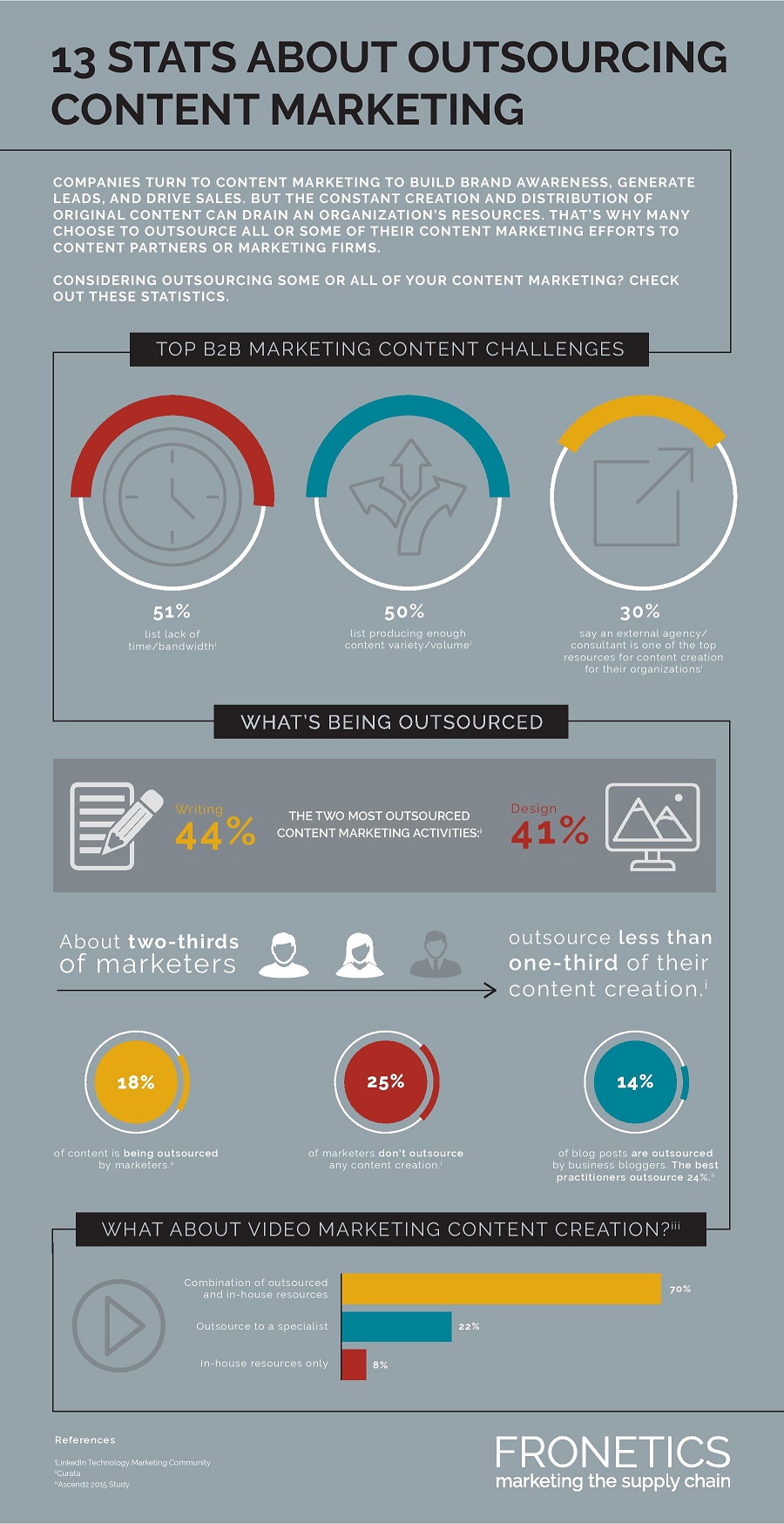
Thinking of outsourcing content marketing? This infographic illustrates how other B2B marketers are handling content creation.
Plan. Create. Distribute. Repeat.
Does the constant creation of content feel like a drain on your resources? Do you feel like the content you’re publishing isn’t on par with the standards of your business? Do you dread the days that you need to write a blog post or prepare a customer resource?
If any of these questions hit home, chances are you’ve thought about outsourcing.
Outsourcing content marketing can be a beautiful thing: You put the content creation, design, and even distribution in the hands of an expert, leaving you free to focus on your job. But, isn’t that cheating? (It’s not.) Are other companies doing it, too? (You bet.) Ultimately, is it a good business decision? (The top business blogs outsource about 24% of their content creation.)
We’ve created the following infographic to illustrate how other B2B marketers are handling outsourcing content marketing. Here are 13 statistics you need to know before you consider outsourcing.
(Made with Canva)
Related posts: