If you’re hoping to generate more leads on your website, you’re going to have to develop a holistic content strategy and create many strong calls-to-action.
You may have read part one of this mini-series about the importance of having a solid website if you’re going to invest in content marketing. Essentially, there’s no point in pouring a bunch of time, money, and resources into a robust content marketing program if the website that you’re driving traffic to stinks.
Be thoughtful about the role your website plays in the lead-generation process. It’s a really important piece of the puzzle that companies often overlook.
Consistently producing quality content and distributing it through various channels, like social media, will help attract your target audience to your website. But unless you provide them with a good user experience while they’re there — and give them plenty of opportunity to opt in to learn more about your business — you’re not going to move them down the sales funnel. And you’re not going to generate more leads on your website.
So how do you ensure your website is a lead-generating machine? Here’s what I know.
5 tips to generate more leads on your website
1) Create a holistic content strategy.
I can’t overstate the importance of creating a content marketing strategy, documenting it, and then designating someone to lead it if you want your content marketing to be successful. As part of that strategy, you should outline the role your website will play in assisting the conversion of leads.
Ask yourself these questions:
Do different pages of my website suit prospects at different stages of the buyer’s journey?
Where do I want traffic to go from each page (so prospects move further down the funnel)?
What calls-to-action can I add to each page to assist them in that move?
Which pages are ripe for lead conversion, and which are better for providing information?
If you’re using the topic cluster model (which you should be!), where are my pillar pages and corresponding topic cluster pages?
Also, make sure your messaging is consistent across your website and your regularly published content (like blog posts).
2) Think about the user and how s/he experiences your site.
Hopefully in creating a holistic content strategy that includes your website, you’re thinking primarily about how the user will be interacting with your site and each page. That means organizing pages in a way that makes sense for the prospective customer, rather than internal politics.
That sounds easy, but I have helped many organizations for whom this is incredibly challenging. Often, one department (or person) feels strongly that something very important to them deserves real estate on the homepage or in the main navigation. But, if it’s not something that is meaningful to a prospective customer, you’d best not cave. Doing some usability testing with prospects is a good way to collect data to support your reasoning.
Also to consider: think about the language your buyers are comfortable with, and avoid any overly jargony or technical wording. Make sure to lay things out in a way that is approachable for them. And aim to provide the information they seek, rather than trying to sell them at every step.
3) Publish original, quality content.
Along those same lines, the best way to convince today’s B2B buyer to choose you as a vendor is to win them over with your content. Content marketing is all about positioning yourself as an expert in the industry, after all, the business that knows the most about your product/service.
Instead of promoting your business on every page, use each as an opportunity to showcase your expertise. Create resources that will help buyers better understand how to solve their pain points. And make sure everything you publish is well-written, offers value to prospects, and is completely original. You want people to want to read what you have to say.
Consider incorporating various content formats to cater to different learning preferences:
In-depth blog posts and articles
Infographics for visual learners
Short video tutorials or explainers
Podcasts for those who prefer audio content
4) Strategically place strong, visible calls-to-action.
I’ve hinted at this one already, but it bears further explanation. Make sure your website is full of calls-to-action, or buttons/links/forms that ask visitors to do something further. After all, how do you expect someone to take an action (like providing their email address) if you don’t ask them to do it?
You can generate more leads on your website by asking visitors to become leads more often.
Make sure these calls-to-action stand out on the page so that visitors’ eyes naturally go there. Be very clear about what you’re asking for and/or what the user will get in return when they complete the action. And, again, be strategic about what you’re asking people to do on which page. You won’t have much luck, for example, asking visitors to call a sales rep on a page that is designed to assist them with initial information-gathering.
Pro tip: Use A/B testing to optimize your CTAs. Try different colors, copy, and placements to see what resonates best with your audience.
5) Offer value with your calls-to-action.
Sometimes it might take a little convincing to get visitors to provide their contact information. The best way to persuade them? Give them something they want in exchange.
We call this high-value content. Examples might include:
Case studies
White papers/industry reports
Webinars
Tutorials or how-tos
Demonstrations
Sneak peaks or previews
Guides or ebooks
Podcasts
Ask visitors to download your high-value content by completing a form, which asks for their email address. Set up your marketing automation to email the content to them, then send a series of lead-nurturing emails following up at strategic intervals to keep them moving down the sales funnel.
If you want to generate more leads on your website, follow these five steps. Above all, just be thoughtful about the role your website plays in the lead-generation process. It’s a really important piece of the puzzle that companies often overlook.
Internet users are changing how they search, and search engines are changing in response — which means writing for SEO is changing, too.
We just wrapped up a detailed series on how SEO is changing and what that means for those of us trying to reach potential customers in the digital world. Writing for SEO means creating content that drives traffic, preferably highly qualified traffic that will convert to sales leads. Basically, you need to write your web pages in a way that tells search engines what your site is all about.
Search engines have been working overtime to keep up with the ways internet users are searching the web. Developers are frequently updating the algorithms that Google and Bing use to make sure that users are finding exactly what they’re looking for.
This means that writing for SEO is also changing. You need to keep up with the changes to make sure your content is reaching your target audiences. Trying to rank for certain keywords in each blog post you publish is a practice on the way out.
So, what now?
Make sure you are focusing your content on what your business does best and structure your content around those topics. It’s called the topic cluster model.
Do you know all the latest packaging trends? Do you love helping clients cut down on production costs? Use these areas of expertise to build website content that support your pillar content.
In this video we’ll discuss the four things to know in a changing search landscape and what you can do to stay ahead of these changes.
Video: Writing for SEO tips
I do want to mention that you should never artificially stuff your blog posts with keywords or links or images. After all, search engines will continue to evolve to help readers find what they’re looking for. They’ve gotten really good at spotting these stuffed posts, so stop wasting your time trying to outsmart them.
Your best bet to improve SEO is to create content that is valuable to your target audience. Then you should use these tips as a guide to help users looking for content like yours to find it.
These 5 steps will help you identify topic clusters for your business that improve your search engine visibility and drive traffic to your website.
As search engines adjust their algorithms to be more sophisticated, marketers have the opportunity to structure content strategically to optimize website search rankings. We’ve written in detail about this new reality in our writing for SEO series.
One of the best ways to strategically structure your content is with the topic cluster model, in which broad cornerstone content is contained on pillar pages, and related subtopics are contained in cluster content. Each grouping of subtopics and corresponding pillar page is called a topic cluster.
This structure is intended to build authority and influence for your business in the eyes of search engines and visitors. Effectively using a topic cluster structure is the best way to drive relevant traffic to your website.
First you need to identify your pillar content. HubSpot’s Leslie Ye sums up her philosophy of choosing pillar content, saying, “Ask yourself this: would this page answer every question the reader who searched X keyword had, AND is it broad enough to be an umbrella for 20-30 posts?”
The key takeaway here is that your core topics need to be broad enough to encompass a fair amount of content, narrow enough to allow you to fully address the topic with your content, and, most importantly, they need to be in an area of expertise for your business.
So how do you identify topic clusters strategically? Below are five steps to get you started.
5 steps to identify topic clusters
1) Chart out five to ten primary issues that your target buyer persona faces. You can do this by running interviews, conducting surveys, and researching within online communities like Quora to gather your data.
2) Group each of the issues into broad topic areas.
3) Using keyword research, flesh out each of the core topics with subtopics.
4) Audit your historical content, and map it to align with each of the core topics and surrounding subtopics.
5) Assess where your content makes the strongest cases. Those are your core topics.
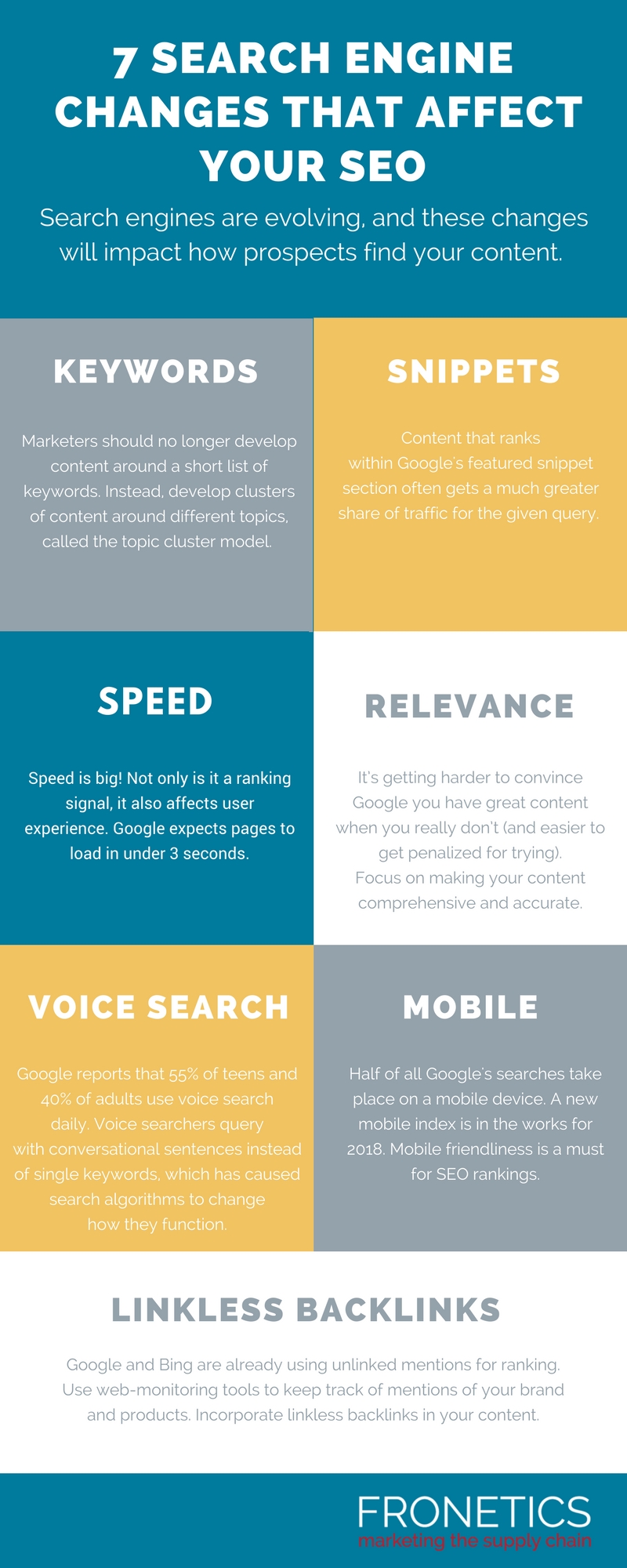
Search engines are evolving, and these changes will have big impacts on how searchers find your content. Here are 7 changes that will affect your SEO.
Internet users are changing how they search, and in response, search engines are changing how they rank content. Newer, more sophisticated algorithms have had big impacts on SEO rankings and the changes haven’t stopped there. Search engines are working around the clock to improve how content ranks for their users. Google and Bing want to ensure its readers are getting the quality content they deserve.
What does this mean for your SEO? It can be very challenging to understand all of the factors that go into a search engine’s algorithm for rankings. Google has over 205 factors that play a part in determining where you content lands in a search and they’re always changing. Instead of worrying about all of those components, here are 7 changes that have big impacts and are easy to integrate into your content.
7 search engine changes you need to know: infographic
Changes to the way search engines work do present a challenge for content creators writing for SEO. But keeping pace with the ever-changing technology is key to keeping your content relevant. Keeping these 7 key changes in mind, content writers can work to integrate these changes into their new content, as well as update older content.
Ultimately, the best way to improve your SEO is through your content. Quality content that is valuable to your target audience should be your biggest priority. With good content and keeping these 7 changes at the forefront, you will be able to optimize your posts and increase the likelihood internet searchers will find them.
Internet users are changing how they search, and search engines are changing in response — which means writing for SEO is changing, too. Here’s what you need to know.
I’ve just completed a really detailed, often-complicated series about writing for SEO in today’s changing search landscape. I hope you read all four posts and now have a better understanding of the new way we marketers are thinking about content marketing.
But, as my colleagues occasionally have to remind me, not everyone enjoys the nitty gritty of SEO writing like I do. It’s also important to step back and take a look at the forest after examining the trees.
So here are some really important takeaways from the series — about how internet users, search engines, and writing for SEO are changing — that I think are important for all marketers in the supply chain and logistics industries.
4 things to know in a changing search landscape
1) Search engines are changing.
While keyword rankings used to be the gold standard for measuring SEO success, this is no longer the case. New search algorithms have moved beyond giving everyone the same results of a query, meaning that keyword ranking can change drastically depending on context (like location).
In addition, Google is increasingly showing featured snippets at the top of search results.
What you need to do:
Know that measuring SEO success is no longer as simple as keeping track of keyword rankings. It’s still information worth having, but it’s part of a larger set of metrics you need to evaluate your success and tailor your efforts.
To effectively take advantage of featured snippets, it’s important to structure your content so it’s optimized to appear in this prime location.
Because of the rise of mobile and voice search, people are now searching with a phrase or question rather than a single term. In response, search engine development has focused on natural language processing — meaning search engines now analyze phrases as a whole rather than a keyword. That essentially means they evaluate a site’s content regarding an entire topic rather than its use of a particular word in order to deliver the best answers to users’ queries. Basically, we’re looking at the same issue as the last post, but from the user end.
What you need to do:
Stop trying to rank for a small set of keywords. What’s important is broad visibility across a topic. You should start thinking about the major themes of your content and then build posts and website pages to support them.
3) Structure your content in topic clusters and pillar content.
Pillar content is your evergreen content that offer a high-level overview of the several ideas/phrases/value propositions that most closely align with your brand. Topic clusters are the subtopics that provide more detail on those high-level ideas of your pillar content. Adding hyperlinks to pillar content pages from topic cluster pages and vice versa creates a structure that signals to search engines that your site has lots of good, well-organized information about a certain topic, which improves ranking across that topic.
What you need to do:
Structure your content into pillar content and topic clusters. Add hyperlinks between the pages. Optimize topic cluster pages to drive traffic and pillar content pages to convert leads.
Measuring success is getting more complex. You can no longer effectively gauge the effectiveness of campaigns on a post-by-post basis. Instead, measure your visibility across each topic.
What you need to do:
Start looking at the bigger picture. Consider how all content under each cluster topic performs as a whole. As you do this, keep the big four questions in mind:
1) Which topics perform best at driving traffic to your website or other web presence?
2) Which topics earn you the most leads?
3) Which topics drive the most revenue to your business?