
by Fronetics | Jun 9, 2016 | Blog, Content Marketing, Marketing, Strategy

A data-driven content marketing strategy will increase your program’s success and help win the buy-in of executives.
What is driving your digital and content marketing strategy? If all you have in the driver’s seat are a few creative ideas, you may find yourself frustrated with the results and struggling to garner support from the C-Suite.
Different audiences respond in different ways. The question is, where are your potential new customers and what are they looking for? Data plays a critical role in uncovering those answers.
Data can guide you to:
- Define your target audience. Who are you trying to reach? When can you best reach them?
- Select the best topics for your content. What information do they need, and what will peak their interest? What do they seek most from the content they read?
- Narrow down a distribution strategy that will produce results. Which digital and social media channels will best reach your audience, grow your business, increase sales, and improve your brand’s reach? Which networks are your competitors using most?
- Gauge what is working and what is not. Reportedly, 53% of digital content marketers don’t measure their success. No wonder so many content marketing programs fail. If you don’t take the time to determine what content is resonating with your target audience, how will you know what to produce in the future?
- Tune into market changes. As your business evolves and customers’ needs change, data serves as your compass to remain competitive in an ever-changing marketplace.
A data-driven strategy will win over the C-suite
In addition to giving you a foundation for your strategy, data can garner the support of the C-suite, which you must have in order to fund your marketing program. A plan based simply on ideas, no matter how brilliant, will not appeal to executives who base decisions on data.
They want to see how your marketing plan provides answers to the needs of your target audience (potential customers) and what those customers are worth to the company’s growth and success. If your strategy aligns with data, they’ll be able to get behind every point.
Creating a data-driven strategy
Aligning your strategy with data takes some time and effort, but it is crucial to optimizing the performance of your content marketing program and winning C-suite support. Here are some steps to get started.
- Analyze your reports, data, and interviews with stakeholders in the company about your target customer. Compile this information, and document the very specific demographic(s) you want to reach. Research the digital behaviors and patterns of this demographic.
- Audit your existing content (or hire an expert to do it). Look at the substance, source, and performance of your most successful and your least successful assets. Are there changes you can make to your poor-performing content to improve it, based on learnings from your successful content and your audience research?
- Plan an editorial calendar of future content based on what has been successful in the past. Sharing this information and seeking ideas from employees outside the marketing department can be a very valuable exercise.
- Test the distribution channels and times that have been most successful in the past and that fit the behaviors of your target audience. Continually refine your distribution strategy based on your results.
- Don’t forget to document your strategy! Marketers who put it in writing report success at significantly higher rates than those who don’t document their strategies.
By distributing the right content, at the right time, to the right audience, on the right channels, your content marketing program will reach its maximum potential.
Related resources:

by Fronetics | May 30, 2016 | Blog, Content Marketing, Marketing, Supply Chain

Fronetics’ new guide offers a road map for content production that will help grow your business.
Content marketing is one of the most effective ways to generate leads and grow your business. Yet only 30% of B2B marketers define their content marketing programs as successful. Time and again, they cite producing effective content as their main challenge.
Consider this: 27 million pieces of content are shared every day, and most of it is crap. For your content to be effective — meaning your content attracts your target audience and drives profitable customer action — it must stand out, really stand out, among the masses.
Fronetics has developed a guide to help companies in the logistics and supply chain industries create effective content. On Writing Good Content : A Guide for the Logistics and Supply Chain Industries provides a road map to producing content that generates leads and drives new business. With this guide, you will:
- Learn the basic principles of good content
- Identify potential content creators within your organization
- Brainstorm ideas for original content
- Receive writing prompts that will get you started producing the kind of content that will resonate best with your target audience
Start creating effective content today by downloading the free guide below.

Related posts:

by Fronetics | May 24, 2016 | Blog, Content Marketing, Marketing, Strategy

Outsourcing content marketing can cost a fraction of what dedicating in-house resources would — and you’ll get better results.
Nobody can do it all, despite what the latest motivational meme tells you. When running your business, it is vital that you focus on where you excel; sticking with your core competency is critical. Essentially, the more hats you wear in your company, the more watered down your efforts become.
Content marketing can be highly effective in generating leads and driving sales, but doing it right requires significant time and effort. If you are trying to manage content on top of overseeing key aspects of your business’ day-to-day operations, you are stretching yourself thin. What’s more, it’s negatively impacting your bottom line.
Why DIY content marketing can be costly
Many companies mistakenly think that managing their content marketing in house is simple, cost effective, and not time consuming. Actually, nothing could be further from the truth. Here is why:
Lost hours on your job
Taking time away from your primary focus prevents you from doing your job. If what you do best is new product development, for example, then dedicating hours each week to writing blog posts means that much less time for market research, design, and implementation. Those few hours away each week add up over time, and the cost to your company is significant.
Lost leads and sales opportunities
You may be a good writer and have personal social media accounts, but do you understand the ins and outs of creating and distributing content in a business setting? Professional content writers have expertise in search engine optimization (SEO), branding, user experience, and storytelling — all of which drive traffic and generate leads. Social media strategists similarly have expert knowledge of networking sites and how to best reach a target audience. If you don’t have that expertise, you are costing your company those opportunities — or, again, taking time away from your primary function trying to learn.
Lost readership and audience retention
If your content does not engage your audience, you shouldn’t have bothered in the first place. And engaging content doesn’t occur by happenstance. Research shows a strong correlation between content marketing success and strategy, documentation, and frequent check-ins. You need to know exactly who your audience is and what they want to read, and then you need a long-term plan for continually reaching them in new and interesting ways. Then you need to regularly assess your strategy and adjust as needed. As you can imagine, that all takes time and focus.
According to Forbes, outsourcing your content marketing is a cost-effective way to increase the success of your program. Essentially, you get expertise and experience — at a fraction of the cost of dedicating in-house resources — with no long-term commitment. By allowing experts to create strategies and leverage well-crafted, engaging content across multiple channels, you can improve lead generation and exponentially increase sales.
The Takeaway
By outsourcing your content marketing to the right firm, you can:
- Get professionally written, optimized content that engages your target customer and builds relationships.
- Benefit from the firm’s experience with content marketing for your industry and beyond.
- See results and ROI. The firm should put metrics on all of your marketing activities and deliver a regular report to you so you can monitor progress.
- Save time and money: You can focus on the core aspects of growing your business, while outsourcing your content marketing costs a fraction of dedicating in-house resources.
Simply put, it ultimately costs less to let experts create and execute your content. Given the reins, they can leverage their experience to produce greater results, capture more leads, analyze results, revise strategies, and, most importantly, free up your schedule to focus on your key responsibilities.
Related posts:
by Fronetics | May 17, 2016 | Blog, Content Marketing, Marketing, Strategy
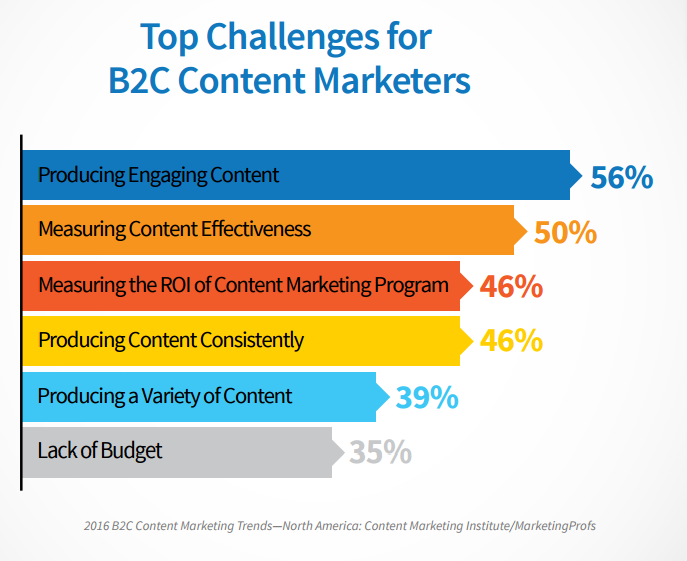
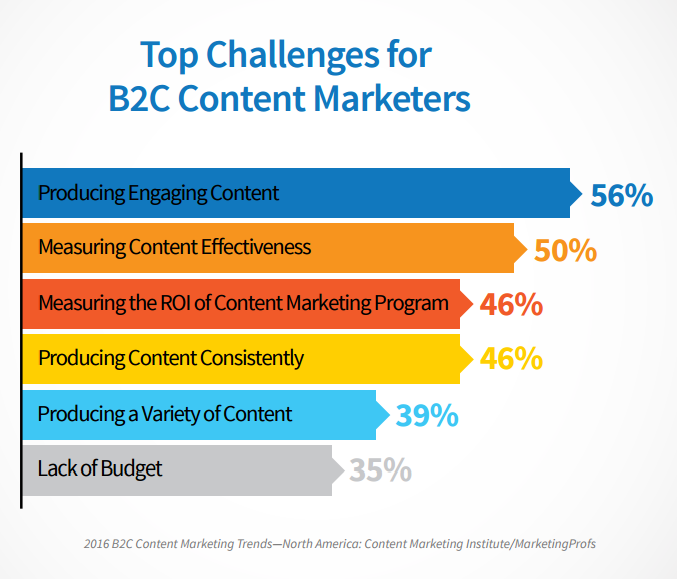
Producing engaging content is the number one challenge for content marketers.
Is content marketing working well for your business? If not, you are not alone. Though it is one of the most effective ways to grow your business, content marketing has been challenging B2B and B2C organizations since its inception.
You may think it should be simple: Write, post, get more customers. But content marketing is much more complex, demanding more time, thought, and careful strategy than churning out a few blog posts. First and foremost, what you produce must engage readers. This is, however, the biggest content marketing challenge facing both B2B and B2C marketers.
2016 reports produced by Content Marketing Institute and MarketingProfs, and sponsored by Brightcove, found that the number one challenge for B2B and B2C marketers is producing engaging content.
Dull content and the domino effect
Unfortunately, if you lack engaging content, it works like a domino, knocking down all your other marketing efforts.
For one, it is much easier to gain the support of the C-suite, and be granted a reasonable budget, for your content marketing plan if you can show that your strategy is attracting more customers, helping with conversions, and driving sales. But if your content is not producing results, you won’t get the support and resources you need to produce the content, which, in turn, fuels results. It is a vicious cycle.
That being said, lack of engaging, quality content may be indicative of other challenges you may be facing, like the resources to produce content.
Creating engaging content
There are a few basics you must address if you are going to produce engaging content:
- Research your customer demographic. You must know who your audience is, what they want to know, how they want to learn it, and where to find them. Use web analytics to learn how your audience interacts with your website, what kinds of posts and emails they are reading, and where improvements can be made.
- Do your due diligence and learn how to reach those potential customers with topical information they want and will read. This means conducting a solid analysis of trends in your industry and producing content that offers expert information on these subjects or answers pressing questions potential customers may have about them. You, thus, will establish your organization as a trusted voice for your industry. This leads to dialogue with prospects and customers that want to learn more from you about industry news — or, even better, who are interested in your products or services.
- Research your distribution channels. This can affect not only what you post, but where and when you post it. Know your target’s social media habits, when they read emails, and what they are looking for. Research your competition and learn which channels they focus their attention on and why. Read the latest industry publications and influential blogs to uncover what topics work to engage their readers. Look for trends and answer to them.
- Look at SEO evaluations and site audits to help identify new middle- and bottom-of-the-funnel opportunities for content.
- Tell a story.
If creating engaging content has proven to be challenging for your business, consider outsourcing your content creation, or your marketing program all together. According to Social Media Today, lack of marketing staff can make it difficult for organizations to produce enough content to keep up with their competition.
Quality research and consistent creation of engaging, relevant content is time-consuming and requires keen writing skills. Promoting your posts on social media also takes time and requires consistent effort. Some of the most successful organizations put this task in the hands of an expert that can create and leverage content to provide the greatest impact to your brand, lead generation, and new customer conversion rate.
Related posts:

by Fronetics | Apr 12, 2016 | Blog, Content Marketing, Marketing, Strategy
Content drives business growth, builds customer loyalty, and helps nurture leads.
One of the best ways to market your business today is to plant the seeds that will generate new customers tomorrow. Enter, content marketing: a long-term solution that helps businesses build brand awareness, grow their audience, and generate new leads and sales.
Most companies, more than 85% of them, realize that content marketing is a vital component to cultivating growth. But, according to the Content Marketing Institute, less than half of those who use it believe they do it well.
It may be particularly difficult for smaller businesses to justify allocating precious time and resources to a strategy that they are not sure is being executed properly. How can they compete against industry giants that have name recognition and massive budgets working for them already?
Medium-sized to smaller companies need to establish a relationship with their potential customers or clients and drive brand awareness, accomplishing this goal with far less resources. And content is the way a company makes that all-important connection.
With quality content, you become a source of knowledge and advice. Most importantly, it reaches potential customers where they most often look for new information: online. Whether a blog, white paper, webinar, video, or social post, you are creating brand awareness and building trust by distributing content. Establishing your company as a reliable source of knowledge is what makes a customer eventually choose to do business with you.
Content Works Overtime
Through your content strategies, you have an endless opportunity to provide potential customers with information about your business, your services, products, tips, or simply advice. The best part is as long as it is good, quality content, on topics that speak to potential customers’ needs and questions, it will continue to generate sales leads.
According to the Harvard Business Review article on the subject, “In both B2B and B2C businesses, customers are doing their own research both online and with their colleagues and friends. Prospects are walking themselves through the funnel (where they gain knowledge for buying decisions), then walking in the door ready to buy.”
Coined by McKinsey, the metaphor of a “funnel” describes where consumers start with a number of potential brands in mind then methodically narrow down their choices. At the end, they emerge with the one brand they chose to purchase from. With social media and digital marketing, content is now a huge factor in the “customer decision journey”.
Will Content Work for Me?
A successful content marketing allows your business to reach more and more potential new customers each week. However, there are some requirements for content to properly do its job.
- Content needs to be consistent (frequent, fresh posts)
- Content must be engaging (taps into what people really want/need to know)
- Content must be good quality (entertains and informs: potential customers should learn something from it and walk away feeling that your company knows what it is talking about)
According to Inc. magazine, it is best to take a holistic approach to your content marketing plan. First you must write down your strategy and be able to tie your overall business goals and objectives into your content calendar.
This is your path and serves as an ongoing content guide. Statistically, only 11% of companies without a documented content marketing strategy find their efforts to be successful, versus 60% of companies with a strategy in place. Designate someone to lead your strategy, and success rises to 86%. In fact, according to a survey by the Content Marketing Institute, the majority of the most effective B2B marketers (86%) have a designated person overseeing their content marketing strategy; versus the 46% of less-effective marketers who do not.
Also remember, content marketing’s main objective is lead nurturing, not producing instant results. You will slowly develop a loyal following of readers and content consumers who continue to return to you for knowledge and, ultimately, your product or services.
Related articles: