by Jennifer Hart Yim | Jul 30, 2019 | Blog, Content Marketing, Leadership, Marketing, Supply Chain
Supply Chain Management can boost productivity – and alleviate issues – for companies as they scale.
This guest post comes to us from Argentus Supply Chain Recruiting, a boutique recruitment firm specializing in Supply Chain Management and Procurement.
Awhile ago, we blogged about how more Startups are looking to Supply Chain Management to boost their productivity as they scale. Procurement – the effective purchasing of raw materials, back-office goods and professional services – as well as Logistics – the orchestration of the movement of those goods – might not seem to be as important as sales, marketing, R&D or finance at first blush. But failure to account for these factors can be a major bottleneck to growth, and many a startup has failed because of Supply Chain issues.
Supply Chain Management is an important factor for fast-growing hardware manufacturing companies, whether they’re producing goods overseas or at home. But it’s important in food manufacturing, consumer goods, Pharma, and Cannabis as well, as well as any industry with direct B2B sales. In fact, we recently brought on a new Cannabis client who’s scaling up a strategic sourcing operation in all of their Procurement, so that all their spend is captured and accounted for as they grow, rather than after. Rather than taming out-of-control spend later, they’re maximizing profitability by being strategic about the company-wide spend now, by hiring a team of Procurement category managers.
The most successful startups grow quickly by relentlessly focusing on the consumer – giving them a better product, or a better customer experience – but customer service is dead on arrival without an effective Supply Chain. Any growing company needs people to forecast demand, produce or source the goods to meet that demand, and ship it quickly and reliably to consumers, while only holding as much inventory as absolutely necessary.
As a founder or senior leader in a growing company, you might think that you have the expertise to “figure it out” on the fly, because how hard can it be? But trust us, if you don’t have Supply Chain experience, you can’t. Developing a product line and business model is hard. Getting it funded is harder. But as a founder, you don’t know true pain until you’ve been saddled with massive inventory because you failed to plan, or until you’ve seen an entire shipment waiting at port for customs clearance three weeks before your launch because you don’t have someone on staff who has the experience to get the paperwork in order before you need to.
Avoid failure.
That’s how Supply Chain has always advocated for itself, and you may have even heard about these considerations before. Get your Supply Chain in order, and you might avoid pain, but you’ll also experience innovation and opportunities to improve your customer experience in ways you never thought were possible. It can also reinforce your core company values and mission, and pass it on to customers in ways you haven’t considered.
As Dave Evans recently talked about in Bloomberg, setting strong values early is the key to sustainable growth at a startup. Most entrepreneurs get that. But what they don’t always get is the importance of making sure that these values extend into your Supply Chain. Founders need Supply Chain experts who can forge close relationships with suppliers, and find manufacturing partners who can provide opportunities to improve the brand.
Too many founders treat Supply Chain like a transactional necessity: “okay, where are we going to source product from fastest and cheapest?” But Evans talks about how founders can actually use Supply Chain Management as an opportunity to improve and build their brand. He uses the example of Everlane, which has built a successful fashion brand out of radical supplier transparency – making it plain to customers exactly where their products come from, and breaking down all the costs associated with bringing it to market.
So where do you start?
Different areas matter more for different industries, and different levels of maturity. A seed-stage startup might need to set an overall direction for logistics and distribution (i.e. what sort of 3rd party logistics solution will you look to leverage?), whereas a scaling business might be able to leverage strong Procurement to extract additional value from supplier relationships – as with the Cannabis company we mentioned above.
Do you want your Supply Chain to be fast, cheap, or flexible? Skilled supply chain professionals can usually help you excel at two of those. The best in the business can get you all three. But if you don’t have any of that expertise, you’ll get zero.
Areas that startups need:
- Logistics and Distribution Strategy
- Demand Planning
- Production Planning
- Lead Time Management
- Inventory Planning
- Supplier Relationship Management
- Strategic Sourcing/Shared Services Procurement (growth stage)
Today’s top Supply Chain Management professionals can bring all these considerations to bear. One other thing to consider: manpower expenses are one of the highest costs in scaling a business, and you don’t want to take on extra full-time staff if you don’t have to. So one thing companies will do is hire a seasoned expert who has developed and implemented Supply Chain strategies at scaling companies before on a contract basis – say 6 or 12 months – to implement the process and strategy, and then move on to another contract. You will likely have to pay a bit more per-hour, but it can be a tremendously flexible and high-value option, especially because some of the best in the business are now working on contracts for growing companies.
Any way you go about it, failing to plan a Supply Chain can quickly sink a growing company – and developing one that excels will make a growing company soar.
If you fail to plan, you plan to fail. Having Supply Chain Management professionals in the room is some of the best business planning possible in 2019. That’s why they’re a founder’s secret weapon.
Related posts:


by Elizabeth Hines | Jul 24, 2019 | Blog, Leadership, Logistics, Supply Chain
Corporate social responsibility is no longer optional; it’s expected. Here are five trends that today’s business leaders need to be aware of.
Highlights:
- 75% of millennials expect their employers to take a stand on social issues.
- In a polarized political climate, successful corporate social responsibility requires authenticity and open dialogue.
- Companies are increasingly measuring the results of corporate social responsibility campaigns, ensuring that they align with business objectives.
Corporate social responsibility in increasingly becoming a buzzword — and a consumer expectation. Businesses are facing external and internal pressures to act in socially responsible ways, tackling issues related to sustainability, social advocacy, and more. And, corporate leaders, in response, are increasingly paying attention.
A recent study by Glassdoor found that 75% of employees between the ages of 18 and 24 expect employers to take a stand on social issues ranging from immigration and equal rights to climate change. Not only that, 84% of U.S. workers of all ages believe that companies have an important role to play in proposed legislation, regulation, and executive orders.
In 2019, donating to charities is no longer enough. Writing for Forbes, Community Health Charities President and CEO Thomas Bognanno points out that today, “corporate leaders are aligning social impact and employee engagement with business objectives.” Companies are evaluating the effects of corporate social responsibility to ensure that these efforts “demonstrate real value to the company.”
Staying abreast of trends, expectations, and issues related to corporate social responsibility is a must for today’s business leaders.
5 corporate social responsibility trends leaders should know about
1) Authenticity
Let’s start with one that’s likely here to stay. Social media has rapidly accelerated the expectation that companies should be both authentic and transparent in their digital marketing. It’s had a similar effect when it comes to corporate social responsibility.
Companies are learning to actively promote authentic social engagement, whether through encouraging internal dialogue among employees or company leaders’ sharing personal messages related to important issues. From Dan Schulman of PayPal standing up against North Carolina’s so-called “bathroom bill” to Chick-fil-A’s Dan Cathy voicing his opposition to gay marriage, corporate leaders across the political spectrum are increasingly speaking out authentically.
As Bognanno points out, however, “Aligning a corporate brand with social issues can backfire if it’s not done thoughtfully and with authenticity, so be sure to understand your brand, measure stakeholder interest, and align with issues that resonate.”
2) Dialogue
In times of deep political and social division, companies and corporate leaders are increasingly recognizing their role in fostering dialogue. In fact, one expert predicts that dialogue is replacing taking a stand when it comes to corporate social responsibility in 2019.
“Faced with the prospect of a divided government in Washington, a looming presidential election in 2020, and the fact that some companies are seeking more federal oversight of their work in areas like data security, businesses will tone down their public advocacy in favor of more dialogue on the issues,” writes leadership strategy expert Timothy J. McClimon.
Whether increased dialogue comes at the expense of advocacy or goes hand-in-hand with it, the fact is that it’s a trend to watch. Companies like Campbell’s are stepping up their efforts to engage employees in social dialogue, using platforms like Workplace by Facebook. Externally, Campbell’s UnCanned by Campbell’s campaign has promoted open conversations on “real food,” GMOs, MSG, BPA, and more.
3) Educational opportunities
Workplaces are arguably far more complex environments than they were a few decades ago. The #metoo movement, for example, has thrown glaring light on issues of sexism and sexual harassment, and companies are tackling them not only with policy, but through education to enact real and lasting changes to corporate culture.
Whether it’s internal training classes, peer-to-peer dialogues, or formal executive education classes in corporate social responsibility at programs like Harvard and Wharton, companies are encouraging personnel to educate themselves on the complex issues we face in the modern workplace.
4) Preventing or mitigating disasters
Disaster relief has been considered a primary corporate social responsibility for generations. American Express, for example, has made disaster relief grants dating back to 1872. However, as natural disasters become more and more frequent globally, companies are looking at new approaches to tackling this issue.
While companies are expected to continue their relief efforts for natural disaster victims, there’s a trend toward increasing proactivity. This means helping communities build up resiliency, as well as taking a tough look at business practices that may be leading to or worsening natural disasters.
“While most natural disasters cannot be prevented from occurring, the impact on people can be mitigated or even largely eliminated through better urban and rural planning, and more restrictions on building and development,” writes McClimon. Companies are increasingly seeing these efforts as a key aspect of their corporate social responsibility.
5) Measuring results
Corporate social responsibility is increasingly being viewed not as a nicety, but as an aspect of doing business – and that means it needs to be measured, evaluated, and adjusted accordingly. Benefits of corporate social responsibility range from increased employee satisfaction to increased creativity, and companies are looking to quantify results.
Recent campaigns from Nike and Gillette have demonstrated that a strong stand on important and controversial issues can have varying consequences for a company’s bottom line. In its essence, corporate responsibility is about serving global interests without regard for gain, but companies are increasingly recognizing that for advocacy to be effective, it needs to align with business interests.
Related posts:
by Elizabeth Hines | Jul 23, 2019 | Blog, Marketing, Social Media, Video Marketing
Videos drive greater conversion rates and increased leads. Here are four takeaways from Vidyard’s 2019 State of Video in Business Report.
Highlights:
- Over 82% of businesses reported greater investments in video last year
- Vidyard’s report stated that high-value video content has become a key factor in SEO and ranking.
- Aside from just tracking views, businesses will also track engagement time, drop-off rates, and reach across all channels, as well as the impact of video on lead generation and revenue.
Video Transcript:
Hi I’m Christy LeMire, the Director of Video Strategy at Fronetics, and today I’ll be sharing 4 takeaways from Vidyard’s 2019 State of Video in Business Report.
This report confirmed what us digital marketers already know, video is everywhere. Over 82% of businesses reported greater investments in video last year and it’s no surprise why. Videos drive more sharing, produce greater conversion rates and increase leads.
Here are the 4 key takeaways from the 2019 State of Video in Business Report
-
Video isn’t just for social media
Though Facebook and Snapchat saw over 8 billion video views every day on their platforms, video didn’t stop with social media. Video took center stage in digital marketing and brand awareness. Vidyard’s report stated that high-value video content has become a key factor in SEO and ranking. This trend will continue to grow as marketers begin using video for frequently asked questions and explanations of complex and intricate business details.
-
Short and sweet videos
Marketers used to create highly produced promotional videos for their websites and blogs. But now marketers are focusing on conversational and educational videos created specifically for social media. These casual videos give followers timely updates on industry trends, a behind the scenes look at projects, and interviews with clients and colleagues. The transparency created in these videos brings personality to your business. Marketers will continue to create video for social media, their blog and YouTube channels, resulting in a spike in short-form content like snackable video series.
-
Video experiences focus on engagement
New approaches to video—including series-based content, video podcasts, interactive video, and personalized video—are helping marketers boost engagement and expand audiences. Experts predict we’ll see these new approaches gain more traction as the tools to create them become more user-friendly and best practices become more widely understood.
-
Expanation of video analytics
As video has expanded, so have the needs of video analytics. Businesses will start making use of analytics tools to track video metrics that align with their digital marketing strategy. Aside from just tracking views, businesses will also track engagement time, drop-off rates, and reach across all channels, as well as the impact of video on lead generation and revenue. With more detailed reporting, businesses will see more efficiency and a higher ROI from their video content.
Check out the full report on our blog and find more digital marketing tips on our website at Fronetics.com.
Related posts:

by Elizabeth Hines | Jul 17, 2019 | Blog, Content Marketing, Current Events, Logistics, Marketing, Supply Chain
Here are four ways the Amazon effect is shaking up supply chain trends – and why it’s a net positive for the industry.
Highlights:
- More companies will start to tap into the gig economy in the last mile, and Uber-style delivery companies will emerge.
- To meet growing customer demand, same-day delivery will become increasingly standard.
- Supply chain leaders will be increasingly evaluated according to customer experience.
Here’s the thing about adversity: it has a tendency to test our strength, and, more often than not, it brings out the best in us. There’s no doubt that the meteoric ascendency of Amazon has created plenty of adversity for the retail, transportation, and supply chain industries. But as the corporation continues to shake up supply chain trends, it’s actually giving the industry an opportunity to sharpen and refine its practices.
Amazon’s dominance has already influenced supply chain trends in big ways. Industry-wide, companies have been compelled to reflect how they do business. In many cases, it’s been a painful process: businesses have had to reinvent, in everything from what and how processes are implemented to the choice of new technologies to purchase. But despite the difficulty, the reinvention process has the potential to pay big dividends in the long term.
Experts are predicting that there are four major ways in which Amazon will continue disrupting supply chain trends going forward.
4 ways Amazon will keep disrupting supply chain trends
1) Uber-style delivery companies
If you think e-commerce sales are high, you haven’t seen anything yet. Recent data from Statista predicts that e-commerce sales will grow as much as 25% by 2022, meaning that retail delivery will undergo analogous growth. As postal service prices rise, FedEx and UPS will likely need to make more deliveries themselves. Meanwhile, Amazon’s 3PL business is booming, putting pressure on the competition.
While these retail delivery services have not yet tapped into the gig economy, largely thanks to opposition from labor unions, it’s only a matter of time according to Convey CEO Rob Taylor. Taylor predicts that a deal will be “brokered between unions and 1099 labor, following in the footsteps of Uber and the taxi and public transportation industries’ unionization efforts.”
2) Same-day delivery
Same-day delivery, once a novelty, is increasingly a subject of consumer demand. PwC’s Global Consumer Insights Survey 2019 found that 40% of online shoppers are willing to pay extra for same-day delivery. To meet the demand retailers are investing in on-demand warehousing and other solutions for increasing localized inventory.
In addition, there’s the rise of drone delivery. Back in 2017, McKinsey estimated that the value of drone activity would reach $1 billion. More recent estimates, including one from ResearchandMarkets, set the value at $11.2 billion by 2022. It’s not long before same-day delivery will be necessary for businesses to compete.
3) Customer satisfaction metrics
As supply chain trends go, the type of metrics used to evaluate personnel may not seem particularly revolutionary. In fact, this type of shift is an indicator of sweeping cultural change. Writing for Fortune, Elementum CEO Nader Mikhail predicts that “tomorrow’s CEOs will come from an unlikely place: the supply chain.”
Customer expectations have been redefined, thanks to the Amazon effect, and businesses need leaders who are skilled at transforming overarching goals into many smaller variables. Where better to find such skills than among the ranks of supply chain leaders?
As a result, in addition to more traditional supply chain key performance indicators (KPIs), Taylor predicts that “net promoter score (NPS) and customer satisfaction (CSAT), which are leading indicators of customer happiness and loyalty, will play a greater role in the supply chain scorecard.” Essentially, supply chain and marketing goals will increasingly intersect.
4) Artificial Intelligence
Artificial Intelligence (AI) is among the most widely discussed supply chain trends in recent years. AI is helping supply chain leaders collate and analyze operational data, and “automating the ability to predict customer demand, forecast product availability, optimize routes for delivery, and better target and personalize communication with customers,” according to Taylor.
Amazon has invested heavily in AI technologies including order optimization, blockchain, warehouse robotics, and the Internet of Things. To keep up, Taylor predicts that “a new generation of supply chain leaders will likely require skills in AI that empower them to translate this highly technical information into business decisions and profitability.”
Navigating the Amazon effect on supply chain trends
When it comes to managing Amazon’s disruptive effects on supply chain trends, the industry will do best to look on them as opportunities. Amazon’s success is, according to Taylor, “pushing brands to modernize and align their teams around the central goal of improving customer experience.” The bottom line is that thanks to Amazon, supply chain companies need to be primarily focused on the customer in order to compete.
Related posts:

by Elizabeth Hines | Jul 10, 2019 | Blog, Content Marketing, Current Events, Marketing, Social Media
Knowing when and how often to tweet is just as important what you post. Here’s how often your business should be tweeting.
Highlights:
- Be consistent with your tweeting frequency, while keeping content fresh.
- To determine how often to tweet for your business, experiment with different posting frequencies, and use analytics tools to track your results.
- As with any digital marketing endeavor, quality is more important than quantity.
It’s a perennial question we get from our clients: how often should business be posting on social media? The answer varies widely from platform to platform, and the answer for how often to tweet has proved a controversial one.
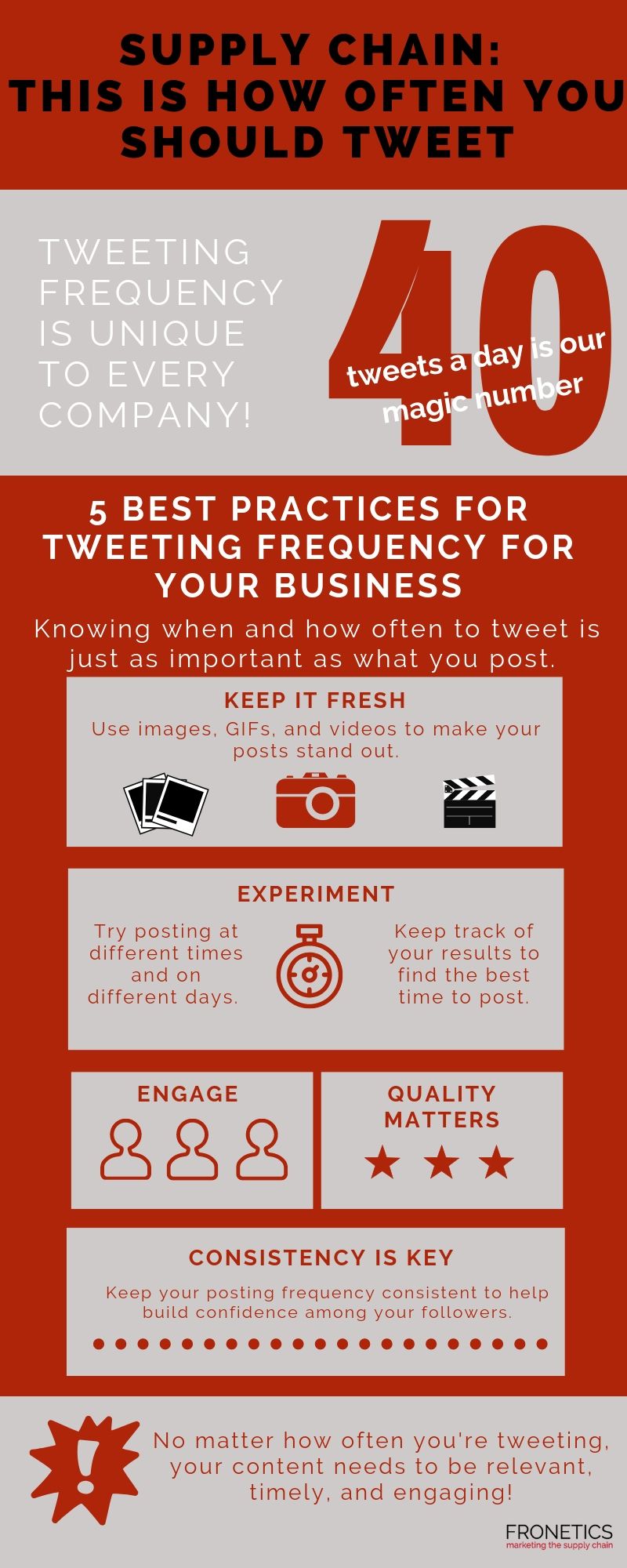
Back in 2016, in response to a Socialbakers study that suggested that posting to Twitter three times a day is an ideal frequency for brands, Fronetics conducted a study of our own. We determined that for our business, tweeting around 40 times a day is optimal.
What these radically divergent results demonstrate is that the answer to how often to tweet is not a simple one. While the bottom line is that optimal tweeting frequency is unique to every brand, there are 5 best practices your business should be aware of.
5 best practices concerning how often to tweet for your business
(Made with Canva)
1) Consistency is key
Whether you’re tweeting once a day, or a hundred, being consistent about posting frequency will serve you best. Keeping your posting frequency relatively consistent lets your followers gain confidence that you will set and expectation and meet it. As social media algorithms become less friendly to businesses, it’s all the more important that you bring your followers to you.
2) Keep it fresh
It’s important to point out that consistency is key only when it comes to how often to tweet – not the content you’re publishing. Particularly on Twitter, varying your content is the best way to keep your audience engaged. Use images, GIFs, and videos to make your posts stand out, or ask questions to promote conversation and engage your followers.
3) Experiment
When it comes to how often to tweet for your business, you’ll find all kinds of divergent ready-made answers. But the truth is, there’s no magic number. Your business or your marketing partner needs to determine what works for your unique brand and audience. The best way to do this is to experiment with posting at different times and keep track of your results. In addition to Twitter’s internal analytics, these five tools can help you track and evaluate the results of your experiment.
4) Engage
As with any social media platform, publishing content shouldn’t be your only focus. Engaging with your followers, from comments to retweets, is crucial for generating an active and loyal audience.
In addition, using social media to interact with your audience can help inform your decisions about how often to tweet. When are your followers most active? What kind of content do they want to see from you? Having a conversation with your followers is one of the best ways you can answer this question.
5) Quality matters
There’s no amount of posting frequency that makes up for posting poor quality content. If your content is bad, you’d likely be better off not posting at all. Publishing content that doesn’t interest your audience will lose you followers and leads. No matter how often you’re tweeting, your content needs to be relevant, timely, and engaging.
Related posts: